How lead generation and customer acquisition work together
Lead generation and customer acquisition are different pieces of the same puzzle. But how exactly do they work together? Learn more about how to harness the power of both to create a seamless customer (and data) journey.
Contents
Lead generation and customer acquisition often get tossed around like synonyms. But they’re not the same thing.
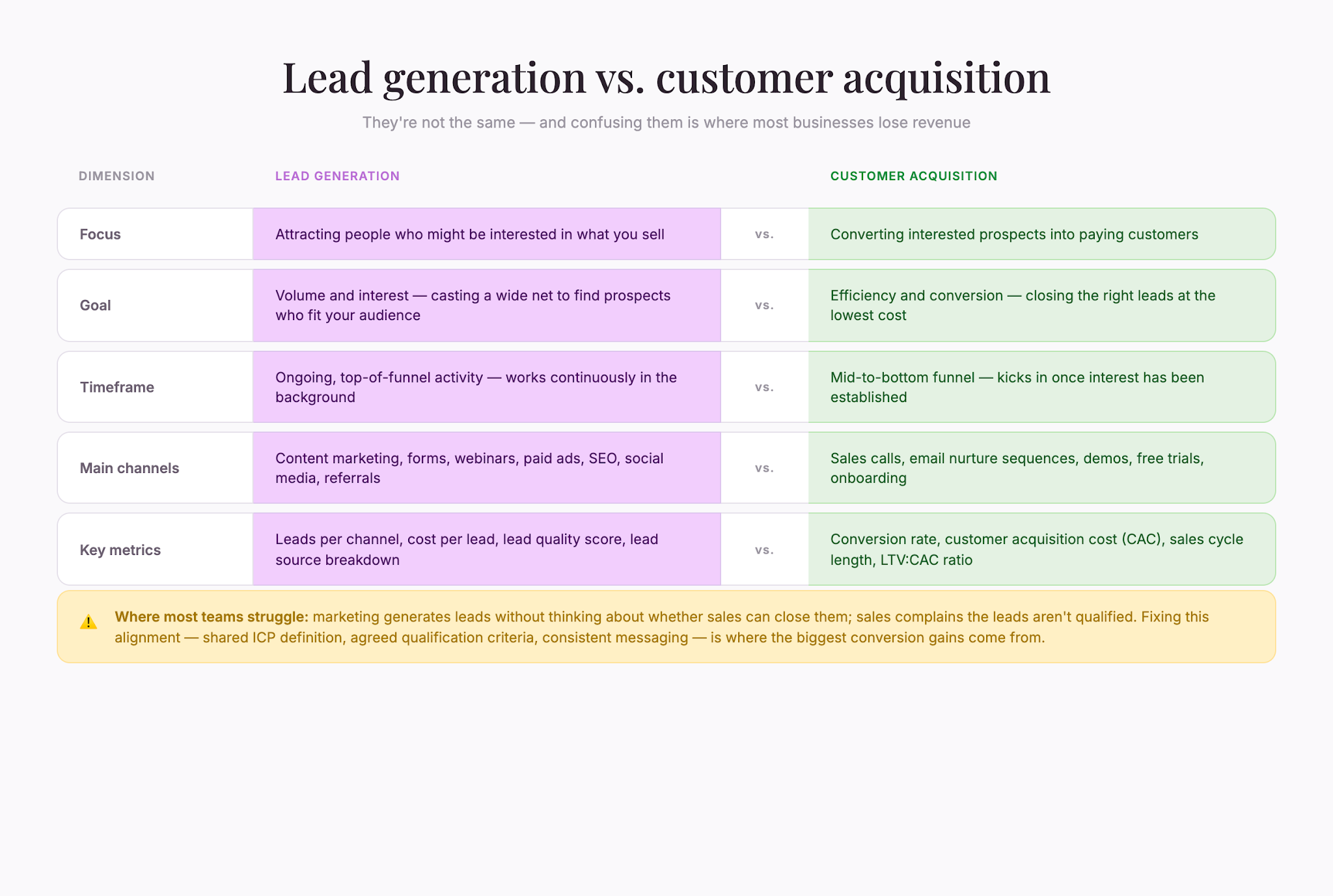
Lead generation gets prospects interested. Customer acquisition turns those prospects into paying customers. One feeds the other.
Below, we break down the differences between lead generation and customer acquisition, where they overlap, and how to measure both.
What is lead generation?
Lead generation is the practice of attracting people who might be interested in what you sell. A lead is someone who’s raised their hand—downloaded a resource, filled out a form, signed up for a newsletter, or engaged with your content meaningfully.
The goal isn’t to sell immediately. It’s to capture attention and start a conversation.
When you run a webinar and ask attendees to register with their email, that’s lead generation. When you publish a whitepaper behind a contact form, that’s lead generation. When a quiz helps people assess their needs and collects details, that’s lead generation.
It happens across many channels:
- Website forms and landing pages
- Content marketing – articles, guides, resources
- Social media engagement
- Events and webinars
- Paid advertising
- Referral programs
The point: lead generation is about volume and interest. You’re casting a wide net to find people who fit your target audience.

What is customer acquisition?
Customer acquisition is converting a prospect into a paying customer. It’s what comes after generating interest.
While lead generation brings people to the table, acquisition closes the deal. That might involve:
- Sales conversations and demos
- Email nurture sequences that build trust
- Free trials or pilots that let prospects experience your product
- Pricing discussions and contract negotiations
- Onboarding and activation
It costs money—both in direct sales effort and in resources spent nurturing prospects to the point where they’re ready to buy.
A prospect might download three guides, attend a webinar, and click through five emails before talking to sales. That entire journey is part of acquisition.
Some leads will never become customers. They might be researching, comparing options, or not ready. The goal is to convert as high a percentage of qualified leads as possible while spending efficiently.
Where they overlap
Lead generation and acquisition aren’t separate silos. They’re deeply interconnected.
A lead is only valuable if there’s a reasonable chance it can become a customer. So when you’re attracting leads, think about acquisition from day one. If you collect leads that don’t match your ideal customer profile, you’ll waste resources later.
Conversely, your acquisition strategy should inform lead generation. If your sales team can realistically follow up with 50 leads per month, don’t generate 500. If your product fits mid-market companies best, don’t spend money attracting startups.
This alignment is where most businesses struggle. Marketing generates tons of leads without thinking about whether sales can close them. Sales complains the leads aren’t qualified. Neither team is happy.
When the two work together:
- Marketing knows what a qualified lead looks like and targets accordingly
- Sales gets relevant prospects and closes deals more efficiently
- You spend less on leads that won’t convert
- Conversion rates improve
- Revenue becomes more predictable
How to measure both
Without measurement, you’re flying blind. Here’s what you need to note:
Lead generation metrics
- Leads per channel – tells you which activities bring people in
- Cost per lead – marketing spend divided by leads generated
- Lead source – where are your best leads coming from?
- Lead quality score – not all leads are equal; score by fit
Customer acquisition metrics
- Conversion rate (lead to customer) – track by source and month
- Customer acquisition cost (CAC) – sales and marketing spend divided by new customers
- Sales cycle length – how long from lead to close
- Lifetime value (LTV)-to-CAC ratio – tells you if acquisition is profitable
A cheap lead is only valuable if it converts profitably. You might spend $20 to attract a lead and $500 in sales time to convert them. You’d be better off spending $100 on a more qualified lead that closes faster.
Building a process that works
Here’s how to build lead generation and customer acquisition strategies that work in tandem to increase conversions.
Define your ideal customer profile first. Before generating a single lead, get clear on who you want to sell to. Industry, company size, problem, budget. Share the profile across marketing, sales, and customer success.
Create a lead qualification system. Score prospects based on fit and engagement. Use a simple system (hot, warm, cold) or something more sophisticated. Make sure marketing and sales agree on the criteria.
Align your messaging. The promise made during lead generation should match what prospects experience during acquisition. If your lead magnet says “cut costs in half,” don’t pivot entirely to features in the sales call.
Set expectations with sales. How many leads per week? How qualified? How quickly should sales follow up? Get it in writing.
Track the entire journey. Use your CRM to track leads from first touch through close. How many enter? How many move to a sales conversation? Where do people drop off? This data shows which part of the process needs work.

Common mistakes
To ensure an effective, streamlined process, avoid these common pitfalls:
Generating leads without a sales process. If no one can follow up, lead generation is wasted money.
Confusing volume with quality. A thousand leads who’ll never buy is worse than 100 leads who fit and are interested.
Handing leads to sales too early. A prospect who’s interested but not ready wastes sales time. Build a nurture process that moves people through education before they talk to a salesperson.
Not sharing data between teams. When teams operate in silos, you miss insights that could improve both processes.
Ignoring the economics. You might acquire a customer for $500 who only spends $400 over their lifetime. Always check whether the acquisition is profitable.
The path forward
The fastest-growing businesses aren’t necessarily generating the most leads. They’re attracting the right leads and converting efficiently. That requires both teams working toward the same goal with shared metrics.
Start by aligning on your ideal customer. Design lead generation to attract those people specifically. Build a sales and nurture process that converts them reliably. Track everything to see where to improve.
With this framework, growth becomes less about luck and more about process.