Employee Satisfaction Survey Form Template
Find out how your team really feels before your best people start job hunting.



Exit interviews tell you why people left. Employee satisfaction surveys tell you why they might. The difference between those 2 data points is the difference between reacting and preventing. But most satisfaction surveys fail for 1 reason: they ask too much, too rarely, and do too little with the results. Employees stop taking them seriously.
This employee satisfaction survey form template is designed to be actionable, not exhaustive. It covers the areas that matter most. Role clarity, management quality, growth opportunities, work-life balance, compensation fairness, and workplace culture — in a focused, one-question-at-a-time format that takes under 10 minutes to complete. Conditional logic surfaces follow-up questions only when an employee rates an area poorly, so satisfied employees breeze through while dissatisfied ones get space to explain.
Roll it out quarterly or bi-annually. Share the link anonymously to encourage honest feedback, and connect it to your analytics or HR dashboard through integrations to track trends over time. Data without action is just noise — use the results to drive real changes.
An employee satisfaction survey is a structured questionnaire that measures how employees feel about their work, environment, manager, compensation, and growth opportunities. It's used to track engagement and identify areas for improvement.
Quarterly is ideal for tracking trends and responding to issues in a timely way. Annual surveys capture a snapshot but miss the nuances of how satisfaction changes throughout the year. If quarterly feels like too much, bi-annual surveys are a solid middle ground. The key is consistency — pick a cadence and stick to it so you can compare results across periods.
A balanced survey covers multiple dimensions of the employee experience:
- Overall satisfaction with their role and responsibilities
- Clarity of expectations and feedback from their manager
- Opportunities for professional development
- Confidence in senior leadership's direction
- Sense of belonging and inclusion
- Likelihood of recommending the company as a place to work (eNPS)
Make the survey anonymous, and make it clear that it's anonymous. Explicitly state that individual responses cannot be traced back to specific employees. Keep the form short (under 10 minutes) so people don't disengage halfway through. And most importantly, act on the results. When employees see that past survey feedback led to real changes, they're far more likely to participate honestly in the next one.
Share a summary of findings with the entire organization. Transparency builds trust. Identify the top 2 to 3 areas with the lowest scores and create specific action plans with timelines and accountability. Communicate those plans to employees so they know their feedback was heard. Then track those areas in the next survey to see whether the changes had an impact. Survey data is only valuable if it drives decisions.
Get inspired by relevant templates and categories
3200+ Templates, 300+ Integrations
Remote Work Survey Form
A remote work survey that asks "How satisfied are you, 1 to 10?" once a year and getting the same safe "8" from everyone isn't measuring how remote work is actually going, it's measuring how safe people feel giving an honest answer. Ask about the actual friction, equipment, communication, isolation, and make it genuinely anonymous.
View template

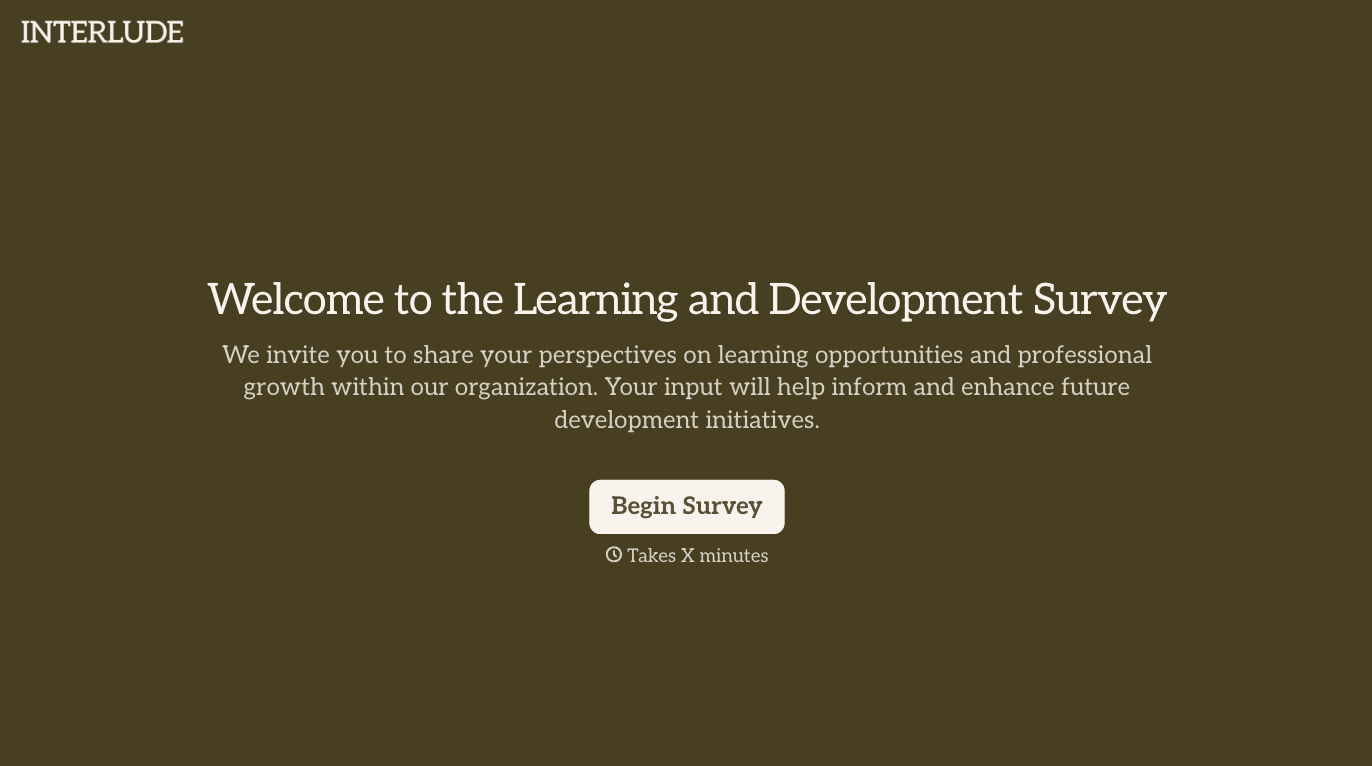
With Typeform, you can customize everything
Change text, colors, and even logos to match the look and feel of your brand. Then embed forms smoothly onto web and email.
Make forms feel effortless to fill out. Pace questions, call people by their name, and adapt the flow based on the data they share.
Stay efficient by connecting forms to your workflow. Typeform integrates with 300+ tools including Slack, Zapier, and HubSpot.