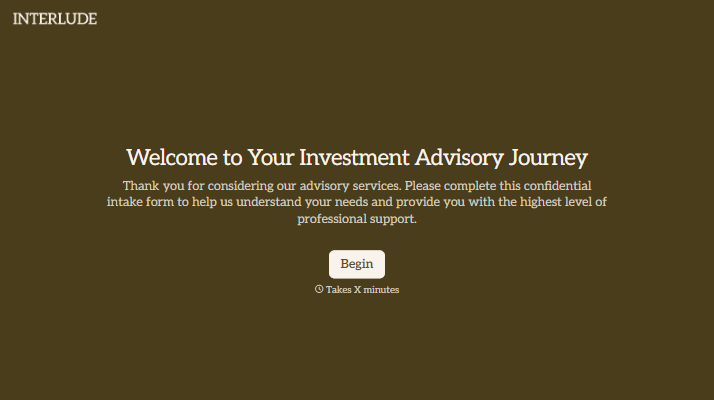
Investment Advisory Service Intake Form
Give prospective clients a clear way to explain what they want from investment advice. Collect financial priorities, relevant background, and questions so your team can prepare for an informed first conversation.



One client wants help organizing investments held across several accounts. Another is planning for retirement but isn’t sure how their savings fit together. Both ask for investment advice, but they need different conversations. An investment advisory service intake form helps you understand what prompted the inquiry.
Prospective clients describe their goals, expected timelines, and experience with investing. You can ask for an overview of their financial situation, anticipated cash needs, and existing advisory relationships. Leave room for uncertainty, especially when someone needs help identifying their priorities.
Your team gets context for follow-up questions and a clearer picture of the requested support. Clients get a chance to gather their thoughts before the meeting. The first conversation can focus on understanding their circumstances and discussing the scope of a potential engagement.
An investment advisory service intake form collects background information from people seeking investment advice. It can cover financial goals, investment experience, time horizons, and the services they’re interested in. Advisory teams use it to prepare for introductory conversations and identify information that needs further discussion.
A request for help with investments can mean anything from reviewing an existing portfolio to planning for several competing goals. An intake form helps clients explain what they need before the meeting. It also gives your team a consistent starting point without expecting clients to prepare a detailed financial summary on their own.
Focus on information useful for the initial conversation:
- Name and preferred contact details
- Reason for seeking investment advice
- Financial goals and expected timelines
- General overview of income, assets, and financial commitments
- Investment experience
- Anticipated withdrawals or access-to-cash needs
- Concerns about investment losses
- Existing advisory relationships
- Questions the client wants to discuss
Use your organization’s approved secure process for financial documents and sensitive identifying information. Do not ask for account passwords or login credentials.
Use familiar language and explain why you’re asking each financial question. Allow estimates or ranges where precise figures aren’t needed yet, and include an “Unsure” option. Someone may know they’re saving for the future without knowing which services or investment terms describe what they need.
It can collect initial responses about experience, concerns, and financial circumstances for further discussion. A brief intake form should not be treated as a complete assessment or used alone to generate personalized recommendations. Your advisory team should clarify the answers and complete its required review before providing advice.
Get inspired by relevant templates and categories
3200+ Templates, 300+ Integrations


Personal Trainer Intake Form
A PAR-Q filled out in the lobby five minutes before a first session isn't intake, it's a formality nobody has time to read closely. Collect health history, injury information, and fitness goals before the first session, so your trainer isn't building a program blind.
View template
With Typeform, you can customize everything
Change text, colors, and even logos to match the look and feel of your brand. Then embed forms smoothly onto web and email.
Make forms feel effortless to fill out. Pace questions, call people by their name, and adapt the flow based on the data they share.
Stay efficient by connecting forms to your workflow. Typeform integrates with 300+ tools including Slack, Zapier, and HubSpot.