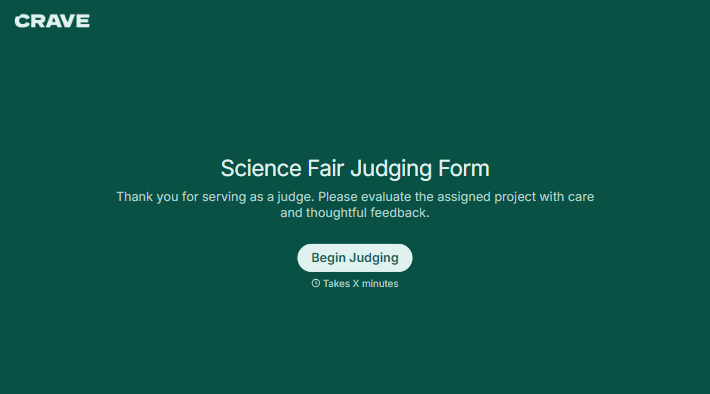
Science Fair Judging Form
Give judges a clear way to score each project and explain their decisions. Collect scores, observations, and feedback students can learn from.



One judge takes notes on the experiment. Another remembers the presentation. By the time everyone compares scores, the reasons behind them can be hard to recover. Typeform's science fair judging form gives each judge the same questions to work through, with space to explain what they noticed.
Judges identify the project and assess it against your fair's criteria, from the research question and experimental method to the analysis and presentation. They record scores alongside specific observations, so a number has an explanation attached.
Organizers get results they can compare without deciphering handwritten score sheets. Judges have a record to refer to when discussing awards. And students get feedback on the work itself: what held up, what needed more evidence, and what they could try next.
A science fair judging form helps judges evaluate student projects using a shared set of criteria. It collects the project details, scores for each category, and comments explaining the assessment. Organizers use it to compare results, support award decisions, and give students useful feedback.
When judges work from different questions, their scores can be difficult to compare. A shared form keeps everyone focused on the same criteria and captures the reasoning while the project is still fresh. It also gives students more to learn from than a final score or placement.
The form should identify the project, guide the assessment, and leave room for specific feedback:
- Project title or identification number
- Judge's name
- Grade level or competition category
- Scores for the research question, method, data analysis, and conclusions
- Scores for presentation and responses to questions
- Comments on strengths and areas for improvement
- Any conflicts of interest or reasons the judge couldn't assess a criterion
Match the categories and scoring scale to your fair's rubric, with short descriptions of what each score means.
Share the rubric before judging begins and discuss a sample project together. Explain what judges should look for in each category, including how expectations differ by age group. Keep those descriptions visible in the form so judges can check them as they score. A shared rubric gives everyone a reference point when scores differ.
Yes. Include separate prompts for what the student did well and what they could improve. Ask judges to point to something they observed, such as a well-controlled experiment or a conclusion that needs more supporting data. Keep student-facing feedback separate from private notes used to discuss awards.
Get inspired by relevant templates and categories
3200+ Templates, 300+ Integrations


With Typeform, you can customize everything
Change text, colors, and even logos to match the look and feel of your brand. Then embed forms smoothly onto web and email.
Make forms feel effortless to fill out. Pace questions, call people by their name, and adapt the flow based on the data they share.
Stay efficient by connecting forms to your workflow. Typeform integrates with 300+ tools including Slack, Zapier, and HubSpot.