How to implement your customer success strategy: a step-by-step guide
Learn how to implement your customer success strategy with this step-by-step guide. Discover best practices, key metrics, and tips for aligning teams and automating workflows.
Contents
Customer success isn’t a department—it’s a commitment. It means your customers reach their goals while using your product or service, and they feel supported the entire way.
Without a strategy, customer success is reactive. You respond after problems blow up. With a strategy, you’re proactive. You see issues coming and prevent them.
Building a customer success strategy takes planning, but the payoff is real: lower churn, higher lifetime value, and customers who advocate for you.
Step 1: Define what success looks like
Success isn’t the same for everyone. One customer wants to save time. Another wants to cut costs. A third wants to scale their team.
So, how do you define what customer success looks like for you?
- Talk to your top customers: “What does success look like in 6 months? A year?”
- Review onboarding conversations, emails, and support tickets for common goals
- Look at how different segments use your product
- Ask new customers during onboarding what they’re trying to achieve
Document these metrics. For a restaurant customer, success might be “increase table turnover by 20% in Q2.” For a recruiting customer, it might be “fill 5 senior roles by year-end.”
Once you know what your customers want, you know what to measure to determine whether they’re on track.
Step 2: Map the customer journey
Customer success starts the moment they decide to sign up, and the journey only continues from there.
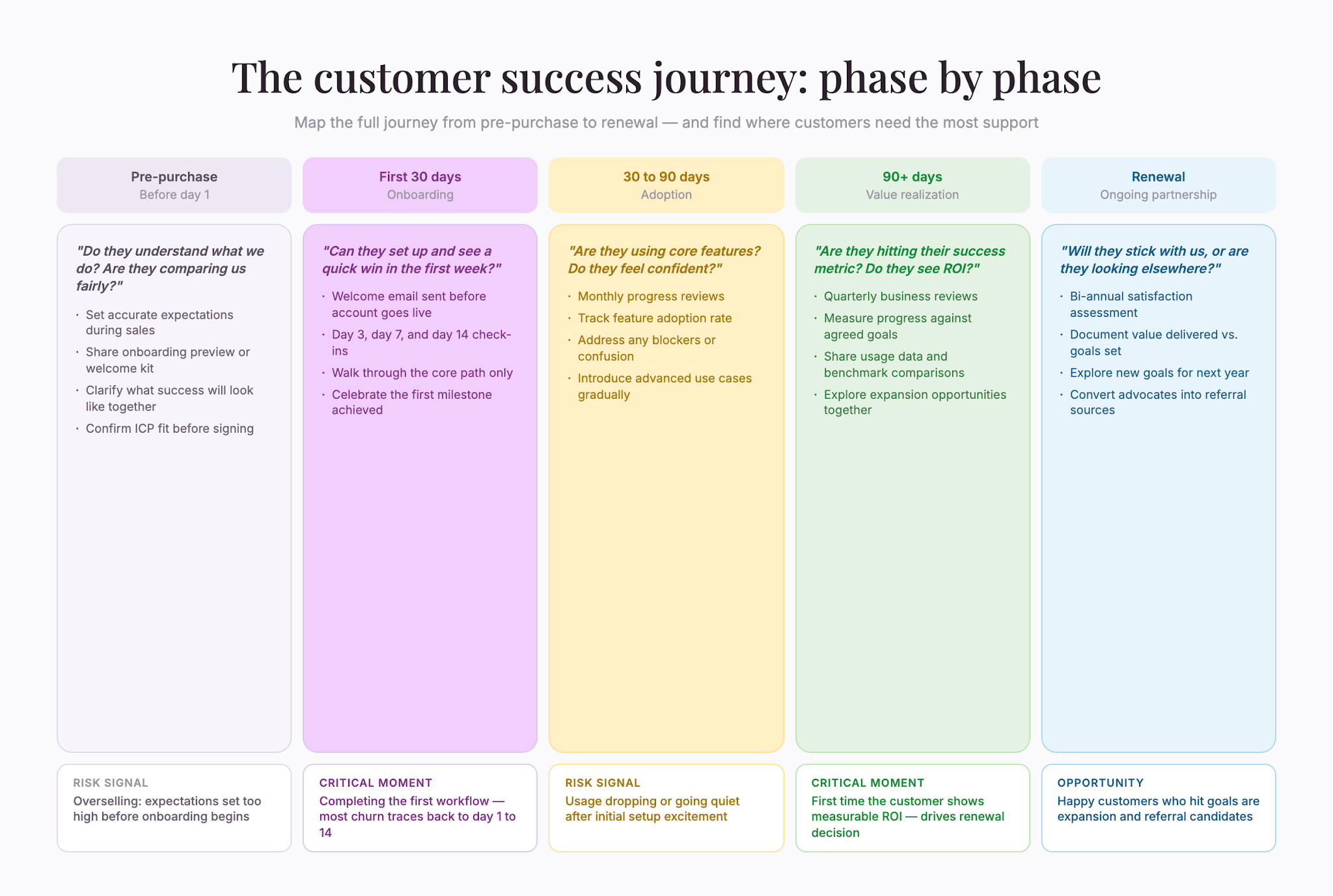
Mapping your full customer journey might look like:
- Pre-purchase: Are they comparing you to competitors? Do they understand what you do?
- First 30 days: Can they set up and see quick wins?
- 30-90 days: Are they using core features? Do they feel confident?
- 90+ days: Are they hitting their success metric? Do they see ROI?
- Renewal: Will they stick with you or look elsewhere?
Within this journey, find the critical moments where customers are most likely to get stuck. For software, it might be “completing the first workflow.” For consulting, “getting the first recommendation.” For a platform, “integrating with existing systems.”
These moments are where your strategy needs teeth. Get stuck here, and the whole relationship stalls.
Step 3: Assign ownership and roles
Customer success fails when everyone thinks it’s someone else’s job. So make sure to clearly assign the following roles:
- Customer success manager – Owns the relationship, removes blockers, tracks progress
- Onboarding specialist – Gets new customers set up confidently in the first 30 days
- Support team – Answers questions and solves technical issues quickly
- Product team – Listens to feedback and builds what customers actually need
- Sales team – Sets accurate expectations (nothing kills success faster than overselling)
Decide which customers get which level of support. High-value accounts might have a dedicated manager. Mid-market gets monthly check-ins. Self-serve customers get in-app resources and a community forum.
Step 4: Build your onboarding program
The first 30 days of your customer journey should set the tone for the entire relationship. That means you need a solid onboarding program.
Ideally, onboarding should:
- Start before day 1 – Send a welcome email before the account is active
- Celebrate quick wins – Help them see value in the first week
- Meet them where they are – Video, written docs, live walkthroughs; offer choices
- Stay focused – Don’t bombard with features; teach the core path first
- Check in regularly – Day 3, day 7, day 14, day 30
Rushed or generic onboarding kills momentum. Personalized, supportive onboarding sets customers up to win.
Step 5: Establish regular check-ins
After onboarding, success requires ongoing attention.
- Monthly – Review progress toward their success metric. What’s blocking them?
- Quarterly – Broader strategic conversation. Are we still aligned? What’s changed?
- Bi-annually – Assess satisfaction and explore expansion opportunities
Check-ins should feel like collaboration, not compliance. Ask genuine questions. Listen for what they’re really saying.
For customers who don’t want constant contact, create low-touch touchpoints:
- In-app notifications about feature updates or tips
- Monthly emails with best practices or usage data
- Quarterly community webinars
- Annual feedback surveys
The goal is to have a consistent presence without being pushy.
Step 6: Measure health signals
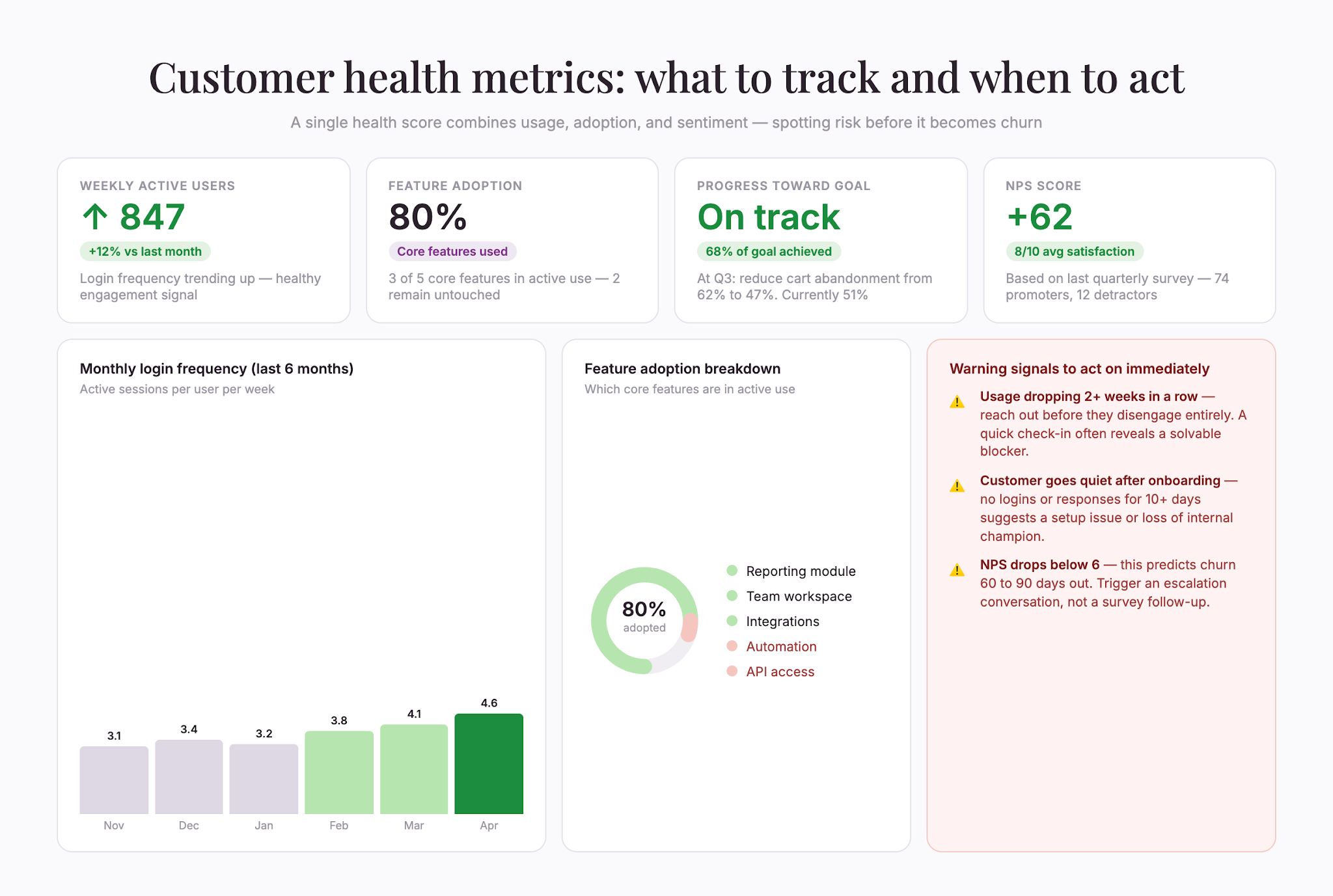
Importantly, you can’t manage what you don’t measure. Be sure to track:
- Usage metrics – Are they logging in, using core features, inviting team members?
- Progress metrics – If their goal was to cut costs, are costs down?
- Health scores – Combine usage, adoption, and sentiment into one risk indicator
- Satisfaction – NPS surveys, quick polls, feedback forms
When you see warning signs—usage dropping, customer going quiet—act fast. A small intervention can often prevent a big problem.
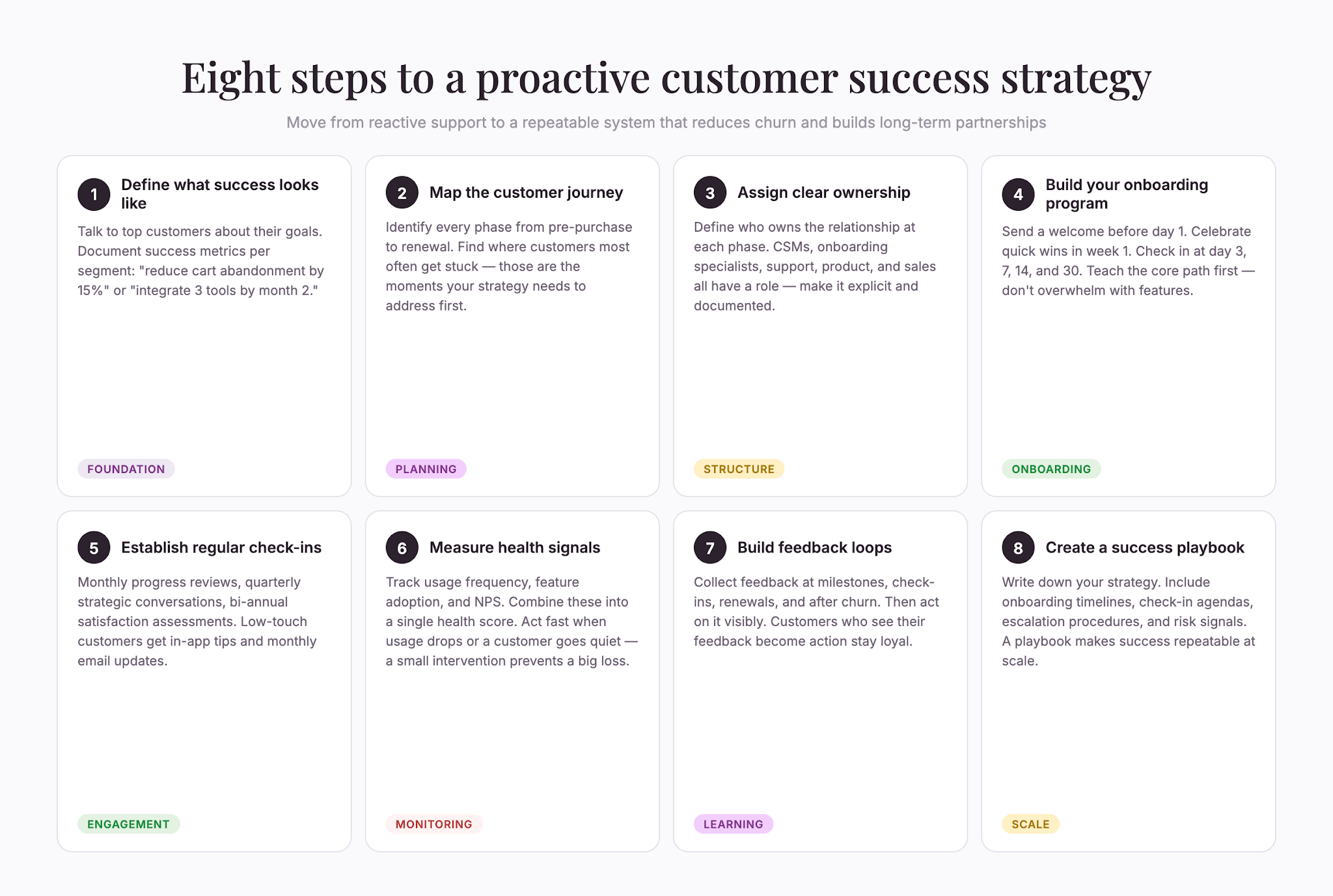
Step 7: Build feedback loops
Customers are your best source of insight about what’s working—and what’s not.
Create structured ways to gather this feedback:
- After key milestones – “You’ve been with us 30 days. How’s it going?”
- During check-ins – Ask about pain points, feature requests, unmet needs
- At renewal – “What made this a good investment? What would make next year better?”
- From churned customers – Ask what went wrong or what you could have done differently
Then, act on it. If multiple customers ask for the same feature, build it. If people are confused by a process, simplify it. When customers see their feedback turn into action, they feel heard.
Step 8: Create a success playbook
A playbook is your strategy written down. It tells your team exactly what to do, when, and why.
Include:
- Definition of success for each segment
- Onboarding timeline and checklist
- Monthly and quarterly check-in agendas
- Escalation procedures
- Success metrics and how to track them
- Communication templates for common scenarios
- Risk signals and intervention steps
A playbook makes customer success repeatable. New team members can follow it, customers get consistent treatment, and you can measure whether you’re actually executing.
The payoff
Implementing a customer success strategy takes work and ongoing attention. But customers who hit their goals are more likely to renew, expand, and recommend you. That turns one-time transactions into long-term partnerships.
Start by defining success. Map the journey. Assign ownership. Build strong onboarding. Maintain momentum with check-ins and feedback. Do that consistently, and your strategy becomes self-reinforcing. Each successful customer becomes an advocate, making acquisition easier and churn nearly impossible.

Liked that? Check these out:

Opinions and Expertise
What’s actually slowing research teams down (Hint: it’s not the research)
From recruiting participants and scheduling interviews to building the actual surveys, the operational drag is taking researchers away from what they do best. See what's actually slowing them down and how Research Flow fixes it.
Read more