Customer flows, not funnels: Why marketers are rethinking how customers move
Marketing funnels assume customers move in straight lines—but they don't. Customer flows use automated workflows to build momentum, with one action triggering the next. See how Typeform Contacts & Automations helps you meet customers where they are, automatically.

The marketing funnel has existed for as long as we can remember. It was a framework that helped us measure progress and visualize the predictable path customers follow:
Awareness → Interest → Decision → Action
It made human behavior predictable and manageable. And, for a while, it worked. But then we started looking at real customer data and uncovered the truth: people don't move in straight lines.
They zig and zag and loop back. They disappear for months or make an impulse buy after a single interaction. Some need 17 touchpoints before they engage with you. Marketing funnels aren't reality—they're wishful thinking.
In reality, the customer journey looks more like this:
- Someone sees your Instagram ad but doesn't click.
- A month later, they Google something related to your product and land on a blog post that they skim and leave shortly after.
- Two weeks later, a friend mentions your brand—they're curious about you now.
- That potential customer checks out your website, completes a product recommendation quiz, and then nothing.
- Life happens, and they forget about you... until they see a retargeting ad six months later.
- They remember you, go back to your website, and finally convert.
That journey doesn't fit in a funnel. It's a customer flow that follows winding paths built around curiosity and convenience. And that's how decision-making really works—not linearly.
Marketers are ditching the funnel for the new school model, using marketing automation tools to meet customers where they are on their messy journey. Thanks to AI, integrations, and automation, we can now respond to human behavior in real time to personalize at scale and turn interactions into triggers, not dead ends.
This approach is built around customer flows that trigger the next step based on previous actions. Instead of sitting in a funnel stage, you build momentum that continuously drives action.
Simply put, customer flows treat people as the non-linear, messy humans they are, vs. shoving them into a tidy funnel that wasn't built for how customers move. They're dynamic systems that move with your customers, not against them.
The marketing funnel is obsolete
People are tired of being treated like dollar signs and receiving nonstop promos designed to get them to finally convert. They want a relationship with your brand, but when you reduce them to simple transactions, you actually push them away.
"Traditional funnels treat people like leads on a spreadsheet—flows treat them like humans you’re actually listening and responding to. Someone hits "Convert" and the funnel says, ‘We’re done here.'" - Kay-Kay Clapp, Head of Content and Social, Typeform
But customers don't move in a straight line through the funnel, and they certainly don't stick around when you treat them like a sale. They engage, forget about you, re-engage, and convert... on their time.
A marketing funnel can't account for these behaviors because it's built around the idea that human behavior is neat and linear, and every action moves a potential customer closer to conversion. But the reality is that it looks more like a constellation with interconnected clusters than a straight line, like this:
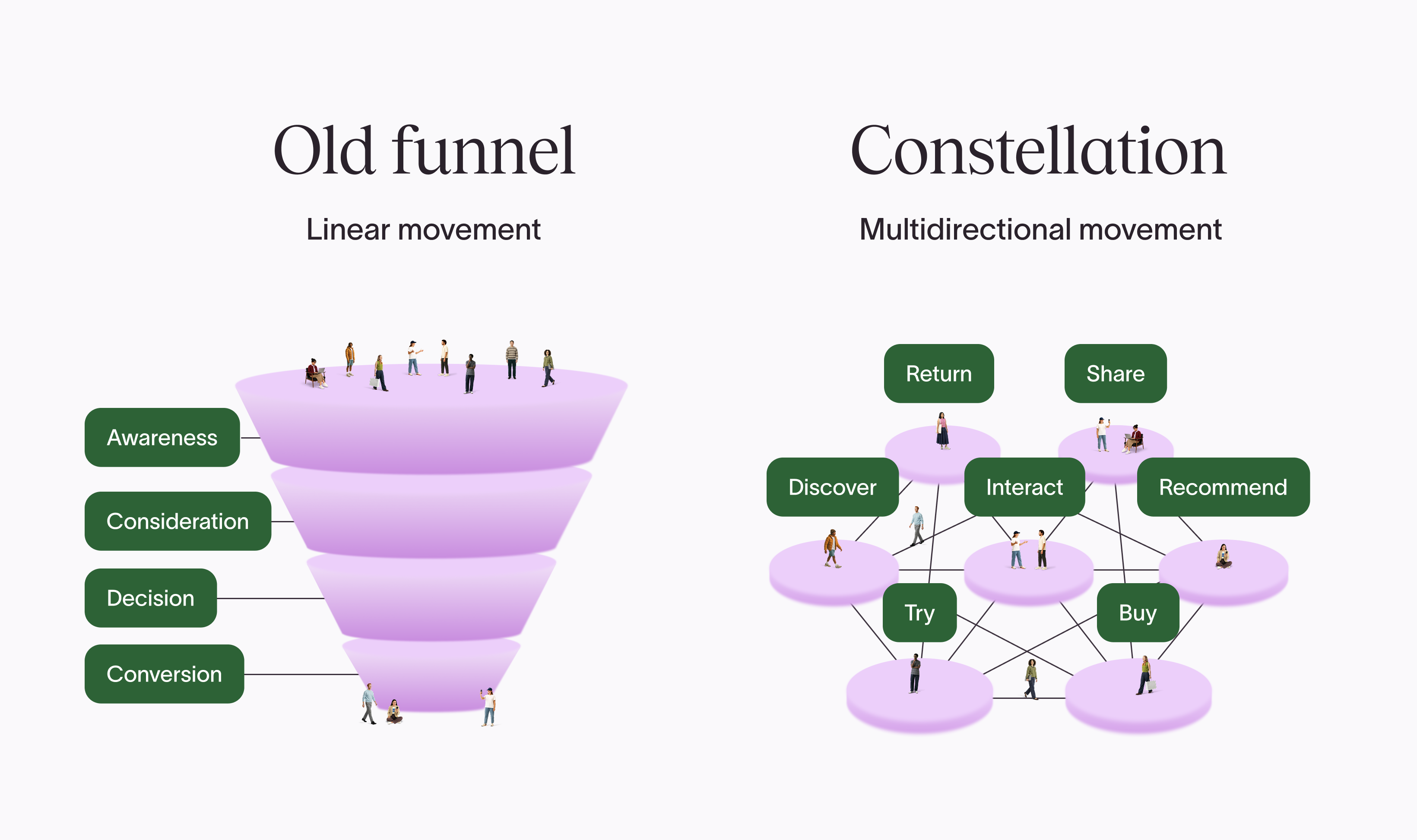
Does the funnel fail because it doesn't always move people closer to conversion with every step? No—it confirms what we already know: the marketing funnel wasn't designed for the modern customer journey or how people move.
The bigger issue? Funnels optimize for conversion, not connection. Success is measured by how many people make it to the bottom of the funnel.
Customer flows, on the other hand, measure success by how much momentum you generate and how many customers stick around, refer others to your brand, or become repeat buyers.
Marketing funnel = transactional. Customer flows = relational.
The rise of customer flows
Flows reflect how marketing works: one interaction triggers another in a continuous loop with no end. Instead of rigid stages, customer flows respond to how we actually move, creating momentum vs. managing a stop-and-go lead gen engine.
Let's say you're a bike retailer. A future customer completes your product recommendation quiz. The moment they hit "Submit," Typeform's automated workflows add that person to your Contact Hub, segments them based on their responses, and triggers a personalized follow-up email.
The best part? You don't have to lift a finger. The potential customer's actions triggered everything, and will keep triggering actions because you've set up a customer flow—powered by automated workflows.
And that's the difference between a marketing funnel and a flow: funnels assume you're in control, while flows recognize that customers are already in motion, and it's our job to meet them where they are (not move them to whatever stage we want them in).
Unlike funnels, customer flows don't have an end. Actions keep triggering the next interaction—there's no bottom of the funnel where the relationship ends. The flow continues as long as the customer does.
How to create customer flows in Typeform

Building flows doesn't have to mean a bloated tech stack or managing a dozen tools. You can make the ones you already have work together—and with Typeform, you can do it all in a single platform.
Whether you're focused on lead generation, customer feedback, or onboarding, the customer flows you build in Typeform help you turn static forms into dynamic systems that respond to—and trigger—action in real time.
Personalize in real time with logic and branching
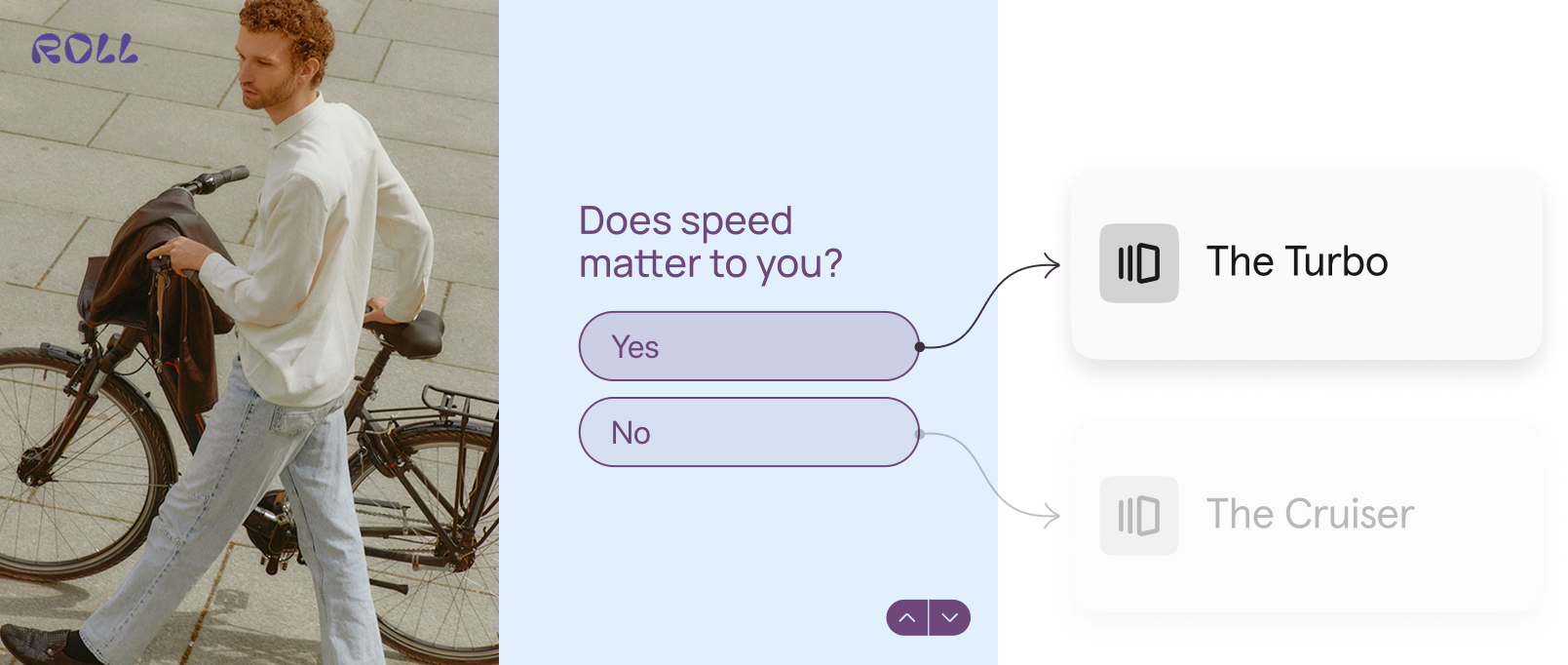
Logic helps you create a tailored experience by guiding form-takers down a specific path in real time based on their answers. Instead of irrelevant questions, they only see questions highly relevant to them.
For example, if they tell you they're interested in road bikes, logic prevents them from seeing questions related to mountain biking. This creates a more personalized, relevant experience.
Leverage workflow automations and integrations
Connect Typeform to the tools you use most, like Klaviyo, HubSpot, Slack—whatever's in your stack. Whenever someone submits a form (even partially), that data flows into your CRM, triggers an email sequence, and alerts your sales team... automatically.
All because you connected your tech stack and let automations do the heavy lifting. No more manual work or delays, just immediate, automated action based on a customer's actions.
Manage contacts automatically with the Contact Hub
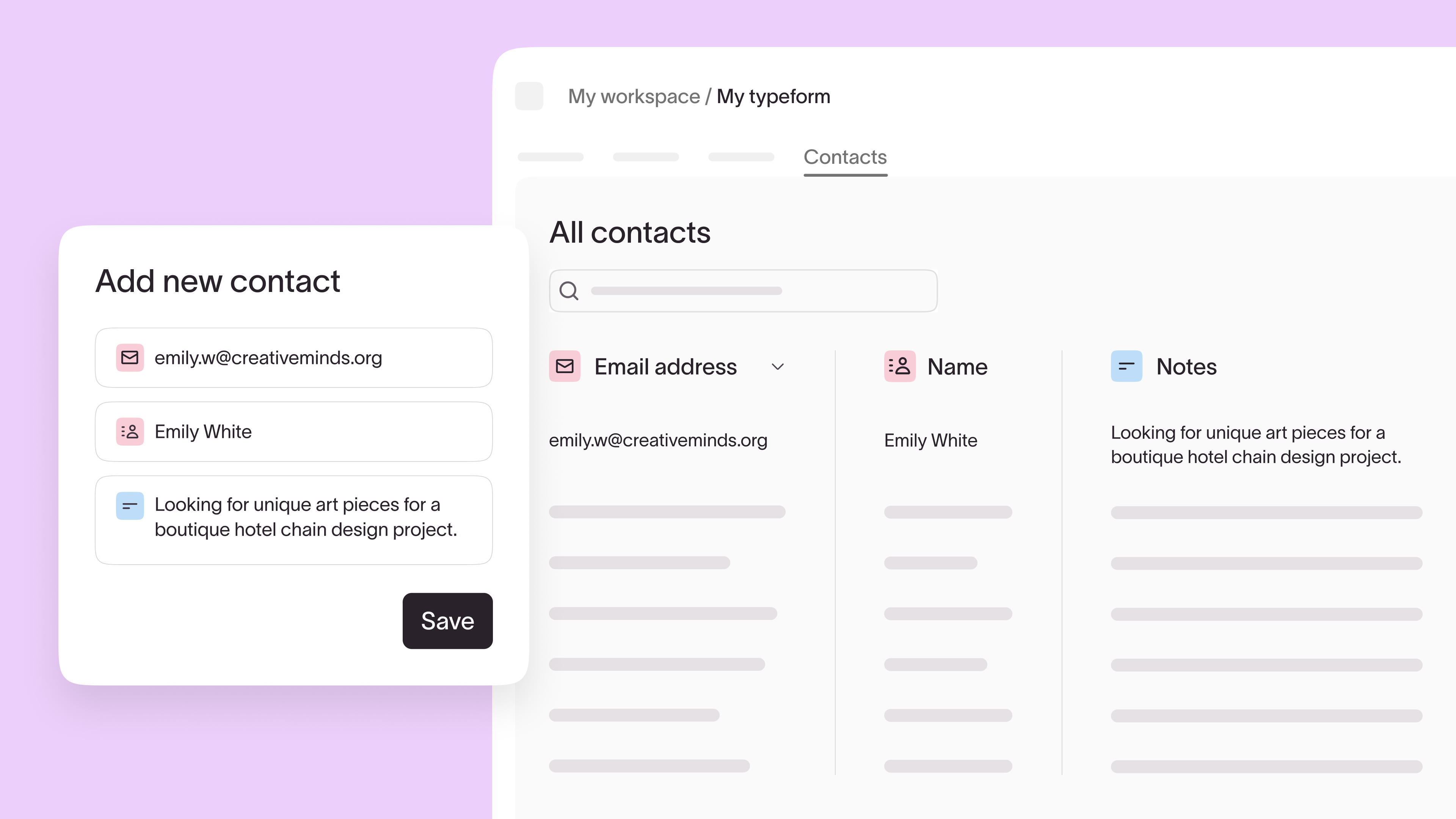
With Typeform Contacts & Automations, you can build and manage customer flows all in one platform. The Contact Hub automatically adds and updates customer profiles every time they interact with your brand—giving you a real-time record of every touchpoint.
Instead of manually adding or updating contacts in spreadsheets or chasing submission notifications, Typeform handles:
- Storing data
- Triggering actions
- Segmenting audience
- Personalizing follow-ups
Contacts & Automations let you manage the entire customer journey in a single platform—automatically.
Turn answers into insights with Smart Insights
Typeform AI surfaces insights in seconds by analyzing responses from both open- and closed-ended questions. It quickly pulls sentiment, themes, and patterns you might miss on your own, so you can make truly data-driven decisions.
No more manual review, just a clear picture of what your customers care about and insights into how to adjust your customer flows.
What the shift from funnels to customer flows means for marketers
The shift from traditional marketing funnels to more dynamic flows is a fundamental change in how we approach marketing and customer engagement. Take a look at what it looks like in practice.
Static campaigns are out. Living systems are in.
Funnels treat campaigns as a fixed activity with clear start and end dates. You launch them, measure the results, and then move on. But flows recognize that marketing never stops—it's a continuous motion.
Customers enter at different points along the journey, engage at different speeds, and then come back to you when it's convenient or you pique their curiosity. Funnels send everyone through the same journey. Flows adapt to how customers move.
Automated workflows handle the timing
With customer flows, there's no manual, "When should we send the next email?" or "Who should receive which message?" because automation takes care of the timing based on customer behavior.
Remember, every customer action in a flow triggers what happens next. The system makes sure that the right person experiences the right touchpoint and the exact right moment without you needing to micromanage the process.
Replace funnel scoring with flow health metrics
Marketing funnels track progression:
- How many people moved from awareness to decision?
- How many made it to the bottom?
- How many are stuck at the top of the funnel?
But customer flows measure momentum. They consider things like how quickly people are responding to you, how engaged they are across various touchpoints, and whether they'll be a repeat customer.
Flows are holistic. They look at whether each step naturally triggers the next and how smooth the customer journey is.
Instead of tracking stage-by-stage conversion rates, you're looking at response velocity, completion quality, and engagement loops.
The goal isn't just to close a sale—it's to build momentum that keeps customers engaged long after the first interaction with your brand.
The new era of marketing: Customer flows
Customer flows have arrived, and there's no going back.
Funnels were designed for control and initially gave us a way to manage the complexity of human behavior. We used the framework to measure marketing progress and effectiveness. But we left out the most important element: how customers actually move.
In this new era, flows deliver connection. They understand that people don't follow neat paths, which is why they respond to behavior in real time—not forcing us into inflexible stages.
When you create dynamic experiences powered by data, empathy, and automation, you stop chasing customers. You meet them where they are, respond to what they do, and build momentum that keeps them engaged long after the first interaction... automatically.
The relationship no longer ends at conversion.
Typeform Contacts & Automations makes it easy to build these flows without overhauling your entire tech stack. Capture leads, segment your audience, trigger personalized follow-ups, and manage the entire customer journey in one platform.
Want to ditch the funnel and start building automated workflows that meet customers where they are? Explore Contacts & Automations.

Liked that? Check these out:
Opinions and Expertise
What’s actually slowing research teams down (Hint: it’s not the research)
From recruiting participants and scheduling interviews to building the actual surveys, the operational drag is taking researchers away from what they do best. See what's actually slowing them down and how Research Flow fixes it.
Read more