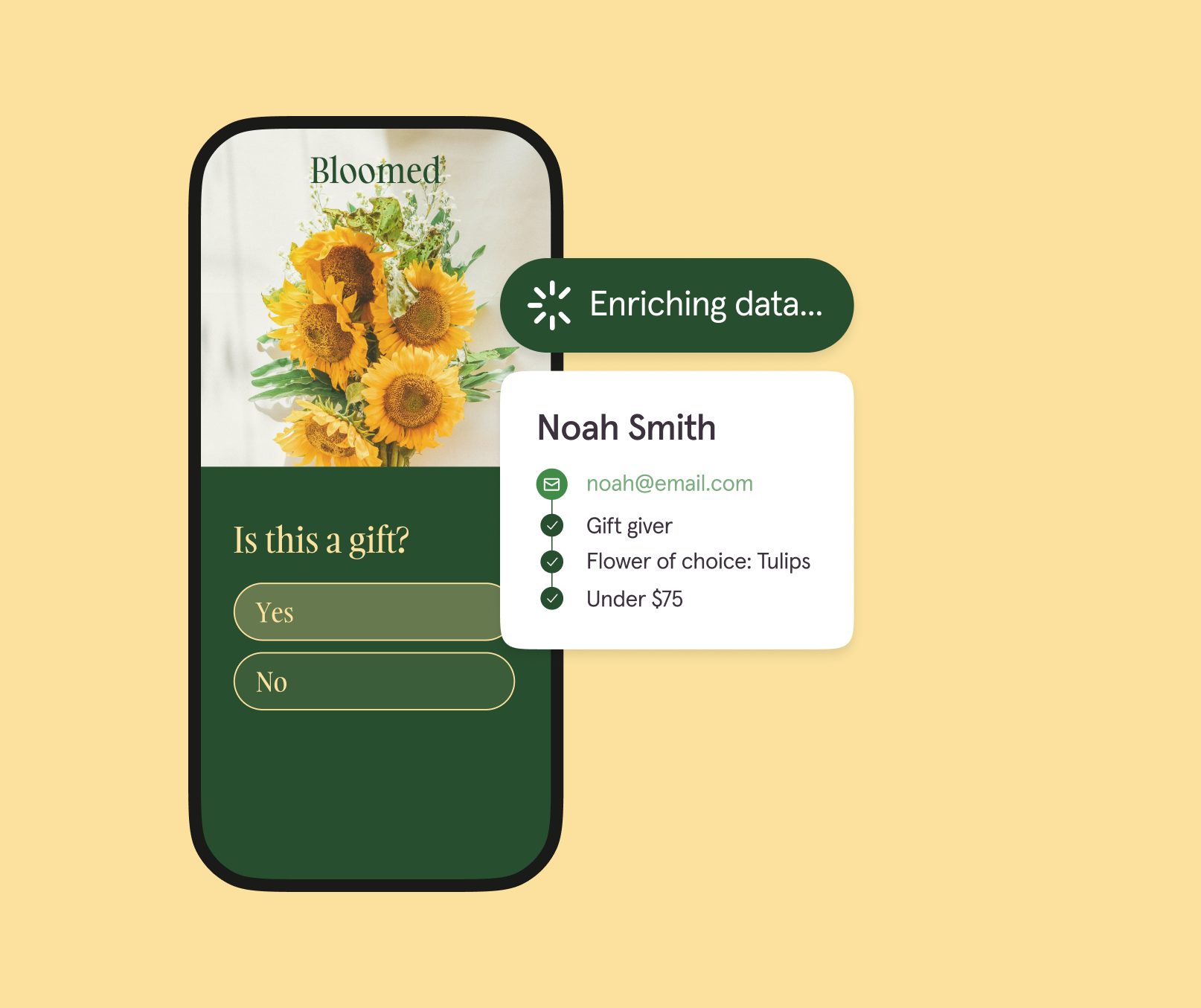
Product recommendation quizzes: A guide for ecommerce
Product recommendation quizzes can attract and convert thousands of sales. Here’s how to build a quiz that'll delight respondents and drive revenue.

Contents
Product recommendation quizzes can attract and convert thousands of sales. Here’s how to build a product recommendation quiz that'll delight respondents and drive revenue.
Confession: we spent a lot of time putting this guide together.
To understand product recommendation quizzes, you’ve got to take a bunch of product recommendation quizzes. (You know the ones—those innocent-looking little quizzes that help you figure out which product you should get.)
And suddenly you’re finding out which skin care products you really should be using… and which sunglasses suit your face shape... and which productivity app will definitely sort out your time management problems.
And the products are just sitting there right in your cart… And, well, you know the rest.
So yes. Done right, product recommendation quizzes are ridiculously effective.
In this guide, we’ll walk you through:
- Why product recommendation quizzes work so (very, very) well
- Best-practice tips and tricks for creating a compelling quiz—whether you’re B2B or B2C
- Examples of the best product recommendation quizzes out there (approach with caution!)
- How to set up your quiz in Typeform with the help of Typeform AI
Here’s how to make the magic happen.
Why are product recommendation quizzes so effective?
What is it that makes product recommendation quizzes work so darn well? There are three main factors at work:
1. Fewer choices make for easier decision-making.
Too many choices can make it much harder to choose anything, resulting in what’s called choice overload or decision paralysis.
Instead of overwhelming your customers with options, product recommendation quizzes steer them toward the perfect choice for them. By asking the right questions, you’ve shown your customer you understand what they really want and that you have the right solution for their needs.
They don’t have to spend mental energy figuring out what to add to their cart. You’ve done the heavy lifting of decision-making for them.
2. Explanations build trust.
Research shows that the average cart abandonment rate is just over 70%.
In other words, most customers end up walking away without spending a dime—even though they’re interested enough to add your products to their cart.
There are plenty of reasons for cart abandonment. Sometimes, a cart acts as more of a wishlist for a browsing shopper. Sometimes, the purchase experience was too buggy or irritating. Sometimes unexpected shipping costs cause people to dip out.
For 19% of shoppers who abandon during checkout, the issue is that they don’t trust the site with their credit card information.
As it turns out, product recommendation quizzes are a great way to build trust with your customers. By asking customers questions and using their answers to recommend relevant products, you can give them more context around why those products may be a good fit.
3. Questions create more personalization.
Consumers expect personalized experiences—and product recommendation quizzes are a great way to create them.
Instead of forcing people to browse your entire website and figure out where they should focus their attention, these quizzes steer your customers to exactly the information they need.
And it doesn’t stop there. For instance, let’s say you’re selling hair care products. You’ve set up a product recommendation quiz so that you can suggest the right products for your web visitors.
Imagine a new lead has landed on your site—let’s call her Jane. Jane takes your quiz and tells you that she has curly hair, struggles with frizz, and washes her hair twice a week.
You recommend your Curly Hair Shampoo and Conditioner, which is automatically loaded into her cart, complete with a discount to add a little urgency. You also gave her a few tips on how to care for her curls.
Jane is so happy with how easy the whole experience was that she goes ahead and clicks ‘Buy Now.’ Not only did you just convert Jane into a delighted paying customer—but you also found out a whole lot about her. So, when you launch your new Curly Hair Serum, you can follow up with a personalized email for Jane with some more tips on curly hair care, plus an update on the new product you know she’ll love.
What are the benefits of a great product recommendation quiz?
According to Typeform’s Alex Armstrong, there are three main ways that any business can use product recommendation quizzes: “To generate awareness, to generate revenue, and then to increase the lifetime value of your customers.”
Let’s break that down.
1. Brand awareness
Product recommendation quizzes are an amazing tool for attracting new traffic to your website. For instance, using a quiz on social media can be way more compelling than a paid ad, because you’re offering someone the opportunity to find out more about themselves and their needs.
So for instance, let’s say you’re selling skincare products. You could pop a quiz on Instagram that helps people figure out their skin type.
Suddenly, someone with no awareness of your brand hasn’t just heard of you—they’re on your website, engaging with your content, getting to know you, and providing you with plenty of juicy zero-party data while they’re at it.
2. Converting prospects into paying customers
If someone is already considering your brand, then a product recommendation quiz can tip them from thinking about buying to actually making a purchase. You’ve removed all the work of figuring out what to buy and made it way easier for them to take that final step.
3. Increasing customer lifetime value
Many people only think quizzes are for lead generation or research, but they can be a fantastic tool to re-engage and nurture existing clients. For instance, in the case of our fictional skincare brand, you could send an email marketing campaign with a quiz on, say, sunscreen use, to promote your sunscreen products to existing skincare clients.
What’s the difference between a good quiz and a bad one?
For Alex, a bad product recommendation quiz is really just a piece of sales content dolled up to look like a quiz: “If you aren't genuinely trying to solve someone's needs, then that always comes out in the wash.”
Instead, you should aim to be:
Authentic
The secret to a great product recommendation quiz is to “begin by making a genuine attempt at solving the customer's needs—and then making that experience tailored toward those needs,” says Alex. Don’t try to steer everyone towards your most expensive products, for instance. Instead, think about their pain points, and which products solve those issues most closely.
Personalized
Quizzes are powerful, in large part because they create a feeling of communication, Alex observes. “It should actually be a two-way conversation, rather than ‘You give us all this information, and we're just going to try to sell you this thing.’”
For instance, you can use Typeform’s Logic features to allow respondents to skip questions based on their answers, or refer to the answers they gave you earlier, to make the experience feel far more conversational.

Read more about using Logic in our Survey School Guide: Using Logic to create truly personalized surveys.
Conversational
Quizzes give you the ideal opportunity to “bring your brand to life,” says Alex. We wrote a whole guide on creating conversational, compelling questions, but in sum:
- Be consistent with the way your brand “talks” on your website and blog
- Use informal, friendly language, as if you were talking to the respondent
- If in doubt, try reading it out loud. Does it sound like the way you talk with your customers? If so, you’re probably right on brand.

Mobile-friendly
Our research shows that over 70% of quiz respondents respond on mobile.
Typeform lets you preview your quiz on mobile and desktop and customize certain layouts for each device, helping you create a strong experience across screen sizes.
Aligned with your product strategy
The more expensive or complex your product, the more sophisticated your quiz needs to be. While the foundations are always the same—every quiz should address the needs of the buyer—you’ll probably need more information if you’re recommending a high-end product.
So, if your product is expensive, you might want to ask a few more questions to gather the necessary nuance to make an accurate, well-considered recommendation. A word of caution here though: remember to always err on the side of brevity. Use concise question formats, such as multiple-choice questions, to keep the overall number of questions to a minimum.
You might also want to give a different ending experience for big-ticket or B2B product offerings. For example, if you’re selling a B2B SaaS product, then you could send someone to the checkout page if they seem like a good fit for your $5-a-month subscription offer. But someone who sounds like they need your Enterprise solution should be redirected to a Calendly page to set up a call with your Sales team.
Ready to build a recommendation quiz of your own?
5 steps to an outstanding product recommendation quiz in Typeform
Here’s a step-by-step guide to creating a compelling product recommendation quiz:
1. Start by articulating the customer’s problem

Don’t start with the products you want to sell—start with your customer’s needs, and then work backward from there. Your questions should help your audience self-select into segments during the process of completing the quiz.
Let’s go back to our hair care example. You shouldn’t start by thinking, “Well, we sell products for curly hair, oily hair, and dry hair, so the first question should be ‘Do you have curly hair, oily hair, or dry hair?’”
Instead, start by thinking about the problems or needs your customer is trying to solve. For our example, help them understand what their hair issues mean. Maybe they don’t know what hair type they really have. So a good first question might be, “Does your hair frizz in damp weather?”
The end result is the same—you’ve segmented your respondents by trait and aligned them with the products that will help them the most—but the focus moves away from, “How can I sell my products?” and towards, “How can I help my customers?”
2. Consider how to segment your respondents

At this point, you also need to figure out the traits and qualities that would mean someone needs one product more than another. Depending on your business, this may be more or less obvious.
For instance, in our hair care example, someone with curly hair might also have dry hair. So, what are the qualities that would make your curly hair product range more or less helpful to someone?
Once you’ve got that list of traits put together, you essentially have your questions figured out. For instance, if you know (from your customer research) that people with frizzy hair enjoy your products for dry hair, then questions about frizzy hair will help steer them in the right direction.
3. Create logical journeys
Now that you’ve created your list of questions, you can use a Logic Map in Typeform to plan out your survey. The Logic Map is a visual representation of how your questions flow, and it helps you make sure the experience you’re giving your respondents just makes sense.

4. Personalize your responses

Use URL parameters and Recall to personalize the quiz with information you already know about a respondent or information they provided earlier in the form.
For instance: “Because you told us that you have XXXX hair, [First Name], we’d recommend our YYY product range. YYY products are perfect for XXXX hair because….”
In Typeform, Recall lets you reference earlier answers or other information later in the form, making recommendations feel more personal and conversational.
5. Make purchasing easy
The most powerful product recommendations flow seamlessly into a shopping cart. Typeform’s Shopify integration can turn form responses into Shopify orders, while Stripe lets respondents pay directly through a Typeform Payment question.
This gives you ways to move respondents from a recommendation toward purchase without adding unnecessary friction.

When should you use a product recommendation quiz?
Short answer—pretty much anywhere! But to be more specific, a quiz like this works well:
- On social media
Because recommendation quizzes work so well for engagement, they’re a great fit for social media. Where obvious ads can feel annoying or jarring when you’re happily scrolling, a quiz feels much more organic and fun to complete.
- In emails to existing customers
Quizzes give you a great, interactive way to engage your existing customers. You can use product recommendation quizzes to upsell new product lines, expand existing accounts, or highlight existing products for a specific customer segment.
- On your website
British fragrance brand Fiole uses a product recommendation quiz to bring leads into their sales funnel right from the start.

When you land on their homepage, their signature Fragrance Finder helps web visitors understand the language of fragrance and choose a perfume based on a series of personalized preference questions.

How Typeform can help you build better quizzes
Fun fact—Typeform quizzes have 6.5% higher conversion rates than the industry average. We’re pretty happy about that, and we chalk it up to a few things we do differently.
Here’s how you can use Typeform to make more compelling product recommendation quizzes:
Create a better user experience
It makes sense, right? The more enjoyable the quiz, the more likely people are to complete it. To quote Alex again, “Because we provide a superior respondent experience through design and UX, people enjoy completing recommendation quizzes on Typeform—and this results in higher conversion rates, more customers, and more revenue.”
- Use different question types to make the form more engaging. For instance, Picture Choice is a strong fit for product recommendation quizzes because respondents can choose between visual options instead of relying on text alone.

Learn more about question types in our Survey School guide: Forms and Questions.
- Logic tools: Use Logic Map to visualize the different paths respondents can take through your quiz and make sure your logic flows as intended.
- Analytics and insights: Use Typeform’s Insights to see where respondents drop off and identify opportunities to improve the quiz experience.
- Integrations with Shopify and Stripe: Connect Typeform with Shopify to turn form responses into orders, or use a Stripe-powered Payment question to let respondents pay directly within the form.

Use AI to work way faster
Skip the grunt work—Typeform AI can help you create, edit, and refine forms and workflows through a conversational interface.

You can use Typeform AI to build and refine forms and workflows, improve questions and writing, and shape the structure of your form through conversational prompts.

Typeform’s current AI tools can also help refine questions and suggest improvements as you build your form.

Product recommendation quizzes are crazily compelling
Ready to drive new leads to your website, convert those leads into paying customers, and keep them coming back for more?
We have tons of gorgeous free product recommendation templates that you can customize to your heart’s content. Go nuts!

.webp)