The rise of adaptive, momentum-driven journeys (and the fall of the static funnel)
Human behavior isn't a neat funnel—it's a constellation of scattered but connected moments. Adaptive, momentum-driven journeys act on these moments in real time to deliver a customer experience that naturally drives conversions. That's why they're replacing the familiar but dead static funnel.
.webp)
Any marketer can tell you the struggles of proving ROI—from unclear metrics to multi-touch attribution to leads generated vs. qualified leads. That’s why we created the almighty funnel. It helps us visualize the customer journey, where we can optimize for conversion, and whether our efforts are driving sales.
But there’s a big problem: the traditional marketing funnel doesn’t reflect reality. Humans don’t move neatly through stages—we zig when brands expect us to zag, we pause or vanish at pivotal points, and then we re-engage months later.
We are messy, unpredictable, and undeniably human—our behavior is more like a constellation of scattered but connected moments than a neat and tidy funnel.
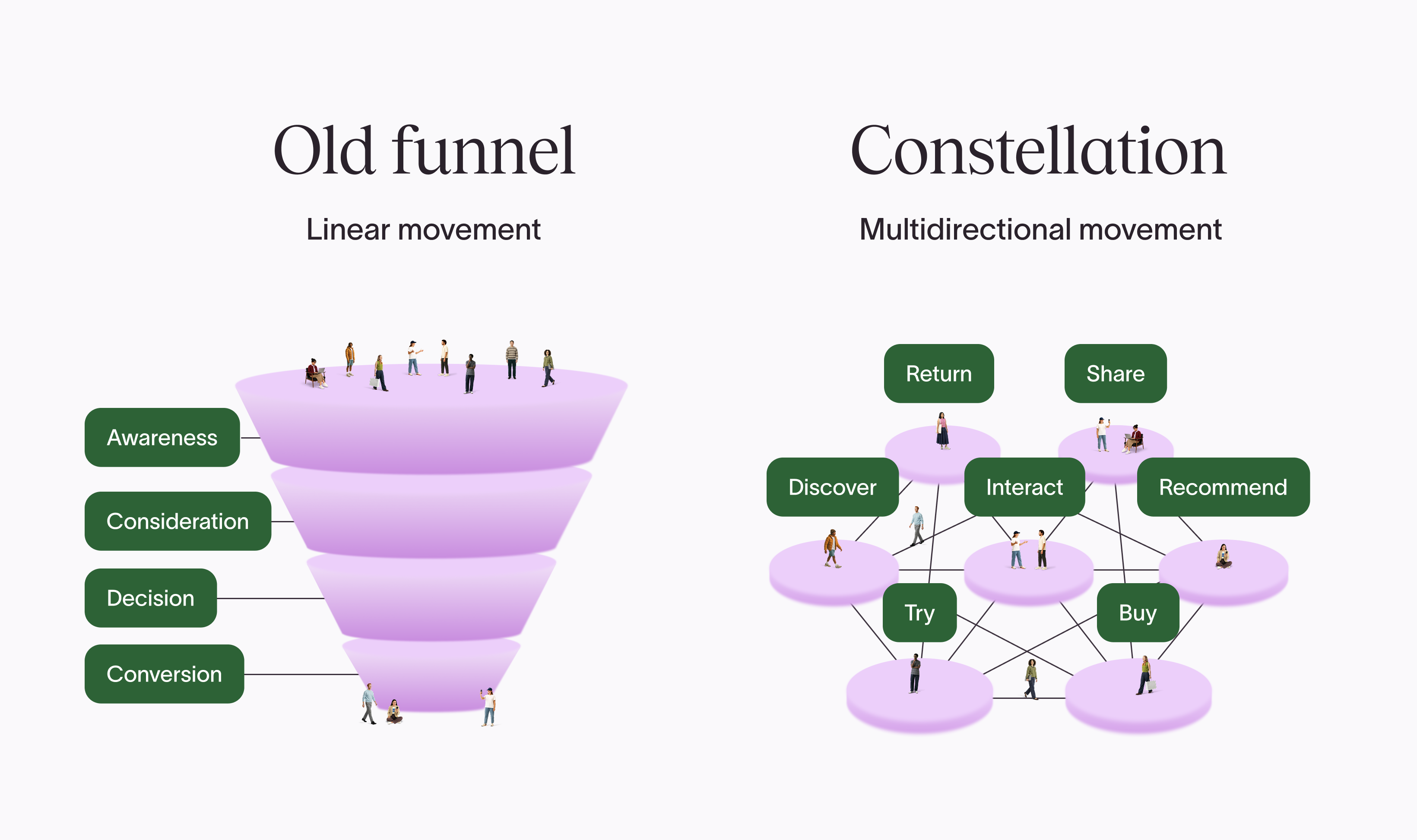
And yet, we optimize exclusively for conversions, forcing people further down the funnel on our timeline, not theirs. We guide them down a fixed path, continually nudging them toward what matters most to us (conversions) without considering them at all.
Conversions become the all-encompassing goal instead of building relationships that naturally lead to conversions. We simply push conversions, look back at who converted and when, and then move on. No in-the-moment action that fosters a better customer experience (CX). No relevant experiences that allow people to convert on their time, in their own way.
We miss everything that matters: the early signals of intent, the subtle hesitations, the moments when someone is this close to taking action.
But the best customer journeys aren't funnels forcing conversion. They're living systems that adapt to human behavior in real time, responding to signals and creating natural momentum. They build relationships that make conversions inevitable.
And this shift from static funnel to adaptive, momentum-driven journeys is changing how we approach marketing, measure success, look at the customer journey, and deliver a more relevant CX.
Why conversions alone can’t explain modern growth
We all love conversions. They’re measurable and concrete, and help us prove ROI. Either someone made a purchase, booked a demo, signed up for a free trial—or they didn’t.
But conversions aren’t all the same.
Five conversions on your top-tier plan are worth more than 500 on your freemium offering. Likewise, a happy customer who brings in dozens of customers through word of mouth is more valuable than a customer who converts and then churns four months later.
And that’s the problem with obsessing over conversions. You’re only seeing the short-term wins—not growth.
“Are they recommending us to their friends?”
“Are they churning? Or renewing their subscriptions?”
The only way to answer these questions is by zooming out and looking at growth more holistically. You can’t do that when you’re focused exclusively on conversions. Here’s why:
Instead of identifying the early signs of engagement, hesitation, or intent and acting in the moment, you’re analyzing data after the moment’s passed. It breaks the customer journey, leaving you to guess what you should do next. Do you nurture the customer? Upsell them? Give them space?
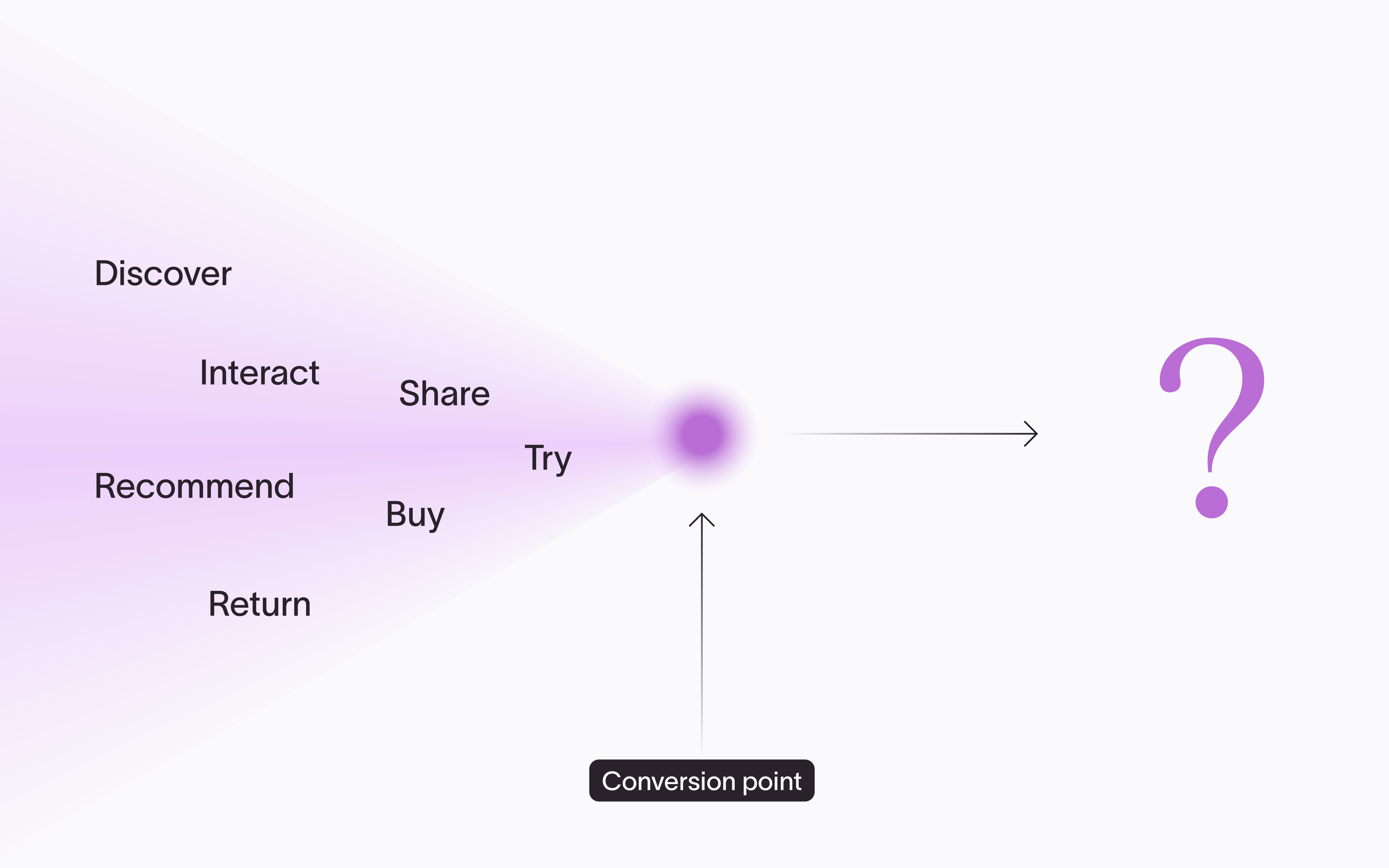
The conversion itself offers no guidance. You don’t know how to keep customers or turn that single “Yes” into a loyal customer relationship.
The good news? You can start looking through the windshield—focusing on the now—to deliver a customer experience that naturally drives conversions. One that:
- Responds to human behavior
- Anticipates customer needs
- Meets customers where they are—not where you wish they were
Conversions are great, but they’re just another metric that can’t give you a complete view of your customers. And while numbers are important, you need to understand and adapt to human behavior to truly measure long-term business growth.
Human behavior becomes your guide—not a single action. It helps you understand whether momentum’s building or stalling. If the relationship is strengthening or starting to fall apart. What the next step should be.
And when you start focusing on how humans actually move, you can identify the patterns, shifts, and signals that tell you what a customer will likely do next. You put the customer in control of their journey. You create a CX that supports long-term growth, not just one-off conversions.
What is momentum?
Moment(um) is all about the moment. The moment a customer books a demo, fills out a form, logs in, uses a new feature. Each individual action is a star in the greater constellation—and that constellation is customer momentum.
.gif)
Every moment creates momentum. That’s why every moment matters.
While conversions tell you what happened, momentum shows you what’s happening now. It’s not a new metric or score to optimize, but a lens for reading the signals customers are already sending your way.
Momentum helps you identify patterns instead of single data points. It shows you whether a conversion is a one-off event or the beginning of a long-term relationship.
Momentum is:
A pattern of signals over time
Momentum shows up in how your customers engage with your brand over time. It’s not about a single form submission or support ticket, but how all those interactions string together to create patterns.
Are they happening more frequently? Moving toward higher-intent actions? Momentum reveals these insights.
A sense of customer relationship health
Is your relationship with your customers warming up, cooling down, about to end entirely? Metrics like NPS and CSAT try to measure this, but momentum appears in the behavior first—before customers ever fill out a survey.
That behavior tells you what's actually happening and whether momentum is building or stalling.
Directional and predictive
Instead of being reactive, momentum lets you know where someone’s likely headed based on their behavior in the moment. Less product usage, skipping feedback requests, shorter session times—they all point toward churn. Momentum lets you act now, before these behaviors turn into churn.
Most teams recognize churn after it happens. They examine the data and see that NPS scores dropped and engagement disappeared. But by then, it's too late.
A momentum mindset takes a different approach. It lets you see patterns forming in real time, like fewer logins or shorter sessions, and intervene before the relationship fizzles out.
That's the shift. From looking back at what broke to acting now on what's starting to break.
Momentum is not:
- A replacement for conversion or revenue. You still need people to buy, sign up, and renew. Momentum helps you reach these goals by creating better customer experiences and acting in the moments that matter most.
- A single metric. There's no score or metric for momentum—it’s a way of seeing the data you're already collecting, but through a sharper, more intentional lens.
- Something you track in isolation. Momentum lives in existing signals, like form responses, email engagement, product usage, and support interactions. It's not a new metric, rather a smarter way of reading the signals you already have.
But knowing momentum exists and recognizing it in your own data are two different things. Here's how to identify those signals in action.
How to recognize momentum using existing signals
As marketers and CX leaders, we measure everything. But momentum isn’t something to be measured—it’s something we identify, interpret, and act on.
Momentum doesn’t focus on a single action or what happened in isolation. It asks, “What’s happening? What pattern are we seeing?” It connects the dots between signals that might seem ordinary on their own, but together, tell you where the relationship’s headed.
Engagement signals tell you whether a customer is leaning into the relationship with your brand or pulling back, and often look like:
- Responses getting faster. A lead who took three days to respond last week is now responding within hours. That's momentum building.
- Interactions happening closer together. Customers aren’t just engaging with you, but they’re doing it more often. They're filling out customer feedback forms, logging in multiple times a week, and opening your emails the same day they arrive.
- People coming back without being nudged. They're returning on their own because they want to engage with you. Not out of obligation or because you sent a reminder—just out of genuine interest.
Intent signals reveal whether a customer is moving toward conversion or simply browsing. These signals include things like:
- Answers getting more specific. Instead of vague responses like "Just exploring," customers are asking detailed questions about pricing, implementation, or timelines.
- Higher-intent behaviors appearing earlier. Customers are self-qualifying by viewing pricing pages, requesting demos, or asking about integrations before you ever nudge them in that direction.
- Fewer drop-offs mid-journey. Leads are no longer abandoning forms halfway through or skipping the end of onboarding. They’re completing surveys and moving through the customer journey without friction.
Relationship signals indicate whether the connection between customer and brand is growing or slowly fraying. If it’s strengthening, you’ll likely see:
- Feedback becoming more complete or thoughtful. Responses are no longer one-word answers—they’re detailed and provide context. Customers might even be invested enough to make suggestions and help you create a better CX based on their feedback.
- Expansion into new features or use cases. Customers are doing more than just using your product—they're exploring it. Trying new workflows, adding team members, asking "What else can this do?" These all suggest a longer-term relationship.
- Re-engagement after friction. Even when a customer hits a snag, they come back. They’re not letting friction erase the relationship. That resilience signals that the relationship can weather challenges.
Momentum shows up when these signals trend together.
Momentum isn’t a single spike, like a great NPS score or jump in product usage. It’s a combination of these signals, all moving in the same direction over time. Like a lead responding faster, asking more specific questions, and coming back to your site unprompted—that’s momentum trending toward conversion.
The patterns tell the story. Once you start looking for those patterns, you’ll get a clear story for every customer. You’ll start seeing momentum.
Why momentum and adaptive customer journeys are the way forward
Static customer journeys are like city roads packed with stop-and-go stoplights that make customers wait and introduce friction. Customers have to wait until the light turns green, even if they’re ready to move full steam ahead. Systems determine the timing—not the customer.
On the other hand, adaptive journeys are highways with open roads and countless exits, where customers can get off, get back on, and change direction. These momentum-driven journeys let customers move at their own speed because the infrastructure adapts to customer behavior, giving customers full control.
And that’s why systems that adapt and act automatically make all the difference between forcing a path and creating one that responds.
Remember, moment(um) lives in the moments and is adaptive by nature. The moment your customers act, you should, too. If they zig, you zig. That kind of responsiveness requires automation.
Tools like Typeform Contacts & Automations let you manage contacts, segment based on behavior, and trigger automated workflows—all in one place. And because it’s all automated, you act in the moment, not weeks later when you’ve manually reviewed the data.
Here are just a few ways you can build and take action on momentum with Contacts & Automations:
- Capture, organize, and manage contacts. Collect data, update it, and manage your contacts in a single Contact Hub, so you can stay on top of leads and have all the information you need at the ready.
- Segment leads to deliver more personalized experiences. Group leads based on shared characteristics to send more targeted campaigns and relevant experiences that keep momentum going in the right direction.
- Trigger instant, automated follow-ups. Create and send personalized follow-ups based on the actions your customers take. No delays, just immediate action that creates a smooth, timely CX.
It’s not about adding more tools or complications. You need systems that can keep up with human behavior and adapt as fast as your customers do.
Because the best customer journeys aren’t static. They’re built on momentum. And momentum only works if you act on it right now, in the small moments that matter most.
Using momentum to make decisions in real time
Recognizing momentum is just the start. Acting on it before the moment passes? That’s what creates truly adaptive and customer-led journeys.
But traditional, static journeys work on delay—collect data, do batch reviews, make decisions, and act weeks later. By the time you finally act, the context has changed.
Think about the customer who reached out to support multiple times in a single week, whose NPS score dropped, who didn’t log in, and who eventually canceled their subscription. Not because you’ve got a bad product, but because no one acted on the warning signs in time.
Momentum works on a customer’s time, not yours. It requires real-time decision-making that adapts based on the last action. Waiting around for weeks simply won’t cut it.
Making decisions in the moment means the customer experience shifts based on behavior, not a predetermined script, and it’s the difference between:
- Sending a generic "Thanks for signing up" email three days later vs. routing a high-intent lead to sales immediately after they request a demo.
- Waiting until the end of the quarter to identify at-risk customers vs. triggering a personalized check-in the moment a customer’s engagement starts to drop.
- Following up with every NPS survey respondent the same way vs. automatically sending a referral request to promoters while their enthusiasm is high.
When you adapt the journey instantly, you're doing more than simply responding. Instead, you're creating a better CX—one that feels personal, timely, and relevant.
That’s how momentum turns into action.
Every signal your customers send becomes a decision point. And when your systems can act on those signals in real time—automatically—momentum compounds.
Adaptive journeys protect momentum by responding when it matters most: in the moment. Not after the data's been processed. Not after the strategy meeting. Now.
Keep the momentum going with adaptive customer journeys
Conversions still matter. They prove marketing effectiveness and show that your customers get value out of your offering, and ultimately, they bring money through the door. But on their own, they’re incomplete.
A conversion tells you that someone said “Yes” once. But momentum tells you whether they’ll say it again and again. It helps you understand whether that single transaction is the beginning of a loyal relationship or a one-time event that's already fading.
When you combine conversions with momentum, you get the full picture. Not just who converted, but who's engaged, who's at risk, who's ready to expand, and who needs attention before they slip away.
You move from measuring outcomes to understanding relationships. And relationships are what drive long-term growth. The best way to maintain those relationships? An adaptable journey that lets you act in the moment.
And that’s exactly what momentum’s all about. Meeting customers where they are, responding when it matters, and building experiences that feel personal instead of predetermined.
The shift from static funnels to adaptive, momentum-driven journeys isn't just a better way to think about customer experience—it's a better way to build it.
Ready to build adaptive journeys that keep momentum alive? See how Typeform can help you act in the moments that matter most, automatically. Get started for free.

Liked that? Check these out:
Opinions and Expertise
What’s actually slowing research teams down (Hint: it’s not the research)
From recruiting participants and scheduling interviews to building the actual surveys, the operational drag is taking researchers away from what they do best. See what's actually slowing them down and how Research Flow fixes it.
En savoir plus
.png)