Botox Patient Assistance Program Application Form
See which patients qualify for help covering Botox treatment, before the cost pushes them off the schedule. Collect income, insurance status, and prescriber details in one application.



Patient assistance applications fail on paperwork more often than on eligibility. The program wants proof of household income, documentation of what insurance denied, and a prescriber section the clinic has to complete, and staff usually collect those across three separate phone calls while the patient's next injection cycle comes due. Typeform's Botox patient assistance program application form gathers all of it in one pass.
Patients enter household size, household income, insurance status, and the condition they're treated for. Conditional logic reads the insurance answer each patient gives and asks only what fits. An uninsured patient answers about household size and income documentation, while a patient whose claim was denied answers about the denial date, the reason the plan gave, and whether they've appealed. The prescriber section covers the diagnosis, the dosing schedule, and the treatments already tried.
You end up knowing whether a patient is likely to qualify, with each document sitting next to the answer that calls for it. Staff stop chasing a denial letter the week an injection is due, and the cost conversation happens while there's still time to file before the next cycle.
A Botox patient assistance program application form is an online form that gathers what a patient needs to apply for help with the cost of therapeutic Botox treatment. It collects household income and size, insurance status and any denial, the prescribed indication, and the prescriber's details. Clinics and neurology practices use Botox patient assistance program application forms to identify patients who may qualify, and collect their information in one place.
Without a Botox patient assistance program application form, staff only mention assistance when a patient brings up cost, and each application gets pieced together over phone calls and emails. Applications stall halfway, because the income documents come in and the prescriber section never does. Clinics that send the form with every new prescription ask every patient the same questions and collect the paperwork at once, so applications actually get finished.
Capture what an application depends on:
- Patient and household details
- Household income and size
- Insurance status and any denial
- Prescribed indication and treatment plan
- Prescriber name and contact
Send the Botox patient assistance program application form the day the prescription is written, not after insurance denies the claim. Assistance decisions take weeks, and patients are on an injection schedule, so an application that starts after a denial usually misses the next treatment. Starting early costs a few minutes, and if coverage comes through, you close the application. Asking every patient at the same point also saves you from guessing who needs help.
Yes. Patients can upload pay stubs, a tax return page, or a denial letter with File Upload, available on paid Typeform plans. They can add PDFs or images up to 10MB each, so you gather the documentation an application needs at the same time as the answers. Every document arrives attached to the application.
Get inspired by relevant templates and categories
3200+ Templates, 300+ Integrations
X-Ray Release Form
A phone call asking to send X-rays to a new provider isn't an authorization your compliance file can rely on. Collect patient information, the receiving provider's details, and a signed authorization before the images go out, so your front desk isn't scrambling to prove who approved a release.
View template
Palliative Care Assessment Form
A symptom check done verbally during a rushed home visit isn't the kind of record that shows whether pain management is actually working from one visit to the next. Collect symptom severity, functional status, and psychosocial needs consistently, so a care team can see change over time instead of relying on memory of the last visit.
View template
Dental Treatment Plan Form
A treatment plan explained chairside, in the few minutes right after an exam, doesn't hold up when a patient's trying to remember it at the front desk. Collect what your practice actually needs, the recommended procedures, cost estimate, and signed consent, before treatment gets scheduled.
View template
Medical Physical Exam Form
A health history filled out on a clipboard in the waiting room, minutes before being called back, isn't a history anyone fills in completely. Collect what your provider actually needs, patient information, health history, and current symptoms, before the exam starts.
View template
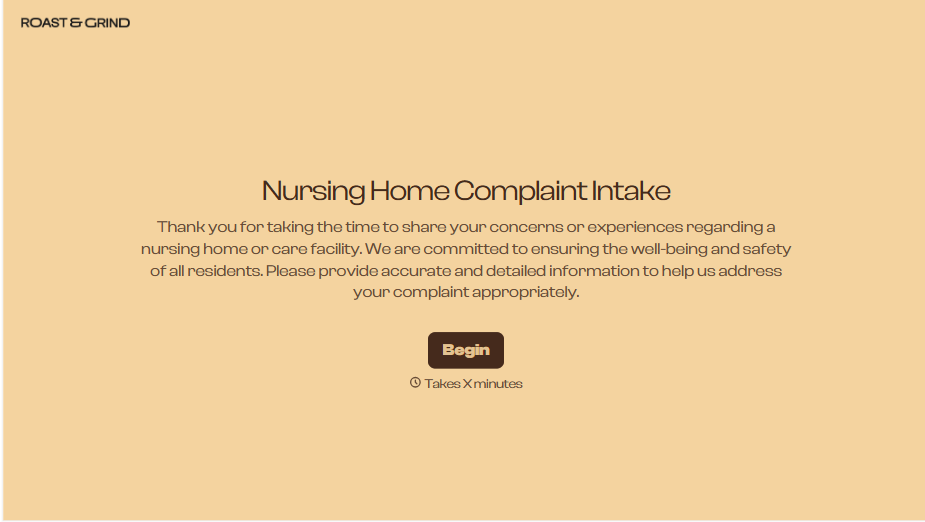
Nursing Home Complaint Form
A family member who calls the front desk about a missed medication or an unanswered call light often gets a verbal apology and nothing written down, no record that it happened, no way to tell if it's the third time this month or the first. And if what's actually being reported is abuse or neglect, a facility's own intake form isn't where that report should end, or even start.
View template
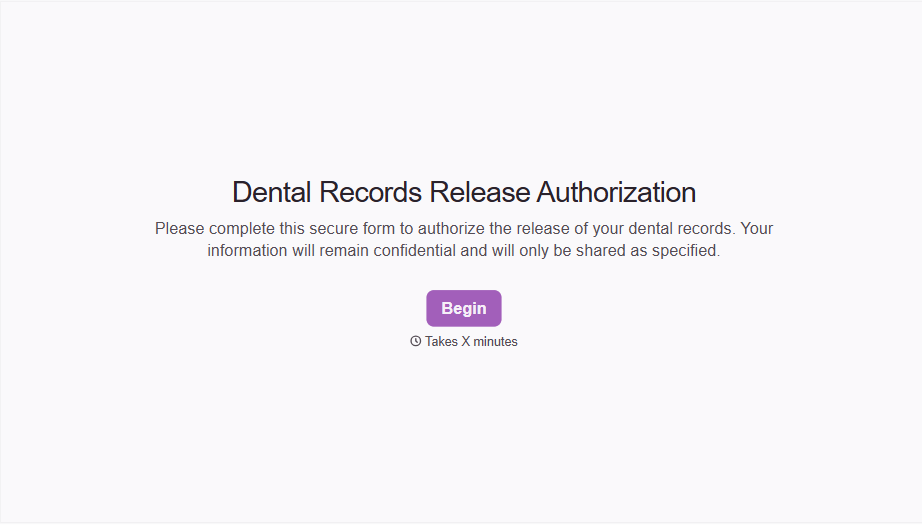
Dental Record Release Form
A release that just says "I authorize my records to be sent" doesn't say which records, sent to whom, or for how long that authorization is good, and HIPAA has a specific list of what actually has to be in there for the release to count as valid. Spell out what's being released, to whom, and until when, before the request goes out.
View template
With Typeform, you can customize everything
Change text, colors, and even logos to match the look and feel of your brand. Then embed forms smoothly onto web and email.
Make forms feel effortless to fill out. Pace questions, call people by their name, and adapt the flow based on the data they share.
Stay efficient by connecting forms to your workflow. Typeform integrates with 300+ tools including Slack, Zapier, and HubSpot.