Mental Health Quiz Form Template
Help people understand their mental health better with a thoughtful, non-clinical quiz experience.



Mental health self-assessments are only useful if people actually complete them — and most people won't push through a clinical-feeling checklist if it feels cold or intimidating. The format matters as much as the questions.
Typeform's one-question-at-a-time approach creates space for reflection between questions, which is especially important for sensitive topics. A mental health quiz feels different when it's not presented as a wall of checkboxes. Conditional logic lets you follow up on concerning answers without making every participant answer the same exhaustive question set.
Use it for awareness campaigns, onboarding assessments in wellness programs, or as a starting point for a coaching or therapy intake — always with clear guidance about what the quiz is and isn't (it's not a diagnosis).
A mental health quiz form is a self-assessment tool that helps people reflect on their emotional wellbeing, stress levels, or mental health habits. It's used by wellness programs, therapists, coaches, and organizations to surface awareness and prompt conversations about mental health.
A quiz format feels more approachable than a clinical checklist. The conversational pace gives people time to consider each question honestly rather than racing through a long form. Higher completion rates mean more useful data and more people who've actually reflected on their wellbeing.
Good mental health quiz questions focus on observable experiences rather than diagnostic labels:
- How often have you felt overwhelmed in the past 2 weeks?
- How would you rate your sleep quality lately?
- Do you feel like you have people you can talk to when things get hard?
- How often do you take time to do something just for yourself?
- Have you noticed changes in your appetite or energy levels?
- On a scale of 1-10, how would you rate your overall mood this week?
No. A quiz is a self-reflection tool, not a diagnostic instrument. It should always include a clear disclaimer that results are not a clinical evaluation and should not be used as a substitute for professional mental health support. For clinical screening tools like PHQ-9 or GAD-7, consult a licensed clinician about appropriate use.
Keep result framing supportive and non-alarmist. Results should offer context, encourage self-reflection, and suggest next steps — not label someone with a condition. Always include resources (a hotline, a link to professional support) for participants whose responses suggest they may need more than a quiz.
Get inspired by relevant templates and categories
3200+ Templates, 300+ Integrations
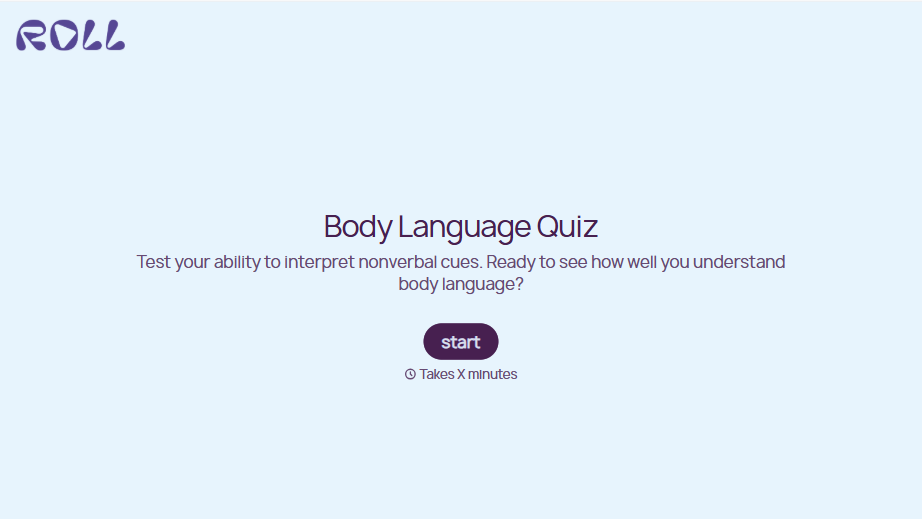
Body Language Quiz
A quiz that hands back the same score no matter which questions someone actually missed isn't teaching anyone to read a room. Ask what the quiz is actually measuring, attraction cues, deception tells, stress signals, and let each wrong answer route somewhere that explains what the cue really meant.
View template

With Typeform, you can customize everything
Change text, colors, and even logos to match the look and feel of your brand. Then embed forms smoothly onto web and email.
Make forms feel effortless to fill out. Pace questions, call people by their name, and adapt the flow based on the data they share.
Stay efficient by connecting forms to your workflow. Typeform integrates with 300+ tools including Slack, Zapier, and HubSpot.