Consumer behavior research: a complete guide
Consumer behavior research explains what customers buy and why, combining surveys, interviews, and behavioral data into insights marketers can use.
You may have seen a customer browse your site, compare a few options, and then leave without buying anything.
What happened?
Key takeaways
- Consumer behavior research helps you understand what people buy, why they choose it, and what influences their decisions.
- The strongest studies combine what consumers say with evidence of what they actually do.
- A clear research question makes it easier to choose the right participants, methods, and metrics.
- Thoughtful survey design, including neutral wording and logical question order, leads to more reliable answers.
- Research becomes valuable when you turn the findings into specific decisions, experiments, and follow-up questions.
Maybe the price felt too high. Maybe the product didn’t solve the problem they had in mind. Or maybe a message pulled their attention away, and they simply forgot about you.
Without any research, every explanation sounds plausible. Consumer behavior research helps you move past the guesswork and find out what’s really shaping your customers’ decisions.
The good news is that you don’t need a huge research department or a lab full of one-way mirrors to get the answers you need. With a focused question, the right mix of methods, and a willingness to listen, almost any team can understand its customers more deeply.
Let’s look at how.
What is consumer behavior?
Consumer behavior is the study of how people choose, buy, use, and eventually stop using products or services.
It covers the visible parts of a decision, like clicking an ad, comparing plans, or making a purchase. It also includes everything happening beneath the surface. That could include someone’s goals, habits, emotions, social influences, budget, or previous experiences with your brand.
Example: two customers buying the same project management tool.
One may want to organize a growing team. The other might simply be tired of sticky notes taking over their desk. The purchase is the same, but the motivations are completely different. That distinction matters because your customers aren’t spreadsheets with shoes on. They’re people making decisions in messy, real-world situations.
Consumer behavior research helps you better understand those situations.
Why consumer behavior research matters
You can collect lots of data without learning a whole lot about your customers.
Your analytics may show that 60% of visitors leave a pricing page. That’s useful information, but it’s also incomplete. It tells you what happened, not why.
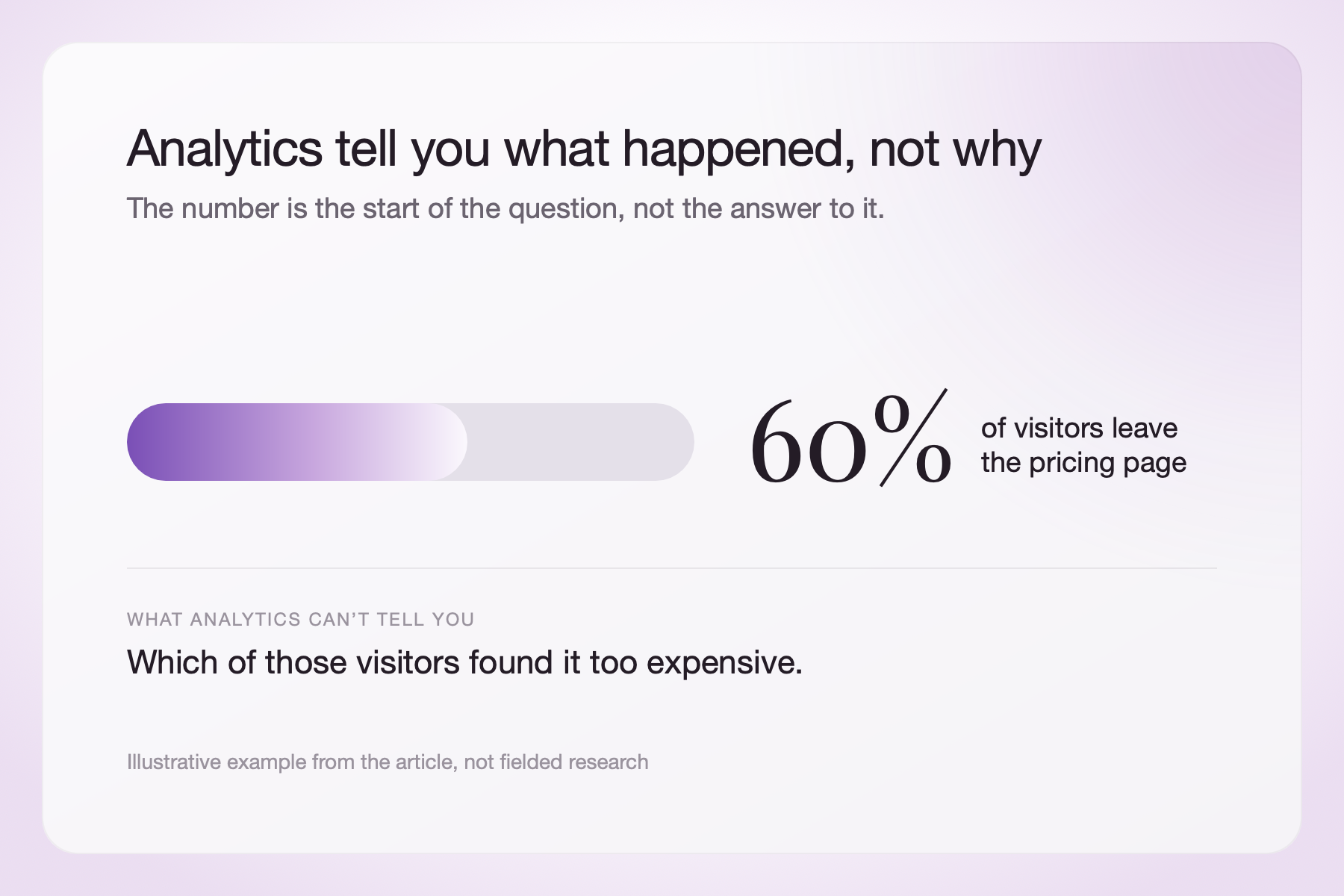
Consumer behavior research fills in the missing context. It can help you:
- Identify the real problem customers are trying to solve
- Understand why people choose you or a different option
- Improve products based on genuine needs
- Create messaging that sounds relevant rather than generic
- Remove friction from the buying experience
- Spot changes in expectations before they become expensive problems
It can also challenge assumptions your team has repeated so often that they’ve started to feel like facts.
Perhaps everyone believes customers chose your premium plan for its advanced reporting. Interviews reveal that they’re actually paying for faster support. Suddenly, you have different value propositions to test, and a much better idea of what not to cut.
If you want to explore this idea further, our guide to understanding your buyers through customer research is a great place to start.
What influences consumer behavior?
Buying decisions rarely have just one cause. They’re usually shaped by a mix of internal and external forces.
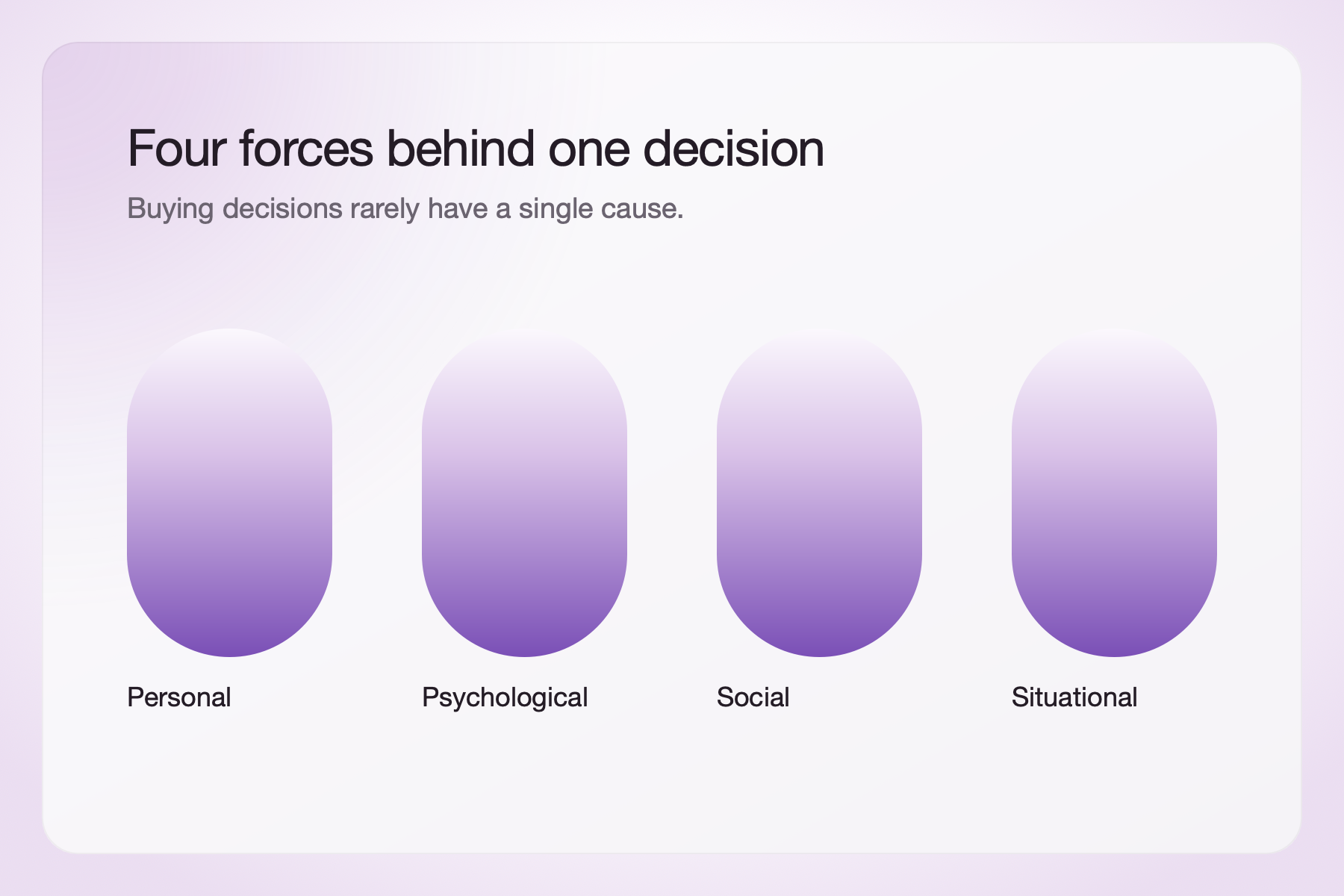
Personal factors
Age, income, lifestyle, responsibilities, and past experiences all affect what someone needs and can realistically buy.
A parent ordering dinner for a family of five evaluates a meal-delivery service differently from a university student ordering for one. Same category, very different priorities.
Psychological factors
Motivation, perception, emotion, and memory influence how people interpret their choices.
A shopper might prefer a familiar brand because it feels safer, even when another product is cheaper. Someone else may buy quickly because a limited-time offer creates urgency.
Social factors
Friends, family, colleagues, creators, reviews, and online communities can all influence a decision. For expensive or unfamiliar purchases, social proof may matter as much as the product description.
Situational factors
Context changes behavior too. Device, location, time pressure, delivery speed, and even someone’s mood can affect what they do next.
This is why research done in a perfectly calm interview doesn’t always predict behavior during a rushed Monday morning. Context isn’t background noise. It’s part of the decision.
What consumer behavior research can uncover
A useful study starts with a specific question. “Tell us about our customers” is too broad to guide meaningful research.
Instead, try questions like:
- What triggers customers to start looking for a solution?
- Which alternatives do they consider?
- What information helps them feel confident?
- Where do they hesitate during checkout?
- Why do some customers renew while others leave?
- How do expectations change after the first month of use?
You can also organize your research around the customer journey.
Before the purchase, explore awareness, needs, and alternatives. During the decision, investigate evaluation criteria, objections, and trust. Afterward, study satisfaction, product use, loyalty, and advocacy.
The “jobs to be done” framework offers another helpful lens. Instead of asking only who bought a product, ask what progress they were trying to make by “hiring” it. The Harvard Business Review overview of jobs to be done explains why the circumstances behind a purchase can reveal more than customer characteristics alone.
Qualitative vs. quantitative research
Consumer behavior research generally falls into two camps: qualitative and quantitative. You’ll often get the clearest picture by using both.

Qualitative research explains the “why”
Interviews, focus groups, diary studies, and open-ended survey questions let people describe experiences in their own words.
Use qualitative research when you want to uncover motivations, learn your customers’ language, or explore a problem that you don’t understand yet.
You may interview 10 recent customers and learn that 8 describe onboarding as “overwhelming.” That doesn’t tell you how common the issue is across your entire customer base, but it gives you a strong hypothesis to investigate.
Quantitative research shows the “how many”
Surveys, experiments, sales data, and behavioral analytics help you measure patterns at scale.
Use quantitative research when you need to compare segments, track change, rank priorities, or estimate how widespread a behavior is.
Sample size matters here. In general, larger samples reduce sampling error, although size alone can’t fix a biased sample. The US Census Bureau’s explanation of sample size and data quality offers useful background.
Attitudes and actions belong together
There’s another distinction worth knowing: attitudinal research examines what people say and think, while behavioral research focuses on what they do.
Those two things don’t always match. People are complicated, and their actions involve trade-offs they may not recognize in the moment. Nielsen Norman Group’s guide to attitudinal and behavioral research explains why you need both perspectives.
How to conduct consumer behavior research
Ready to run your own study? Keep the process simple and deliberate.
1. Define the decision you need to make
Start with the business decision, not the survey questions.
Are you choosing which feature to build? Reworking your positioning? Trying to reduce abandoned checkouts? Write down what you’ll do differently based on the results. If you can’t imagine any finding changing your decision, the research may not be worth running.
2. Choose the right participants
Your participants should reflect the people involved in the decision you’re studying.
That could mean current customers, first-time buyers, power users, former customers, or prospects who considered your product and chose something new. Avoid surveying only the easiest people to reach. Your biggest fans are valuable, but they can’t tell you why less-engaged customers leave.
3. Select your research methods
Match the method to the question.
Use interviews when you need stories and context. Use surveys to measure patterns across a larger group. Observe usability sessions when you want to see where people struggle. Review support conversations to find recurring frustrations. Analyze behavioral data to identify drop-offs and repeat actions.
You don’t need to use every method at once. A few interviews followed by a focused survey can be surprisingly powerful.
4. Write questions like a human
Good questions are clear, neutral, and easy to answer.
Ask “What made you decide to try the product?” instead of “How helpful was our industry-leading feature?”
Avoid double-barreled questions like, “How satisfied are you with our price and customer support?” Someone may love one and dislike the other.
Question order matters too. Earlier questions can influence later answers, while the wording of response options can change what people select. Pew Research Center’s guide to writing survey questions breaks down these effects in detail.
For a more conversational approach, see our tips for writing survey questions people actually answer.
5. Run a small pilot
Test your interview guide or survey with a handful of people before launching it widely.
Ask testers which questions felt unclear, repetitive, or difficult. Check whether answer choices cover the responses people want to give. Look for points where they pause or abandon the survey.
A short pilot can save you from collecting hundreds of beautifully organized answers to the wrong question.
6. Look for patterns and contradictions
Once responses arrive, group them by themes, behaviors, and customer segments.
Compare what people say with what they do. Notice where new customers and experienced customers disagree. Pay attention to outliers, but don’t let one dramatic quote outweigh the rest of the evidence.
Our guide to survey analysis can help you turn a page of responses into a clearer story.
7. Turn insight into action
A research report isn’t the finish line. Give every important finding an owner and a next step.
That might mean rewriting a landing page, simplifying checkout, testing a new onboarding email, or conducting follow-up interviews.
Share the evidence alongside your recommendation. “Customers are confused” is vague. “7 out of 10 participants couldn’t explain the difference between our plans” gives your team something concrete to fix.
Then close the loop. Track whether the change improves behavior, and keep listening. Our voice of the customer guide offers a practical model for making feedback an ongoing habit.
Common consumer behavior research mistakes
A few traps can quietly weaken otherwise solid research.
Starting with a preferred answer: If the goal is to prove your idea is right, you’ll naturally notice supporting evidence and dismiss the rest.
Asking people to predict the future: “Would you buy this?” often produces optimistic answers. Questions about recent, specific behavior are usually more reliable.
Using a biased sample: Surveying loyal customers won’t explain why prospects reject you.
Collecting too much data: A 40-question survey may feel thorough, but tired respondents rarely give thoughtful answers. Our market research survey tips can help you keep the experience focused.
Treating one study as permanent truth: Consumer behavior changes as prices, technology, competitors, and expectations change. Research should be a rhythm, not a one-time event.
Get curious about the humans behind the clicks
Consumer behavior research isn’t about perfectly predicting every purchase. Humans will always surprise you.
It’s about replacing broad assumptions with better questions and better evidence. Start small: interview 5 customers, add one open-ended question to your post-purchase survey, or investigate a single point of friction in your funnel.
Listen for the story behind the behavior. Compare that story with the data. Then make one decision differently because of what you learned.
That’s how research becomes more than a report. It becomes a habit, and a practical way to build experiences people genuinely want.

Liked that? Check these out:


Opinions and Expertise
What’s actually slowing research teams down (Hint: it’s not the research)
From recruiting participants and scheduling interviews to building the actual surveys, the operational drag is taking researchers away from what they do best. See what's actually slowing them down and how Research Flow fixes it.
Read more