Customer research: How to understand your buyers
Customer research turns buyer assumptions into evidence. Covers surveys, interviews, CSAT, NPS, and a 5-step framework for what customers actually want.

Getting to know your customers isn’t a luxury—it’s how you survive in competitive markets. When you understand what your buyers actually want, need, and think, you make better products, run smarter campaigns, and build loyalty that lasts.
Yet many businesses skip the work of truly understanding their audience. They guess at what matters, launch offerings based on assumptions, and wonder why engagement falls flat. Customer research closes that gap. It transforms hunches into insights and opinions into evidence.
This guide covers what customer research is, why it matters, and how to do it right, empowering you to build products and experiences people actually want.
What is customer research?
Customer research is the systematic process of gathering information directly from your audience to understand their behaviors, needs, preferences, and pain points. It’s the bridge between what you think customers want and what they actually want.
This research can take many forms: surveys, interviews, usability tests, focus groups, or feedback from customer support interactions. The common thread is that you’re collecting real data from real people—not relying on hunches or historical assumptions.
Customer research answers questions like:
- Who are your customers, and what are their demographics?
- What problems do they solve with your product or service?
- How do they make purchasing decisions?
- What’s stopping them from buying?
- How satisfied are they with what you offer?
- What would they like to see change?
The depth and breadth of your research depends on your goals. You might run a quick pulse survey to check sentiment, or invest in in-depth interviews to understand motivations. Both are valid—it’s about matching your method to your question.
Why customer research matters
There are hard numbers behind the value of understanding your customers.
Trust drives decisions. 81% of consumers need to trust a brand to consider buying from it (WiserNotify, 2025). Trust isn’t something you build by guessing. It comes from listening, responding, and consistently meeting expectations. Customer research helps you identify what trust looks like to your audience, because it’s different for everyone.
Retention beats acquisition. Acquiring new customers costs 5x more than retaining existing ones (Firework, 2025). A 5% increase in retention leads to a 25-95% increase in profits. If your focus is growth, you need to understand the customers you already have well enough to keep them.
Existing customers spend more. 65% of revenue comes from existing customers, who spend 67% more than new customers (Firework, 2025). This means the people you’ve already won are your biggest opportunity. Customer research helps you deepen those relationships and unlock more value.
Brand loyalty reduces churn. Customer churn costs US businesses $136 billion annually. Brands with strong loyalty programs report a 12-18% revenue increase, and 79% of millennials stay loyal to brands with great loyalty programs (Firework, 2025). Loyalty doesn’t happen by accident—it’s built on understanding what keeps people coming back.
When you invest time in customer research, you’re not just learning facts. You’re building empathy. You’re creating a shared understanding across your team about who you’re serving and why that matters. That alignment is what separates companies that grow from companies that stall.
The main types of customer research
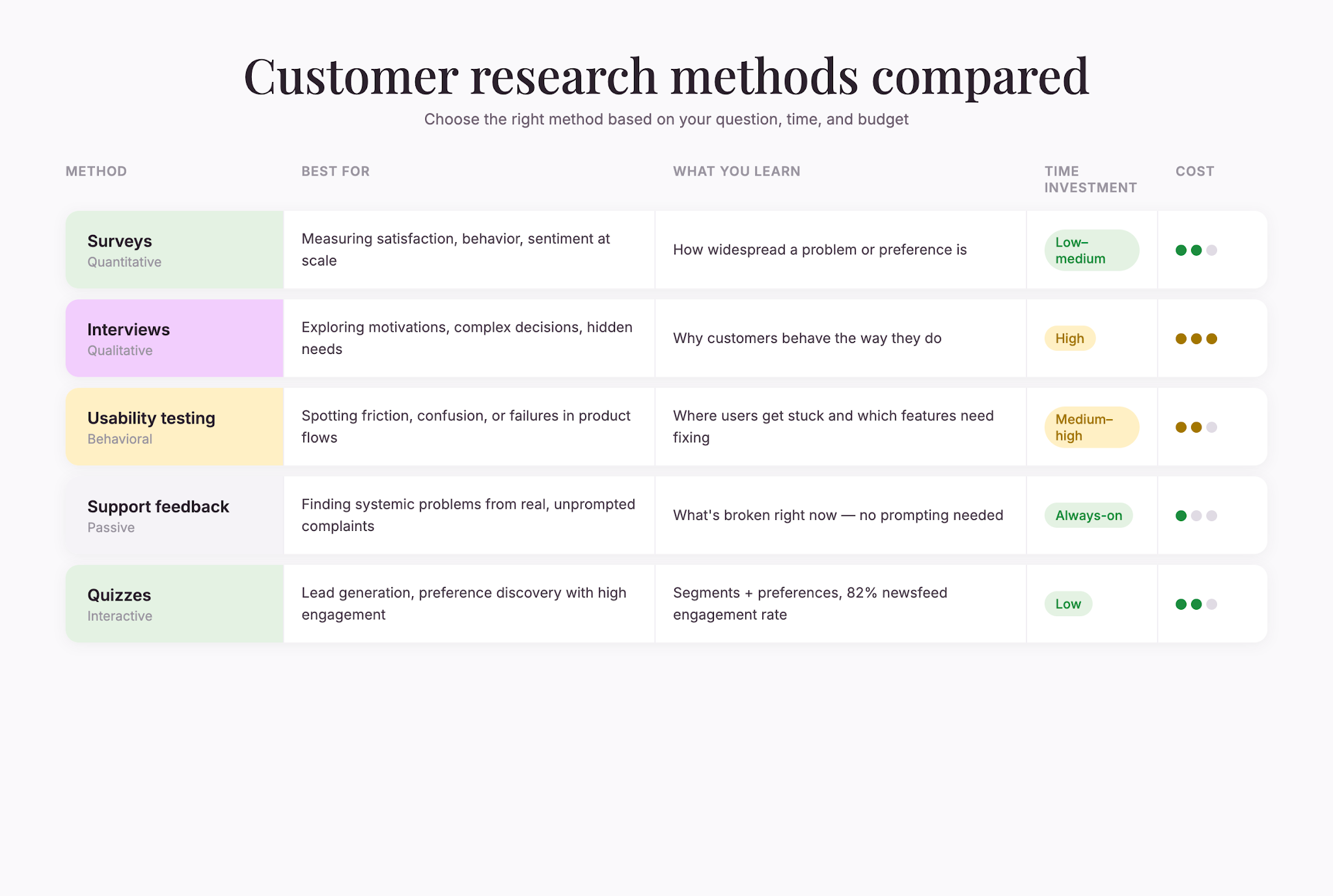
Different research methods answer different questions. Here’s what each one does best.
Surveys and questionnaires
Surveys let you ask structured questions to a large number of people quickly. They’re scalable, cost-effective, and great for quantifying opinions and behaviors.
Surveys work well when you want to:
- Measure satisfaction or sentiment across your customer base
- Understand how widespread a problem or preference is
- Test reaction to new ideas or features
- Gather demographic or behavioral data
The trade-off is depth. A survey might tell you that 60% of customers are unhappy with your onboarding, but it won’t always tell you why. That’s where follow-up interviews or open-ended survey questions help.
Interviews and focus groups
One-on-one interviews and small group discussions let you dig deeper. You can ask follow-up questions, explore motivations, and hear stories that numbers alone don’t capture.
Interviews are ideal for:
- Understanding customer motivations and decision-making
- Exploring complex problems in depth
- Discovering unexpected insights you didn’t know to ask about
- Building relationships with key customers or personas
The downside is that interviews take time and scale less easily than surveys. You typically conduct 5–20 interviews to find patterns, not hundreds.
Usability testing
Usability testing watches real people interact with your product, website, or prototype. You observe where they succeed, where they struggle, and what confuses them.
Usability testing reveals:
- Where users get stuck or frustrated
- Which features are intuitive and which aren’t
- How people actually use your product (versus how you designed it)
- Features you can fix to improve experience
User interviews, usability testing, and user surveys are the most popular UX research methods, used by 86%, 84%, and 77% of companies, respectively (TrueList, 2025). And for every $1 invested in UX, companies see a $100 return (TrueList, 2025)—that’s a 9,900% return on investment.
Customer support and feedback channels
Your support team, reviews, chat logs, and social mentions are a goldmine of unsolicited feedback. Customers tell you what’s broken, what’s working, and what they wish you’d build.
This data is valuable because it’s unprompted—customers aren’t answering your questions, they’re raising their own. Patterns in support tickets often reveal systemic problems faster than surveys do.
Quizzes and interactive tools
Quizzes engage people while collecting data. They’re fun to take, which means higher completion rates, and they naturally segment respondents based on their answers.
In one study, 82% of users engaged with quizzes shown via their newsfeed (BuzzSumo, 2024). Quizzes are particularly powerful for lead generation and understanding customer preferences without the friction of a traditional form.
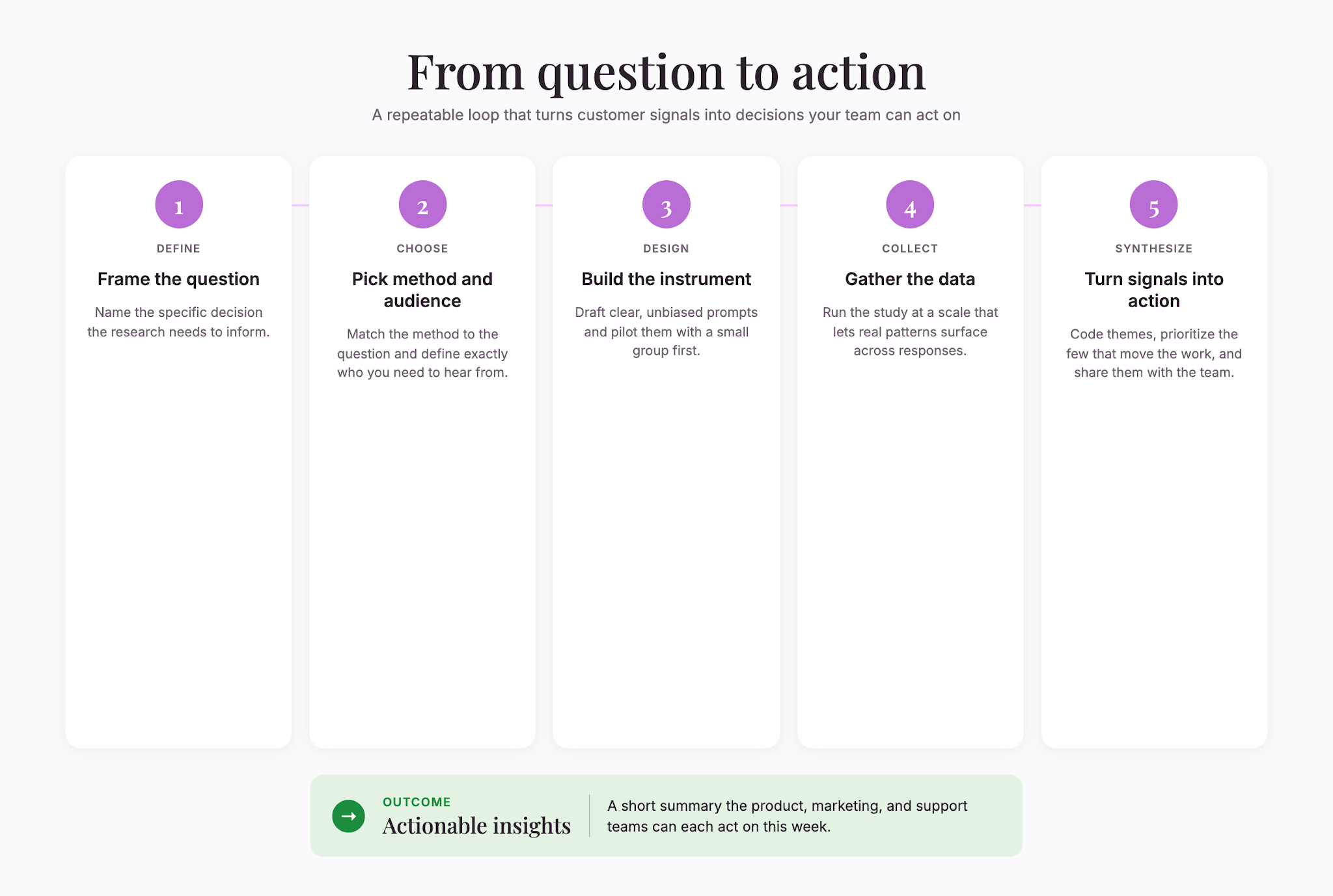
How to plan and execute customer research
A research plan keeps you focused and ensures you get usable answers. Here’s how to structure it.
Step 1: Define your research questions
Start by asking yourself: what do I actually need to know? Be specific.
Instead of “What do customers think?” ask:
- “Why do customers churn in their first 30 days?”
- “Which features do small businesses value most?”
- “What barriers prevent trial users from upgrading?”
- “How satisfied are long-term customers, and why?”
Clear questions guide everything that follows: your method, your sample size, your analysis. Vague questions lead to vague data.
Step 2: Choose your method and audience
Different questions need different methods. A research question about why something happens calls for interviews. A question about how many people experience a problem calls for surveys.
Then define your audience. Are you researching:
- All customers or a specific segment?
- Active users or inactive ones?
- Recent buyers or long-term customers?
- Prospects who never bought?
The tighter your definition, the clearer your insights.
Step 3: Design your research instrument
If you’re using a survey, write clear questions that don’t lead respondents toward your preferred answer. If you’re conducting interviews, prepare open-ended questions that let people share their thinking.
Good research design takes practice. Common mistakes include:
- Asking yes/no questions when you need detail
- Bundling multiple ideas into one question
- Using jargon your audience doesn’t use
- Making assumptions in your wording
Test your survey or interview guide with a small group before rolling it out. You’ll catch confusing wording and refine your approach.
Step 4: Collect data
Run your research with enough respondents to find patterns. For surveys, that usually means 30–100+ responses, depending on how granular you want to go. For interviews, 5–15 in-depth conversations often surface the key themes.
Modern customer feedback platforms integrate multiple data collection channels—surveys, reviews, support tickets, chats, and in-app feedback—alongside AI-powered analytics to help you gather and make sense of feedback across teams (Mopinion, 2026). Tools like ResearchFlow streamline the process by automating data collection, organizing responses, and surfacing key findings so your team can act on insights faster.
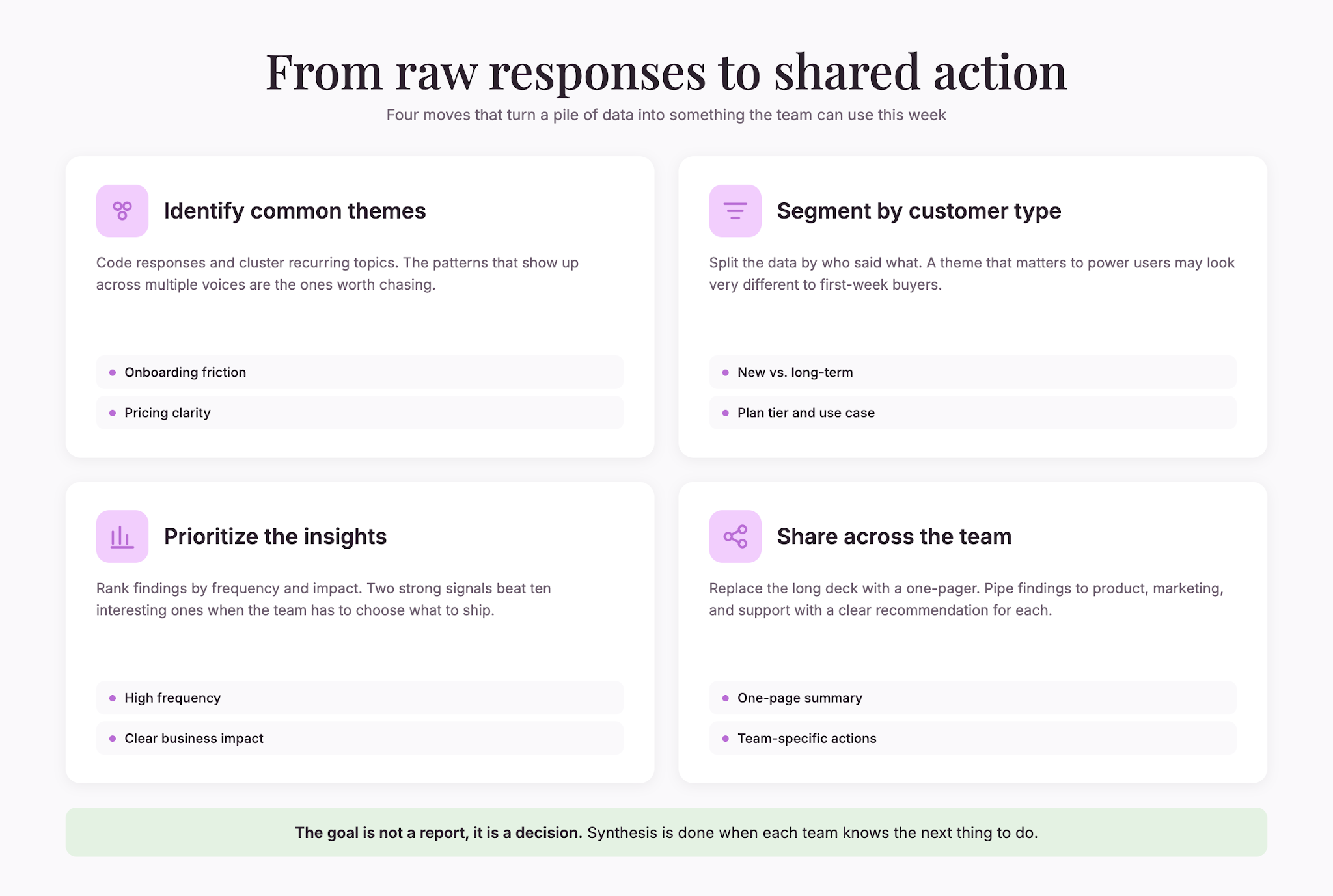
Step 5: Analyze and synthesize
Look for patterns. What themes show up repeatedly? Where do customers agree, and where do they diverge?
Don’t cherry-pick quotes that confirm what you already believe. Instead, ask: what’s the evidence actually saying? If 5 customers mention a problem but 95 don’t, that’s different from the other way around.
Document your findings in a way your team can act on. Instead of a 50-page report nobody reads, create a one-page summary with key insights and recommendations.
How to measure customer satisfaction
One of the most common customer research goals is measuring satisfaction. Here are the main metrics.
Customer satisfaction score (CSAT)
CSAT asks a simple question: “How satisfied are you with [product/service/interaction]?” Respondents rate on a scale, usually 1–5 or 1–10.
The average CSAT across industries is 78% (American Customer Satisfaction Index, 2024-2025). Scores above 80 are considered excellent. Below 70 signals problems. However, industry varies widely: full-service restaurants average 84, banks and e-commerce both hit 80, and internet service providers lag at 68 (American Customer Satisfaction Index, 2024-2025).
CSAT is quick to measure and easy to understand, but it only tells you satisfaction right now—not whether someone will stay or recommend you.
Net Promoter Score (NPS)
NPS asks: “How likely are you to recommend us to a friend or colleague?” on a 0–10 scale. Respondents who give 9–10 are “promoters,” 7–8 are “passives,” and 0–6 are “detractors.” Your NPS is the percentage of promoters minus the percentage of detractors.
NPS predicts customer loyalty and growth better than CSAT alone because it measures whether people will actively advocate for you.
Customer effort score (CES)
CES asks how easy it was to interact with you or solve their problem. It’s especially useful for measuring support quality and product usability.
Each metric tells a different story. Use all three if you have the bandwidth, or pick the one that best aligns with your current priorities.
Trust and customer research
For the first time in recent research, trust is equal to price and quality in brand purchase decisions (Edelman Trust Barometer, 2025). 68% of people say it’s very important that brands help them feel safe, confident, and inspired (Edelman Trust Barometer, 2025).
This means customer research isn’t just about features or satisfaction. It’s also about understanding how your audience experiences trust with you.
Ask yourself:
- Do customers feel safe sharing data with you?
- Do you deliver on promises consistently?
- Are you transparent about how you use customer information?
- Do customers feel heard when they have concerns?
Trust-related research questions often show up in interviews or open-ended surveys, where people can explain their reasoning rather than pick from a list.
The role of AI in customer research
Around 47% of researchers worldwide now use AI regularly in their market research activities (Backlinko, 2026). AI is changing the game by automating data collection, identifying patterns, and surfacing insights that would take humans much longer to find.
AI can help you:
- Analyze hundreds of open-ended responses to find themes
- Identify sentiment in support tickets automatically
- Spot patterns across multiple data sources
- Generate summaries of key findings for busy teams
That said, AI is a tool, not a replacement for human judgment. You still need to validate insights, ask follow-up questions, and apply your domain knowledge. The best approach pairs AI speed with human wisdom.
Common pitfalls to avoid
Asking leading questions
“Don’t you think our product is easy to use?” leads people toward a yes. Instead, ask: “How easy was it to complete this task?” and let the answer come naturally.
Surveying only happy customers
If you only hear from satisfied customers, you miss the reasons people leave. Make space to hear from inactive users and people who’ve churned.
Ignoring qualitative feedback
“89% satisfaction” sounds good until you read the 5 open-ended comments explaining why people are actually frustrated. Numbers and stories both matter.
Doing research once and forgetting
Customer needs and markets shift. Build research into your regular rhythm—quarterly pulse surveys, monthly support analysis, ongoing user testing. Research is continuous, not a one-time project.
Not sharing findings with the team
The best research sits in a deck nobody reads. Instead, create feedback loops. Tell your product team what customers said. Show your marketing team why people churn. Make research a conversation, not a report.
Getting started with customer research
One of the best things about customer research is that you don’t need a big budget to start. Begin with the easiest method for your situation:
- Send a 5-question survey to your last 50 customers
- Schedule 3 customer interviews this month
- Do a usability test with 5 people using your product
- Review your last 20 support tickets for patterns
Once you have data, sit with your team and ask: What changes if we act on this? That’s when research becomes strategy.
The companies that win aren’t the ones with the best guesses. They’re the ones that listen, learn, and build based on what their customers actually need. Customer research is how you join that group.