Cookieless marketing: the marketer's survival guide
Third-party tracking cookies are already on their way out. But, without the mighty cookie to guide marketers' insights and strategies, what's one to do? Luckily, we've put together a concise guide to surviving the cookieless future.

Third-party cookies are going away. Regulators have made it official. Browsers are phasing them out. The deadline isn’t tomorrow, but it’s close enough that ignoring it isn’t an option.
The good news is that the end of third-party cookies doesn’t mean the end of effective marketing. It means rethinking how you collect data, understand your audience, and prove your value.
Here’s how to navigate a cookieless future effectively.
What’s happening to third-party cookies
Third-party cookies are small files that track people across websites. An ad network plants them on your site, then follows that person to dozens of others, building a profile that helps advertisers target ads and measure performance.
For 15 years, this was the backbone of digital marketing. Now, it’s disappearing.
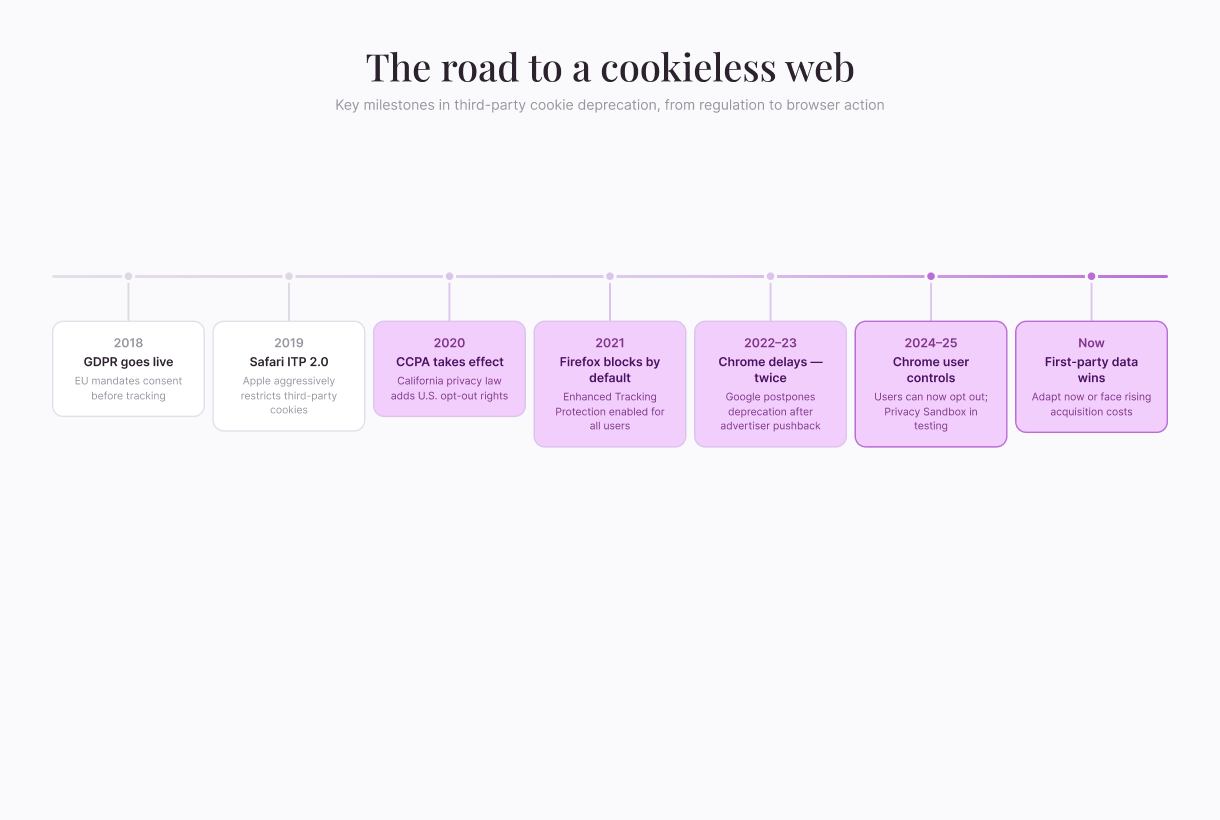
Safari and Firefox stopped supporting cookies years ago, and Google now allows users to block cookies themselves. What does this mean for today’s marketing strategies?
Why this matters for marketers
Third-party cookie loss creates three concrete problems.
1. You lose audience visibility. Without cookies, you don’t know what influenced a customer’s decision or where they should have seen your ads.
2. Attribution becomes murky. Multi-touch attribution relied on cross-domain tracking. You might know someone converted, but proving which marketing effort drove it is harder.
3. Retargeting gets expensive. It’s now limited to people you’ve actively collected data on, and reaching them costs more.
For B2B teams, account-based plays that relied on IP tracking face headwinds. For e-commerce, lookalike audiences built from customer data become critical.
The truth is this: companies that don’t adapt face higher acquisition costs, lower conversion rates, and harder-to-prove ROI.
First-party data is the foundation
This shift isn’t a disaster. It’s a reset—and the reset favors companies willing to ask people directly.
First-party data has always been more valuable. It’s cleaner, more reliable, and people are more likely to act on it because they’ve shared it explicitly.
Here’s how to make first-party data the foundation of your marketing strategy.
Collect data through direct channels
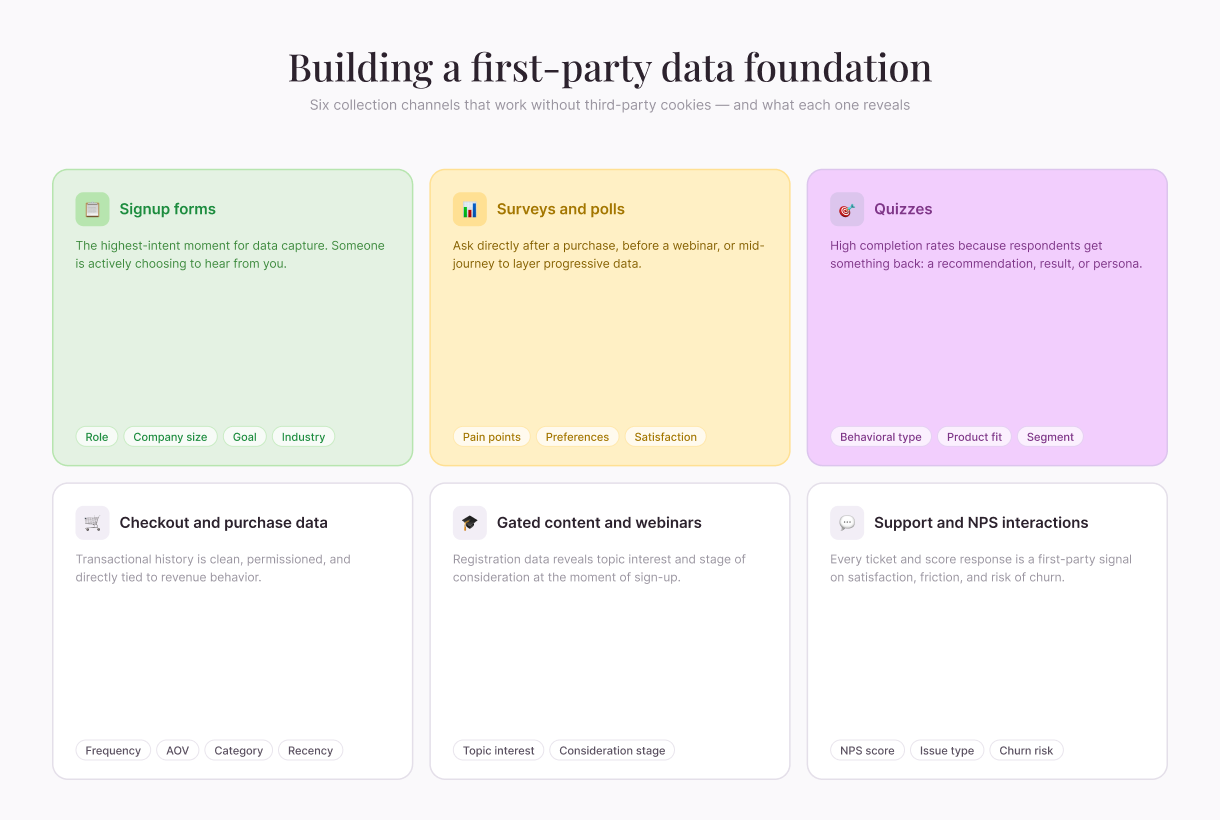
Stop relying on passive tracking. Start asking. Use signup forms, surveys, quizzes, and polls to collect information about role, goals, pain points, and industry. Ask once, then layer data over time—after a purchase, before a webinar, during a quiz.
Make it worth their time. Be transparent. Keep forms short. And treat your email list like the asset it is.
Organize data into audience segments
Raw data is noise. Organized data is insight. Segment by behavior, demographics, purchase history, or engagement. A segment might be “high-intent SaaS prospects who’ve opened 75% of emails” or “customers who bought six months ago and haven’t repeated.” Each needs different messages.
Measure what actually matters
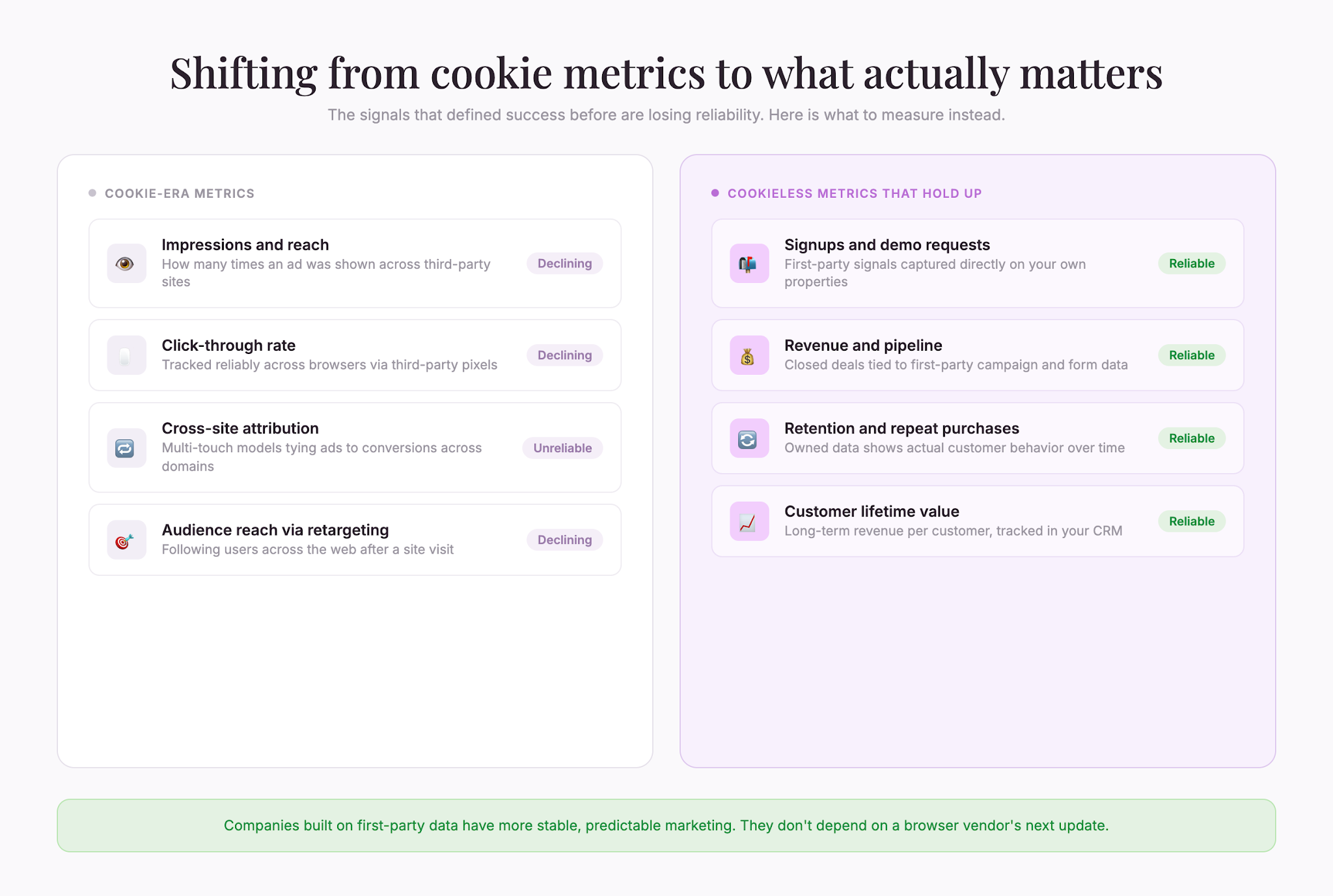
Cookies made it easy to obsess over impressions and clicks. Shift focus to signups, demos requested, sales closed, retention, and lifetime value. Measure what happens on your own properties.
If someone hasn’t opted in, don’t track them. Build your strategy on people who want to hear from you.
Run a first-party data audit
Before you change tactics, take stock of what you already have. Walk through every place a person interacts with your brand—signup forms, checkout, gated content, webinars, support tickets, net promoter score prompts—and write down what data each touchpoint captures. Most teams find duplicates, gaps, and fields nobody uses.
Then check three things. First, is the data permissioned? Look at the consent language people saw when they handed it over. Second, is it fresh? Email lists go stale quickly, and old data drags down deliverability. Third, is it usable? Data trapped in a spreadsheet your CRM can’t read is worth less than data you can segment on tomorrow.
Contextual targeting as an alternative
Before cookies, advertisers placed ads next to relevant content. That approach is making a comeback. Instead of tracking a person across the web, you target the page itself—a running shoe ad on a marathon training article, a payroll tool ad on a small-business finance blog.
Modern contextual platforms read the page in real time and match ads to topic, sentiment, and tone. No personal data, no consent headaches.
The trade-off is that you lose individual-level targeting. But the upside is that you reach people in the moment they’re already interested.
Pair contextual with your first-party segments where you can. A returning subscriber on a relevant article is a stronger signal than either alone.
Google’s answer: Privacy Sandbox
Google is investing in Privacy Sandbox—technologies designed to replace third-party cookies.
The Topics API lets a browser infer interests from sites visited and share those interests (not identity) with advertisers. There’s also FLoC, which groups similar people, and Aggregation Service for trend-level reporting.
These tools are still in testing. Adoption is uneven. And none will help you reach existing email subscribers—you still need first-party data. The takeaway? Use Privacy Sandbox as a supplement, not a replacement.
Preparing your martech stack
Your stack was probably built around cookies. Audit it.
Start with analytics: can it track first-party data accurately? Verify your CRM can ingest first-party data and create usable segments. Check that your email platform tracks opens, clicks, and conversions without cookies. If you run programmatic ads, ask your platform about Privacy Sandbox readiness.
For retargeting, look at customer data platforms (CDPs). They unify first-party data from multiple sources into audience segments you can act on.
Rethinking advertising
Display and programmatic depended heavily on cookies. Your costs will likely rise. Your ability to prove ROI will get tougher.
That doesn’t mean abandoning paid ads. Be more intentional. Search becomes more valuable—someone searching “project management software” signals intent without cookies. Social platforms collect first-party data directly, so targeting will continue, though relying solely on social means relying on a single platform’s rules.
Direct mail, events, and partnerships are worth revisiting. Spend less on broad-reach display. Spend more on search, social, and direct channels you control.
Privacy regulations are accelerating the shift
GDPR and CCPA require consent before collection, and more rules are coming: California’s CPRA, the UK’s post-Brexit framework, Canada’s PIPEDA, Brazil’s LGPD, China’s CAC. Regulations will get stricter, not looser.
But companies that build on consent and transparency don’t fear new regulations. Companies cutting corners do. If you ask for consent clearly, use data only for the purposes you promised, and give people control, you can set yourself up for success.
What happens next
The cookieless future is already here—just unevenly distributed. As we continue to move forward, expect lower attribution accuracy, ad cost increases, and time spent updating tools.
But there’s an upside: companies built on first-party data have more stable, predictable marketing. They aren’t dependent on a browser vendor or an algorithm.
Start now. Audit where your data comes from. Identify gaps. Pick one new source—a survey, an email capture—and test it. The earlier you move, the smoother the transition.

Liked that? Check these out:

Opinions and Expertise
What’s actually slowing research teams down (Hint: it’s not the research)
From recruiting participants and scheduling interviews to building the actual surveys, the operational drag is taking researchers away from what they do best. See what's actually slowing them down and how Research Flow fixes it.
Read more