Sales funnel stages: A guide to mapping the buyer journey
Learn how a 30-day quiz challenge can drive targeted traffic, generate brand awareness, and fill up your sales funnel with quality leads.

Key Takeaways
- Each stage narrows the field and needs different tactics: Awareness casts a wide net with content and ads, while decision-stage prospects need personalized proposals and direct sales conversations.
- Conversion rates between stages reveal where prospects get stuck: A 10% drop is normal, but a 50% drop signals a specific problem—whether that's messaging, nurturing, or sales qualification.
- Retention isn't optional, it's part of the funnel: Customers who get strong onboarding and proactive support stay longer, spend more, and refer others.
- Real customer journeys rarely move in a straight line: Prospects loop back and re-enter at different stages, so the funnel works best as a planning model, not a rigid path.
A sales funnel is a mental model that represents how potential customers move through distinct stages, from first hearing about your company to making a purchase. Each stage narrows the field: more people at the top, fewer at the bottom, and only the most qualified moving forward to close.
Understanding these stages helps your sales and marketing teams work in sync. You know where to focus effort, what messaging resonates at each step, and where prospects tend to drop off.
This guide walks you through the classic funnel stages, what happens at each one, and how to evaluate whether your funnel is working.
The four main stages of a sales funnel
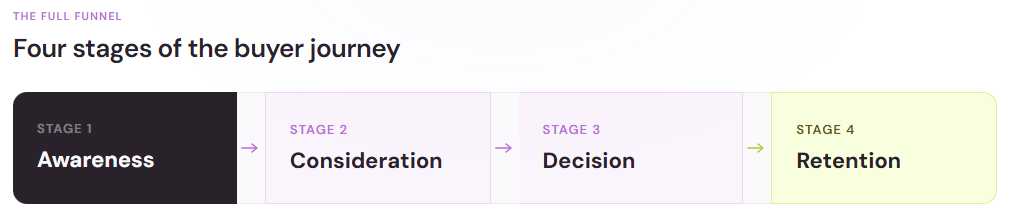
Most sales funnels are divided into four distinct phases: entry point, waypoints where prospects move forward or exit, and a final destination.
Awareness: The top of the funnel
A prospect doesn't know your company exists yet. Your job is to make a memorable first impression.
Awareness-stage tactics include:
- Content marketing (blog posts, whitepapers, videos) that answers questions your audience is asking
- Social media presence on platforms where your prospects spend time
- Paid advertising (search, display, social) that reaches people actively seeking solutions
- Public relations and earned media that boost credibility
- Referrals and word-of-mouth from existing customers
At this stage, you're casting a wide net. The goal is to be the company that shows up when someone needs help, not just to sell.

Consideration: The middle funnel
At this stage, a prospect knows you exist and is actively evaluating whether you solve a problem they have. They're actively weighing options: comparing your solution to competitors, reading reviews, downloading case studies, or requesting a demo.
Consideration-stage tactics include:
- Email nurture sequences that provide value and keep your brand top-of-mind
- Case studies and testimonials showing real-world proof
- Webinars or product demos
- Comparison guides or resource libraries
- Sales outreach addressing specific objections
The volume shrinks here, but engagement goes up. People spending time researching are serious prospects.
Decision: The lower funnel
A prospect has narrowed options and is deciding whether to buy from you. They may be negotiating terms, requesting a custom proposal, or working with your sales team on final details.
Decision-stage tactics include:
- Personalized proposals tailored to their needs
- One-on-one sales conversations addressing final concerns
- Contract review and legal discussions
- Implementation timelines and onboarding previews
- Special offers to close the deal
At this point, the pool is small—maybe 5–10% of the original funnel top. Sales reps focus intensely on these high-intent prospects.
Retention: The bottom and beyond
Modern sales thinking recognizes the funnel doesn't end at close. Retention turns a one-time buyer into a repeat customer and advocate.
Retention-stage tactics include:
- Onboarding and training that helps customers realize value fast
- Ongoing support and customer success programs
- Regular check-ins and expansion conversations
- Community building and user groups
- Feedback loops that inform product improvements
Customers who feel supported stay longer, spend more, and refer others.
Key metrics at each stage
To know if your funnel is healthy, measure conversion at each stage. This reveals where prospects get stuck.
Awareness metrics:
- Website traffic and social media impressions
- Cost per impression (CPM) for paid campaigns
- Brand search volume
Consideration metrics:
- Email open and click rates
- Demo requests and content downloads
- Sales meeting bookings
Decision metrics:
- Proposal-to-close conversion rate
- Average sales cycle length
- Win rate and deal size
Retention metrics:
- Customer lifetime value (LTV)
- Churn rate
- Net retention rate
- Customer satisfaction (CSAT) and Net Promoter Score (NPS)
A healthy funnel moves prospects steadily downward. If 1,000 enter at awareness and only 50 close, that's a five percent end-to-end conversion rate. If awareness is high and consideration weak, the problem is messaging or nurturing.
Common funnel problems and how to fix them
Leaky top of funnel
Problem: High traffic and leads, but most aren't qualified.
Solution: Tighten targeting and messaging at awareness. Make sure you're reaching the right audience with a clear value proposition. Unqualified prospects waste ad spend and sales time.
Stalling in the middle
Problem: Prospects move from awareness to consideration, then go silent.
Solution: Strengthen nurture sequences. Most prospects spend time in the middle stage. Better email, timely touchpoints, and clearer next steps improve conversion.
Low deal conversion
Problem: Prospects reach the sales team but don't close.
Solution: Review your sales process and qualifying criteria. Closing fewer, better-fit deals is better than chasing marginal ones.
High churn after purchase
Problem: Customers leave quickly or never expand.
Solution: Invest in post-sale success. Structured onboarding, regular check-ins, and proactive support prevent churn and open expansion revenue.

How to build and optimize your own funnel
Start by mapping your current state.
Step 1: Define your stages. The four-stage model (awareness, consideration, decision, retention) is standard, but add micro-stages if needed.
Step 2: Identify inputs and outputs. How do leads enter the funnel? What signals tell you a prospect is ready to move down?
Step 3: Audit your messaging and tactics. For each stage, list the content, emails, conversations, and touchpoints a prospect experiences.
Step 4: Measure conversions. Calculate what percentage moves between stages. A 10% drop is normal; a 50% drop signals a problem.
Step 5: Test and iterate. Pick the stage with the biggest drop-off and run small experiments. Try different messaging, remove friction, or add touchpoints.
Step 6: Align sales and marketing. Sales and marketing must agree on what a qualified lead looks like, when to hand off prospects, and how to handle dormant ones.
The evolution of funnel thinking
The traditional sales funnel model has been standard for decades. But modern customer journeys rarely follow a straight line. Real customer behavior is more dynamic and non-linear, with prospects looping back, re-entering at different stages, or taking sideways paths.
The funnel remains a useful mental model for planning and measurement. Successful teams combine funnel discipline (clear stages, measured conversion, defined handoffs) with flow flexibility (automation responding to real-time behavior, multiple entry points, and willingness to adapt based on context).
Key takeaway
A sales funnel gives structure to the customer journey. It helps you spot where prospects get stuck, allocate resources wisely, and hold teams accountable for moving deals forward. Understanding the four main stages—awareness, consideration, decision, and retention—and the metrics that matter at each one is the foundation of predictable revenue growth.

Liked that? Check these out:
.webp)
Customer
Same Typeform, new approach: How Digital Hamster rethinks forms
Grab the playbook for using forms for more than data collection. See how Digital Hamster’s co-founder Aida Selimova turns Typeform into a tool for understanding people, from building relationships on the blog and rethinking NPS to personalizing onboarding.
Read more

.webp)