Top 10 employee satisfaction survey questions to ask
Happy employees don't just stick around longer. They do better work, support their teammates, and advocate for your company in ways no recruitment campaign can replicate. Unhappy employees do the opposite—quietly disengaging before eventually leaving, often taking institutional knowledge and team morale with them.

The problem is that dissatisfaction rarely announces itself. People don't walk into their manager's office and say "I'm losing motivation because I don't see a path forward here." They keep it to themselves until they've already decided to leave. An employee satisfaction survey—designed well, asked at the right time, and actually acted on—can catch those signals early enough for you to do something about them.
Here are 10 employee satisfaction survey questions to ask, along with why each one works and what to do with the answers.
Before you start: principles that make or break the survey
The questions matter, but the conditions matter more. A brilliant survey in a low-trust environment produces useless data. Before sending anything, establish these foundations:
Guarantee anonymity and mean it. If employees suspect their responses can be traced back to them, they'll self-censor. Use a third-party survey platform, don't collect identifying information, and communicate clearly that responses are anonymous. If your team is small enough that demographics could identify someone (the only person in the London office, for instance), consider suppressing results for groups below a minimum size.
Commit to action before you ask. Sending a survey and doing nothing with the results is worse than not surveying at all. It signals that feedback doesn't matter, which just about guarantees lower participation and more cynicism next time. Before you launch, decide who will review the results, how findings will be shared, and what the process for acting on them looks like.
Keep it focused. Resist the urge to ask about everything. A 50-question survey generates survey fatigue and surface-level answers. Ten well-chosen questions, answered thoughtfully, produce more actionable insight.
The top 10 questions to ask your employees
Each question below targets a different dimension of the employee experience. Together, they give you a complete picture—from day-to-day satisfaction to long-term career outlook.
1. "On a scale of one to 10, how satisfied are you with your job overall?"
This is your headline metric. A single number that captures the big picture before any specific topics color the respondent's thinking. Place it first, before the detail questions, to get an uncontaminated read on general sentiment.
Track this number over time. Is satisfaction stable, rising, or declining? Sudden drops signal that something has changed and needs investigation.
2. "Do you feel your work is meaningful and contributes to the company's goals?"
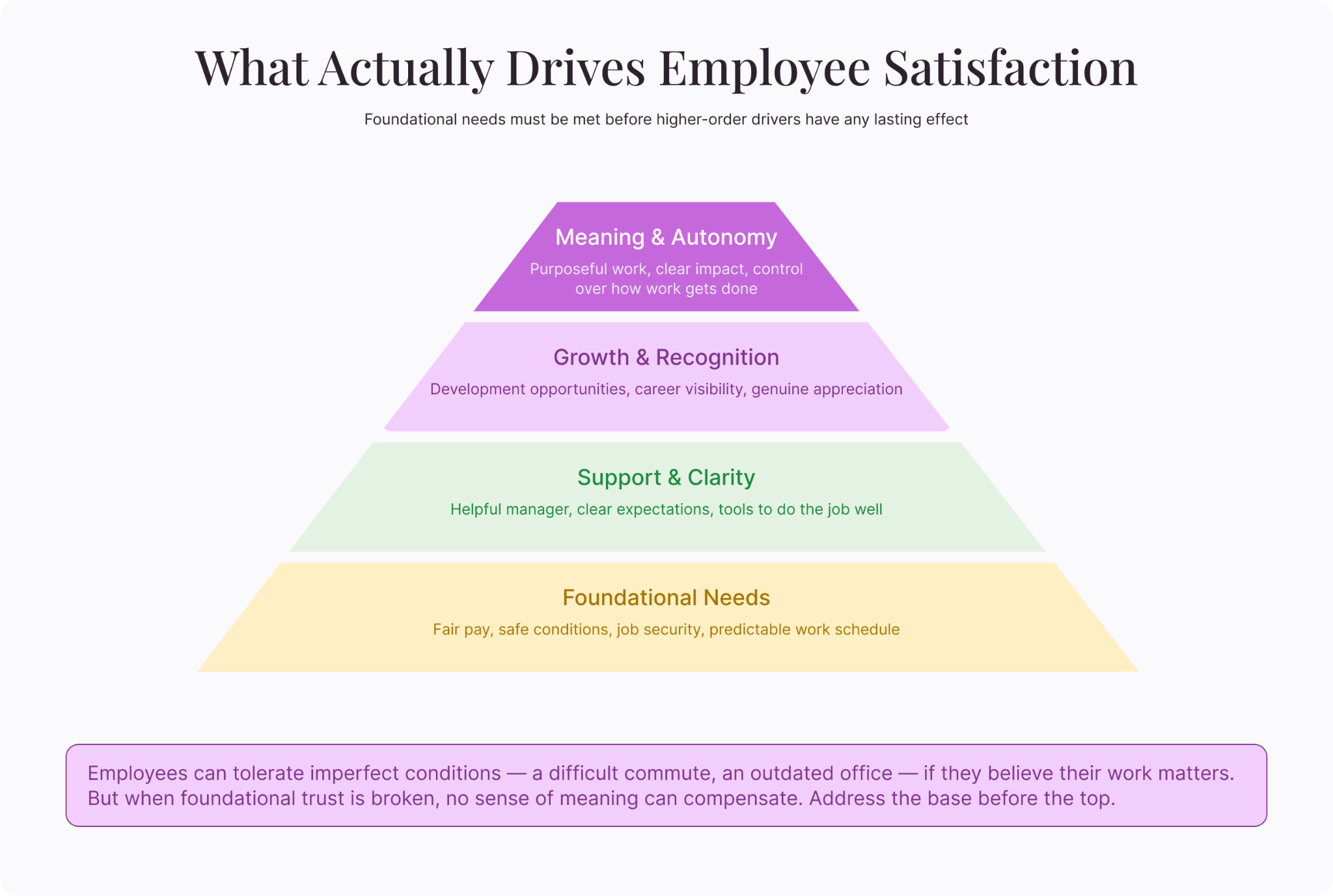
Meaning is one of the strongest predictors of sustained engagement. People can tolerate imperfect conditions—a difficult commute, an outdated office, a so-so salary—if they believe their work matters. But when the sense of purpose disappears, everything else starts to feel unbearable.
Low scores here might mean employees don't understand how their role connects to the broader mission. That's often a communication problem, not a structural one—and it's fixable.
3. "How supported do you feel by your direct manager?"
The manager relationship is the single biggest lever in employee satisfaction. People leave managers more often than they leave companies. This question directly measures the quality of that relationship.
If scores vary significantly across teams, the issue likely isn't company-wide policy—it's individual management effectiveness. That specificity makes the finding immediately actionable: invest in coaching, training, or restructuring for the teams where support scores are lowest.
4. "Do you have the tools, resources, and information you need to do your job well?"
This question identifies practical obstacles. It catches problems that leadership might not be aware of: outdated software, missing documentation, unclear processes, understaffed teams. These are the friction points that drain motivation not through dramatic events but through daily, cumulative frustration.
Providing the right tools or clearing a process bottleneck can have a huge impact on satisfaction because it removes something that was irritating people every single day.
5. "How fairly are you compensated for the work you do?"
Compensation doesn't have to be the highest in the market to satisfy people. But it does have to feel fair. Perceived fairness—relative to the work performed, relative to peers, relative to the market—matters as much as the absolute number.
This question measures perception, not objective market position. If employees perceive compensation as unfair even when it's competitive, the problem might be transparency. Sharing salary bands, explaining the compensation philosophy, or clarifying how raises are determined can shift the perception without changing the numbers.
6. "Do you see clear opportunities for growth and advancement here?"
Stagnation is one of the top reasons people leave. Even employees who are currently satisfied will start looking elsewhere if they can't envision a future at the company. This question captures whether that future feels visible and achievable.
Low scores don't necessarily mean you need to promote everyone. Growth comes in many forms: skill development, lateral moves, expanded responsibilities, mentorship opportunities, and stretch projects. But those options need to be visible and accessible—not theoretical.
7. "How comfortable are you sharing honest feedback with your team and leadership?"
This is a trust barometer. In high-trust environments, people speak up when they see problems, suggest improvements without fear of reprisal, and flag risks early. In low-trust environments, they stay quiet—and problems grow until they become crises.
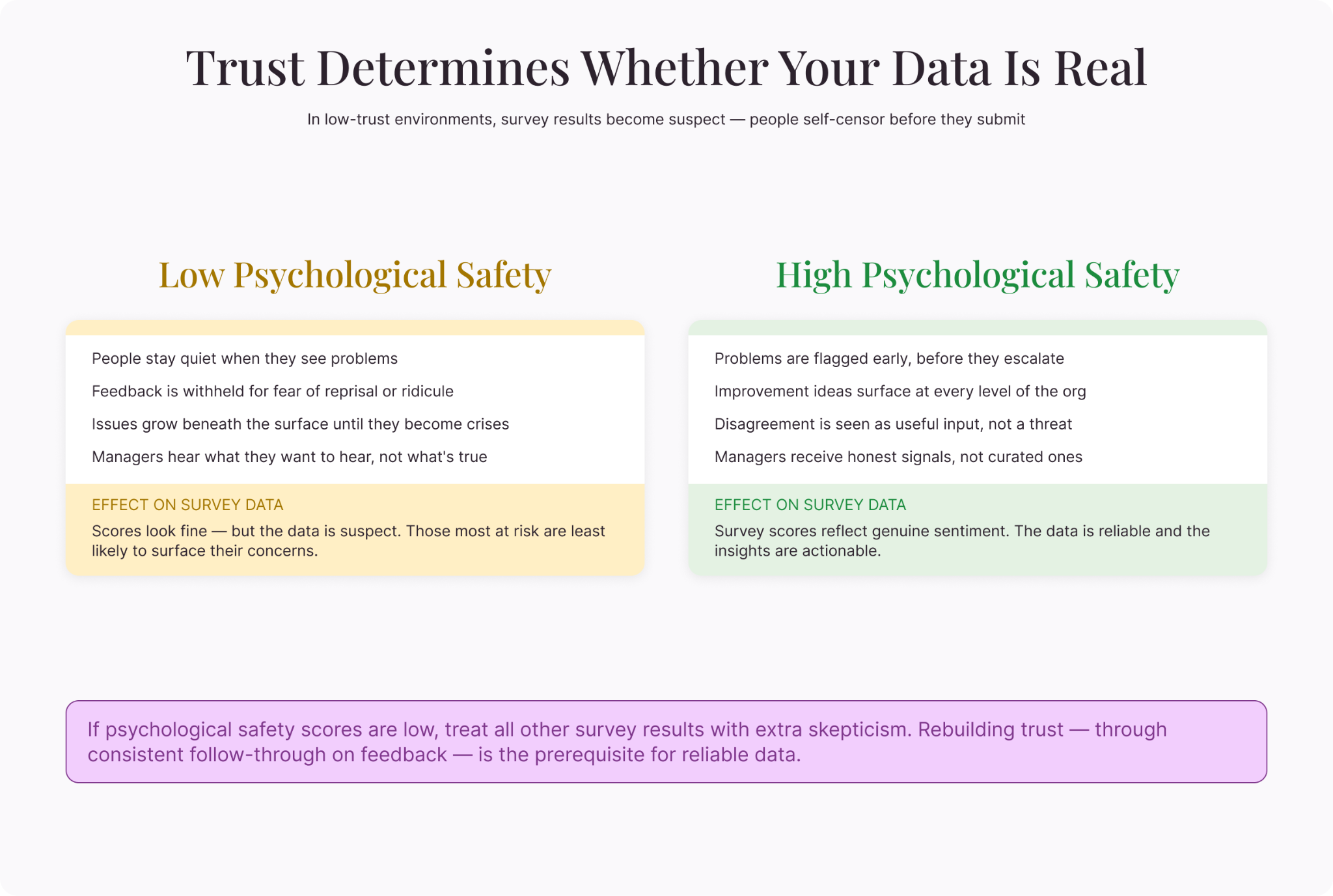
If this score is low, the other survey results become suspect too. That’s because people who aren't comfortable sharing honest feedback probably aren't being honest in the survey either. Improving psychological safety is foundational to everything else.
8. "How would you rate the balance between your work responsibilities and personal life?"
Work-life balance means different things to different people. For some, it's about hours. For others, it's about flexibility, predictability, or the ability to disconnect outside of work. This question captures the overall perception without defining what balance should look like.
Low scores here correlate strongly with burnout and turnover. If the issue is workload, the solution might be hiring or reprioritization. If it's culture (an expectation of constant availability, for example), the solution is different—and usually starts with leadership modeling the behavior they want to see.
9. "Would you recommend this company as a good place to work?"
This is the employee version of Net Promoter Score (eNPS). It cuts through complexity to measure one thing: would you vouch for this place to someone you know? That willingness—or reluctance—is a powerful summary metric because recommending something puts your personal reputation on the line.
People who wouldn't recommend the company as a workplace are either dissatisfied themselves or aware of issues that affect others. Either way, a low score demands investigation. The follow-up question ("What's the primary reason for your answer?") is where the actionable detail lives.
10. "What's one thing we could change to make this a better place to work?"
End with an open-ended question. Everything before this captured structured data—ratings and scales that are easy to compare and track. This question captures what none of those items could: the specific, unscripted, sometimes surprising feedback that employees carry around but rarely have a channel to express.
Read every response. Not a summary, not a word cloud, but every individual answer. The most actionable insight in the entire survey often comes from this question—a specific, concrete suggestion that resonates across multiple respondents and points to a clear intervention.
After the survey: making it count
Collecting the data is the easy part. What you do next determines whether the survey builds trust or erodes it.
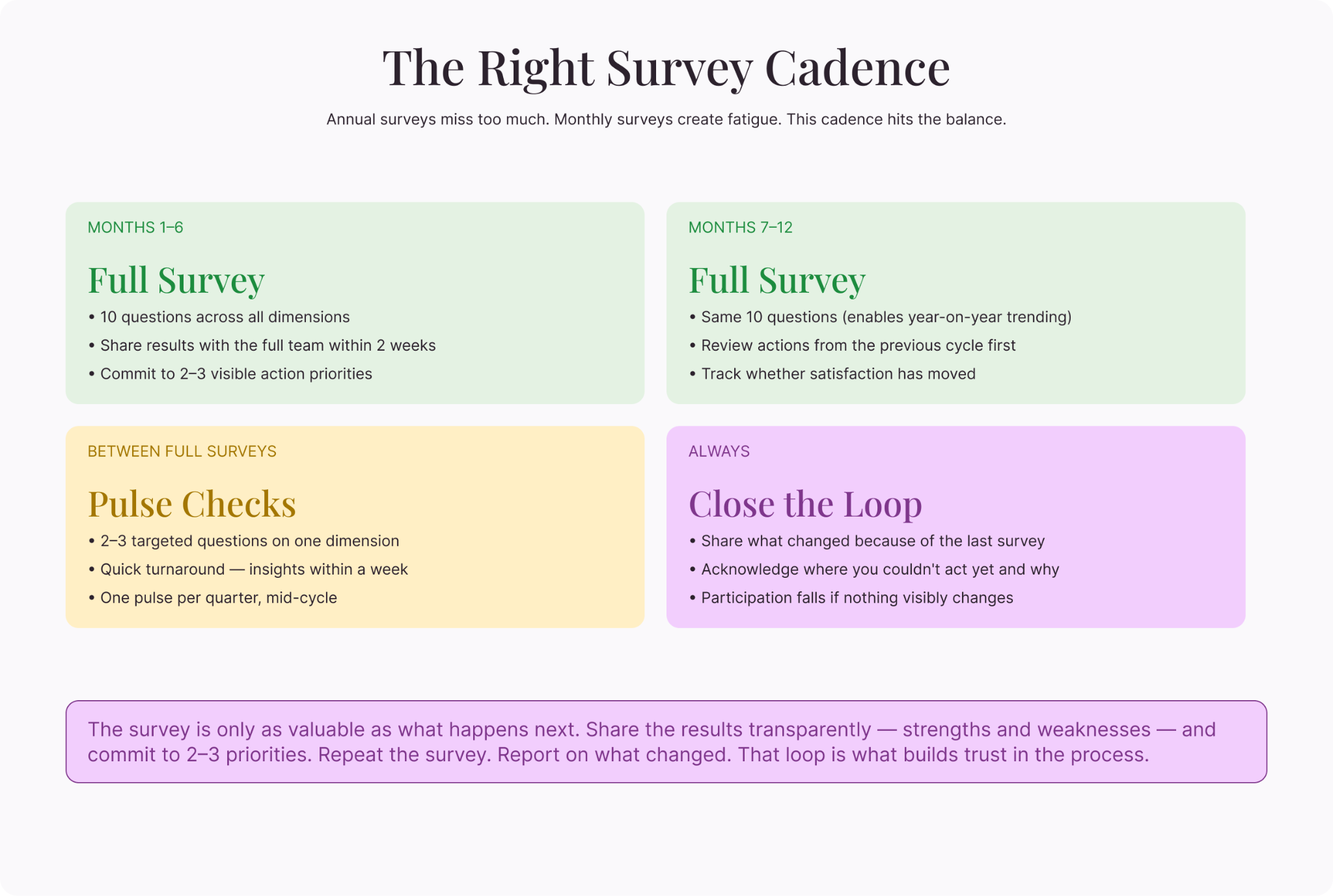
Share the results transparently. Don't cherry-pick the positive findings. Share the full picture—strengths and weaknesses—with the entire organization. Transparency signals that you take the feedback seriously and aren't afraid of honest results.
Identify two to three priorities. You can't fix everything at once. Pick the two or three findings with the highest impact and the clearest path to improvement. Communicate these priorities explicitly: "Based on your feedback, we're focusing on X, Y, and Z over the next quarter."
Follow through and report back. Before the next survey, report on what changed. "You told us you needed better tools. Here's what we did." This closes the loop and demonstrates that participating in the survey leads to real outcomes, which is one of the strongest predictors of high participation next time.
Survey regularly, but not too often. Annual surveys miss too much. Monthly surveys create fatigue. Biannual surveys (with shorter pulse checks in between) strike the right balance for most organizations.
Common mistakes that undermine trust
Even a well-designed survey can backfire if the surrounding process breaks down. With that in mind, watch for these patterns:
Asking but not acting. The fastest way to kill survey participation is to collect feedback and do nothing visible with it. By the second or third cycle with no follow-up, response rates will likely fall, and the people who do respond will likely become increasingly cynical in their answers.
Surveying during layoffs or restructuring. Timing matters. Sending a satisfaction survey while people are worried about their jobs reads as tone-deaf at best and manipulative at worst. Wait until the dust settles, or acknowledge the context explicitly: "We know this has been a difficult period. We still want to hear from you."
Breaking anonymity—even accidentally. If a manager confronts an employee about feedback that was supposed to be anonymous, the damage extends far beyond that one relationship. Word travels fast. One breach of trust can poison the entire survey program for years.
Only listening to the loudest voices. Open-ended responses tend to overrepresent strong feelings—both positive and negative. The quiet majority who gave moderate scores often have the most representative perspective. Make sure your analysis accounts for the full distribution, not just the memorable outliers.
Employee satisfaction isn't a number. It's a signal—one that tells you whether the people doing the work feel valued, supported, and motivated to keep doing it. These 10 questions give you that signal. What you build with it is up to you.


