How to use this or that questions in your surveys: Examples and best practices
A practical guide to writing this or that survey questions that reveal real preferences, priorities, and trade-offs from your audience.

Coffee or tea? Remote or in-office? Speed or accuracy? "This or that" questions strip decision-making down to its simplest form—two options, one choice. And that simplicity is exactly what makes them so effective in surveys.
For marketers testing messaging, product teams prioritizing features, or researchers exploring preferences, this or that questions cut through overthinking and reveal how people actually lean when forced to choose. They're fast, easy to analyze, and surprisingly powerful when used in the right context.
Here's how to make the most of them—with examples you can steal and adapt.
What makes this or that questions different
Most survey questions offer a spectrum. Rating scales let people land anywhere between "strongly disagree" and "strongly agree." Multiple-choice questions offer four, five, or six options. This or that questions offer exactly two.
That constraint is the point. By removing the middle ground, you force respondents to commit to a direction. There's no "somewhat" or "neutral" to hide behind. The binary format reveals priorities in a way that softer question types can't.
This doesn't mean the answers are simplistic. "Quality or speed?" sounds like a basic question, but the aggregate response from 500 customers tells you something meaningful about what your audience values most when they can't have both. That's strategic insight compressed into a single question.
When to use this or that questions
This or that questions aren't the right fit for every survey, but they excel in specific situations:
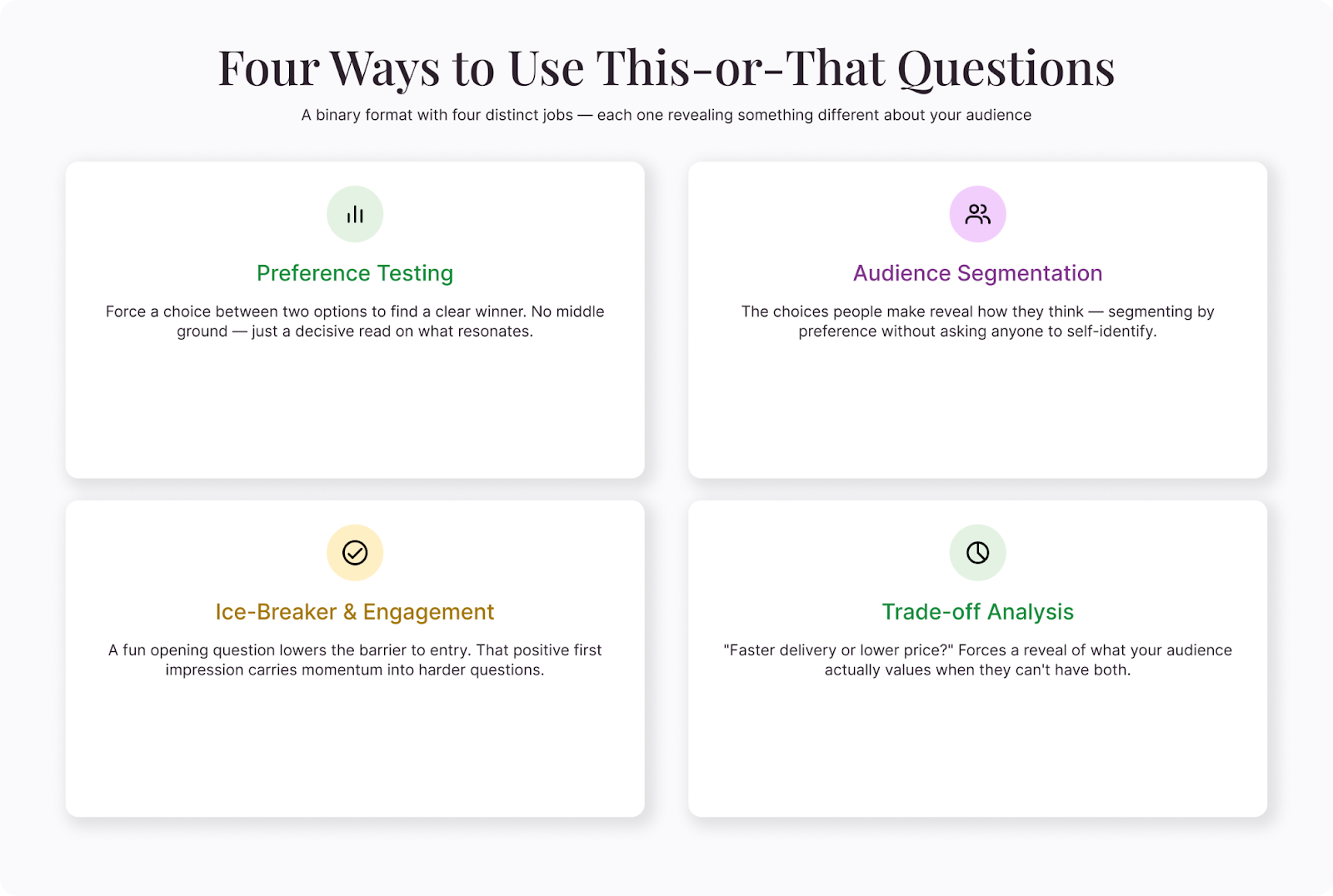
- Preference testing – Which design, headline, feature, or pricing model resonates more? When you need a clear winner between two options, this format delivers one.
- Audience segmentation – The choices people make reveal how they think. "Do you prefer detailed tutorials or quick-start guides?" segments your audience by learning style without asking them to self-identify.
- Ice-breakers and engagement – A fun this or that question at the start of a survey lowers the barrier to entry. People enjoy the format, and that positive first impression carries through to more substantive questions later.
- Trade-off analysis – When you need to understand priorities, force a choice. "If you had to pick one: faster delivery or lower price?" reveals what respondents actually value when both can't be optimized simultaneously.
- Quick pulse surveys – Need a fast read on sentiment? A few this or that questions can capture a snapshot of preferences in under a minute, which keeps response rates high.
Examples across different contexts
Another benefit is that the format adapts to nearly any topic. Here are examples organized by use case:
Product and feature priorities
These questions help product teams understand which improvements matter most to users:
- "If we could only improve one: loading speed or design customization?"
- "Would you rather have more integrations or a simpler interface?"
- "New features more often, or fewer features with better documentation?"
Marketing and messaging
These help marketers test which angles resonate:
- "Which headline grabs your attention more: 'Save 10 hours a week' or 'Work smarter, not harder'?"
- "Free trial or money-back guarantee—which makes you more likely to try a new tool?"
- "Would you rather see customer testimonials or product demos on a landing page?"
Workplace and employee engagement
HR teams can use these to gauge preferences without running a full engagement survey:
- "Do you prefer structured feedback in reviews or informal check-ins throughout the year?"
- "Team-building events during work hours or after hours?"
- "More vacation days or a higher training budget?"
Customer experience
These reveal what customers prioritize in their interactions with you:
- "When something goes wrong: do you prefer phone support or live chat?"
- "Detailed email updates or a self-service status dashboard?"
- "Faster response from support, or getting the right answer the first time?"
Fun and engagement
Lighthearted this or that questions work well as icebreakers or audience warmups:
- "Morning person or night owl?"
- "Inbox zero or organized chaos?"
- "Spreadsheets or sticky notes?"
These won't produce strategic insights on their own, but they can help set a conversational tone that makes respondents more willing to engage with the questions that follow.
Best practices for writing this or that questions
While the format of this or that questions is simple, writing good ones takes thought. A few guidelines will keep the quality of your questions high:
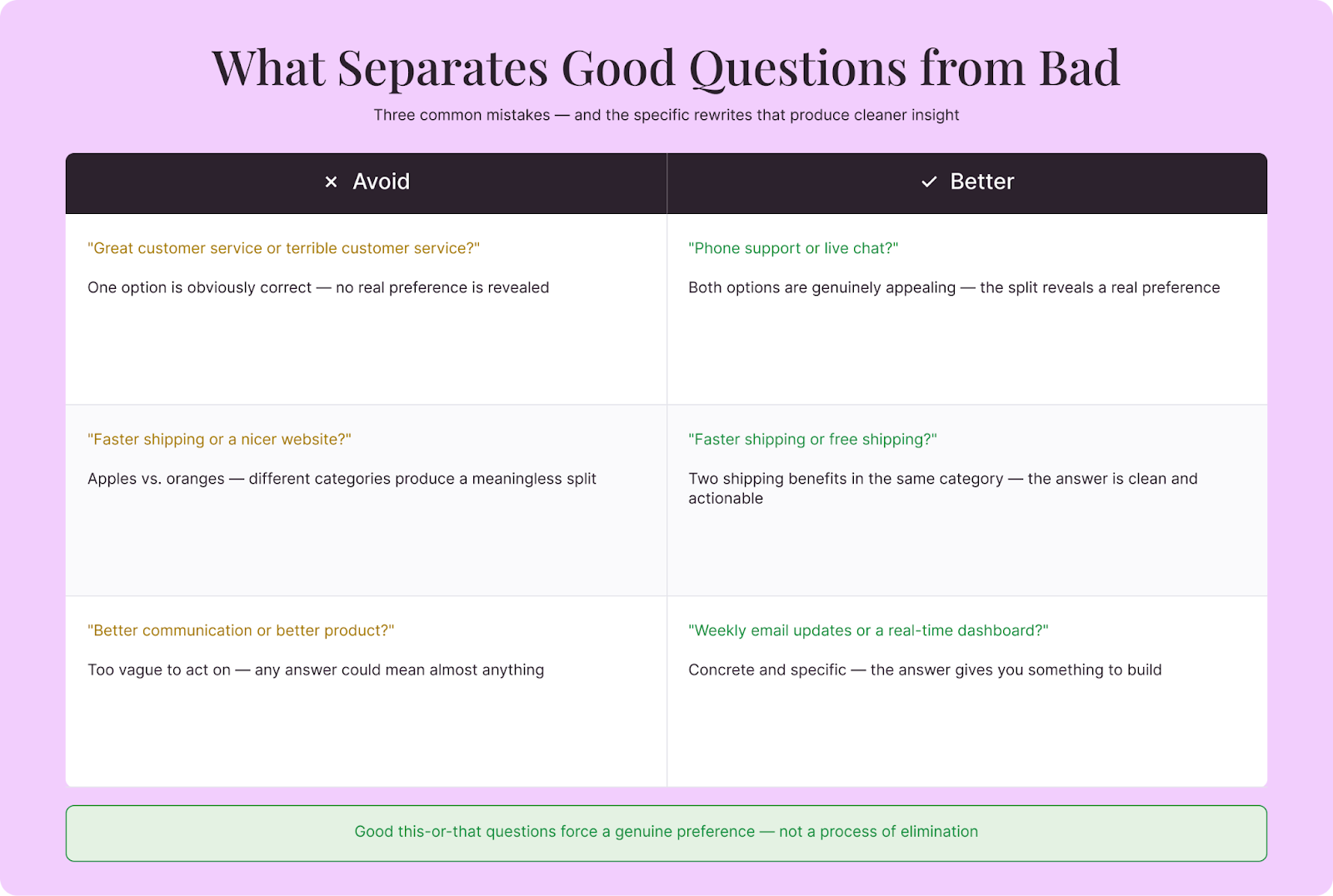
Make both options genuinely appealing. If one option is obviously better, the question doesn't reveal anything useful. "Great customer service or terrible customer service?" has a correct answer, not a preference. The most insightful this or that questions present two things that are both desirable but can't easily coexist.
Keep the options parallel. Both choices should be the same type of thing—two features, two benefits, two approaches. "Faster shipping or a nicer website?" compares apples to oranges. "Faster shipping or free shipping?" compares two shipping benefits, which produces a cleaner insight.
Be specific. Vague options get vague insights. "Better communication or better product?" is too broad to act on. "Weekly email updates or a real-time dashboard?" gives you something concrete.
Avoid false dichotomies on sensitive topics. "Work-life balance or career advancement?" might seem like a useful question, but it can feel loaded—implying that respondents must sacrifice one for the other. For sensitive topics, frame the choice as a preference between two positives rather than a trade-off with negative implications.
Acknowledge the limitation. This or that questions sacrifice nuance by design. They're best used alongside other question types that capture the "why" behind the choice. A follow-up open-ended question—"What made you lean that way?"—adds depth to the binary data.
How to analyze the results
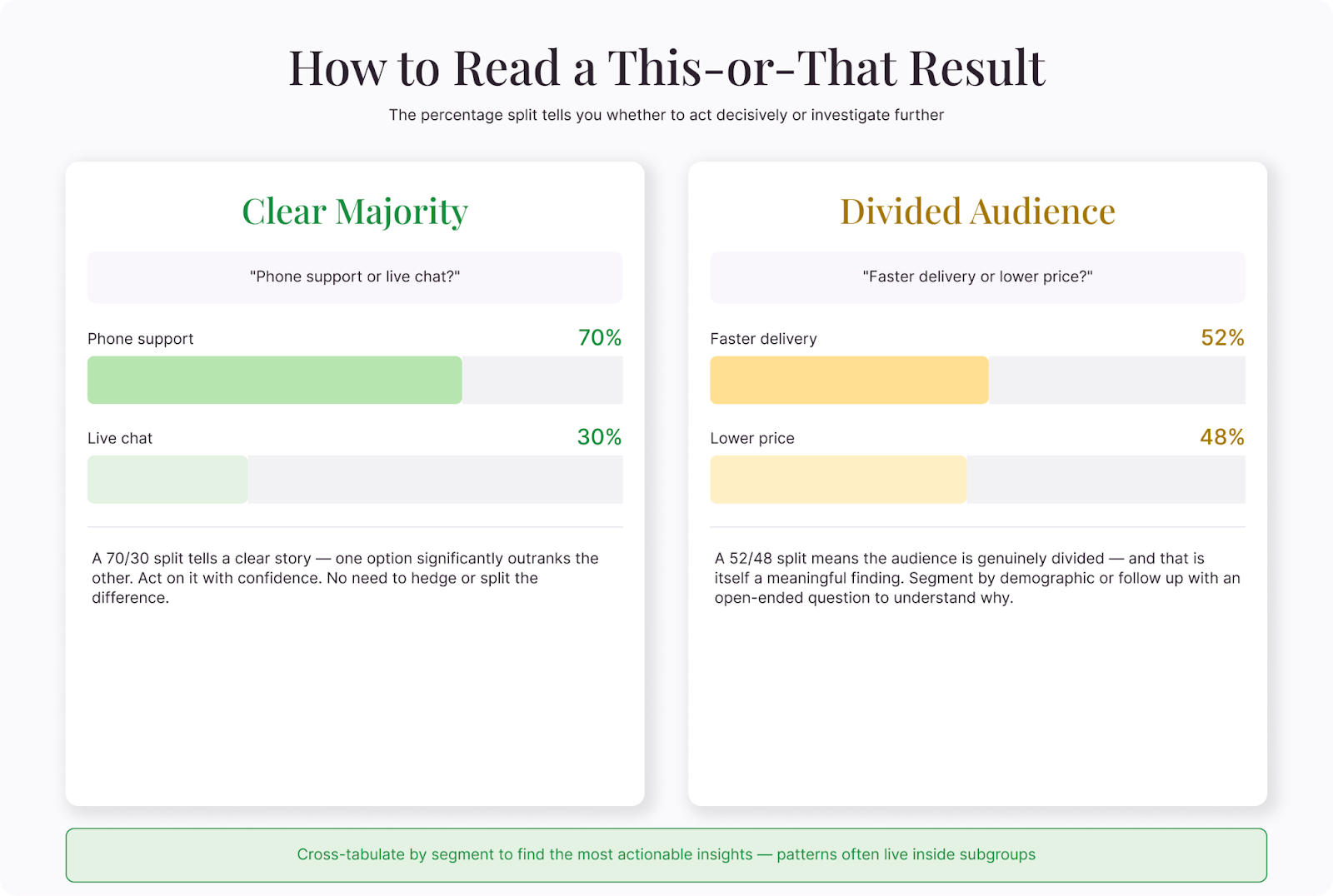
Analysis of these questions is straightforward, which is part of the appeal. For each question, calculate the percentage that chose each option. A 70/30 split tells a clear story. A 52/48 split tells you the audience is genuinely divided, which is its own useful finding.
For richer analysis, cross-tabulate the results with demographic or behavioral data. Maybe younger respondents overwhelmingly prefer option A while older respondents prefer option B. Or maybe power users lean one direction while new users lean the other. These segments-within-segments often contain the most actionable insights.
If you're testing multiple pairs (design A vs. B, headline A vs. B, feature A vs. B), look for consistency across choices. Do the same respondents consistently prefer the simple option, or the powerful one? Patterns across multiple this or that questions can reveal deeper preference profiles than any single question could.
Where this or that questions fall short
This or that questions aren't ideal when:
- The topic requires nuance. Measuring satisfaction, gauging agreement intensity, or understanding complex opinions needs rating scales or open-ended questions.
- More than two options are viable. If there are genuinely three or four strong contenders, forcing a binary choice cuts out valid possibilities.
- The audience resists false binaries. Some respondents find forced-choice formats frustrating, especially on topics where "it depends" is the honest answer. Offering an optional "I'd need more context" option can reduce frustration without defeating the purpose.
Variations on the format
This basic "A or B" structure has several variations worth experimenting with:
"Would you rather" framing. Slightly more playful, this version works well for engagement-focused surveys and audience building. "Would you rather have unlimited storage or unlimited integrations?" feels lighter than a straight feature comparison.
Forced ranking of pairs. Instead of presenting one this-or-that question, give respondents a series of paired comparisons drawn from a longer list. The aggregate results produce a complete preference ranking without asking anyone to sort 10 items at once. This technique—called pairwise comparison—is especially useful when you have more than two options but still want the simplicity of binary choices.
Image-based options. Replace text with visuals. Instead of "minimalist design or feature-rich layout," show two screenshots side by side and let respondents click the one they prefer. Visual this-or-that questions are faster to process and particularly effective for design, branding, and product feedback.
Conditional follow-ups. After the binary choice, branch into a short follow-up based on which option was selected. Someone who picks "lower price" might see "What price range feels right?" while someone who picks "faster delivery" might see "How fast is fast enough?" This preserves the simplicity of the initial choice while adding targeted depth.
Putting it all together
This or that questions are a sharp tool with a specific job. They won't replace your rating scales, your open-ended questions, or your detailed demographic filters. But when you need a quick, clear read on how your audience leans between two options, they're hard to beat.
Sprinkle a few into your next survey. Start with something light to build momentum, move to strategic trade-offs in the middle, and follow up with an open-ended question to capture the reasoning. The combination of speed and depth is where this or that questions will deliver real value for your survey.