How can open-ended questions benefit surveys?
Discover how open-ended questions benefit surveys, when to use them, and how to write prompts that generate genuinely useful responses.

How can open-ended questions benefit surveys?
Multiple-choice questions are efficient. They're easy to answer, simple to analyze, and they give you clean data in neat little columns. But they only let people choose from the options you've already thought of. And that's exactly the problem.
Open-ended questions—the kind that invite respondents to write their answers in their own words—fill the gaps that closed-ended formats can't reach. For marketers running customer research, HR teams measuring engagement, or researchers exploring unfamiliar territory, open-ended questions are often where the most valuable insights live.
Here's why they matter, when to use them, and how to get the most out of them.
They reveal what you didn't think to ask
The biggest limitation of closed-ended questions is that they're constrained by your imagination. You can only offer answer options you've already considered, which means you'll never learn about the things you haven't thought of yet.
Open-ended questions remove that ceiling. When you ask "What's the biggest challenge you face with project management?" instead of providing a predefined list, respondents tell you about problems you didn't know existed. Maybe it's a workflow bottleneck nobody on your team has experienced. Maybe it's a frustration so specific that it would never have appeared in a multiple-choice dropdown.
This makes open-ended questions particularly powerful in early-stage research, when you're still mapping the landscape. They help you discover the right questions to ask—which is often more important than getting precise answers to the wrong ones.
They capture nuance and context
Numbers tell you what's happening. Words tell you why.
A rating scale might show that 30% of customers are dissatisfied with your onboarding process. That's useful. But a follow-up open-ended question—"What would have made your onboarding experience better?"—tells you exactly what went wrong and what to fix. Maybe the instructions were unclear. Maybe the setup took too long. Maybe the confirmation email never arrived.
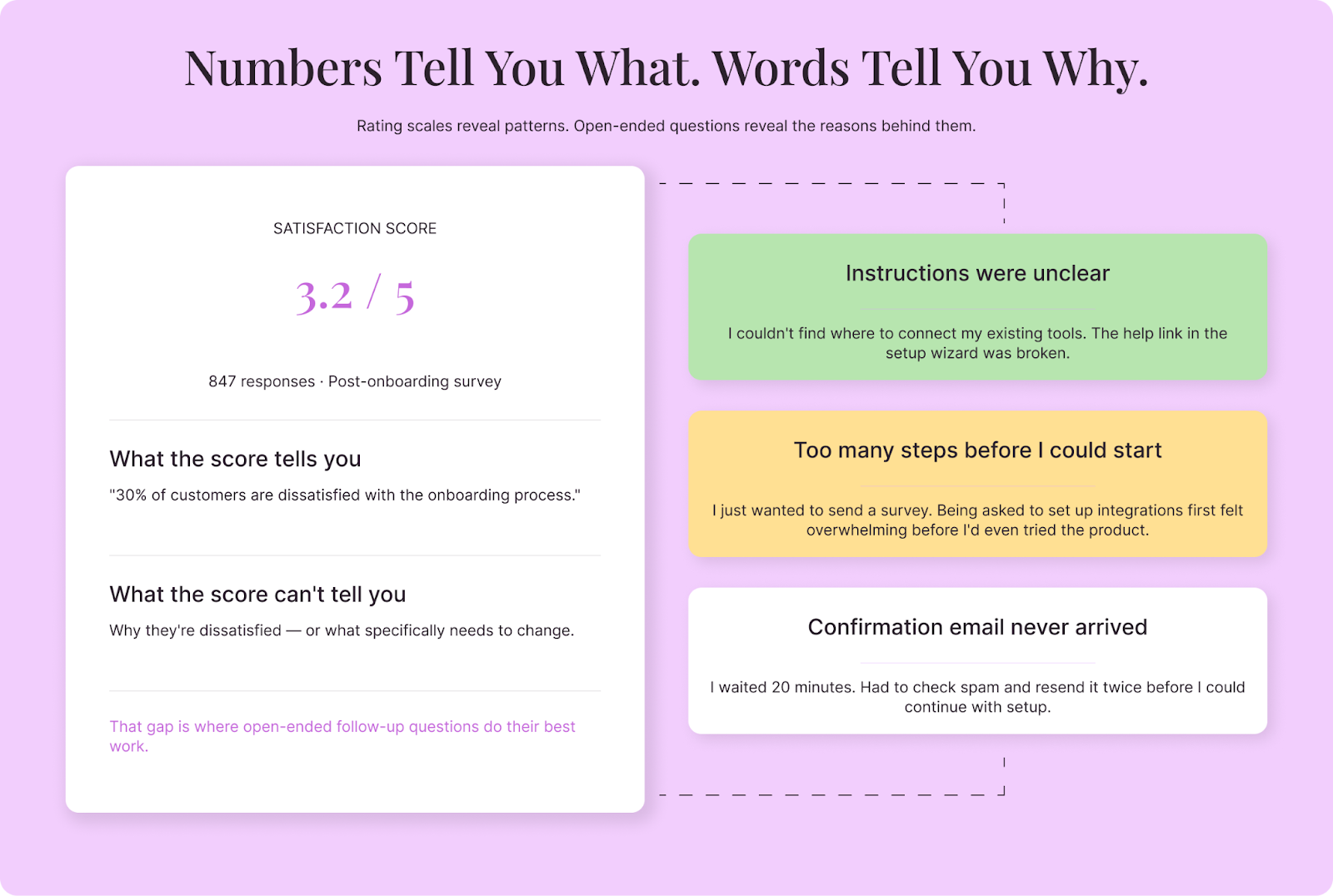
This nuance is impossible to capture with predetermined answer choices. Human experiences are complex. A well-placed open-ended question gives respondents the space to express that complexity.
They reduce response bias
Closed-ended questions carry an inherent risk: the answer options can influence the response. If you list "price," "quality," "convenience," and "brand reputation" as reasons people chose your product, you've anchored the conversation around those four factors. Respondents who were motivated by something entirely different—say, a friend's recommendation—may just pick the closest match rather than explain the real reason.
Open-ended questions sidestep this problem. Without predefined options, there's nothing to anchor to. Respondents generate their own answers, which means the data reflects their actual thinking rather than your assumptions.
This doesn't mean open-ended questions are bias-free. Social desirability still plays a role (people tend to give polished answers when writing), and articulate respondents may be overrepresented in the results. But the specific bias of forced-choice framing disappears.
They give respondents a voice
Surveys can feel transactional—click, click, click, submit. Open-ended questions break that pattern. They signal that you actually want to hear what people think, not just categorize them.
This matters more than you might expect. When people feel heard, they’re usually more engaged with the survey process and more likely to provide thoughtful, accurate responses across all question types. An open-ended question midway through a survey can re-engage a respondent who's started to zone out.
For employee surveys, this effect is especially significant. When people have the chance to describe their experience in their own words—rather than selecting from a menu that may not represent their situation—they’re more likely to feel respected. And that feeling of respect can itself improve engagement with the survey.
When to use open-ended questions
Open-ended questions aren't always the right choice. They take longer to answer, they're harder to analyze, and they yield lower response rates when overused. The trick is knowing when their strengths outweigh their costs.
They work best in these situations:
- Exploratory research – When you're investigating a new topic and don't know enough to write good multiple-choice options yet
- Follow-up to quantitative findings – When you have a number that needs explanation ("You rated us three out of five. What could we do better?")
- Feedback collection – When you want specific, actionable suggestions rather than satisfaction scores
- Voice-of-customer programs – When you need quotes, stories, and language that reflect how customers actually talk about your product
- Sensitive topics – When predefined answer options might feel reductive or presumptuous
They're less useful when you need data that's easy to compare across groups. They're also not ideal when your sample is very large, and you can't realistically read thousands of written responses. And if the question has a straightforward factual answer, use a closed-ended format instead ("How many employees does your company have?").
How to write effective open-ended questions
A poorly written open-ended question gets vague, one-word answers that don't tell you much. A well-written one draws out specific, detailed responses that generate real insight. Here's what separates the two:
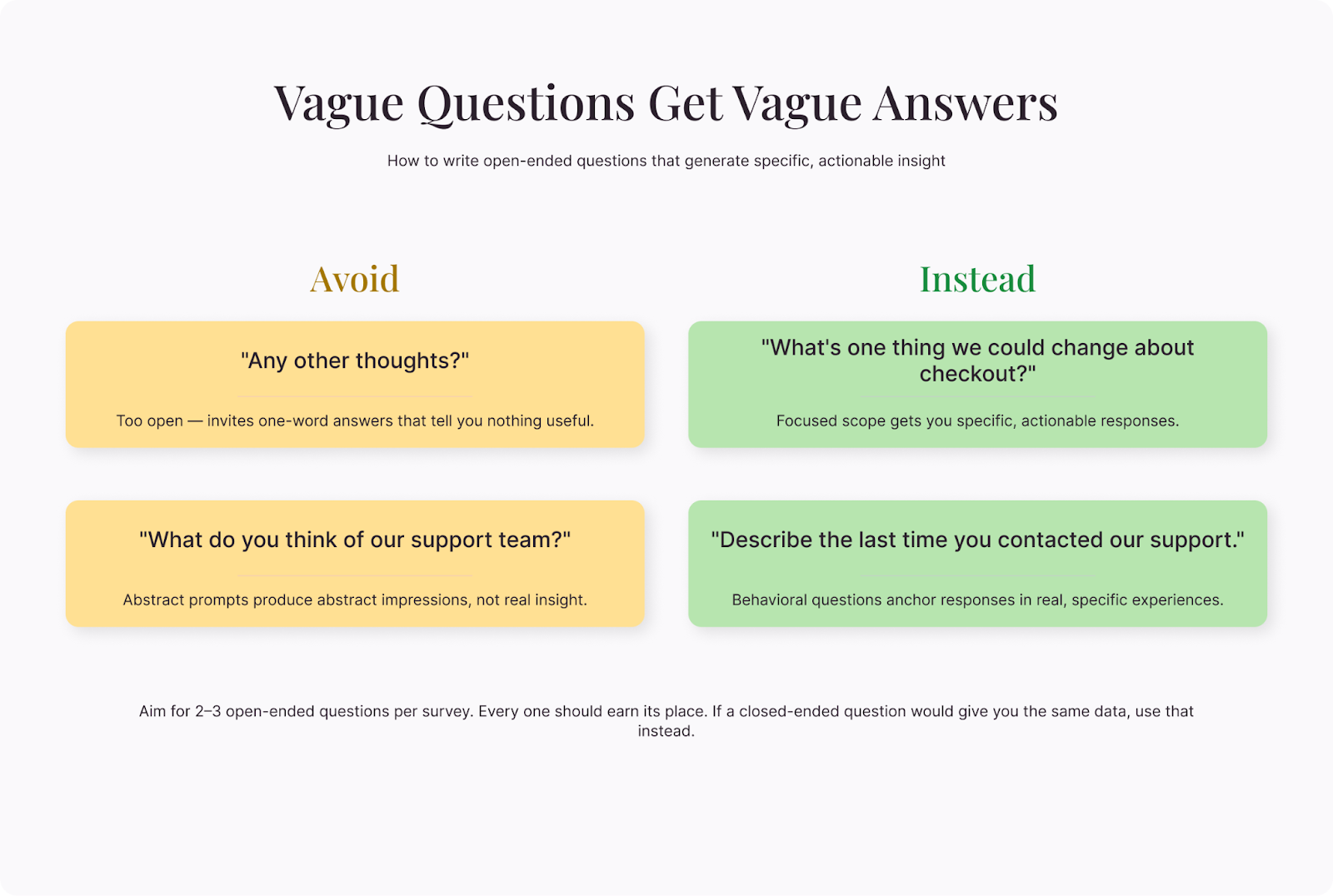
Be specific. "Do you have any other thoughts?" invites "Nope." Instead, try "What's one thing we could change about the checkout process to make it easier for you?" The more focused the question, the more focused the answer.
Ask about behavior, not just opinions. "Tell us about the last time you contacted customer support" generates richer responses than "What do you think of our customer support?" Behavioral questions ground responses in real experiences rather than abstract impressions.
Place them strategically. Don't front-load your survey with open-ended questions. Respondents haven't warmed up yet and may skip them. One or two well-placed open-ended questions after related closed-ended items tend to perform best.
Limit the number. Two to three open-ended questions per survey is usually the sweet spot. More than that, and completion rates usually drop. Every open-ended question should be genuinely necessary. If a closed-ended question could get you the same information, use that instead.
Give respondents a reason to elaborate. Brief context helps. "We're redesigning our onboarding flow and would love your input. What was confusing or frustrating when you first started using the platform?" tells people their answer will actually be used, which motivates more thoughtful responses.
Analyzing open-ended responses
The richness of open-ended data is also its challenge. You can't just calculate a mean or plot a bar chart. Instead, analysis typically involves coding—reading through responses and categorizing them into themes.
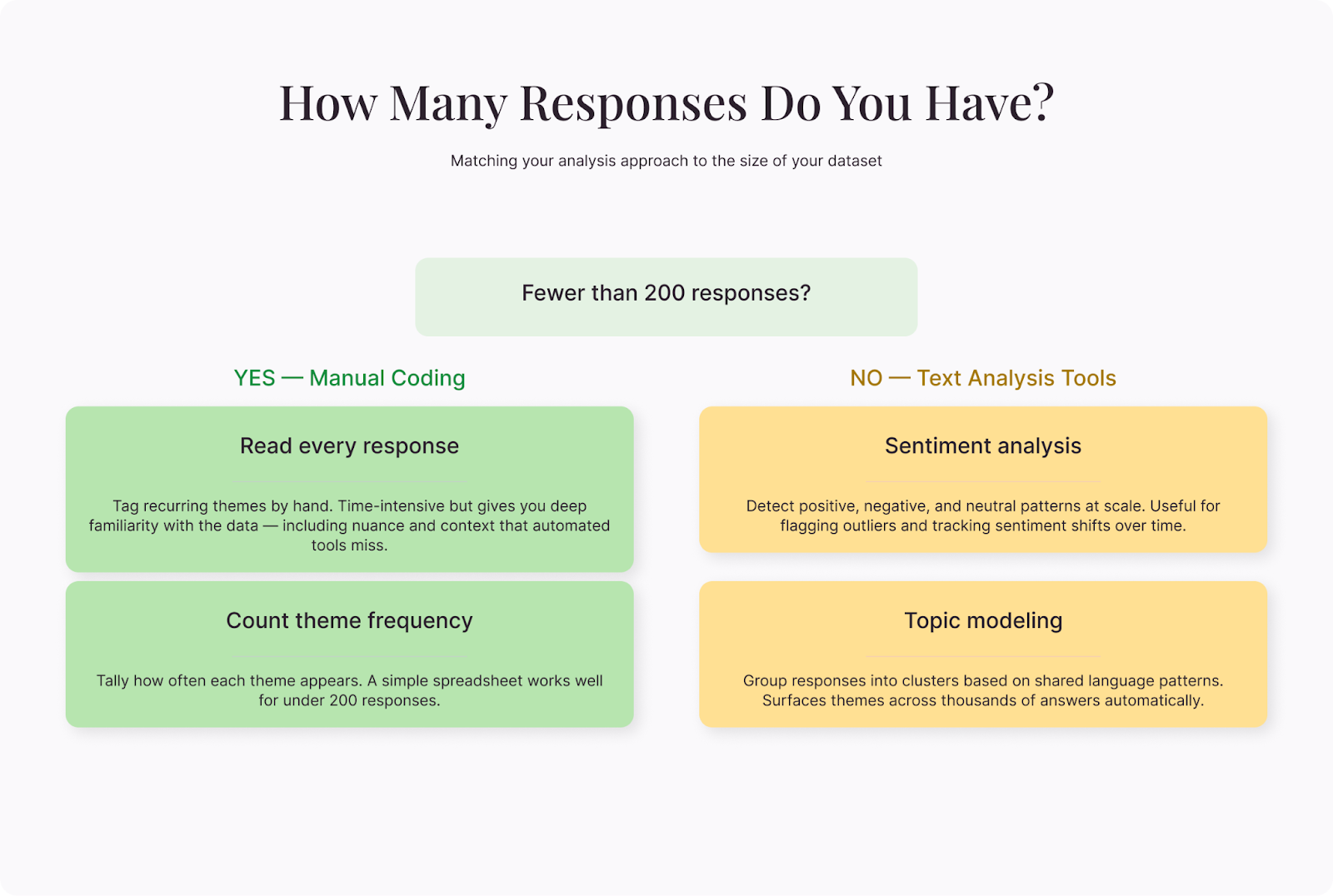
For smaller datasets (under a few hundred responses), manual coding works well. Read every response, tag recurring themes, and count how often each theme appears. This process is time-consuming but gives you an intimate understanding of the data.
For larger datasets, text analysis tools can help. Sentiment analysis detects whether responses are positive, negative, or neutral. Word frequency analysis identifies the most common terms. Topic modeling groups responses into clusters based on shared language patterns.
Neither approach replaces actually reading the responses. Automated tools catch patterns, but they miss sarcasm, context, and the individual stories that often contain the most actionable insights.
Common mistakes to avoid
Even well-intentioned open-ended questions can fall flat. To avoid that, watch for these patterns:
Placing them too early. Respondents who encounter an open-ended question before they've built any momentum tend to skip it or give a one-word answer. Let people warm up with a few closed-ended questions first, then introduce the open-ended item once they're engaged.
Making them mandatory. Requiring a written response frustrates people who genuinely have nothing to add. You'll get filler ("N/A," "nothing," "all good") that clutters your dataset. Make open-ended questions optional, and the responses you do receive will be far more genuine.
Asking after the respondent is exhausted. An open-ended question at the end of a 30-question survey is asking for effort from someone who's already depleted. If you're going to include one at the end, keep the overall survey short enough that people still have energy to write something meaningful.
Ignoring the responses. This might sound obvious, but it happens constantly. Teams collect open-ended data, glance at a few responses, and then focus entirely on the quantitative results because they're easier to chart. The qualitative data sits untouched. If you're not going to analyze it seriously, don't waste the respondent's effort asking for it.
The payoff
Open-ended questions require more effort—from your respondents, from your analysts, and from you as the survey designer. But that effort pays for itself in insights you'd never get any other way.
The next time you're building a survey, resist the urge to make everything multiple choice. Leave room for people to surprise you. The most important thing a respondent can tell you might be something you never thought to ask about.