How to determine your target market and audience
Discover how to find your target market and audience, build research-backed personas, and sharpen the messaging that brings them in.

Trying to sell to everyone is a reliable way to sell to no one. The businesses that grow fastest aren't the ones with the broadest reach. They're the ones with the sharpest understanding of exactly who they're for.
Your target market and audience define who your product or service is built for, who's most likely to buy it, and how you should talk to them. Getting this wrong means wasting budget on ads that reach the wrong people, creating content that doesn't resonate, and building features nobody asked for. Getting it right means every dollar and every hour of effort works harder.
Whether you're launching something new or refining your approach to an existing business, this guide walks through how to identify, validate, and understand the people who matter most.
Target market vs. target audience—what's the difference?
These terms get used interchangeably, but they refer to different things.
Your target market is the broader group of people who could benefit from what you offer. It's defined by demographics, geography, and shared characteristics. "Small business owners in North America with 10-50 employees" is a target market.
Your target audience is narrower. It's the specific subset of your target market that you're actively trying to reach with a particular campaign, piece of content, or product feature. "First-time small business owners looking for affordable accounting software" is a target audience within the market above.
Think of your target market as the pond and your target audience as the specific fish you're casting for. The market tells you where to fish. The audience tells you what bait to use.
Start with what you already know
Before diving into research, take stock of the information you already have. If you have existing customers, they're your best starting point.
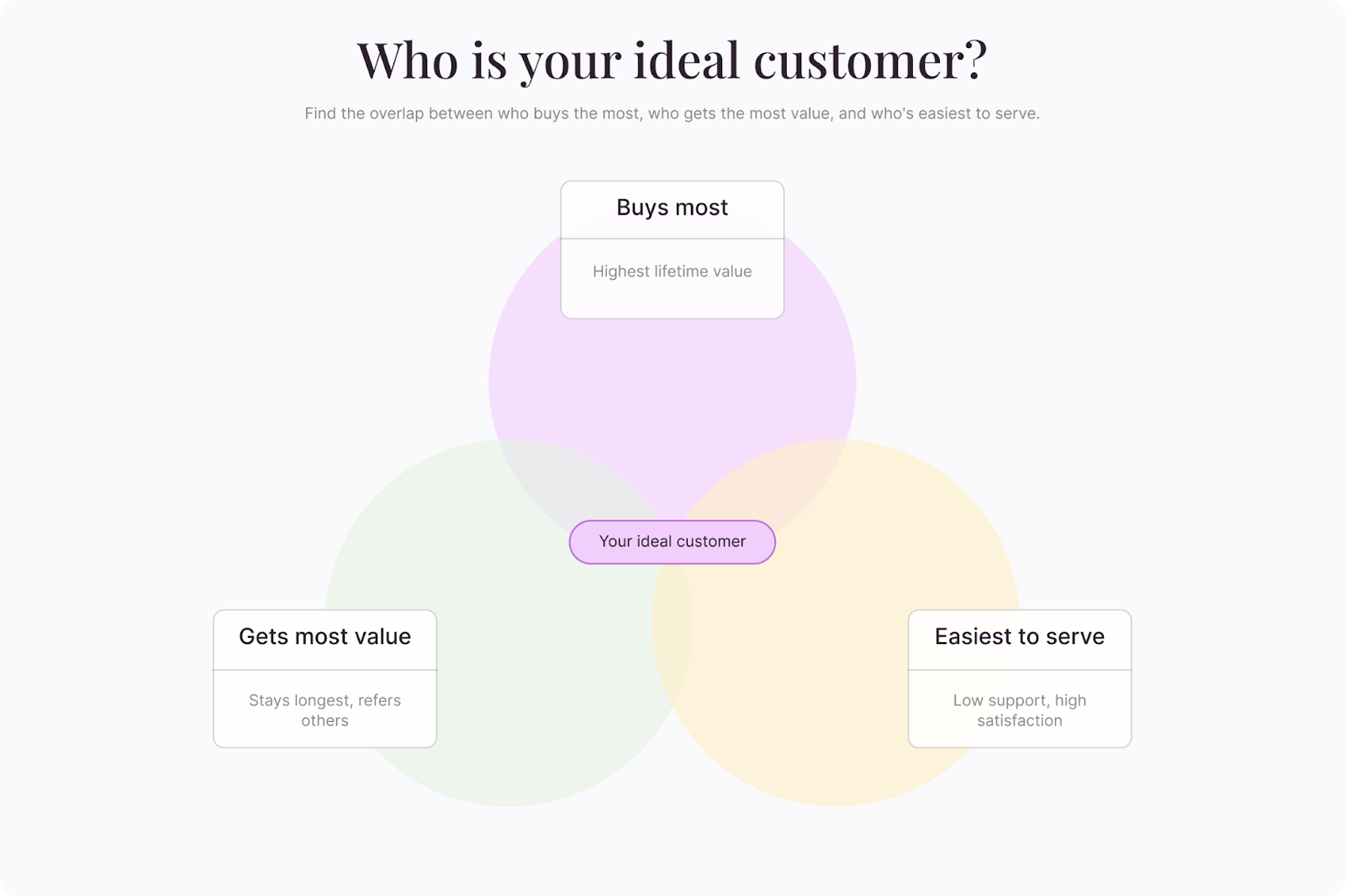
Look at your current customer base and identify patterns:
- Who buys the most? Not just the most frequently, but the highest value over time.
- Who gets the most value? These customers stick around longest and refer others.
- Who's the easiest to serve? Low support costs and high satisfaction signal a strong fit.
- What do they have in common? Industry, company size, job title, age, location—any shared traits.
If you're pre-launch and don't have customers yet, look at your competitors. Who are they serving? Read their reviews. Browse their testimonials. Study their marketing. The audiences they target (and the ones they neglect) can help you find your starting point.
Define your demographics
Demographics are the quantifiable characteristics that describe a population. They're the most straightforward way to segment a market, and they're where most businesses start.
The key demographic dimensions to consider include:
- Age range – A 22-year-old college graduate and a 55-year-old executive have different needs, budgets, and communication preferences
- Location – Geography affects language, culture, regulations, and logistics
- Income or budget – This determines what price points are realistic
- Education level – Influences how technical or simplified your messaging should be
- Job title or role – Especially important in B2B, where the buyer and the user are often different people
- Company size and industry – For B2B products, these shape the problems your customers face
Demographics give you the outline of your audience. They tell you who these people are on paper. But they don't tell you why they buy, what frustrates them, or how they make decisions. For that, you need psychographics.
Dig into psychographics
Psychographics describe the psychological characteristics of your audience—their values, attitudes, interests, motivations, and pain points. If demographics are the skeleton, psychographics are the personality.
Two people can share identical demographics (same age, same income, same city) and have completely different reasons for buying the same product. One might value convenience above everything else. The other might be driven by status. Understanding these motivations changes how you position, price, and promote your offer.
To uncover psychographic patterns, ask questions like these:
- What problem is this person trying to solve?
- What does success look like to them?
- What keeps them up at night professionally?
- Where do they go for information and advice?
- What has to be true for them to trust a new product or service?
Surveys, interviews, and social media listening are the most direct ways to gather psychographic data. Pay attention to the language people use when describing their challenges—it's often more revealing than any demographic profile.
Analyze the competition
Your competitors have already done some of this work for you. Studying who they target—and how—reveals opportunities and blind spots.
Map out your main competitors and examine three things:
- Who they're targeting. Look at their website copy, ad campaigns, and content. Who are they speaking to? What pain points do they address?
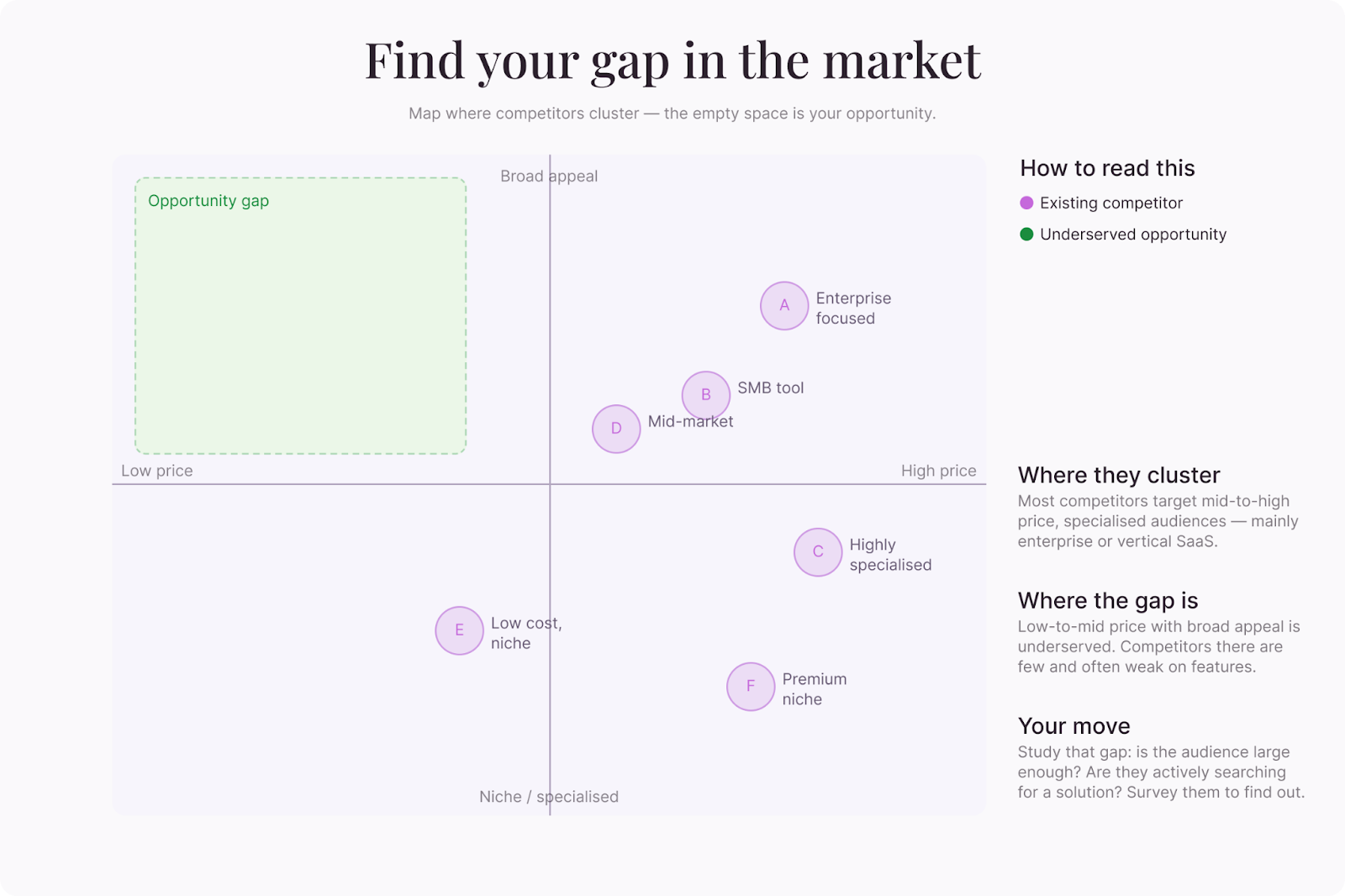
- Who they're ignoring. Every positioning choice excludes someone. If all your competitors target enterprise clients, the mid-market might be underserved. If they all focus on one industry, adjacent industries might be hungry for a solution.
- How customers feel about them. Reviews, forum discussions, and social media complaints reveal unmet needs. A competitor's weakness is your opportunity—but only if the people affected are part of a viable audience for you.
Validate with research
Assumptions are dangerous. Once you have a hypothesis about your target market and audience, test it.
Quantitative research helps you confirm whether the audience is large enough to sustain your business and whether the demand you're assuming actually exists. Use surveys to measure interest, willingness to pay, and current behavior patterns across a representative sample of your proposed target.
Qualitative research helps you understand the nuances. Interviews with five to 10 people from your proposed audience can reveal whether your assumptions about their motivations, frustrations, and decision-making process are accurate—or completely off base.
Pay special attention to disconfirming evidence. It's tempting to notice only the data that supports your hypothesis and explain away the rest. Resist that impulse. If your research suggests your target is wrong, better to find out now than after you've spent six months building campaigns for the wrong people.
Create audience personas
Once your research is done, distill your findings into audience personas—fictional profiles that represent the key segments within your target audience. A good persona is specific enough to guide real decisions.
It should include:
- A name and brief background (to make the persona feel like a real person, not a data point)
- Demographics (age, role, industry, location)
- Goals and motivations (what they're trying to achieve)
- Pain points (what's standing in their way)
- Preferred channels (where they spend time and seek information)
- Decision-making factors (what influences their purchase decisions)
Most businesses need two to four personas. More than that and the specificity starts to dilute. Fewer than that and you might be oversimplifying.
These personas aren't decorative. Use them actively. When writing an email campaign, ask "Would this resonate with [persona name]?" When prioritizing features, ask "Which of our personas benefits most from this?" When choosing ad placements, ask "Where does [persona name] actually spend their time?"
One important caveat: personas should be built from research, not imagination. A persona that reflects your team's assumptions about who the customer is—rather than data about who the customer actually is—can be worse than having no persona at all. It gives you false confidence that you understand your audience while steering your strategy toward a fictional version of them. Ground every persona in real interview quotes, real survey data, and real behavioral patterns.
Test your messaging against your audience
Once you've identified your target audience, the next step is confirming that your messaging actually resonates with them. The most common way to do this is through small-scale tests before committing to full campaigns.
Run A/B tests on landing pages, email subject lines, and ad copy with your target segments. Survey a sample of your audience about which value propositions matter most to them. Share positioning statements with five to 10 people in your target and ask them to describe what they think you do and who it's for. If their description doesn't match your intent, the messaging needs work—not the audience definition.
This testing loop is where audience strategy meets execution. The clearest target audience definition in the world won't help if the words you use to reach them don't connect.
Revisit and refine
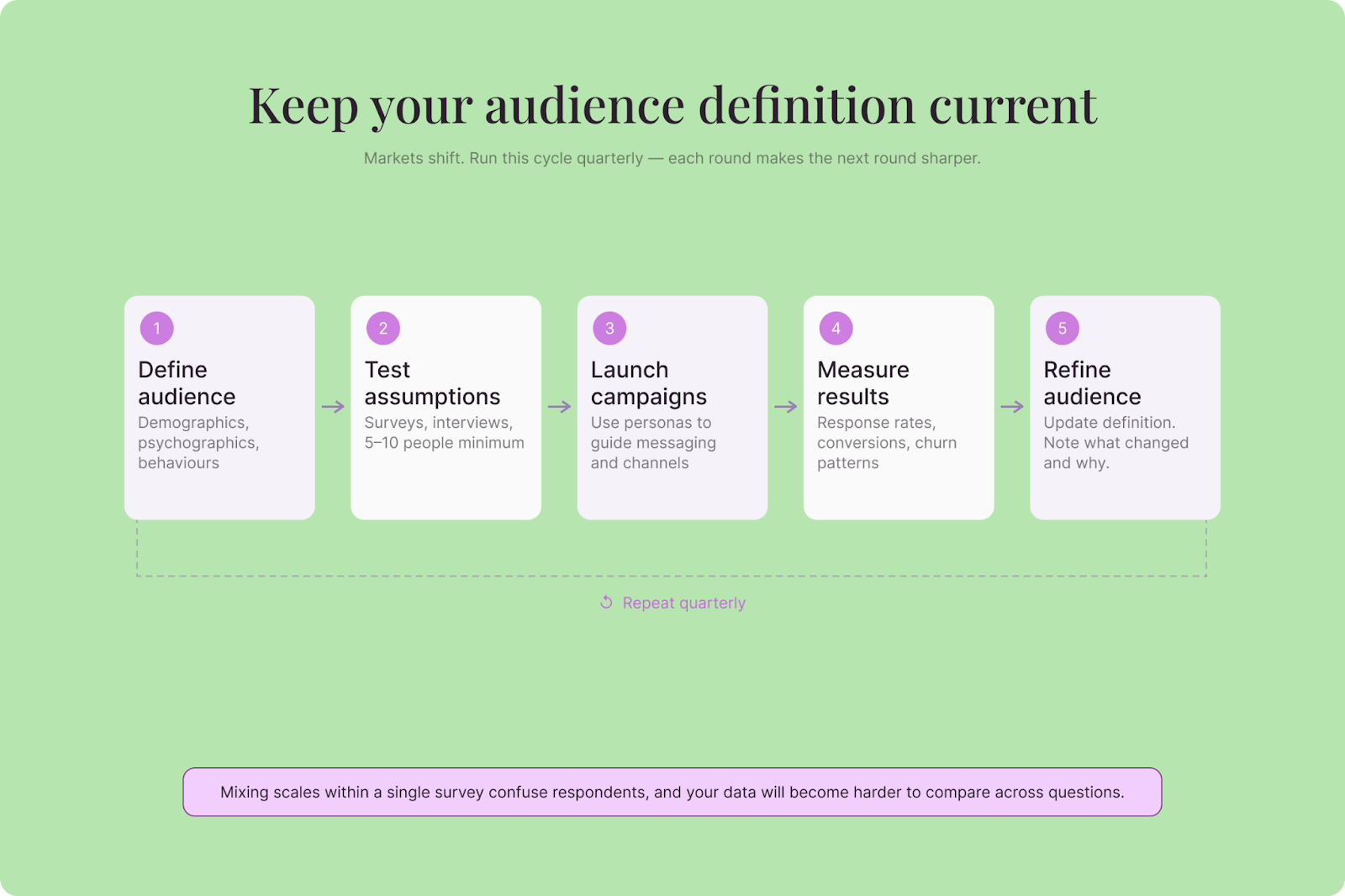
Your target market and audience aren't permanent. Markets shift. Competitors emerge. Customer needs evolve. Products change. A target audience that made perfect sense two years ago might be less relevant today.
Build regular check-ins into your process. Review your customer data quarterly. Run an audience survey at least once a year. Pay attention to which customers are churning and which ones are growing—these shifts often signal that your audience definition needs updating.
The companies that consistently outperform their competitors aren't necessarily the ones with the best products. They're the ones with the clearest understanding of who they serve—and the discipline to keep that understanding current.
Remember: Your target market and audience aren't just marketing inputs. They're strategic decisions that shape everything from product development to hiring to customer support. Take the time to get them right, and revisit them often enough to keep them right.