IT new hire form template
Onboard a new IT hire with the access and tooling their role actually needs, not the standard new starter bundle. Collect the IT role's scope, the systems they'll be responsible for, on-call setup, and who signed off.



For most new hires, onboarding finishes when they can log in. For an IT hire, that’s where it starts. They can't pick up a ticket without access to the system behind it, or take a page without VPN and the paging tool. Production access waits until someone senior has scoped what the new IT hire is allowed to touch. Typeform's IT new hire form collects all those details in one request, so the work of granting a new IT hire access starts well before their first morning.
The hiring manager provides details on the new role, team, and start date, then works through what access that role needs. Choosing a platform or infrastructure role brings up cloud console access, production permissions, and which environments the new hire will work in, while a helpdesk role brings up ticketing, remote support tooling, and admin rights on user machines. The manager also marks what the hire needs on day one against what can wait until a lead signs off, so nobody hands a new engineer production keys in their first week.
IT knows what to provision, at what level, and in what order, before the hire arrives. The new engineer picks up their first ticket on day one instead of spending a week waiting for someone to notice they can't see the queue.
An IT new hire form is an online form hiring managers use to request the access, equipment, and tooling a new member of an IT or engineering team needs. It collects the hire's role and scope, the systems and environments they'll work in, their equipment and on-call setup, and who approved their elevated access. IT teams use IT new hire forms to provision a technical hire properly rather than running them through the standard new starter checklist.
Without an IT new hire form, a technical hire gets the standard onboarding bundle: laptop, email, the usual SaaS apps. None of that lets them do the job, so their first week involves raising tickets for their own access, while a senior engineer approves them one at a time. An IT new hire form asks what the role actually needs up front, so those approvals land before the hire starts, rather than during their first week.
Capture what day one depends on:
- Name, role, and start date
- Manager and department
- Remote or office-based
- Equipment they need
- Systems and access required
Treat on-call access as its own set of items rather than assuming it arrives with the role. VPN, the paging tool, runbook access, and the escalation contacts are four separate grants, and a new engineer usually discovers which one is missing at 3am on their first rotation. Ask for them explicitly on the form and IT provisions them alongside everything else.
Yes. Every request lands with a start date attached, so sort by it and you have a queue in the order the work is actually due. A hire starting in three weeks and one starting Monday stop competing for attention in the same inbox.
Get inspired by relevant templates and categories
3200+ Templates, 300+ Integrations
Work From Home Request Form
A Slack message asking to work from home on Thursday isn't a request anyone can track, especially once the same employee has asked five different ways over a month. Collect the request type, dates or schedule, and manager approval in one place, so HR isn't reconstructing who's working where from a scattered inbox.
View template
Return of Property Form
A property checklist stapled to an exit interview packet isn't a record anyone can rely on when a laptop turns up missing three weeks later. Collect itemized equipment details, condition at return, and a signed acknowledgment before an employee's last day, so IT isn't chasing down a laptop that already walked out the door.
View template
Early Retirement Form
A retirement mentioned to a manager in conversation doesn't give HR anything to actually process, and if there's an incentive deadline attached, the date that conversation happened can matter more than anyone realized at the time. Collect what your HR team actually needs, employee information, requested date, and benefit elections, before a window closes.
View template
Staff Leave Application Form
A vacation request approved with a thumbs-up emoji in Slack isn't the kind of record payroll can work from when it's time to reconcile someone's leave balance. Collect the leave type, dates, and manager approval in one place, so a team doesn't accidentally double-book someone's time off.
View template
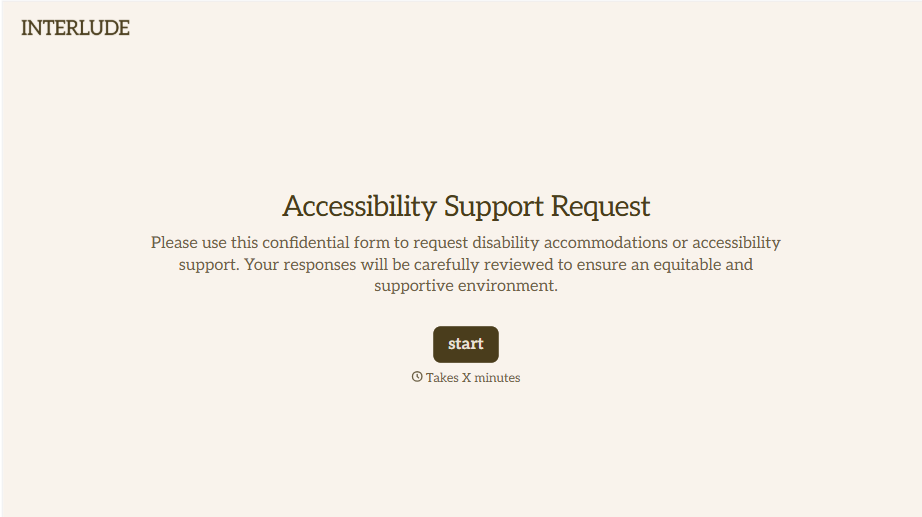
Disability Accommodation Request Form
A quiet word to a manager about needing a different desk setup isn't the kind of request that starts a documented process. Collect the specific accommodation needed and any supporting information before a decision gets made informally, so a request doesn't get lost between a hallway conversation and HR's desk.
View template
With Typeform, you can customize everything
Change text, colors, and even logos to match the look and feel of your brand. Then embed forms smoothly onto web and email.
Make forms feel effortless to fill out. Pace questions, call people by their name, and adapt the flow based on the data they share.
Stay efficient by connecting forms to your workflow. Typeform integrates with 300+ tools including Slack, Zapier, and HubSpot.