AI in market research: Real use cases that work in 2026
AI market research is already delivering results, 47% of researchers use it regularly. See how teams apply it for data collection and faster analysis.

Artificial intelligence has moved from “emerging trend” to everyday tool in market research. Yet many teams still aren’t sure what AI actually does, or where it fits into their workflow. The technology gets hyped, but the practical applications often stay fuzzy.
This guide cuts through the noise. You’ll see real, concrete ways AI helps researchers collect better data, uncover patterns humans might miss, and make faster decisions. We’ll also explore what adoption looks like right now and where the gaps still exist.
The current state of AI in market research
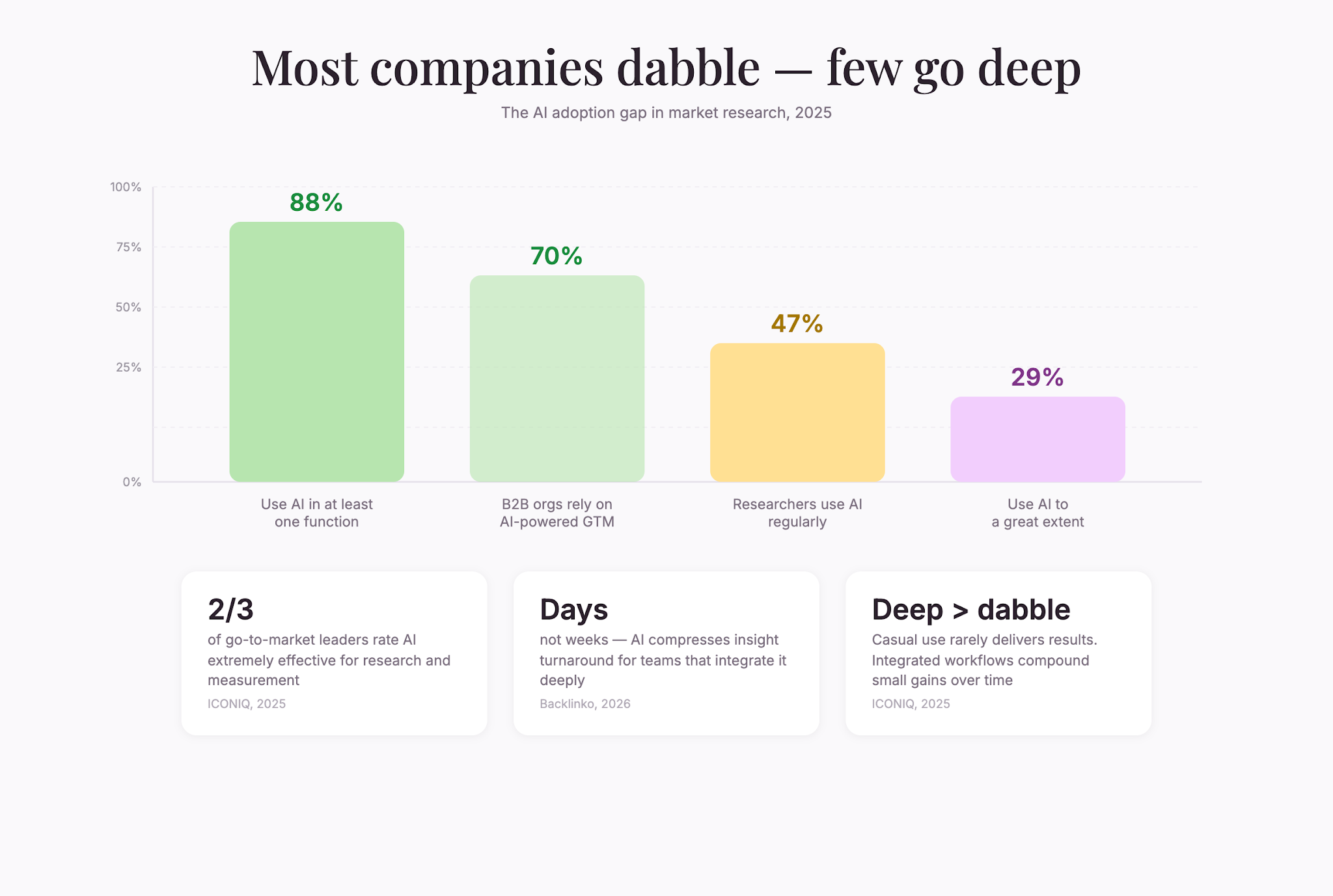
The numbers tell an interesting story. Around 47% of researchers worldwide use AI regularly in their market research activities (Backlinko, 2026). That’s a meaningful chunk, but it also means half the industry hasn’t integrated it yet.
When researchers do use AI, the results are noteworthy. Two-thirds of go-to-market leaders report that AI is extremely effective for market research, analysis, and measurement (ICONIQ State of Go-to-Market, 2025). That’s confidence you can’t ignore. This effectiveness translates into tangible outcomes: teams report faster turnaround times on insights, reduced manual labor in data processing, and higher confidence in their findings. The practical benefits extend beyond speed; they touch strategy, resource allocation, and competitive positioning.
The adoption gap is real, though. Over 70% of B2B organizations rely heavily on AI-powered go-to-market strategies, and 88% of companies use AI in at least one function (ICONIQ State of Go-to-Market, 2025). But only 29% of go-to-market leaders report using AI to a great extent.
In other words: most teams are dabbling, not diving deep.
This distinction matters. Companies that use AI casually—perhaps for one isolated task—rarely see significant results. Those that integrate AI methodically across their research operations see compounding benefits: better data quality feeds into better analysis, which informs better strategy, which then requires better market research to validate. It’s a virtuous cycle, but only if you commit to it.
Data collection: faster, smarter, less biased
One of AI’s biggest wins in market research is how it handles data collection. Traditional methods are time-consuming. Surveys need to be written, tested, and distributed. Interviews require scheduling and transcription. Focus groups demand logistics coordination. Even simple customer feedback collection requires manual routing, categorization, and initial review before any real analysis can begin.
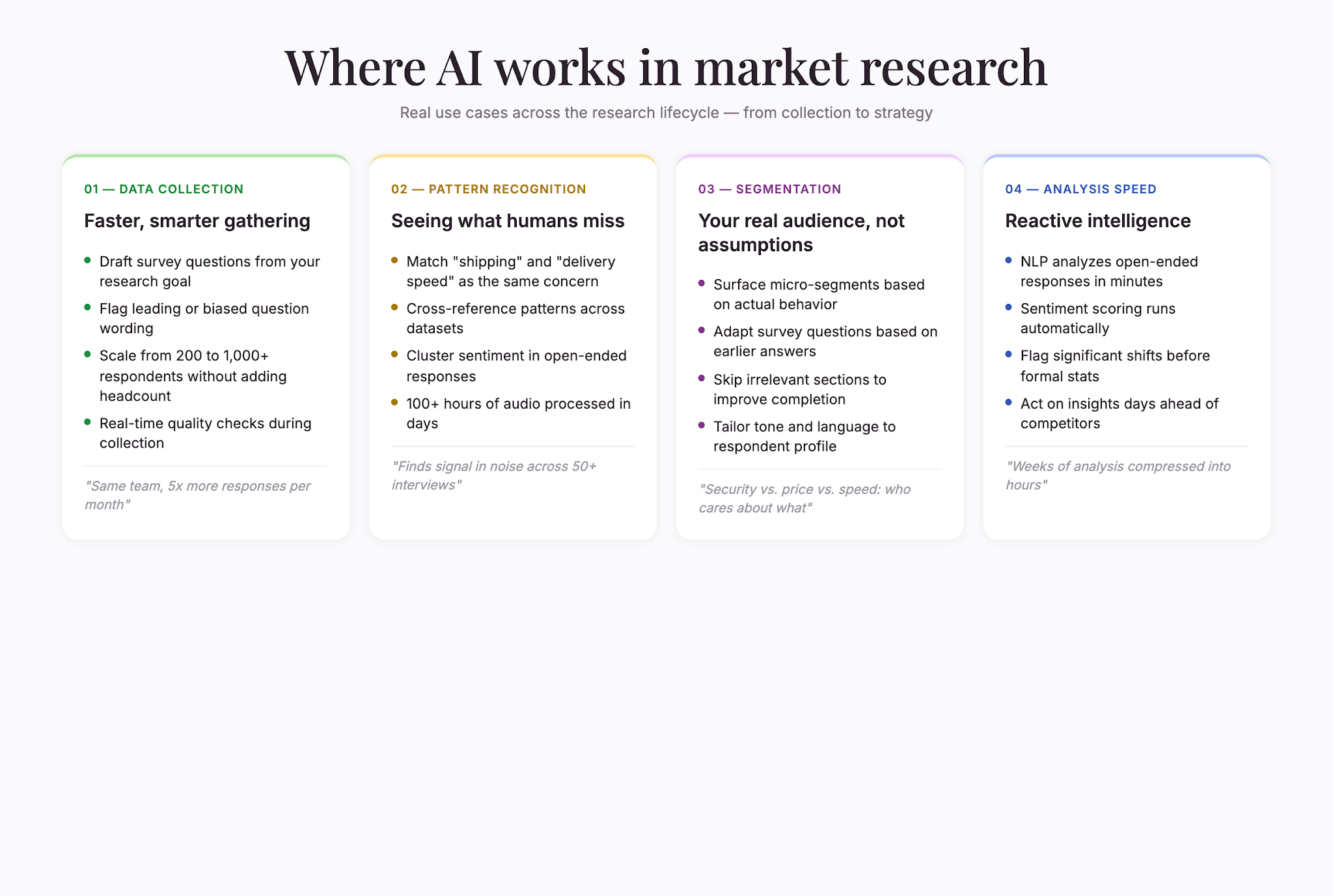
AI accelerates every step. It can draft survey questions based on your research goals, spot flawed wording before you launch, and flag response patterns in real time. For qualitative research—interviews, open-ended feedback—AI tools can transcribe, summarize, and even highlight themes that would take a human researcher hours to find. More importantly, AI can identify when your survey design itself might be biased. It catches leading questions, unbalanced response options, and assumptions baked into your wording that might skew results.
The real value shows up in scale. You can collect data from larger, more diverse audiences without proportionally increasing your workload. This means your insights reflect your actual market, not just the people easiest to reach. A team of five researchers using traditional methods might survey 200 customers per month. The same team using AI-assisted collection can survey 1,000 or more, because the automation handles distribution, initial data cleaning, and quality checks. That scalability matters when your market is fragmented, or your customer base spans multiple geographies and personas.
First-party data collection has become especially critical. Nearly 90% of marketers report shifting their personalization tactics and budget toward first- and zero-party data (IAB, 2024). AI helps you gather this data efficiently through surveys, quizzes, and polls that feel natural to respondents rather than invasive. When customers see questions tailored to their role, industry, or previous interactions, they’re more likely to respond honestly and thoroughly. That trust and engagement are what separate useful data from superficial responses.
Tools that streamline this workflow let you set up research processes that repeat and improve over time. ResearchFlow is one approach. It structures your research questions, response collection, and analysis so you’re not starting from scratch each cycle. The less time you spend on mechanics, the more time you spend on insight. Over multiple cycles, you also build institutional knowledge: you learn which questions get the best responses, which audience segments are most accessible, and which research timing correlates with the most accurate data.
Pattern recognition: where AI sees what humans don’t
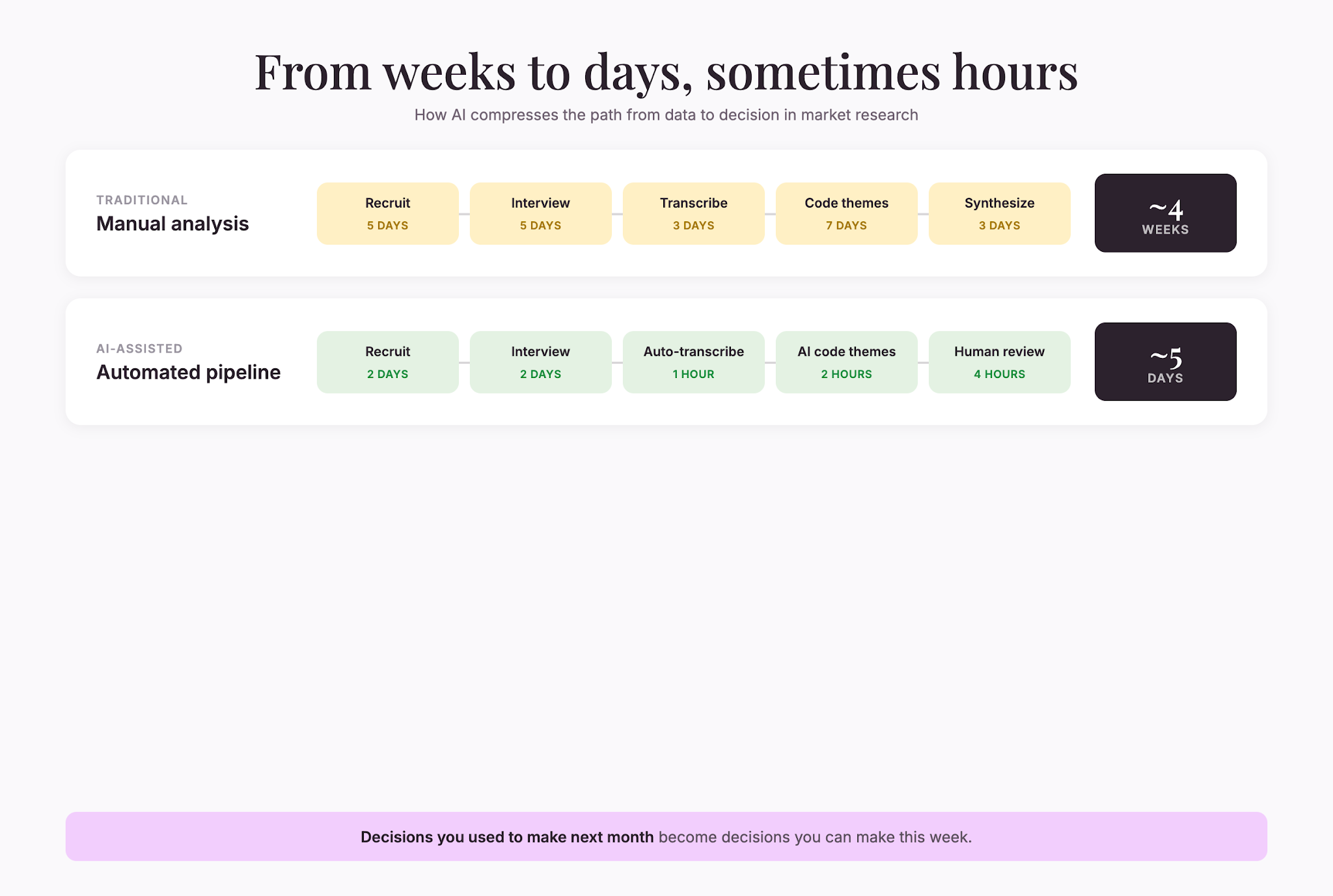
Numbers alone tell an incomplete story. A survey might show that 60% of customers are “somewhat satisfied,” but what does that really mean? Where are they losing trust? What would push them to switch? Manual analysis of thousands of responses would take weeks. You’d assign codes to responses, track which codes cluster together, and try to spot themes. It’s methodical but slow, and human coders get tired or inconsistent.
This is where AI’s pattern-recognition strength shines. Machine learning models can sift through hundreds or thousands of responses and surface hidden connections. A customer might mention “shipping” in one response and “delivery speed” in another. To a human coder, these look different. To AI, they’re the same underlying concern. This matters because it reveals what customers actually care about, not what you assumed they cared about.
AI can also cross-reference patterns across datasets. If survey respondents who mention price sensitivity also tend to skip your premium product features, that’s a connection worth investigating. AI flags it; you explore why. Perhaps price sensitivity correlates with a certain company size, geographic region, or industry vertical. Once you spot that pattern, you can test it: does the pattern hold in new data? Can you predict who’ll be price-sensitive based on other factors? Does it change your go-to-market strategy?
The same applies to unstructured data: open-ended survey responses, interview transcripts, social media comments. AI can cluster similar sentiments, extract emotion, and identify emerging themes without you manually reading every single entry. For large research projects, this is substantial. A team running 50 customer interviews might generate 100+ hours of audio. Manually transcribing and analyzing that would take weeks. AI can produce a searchable transcript with extracted themes in days.
Segmentation and personalization: knowing your real audience
Generic audience segments—“millennials,” “high income,” “frequent buyers”—miss the mark. Your actual audience breaks down into micro-segments with distinct needs, preferences, and behaviors. Yet identifying these segments manually requires analyzing correlation matrices, running cluster analyses, or making educated guesses based on limited data.
AI helps you identify these real clusters by analyzing response patterns, demographics, and behavior. Instead of assuming all mid-market companies care about price, AI can surface that some prioritize security, others want ease of use, and a third group wants implementation speed. This matters because it changes how you position, price, and support your offering. You can tailor your website messaging to each segment. You can create different pricing tiers that appeal to different priorities. You can even design your product roadmap around segment-specific needs.
Personalization—making each respondent’s experience feel tailored—also benefits. AI-driven surveys can adjust questions based on earlier answers, skip irrelevant sections, and even adapt tone or language based on the respondent’s profile. This makes surveys feel less like a chore and more like a conversation, which lifts completion rates and data quality. When a B2B respondent in healthcare sees questions relevant to healthcare compliance, they take the survey more seriously. When a freelancer sees questions about solo workflows rather than team management, the survey feels designed for them.
User experience research shows just how valuable this is. User interviews, usability testing, and user surveys remain the most popular UX research methods (86%, 84%, and 77% adoption, respectively), but only 55% of companies conduct UX testing (TrueList, 2025). The companies that do invest see dramatic returns—every $1 spent on UX returns $100 (TrueList, 2025). AI makes UX research faster and cheaper, so more teams can afford to do it. Small companies can now run testing programs that once required large dedicated teams. This democratization of research capability shifts competitive dynamics: the barrier to understanding your customer has dropped significantly.
Analysis across teams: insights faster than ever
Traditional market research has a timing problem. You collect data, then spend weeks analyzing it. By the time you present findings, market conditions have shifted. Your recommendations are accurate but stale. Decision-makers have already moved on to the next quarter.
AI compresses that timeline. Natural language processing can analyze open-ended responses in minutes. Sentiment analysis can score customer feedback automatically. Trend detection can flag significant shifts in your data before you even run formal statistics. This speed enables something traditional research can’t: reactive intelligence. When customer sentiment shifts, you know within days, not weeks.
This speed is crucial in competitive markets. If you spot a shift in customer priorities before your competitors do, you can act first—adjust messaging, revise product roadmaps, or pivot strategy while others are still in meetings. In fast-moving industries like SaaS, fintech, or e-commerce, that temporal advantage compounds quickly into market share.
The quality of analysis improves, too, as AI removes some of the guesswork. Instead of eyeballing a chart and guessing what matters, you get statistical tests, confidence intervals, and flagged anomalies. This reduces the chance that you’ll mistake noise for signal. It also reduces the influence of cognitive biases—anchoring bias, confirmation bias, availability bias—that humans unconsciously bring to data interpretation.
In other words, an AI model will never “believe” in a particular outcome and then interpret data to support it.
Where AI adoption still has gaps
AI in market research isn’t a magic fix. Several real challenges remain, and understanding them helps you implement AI market research more thoughtfully.
Integration friction. Many teams use a patchwork of tools—one for surveys, another for interviews, a third for analysis. Stitching these together manually is tedious and error-prone. The ideal solution is a workflow where data moves seamlessly from collection through analysis and reporting. Without this integration, you lose the efficiency gains. You still need someone to export data from tool A, reformat it, and import it into tool B. That friction point wastes time and introduces opportunities for data corruption or loss.
Skill and confidence gaps. Using AI requires knowing which tool to deploy and when. It means understanding what your AI is actually doing—and spotting when it’s making mistakes. Not every team has built this expertise yet. This isn’t just a technical skill; it’s a research methodology skill. You need to know when an AI sentiment analysis is trustworthy and when it’s misinterpreting context. You need to know when a pattern the AI found is statistically significant versus merely coincidental.
‘Garbage in, garbage out,’ still applies. AI is only as good as the data it processes. If your survey is badly designed or your sample is skewed, AI won’t fix that. It might even amplify the problem by confidently surfacing patterns that are artifacts of your biased data, not reflections of reality. This is why starting with a solid research design remains essential.
Privacy and ethics. Collecting detailed data to drive AI analysis raises legitimate questions about consent, data security, and fair use. Regulations like GDPR and shifting attitudes toward data ownership mean you need clear policies. Respondents need to understand why you’re collecting their data and how you’ll use it. If you’re using AI to analyze their responses, they arguably deserve to know that too.
In 2025, only 15% of global marketers felt fully ready for a cookieless world (Deloitte, March 2025), and the shift toward first-party data collection has only accelerated since then. This means research teams need to be even more thoughtful about what data they collect, how they use it, and how they communicate that to respondents. The companies that win on research aren’t just using the best tools; they’re earning the deepest trust from their customers, which means their research data is richer and more honest.
The practical next steps
If your team wants to move from “dabbling in AI” to “using it strategically,” start here:
Define your research question first. Don’t pick an AI tool and then figure out what to do with it. Start with what you actually need to know. That question shapes everything else. Are you trying to understand why customers churn? Or how they use your product? Or what messaging resonates with prospects? Each question suggests different data collection methods and analysis approaches.
Audit your current workflow. Where does time get lost? Is it in question design, distribution, transcription, coding, or analysis? AI can accelerate some steps more than others. Focus on your biggest bottleneck. If 60% of your research time goes to transcription and coding, that’s where automation delivers the most value. If your bottleneck is getting people to respond, AI-powered segmentation and personalization might be the answer.
Start small. Use AI to handle a low-stakes task first—maybe sentiment analysis of feedback you’ve already collected, or generating draft survey questions. See what works before rolling it out across your entire research operation. This approach reduces risk and builds confidence. Your team learns what AI can and can’t do in your specific context.
Invest in training. Your team needs to understand both the power and the limitations of the tools you’re using. This isn’t a “set it and forget it” situation. Researchers should understand how the AI model works, what assumptions it makes, and when its outputs are trustworthy versus when they need human judgment.
Integrate systematically. Look for platforms that handle multiple steps of your research workflow, from questionnaire design through data collection and initial analysis. ResearchFlow is one such approach, designed to let you build repeatable research workflows where AI assists at each stage. The goal is to reduce manual handoffs and make iteration faster. When data moves automatically from collection to analysis to reporting, you eliminate friction points and can run research cycles more frequently.
The reality of AI in market research
AI isn’t replacing researchers. It’s freeing them from mechanical work so they can focus on what humans do best: asking the right questions, spotting surprising connections, and translating data into strategy. The most sophisticated AI market research programs combine machine intelligence with human judgment, letting each do what it does best.
Nearly half of researchers already use AI regularly. The other half are watching to see where it delivers real value. If your team hasn’t moved yet, now is the time. The gap between early adopters and laggards is widening, and the laggards are falling behind not because AI is magic, but because it compounds small advantages into big ones over time.
Teams that run research faster can iterate faster. Teams that iterate faster learn faster. Teams that learn faster adapt faster. In competitive markets, that compounding advantage becomes decisive.

Liked that? Check these out:

Opinions and Expertise
What’s actually slowing research teams down (Hint: it’s not the research)
From recruiting participants and scheduling interviews to building the actual surveys, the operational drag is taking researchers away from what they do best. See what's actually slowing them down and how Research Flow fixes it.
Read more