White labeling: a guide for brands and resellers
White labeling: resell partners' products under your name to expand fast. Learn when partnerships work and what brand risks you inherit from their work.
Key Takeaways
- White labeling separates who builds from who sells: The provider handles the technology and infrastructure while the reseller owns branding, pricing, and the customer relationship.
- White labeling works best when three conditions align: Customers are already asking for something you don't currently offer, you've found a partner whose quality you trust enough to put your name on, and your team has the capacity to support the new customers that come with it.
- Your brand absorbs the risk, not just the benefit: Customers hold you accountable for the white-labeled product's quality, so a partner's slow or unreliable service reflects directly on you.
- Check the fine print before committing: Service level agreements, customization limits, pricing splits, lock-in periods, and data ownership all shape whether the partnership actually pays off.
White labeling is when one company creates a product or service and another company rebrands it as their own. The end customer sees only the second company's branding, not the original creator's. It's a straightforward way for businesses to expand their offerings without building everything from scratch.
White labeling happens across nearly every industry. A retailer might white-label a software tool. An agency might white-label a design service. A SaaS platform might white-label analytics software. A marketing firm might white-label email automation. The original creator remains invisible to the customer, while the reseller builds their brand and customer relationships.
For brands, white labeling offers speed to market and cost savings. For resellers, it opens revenue streams without massive development investment. Understanding how white labeling works—and when it makes sense for your business—helps you decide whether it's the right strategy for growth.
How white labeling works
White labeling is fundamentally a partnership. A company (the white-label provider) builds a product and makes it available for resale. A second company (the reseller) licenses that product, rebrands it completely, and sells it under their own name. The reseller keeps customer relationships and revenue, while the provider handles the underlying work.
The reseller customizes the look and feel—logo, color scheme, domain, help text—so it feels like their own creation. What stays hidden is the infrastructure, technology, and operations powering it behind the scenes.

The reseller controls the entire customer experience from onboarding to support. They set pricing, manage relationships, and handle customer service. The provider works invisibly, ensuring the product runs smoothly and stays updated. This separation of roles is crucial: the reseller becomes the face of the product while the provider remains the backbone.
This arrangement lets both parties win. The provider reaches new markets through reseller channels without building a direct sales team. The reseller offers customers a wider range of solutions without the time and expense of developing new products in-house. The provider can focus on improving the core product while the reseller focuses on sales and customer relationships.
When white labeling makes sense
White labeling works best when three conditions align: you have a clear need, a trusted partner, and the ability to handle customer relationships across a growing book of business.
You need to grow your product line quickly
If your customers ask for a service you don't offer, white labeling lets you fill that gap in weeks instead of months or years. You can satisfy demand without derailing your core product roadmap. This speed advantage is particularly valuable in competitive markets where being first with a solution matters.
You want to avoid development costs
Building a new product from scratch costs money, time, and attention. White labeling cuts those costs dramatically. You skip the research, design, testing, and ongoing maintenance, all handled by the provider. Instead of allocating engineering resources to a new product, your team stays focused on optimization and innovation in your core offering.
You have customer relationships to leverage
White labeling only works if you have customers ready to buy what you're reselling. If you're starting from zero customers, white labeling won't create demand. It's a way to sell more to people who already trust you.
You trust the provider completely
Your reputation is on the line when you put your brand on a product. Choose a partner with a strong track record, solid infrastructure, and alignment on support standards. This trust becomes the foundation of a successful partnership.
Benefits for resellers
Resellers gain several advantages by white-labeling instead of building from scratch.
- Faster time to market – launch a new offering in weeks, not quarters, getting to market ahead of competitors building custom solutions
- Lower financial risk – you avoid upfront development costs and instead pay as you grow, usually through a revenue share or per-user fee
- Focus on what you do best – your team stays focused on sales, customer success, and relationships while the provider handles technical work and infrastructure
- Easier scaling – as your customer base grows, the provider's infrastructure grows with it, so you don't need to hire engineers or manage servers
- Room for customization – most white label solutions let you customize branding, workflows, and integrations, so the product feels genuinely yours
Benefits for providers
Providers also benefit by opening their product to reseller channels.
- New revenue streams without extra overhead – you reach customers through resellers who become an extension of your sales team
- Faster growth and market expansion – resellers know their local markets and customer bases better than you do, letting you enter new regions without building a presence yourself
- Validation and feedback – each reseller brings real customer data back to you, and that feedback drives better product decisions
- Lower customer acquisition costs – resellers shoulder marketing and sales costs, so your acquisition expense drops significantly
Common white-label models
White labeling takes different forms depending on the product, relationship, and customization needs.
Full white label – The reseller's brand appears everywhere: the interface, emails, help docs, billing pages, customer support. This is most common for SaaS products, design services, and software tools.
Co-branding – Both the reseller and provider brands appear, with the reseller's brand more prominent. This works well when the provider has strong credibility.
Hybrid model – The reseller brands customer-facing parts, but the provider brand might appear in backend systems or support materials.
Platform partnerships – One company provides the core platform, and resellers add specialized features, integrations, or services on top.
What resellers should know before committing
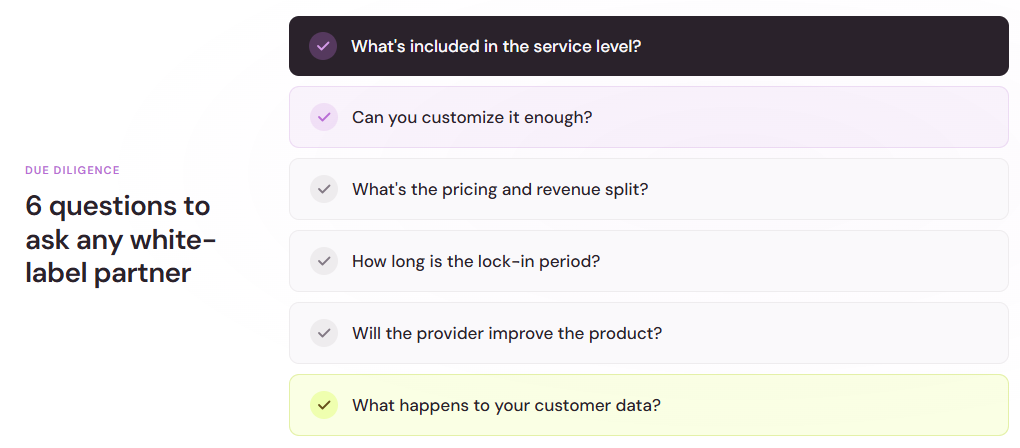
Before signing a white-label agreement, consider these critical questions.
What's included in the service level? Know exactly what the provider maintains and what you're responsible for. Service level agreements matter because your customers will hold you accountable.
Can you customize it enough? Will the white label solution let you customize branding, UI elements, and workflows to match your brand promise?
What's the pricing and revenue split? Understand the full cost structure and calculate the margins you'll actually keep.
How long is the lock-in period? Can you exit if it's not working? Some agreements have long terms with steep penalties.
Will the provider improve the product? Ask about their roadmap. Are they actively developing features, fixing bugs, and keeping the platform secure?
What happens to your customer data? Know who owns customer data, where it's stored, and what happens if the partnership ends.
Trust is hard to earn and easy to lose, and when you put your name on a partner's product, your customers' trust in your brand becomes the trust they extend to the underlying tool. Pick a partner whose standards match yours.
What white-label providers should know before launching
If you're the creator selling a white-label product, a few things shape your success.
Build for resellers, not just your own brand – Design your product with white labeling in mind. Make sure resellers can customize branding without touching code.
Set clear support boundaries – Decide what you'll support and what's the reseller's responsibility.
Create partner success resources – Give resellers sales templates, marketing materials, and onboarding guides so they can sell and support your product effectively.
Price fairly and grow with the partnership – Structure pricing so both you and the reseller profit. If your cut is too high, resellers can't compete.
Invest in the partnership – Treat resellers as partners. Regular check-ins, product updates, and collaborative problem-solving strengthen the relationship.
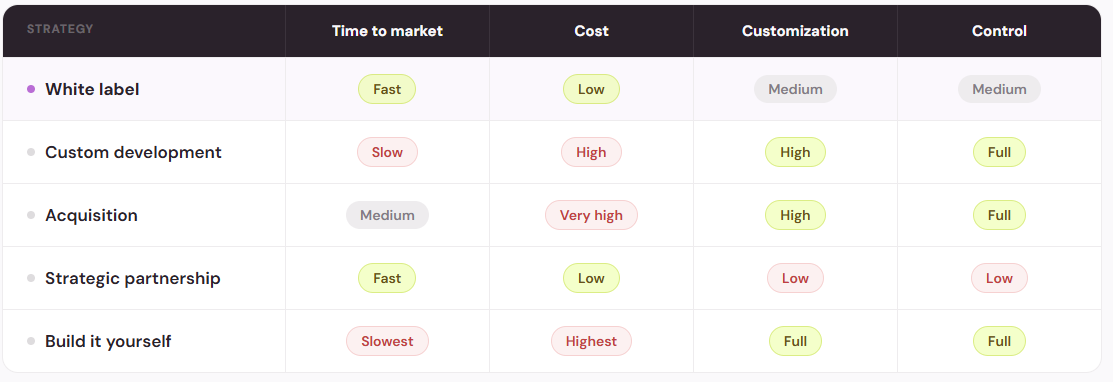
White labeling vs. other expansion strategies
White labeling isn't the only way to expand your offering.
Custom development – You hire a vendor to build exactly what you need. This is slower and more expensive than white labeling, but the result is fully owned.
Acquisition – You buy an entire company or product line. This is the most expensive option but gives you full control and proprietary technology.
Strategic partnerships – You integrate with another company's product instead of rebranding it. Your customers use both tools side-by-side.
Organic product development – You build it yourself. This takes time and resources but gives you complete control and differentiation.
White labeling is the middle ground: faster and cheaper than custom development or acquisition, but more integrated than a partnership.
How white labeling affects brand perception
When you white-label a product, your customers experience it as part of your brand. That's powerful for your reputation, and risky if things go wrong.
If you white-label a tool, you're extending your brand promise to cover it. Customers expect the same quality, reliability, and support they associate with your other offerings. A frustrating experience with a white-labeled feature reflects on you, not on the invisible provider.
Choose a white-label partner whose values and quality standards match yours. If their product is slow, confusing, or unreliable, your brand takes the hit, even though you didn't build it.
The flip side is that white labeling lets you fulfill brand promises you couldn't keep alone. If your customers need a feature or service you don't offer, white labeling lets you stay their complete solution. That strengthens loyalty and increases customer lifetime value.
Making the white-label decision
White labeling works for businesses that need to move fast, avoid development costs, and leverage existing customer relationships. It's a way to fill real customer needs efficiently, not a shortcut to building a real brand.
For resellers, the decision comes down to this: is there demand from your customers? Do you have a trusted provider? Can you customize it enough to feel authentic? If yes to all three, white labeling is worth exploring.
For providers, the question is whether your product is complete enough to resell, whether you can support multiple resellers, and whether the economics work. Get the partnership structure right—clear SLAs, fair pricing, and aligned incentives—and both parties win.
Understanding what white labeling is and how it works helps you make smarter decisions about where to invest your time and money. When executed well, white labeling creates genuine value for both parties and ultimately delivers better solutions to end customers.