Customer service excellence: 10 principles that hold up
Great customer service comes from clear principles: empathy, speed, consistency, accountability. Apply them across all channels to drive loyalty and retention.
.png)
Key Takeaways
- Empathy sets the tone: It de-escalates tension and turns a negative interaction into a chance to build trust—especially since customers need to trust a brand before they'll buy from it.
- Speed only helps if the answer is right: A fast customer service response that doesn’t address customers’ real problems risks more churn than a more considered, thoughtful response that gets it right.
- Consistency across channels builds trust: Customers lose confidence fast when support gives different answers by email, chat, or phone. Aim to provide the same quality experience across all channels and touchpoints.
- How you own your mistakes matter: Customers forgive errors when a company acknowledges the problem quickly and fixes it, but they don't forgive deception or attempts to hide what went wrong.
Great customer service experiences don't happen by accident. They're the result of deliberate choices, clear principles, and consistent execution.
The businesses that earn loyalty and glowing reviews understand this. They've moved beyond transactional support to service that makes customers feel heard, valued, and genuinely taken care of. In today's competitive landscape, where customers have countless alternatives, the quality of your service becomes a key differentiator.
Companies that prioritize service excellence don't just retain more customers. They create advocates who recommend them to others.
Here are 10 principles that define customer service excellence, along with practical guidelines that work across industries, channels, and customer types.
1. Empathy comes first
Empathy is the foundation of every meaningful customer interaction. It's the ability to step into someone else's experience, understand their frustration or confusion, and respond with genuine care.
When customers feel understood, they're more forgiving of mistakes and more likely to stick around. Empathy turns a negative interaction into an opportunity to build trust. It signals that you see them as a person, not just a transaction to process.
81% of consumers need to trust a brand to consider buying from it. That trust starts with how your team responds when something goes wrong. Trust is fragile; it takes time to build and moments to break. But empathetic interactions can actually strengthen trust even after a failure, because customers recognize genuine effort to make things right.
Practical empathy looks like:
- Acknowledging the customer's feelings ("I understand how frustrating that must be")
- Avoiding robotic scripts that ignore context
- Taking ownership instead of deflecting blame
- Following up to make sure the issue is truly resolved
Empathy is about being effective, not just being nice. It de-escalates tension, makes customers feel heard, and sets the tone for a solution-focused conversation. When someone feels their emotions are validated, they're more willing to work with you toward resolution rather than escalating their frustration or taking their business elsewhere.

2. Speed matters, but accuracy matters more
Customers want fast answers. But a fast wrong answer is worse than a slightly slower right one.
The key is balancing speed with quality. Automate where it makes sense: use chatbots for FAQs, self-service portals for common tasks, and knowledge bases for quick lookups. But when a question requires nuance, take the time to get it right. A customer with a complex issue would rather wait an extra hour for a complete solution than get a quick but incomplete response that leads to follow-up conversations.
Acquiring new customers costs five times more than retaining existing ones. A rushed, incomplete response that leaves the customer frustrated is a retention risk. Every interaction is an opportunity to strengthen or weaken the relationship. Speed without accuracy can actually cost you more in the long run through churn, negative reviews, and the expense of replacing lost customers.
Set realistic response time expectations and hit them consistently. If you promise a reply within 24 hours, deliver in 24 hours, not 48. Consistency in meeting response times builds confidence in your service and allows customers to plan accordingly.
3. Make it easy
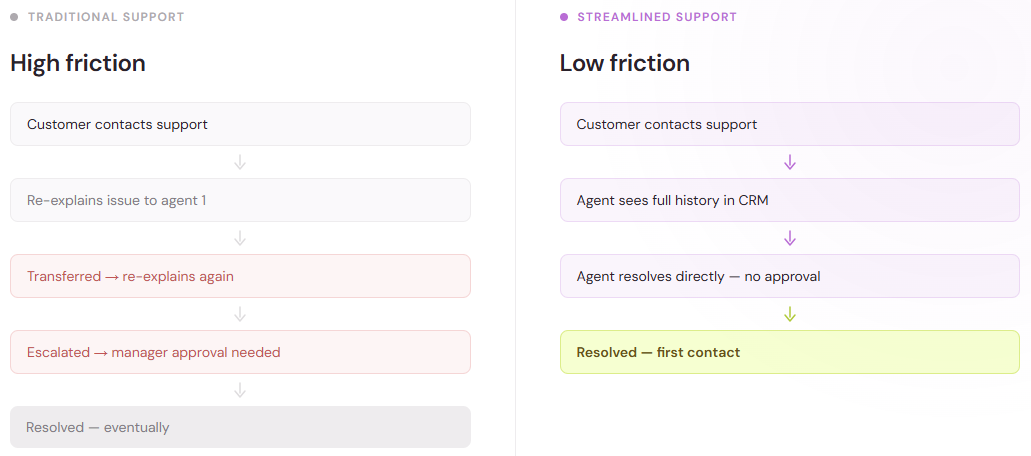
Friction kills customer satisfaction. Every extra click, every repeated explanation, every transfer to another department adds frustration. Customers already have limited time and patience; making them work harder to get help is a missed opportunity to build loyalty.
Excellent customer service interactions are effortless. Customers shouldn't have to work hard to get help. The easier you make the process, the more likely they are to engage with you again and recommend you to others.
Ways to reduce friction:
- Use CRM tools so agents can see the customer's history
- Offer multiple contact channels (email, chat, phone, social) and let customers choose
- Build a searchable help center so customers can solve simple problems themselves
- Empower agents to resolve issues without escalating to a manager
Modern customer feedback platforms in 2026 integrate AI-powered analytics, multi-channel collection (surveys, reviews, support tickets, chats, in-app), and case management automation. Use those tools to streamline the experience. When you eliminate unnecessary steps and make information accessible across channels, customers can get help their way, on their timeline.
4. Consistency across every touchpoint
Your customer's experience should feel the same whether they reach out via email, chat, phone, or social media. Inconsistency breeds confusion and erodes trust. Imagine calling support and getting one answer, then emailing the next day and getting a different answer. That experience undermines confidence in your entire organization.
This means:
- Policies are applied uniformly (no "that's not what the other agent told me")
- Tone and messaging align across channels
- Information is accurate and up-to-date everywhere
- Customers don't have to re-explain their issue when switching channels
Average CSAT across industries is 77%. Scores above 80 are excellent; scores below 70 indicate issues. Consistency is a major driver of those scores. When customers know they'll get the same quality experience regardless of how they reach you, satisfaction increases, and the likelihood of escalations decreases.
5. Empower your team
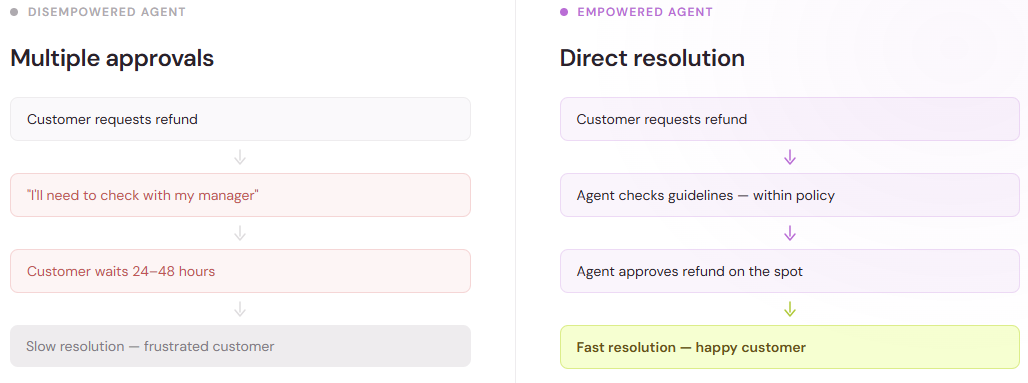
Agents who have to ask permission for every small decision slow down resolutions and frustrate customers. Empowerment means giving your team the authority, tools, and training to solve problems on the spot. When agents feel trusted to make decisions, they're more confident, more engaged, and more effective at solving customer problems.
This includes:
- Clear guidelines on what agents can do without approval (refunds, discounts, replacements)
- Access to customer data so they can make informed decisions
- Training that builds confidence in handling complex situations
- A culture that supports reasonable judgment calls
When agents feel trusted, they're more engaged. When customers see that agents can actually help, satisfaction rises. Empowerment also reduces the frustration of being told "I'll have to check with my manager," which can make customers feel like they're not being taken seriously.
6. Listen to feedback and act on it
Customer feedback is a gift. It tells you exactly where you're falling short and what matters most to your audience. Companies that ignore feedback are essentially choosing to miss opportunities for improvement that customers are voluntarily offering.
But collecting feedback means nothing if you don't act on it. This is where many organizations fall short. They gather insights but fail to implement changes based on what they learn.
Brands with strong loyalty programs report a 12-18% revenue increase. Part of that loyalty comes from customers feeling heard, and knowing their input leads to real change. When customers see their suggestions actually implemented, they feel invested in your success and are more likely to stay loyal even when competitors emerge.
Make feedback easy to give:
- Send short post-interaction surveys
- Monitor social media and review sites
- Ask open-ended questions, not just ratings
- Close the loop by telling customers what you've changed based on their input
When customers see their suggestions implemented, they feel invested in your success. This creates a virtuous cycle where engaged customers provide better feedback, leading to smarter improvements, which drive higher satisfaction.
7. Own mistakes openly
No company is perfect. When something goes wrong, acknowledge it quickly, apologize sincerely, and fix it. The temptation to minimize or hide problems is natural, but it's almost always counterproductive.
Customers don't expect perfection. They expect honesty and accountability. In fact, how you handle mistakes often matters more to customer loyalty than whether mistakes happen in the first place.
80% of people trust brands they use more than they trust business, media, government, or NGOs. That trust grows when you own up to failures and make them right. Transparency about problems signals confidence and integrity.
A good apology includes:
- Acknowledgment ("We made a mistake")
- Explanation (without excuses)
- Action ("Here's what we're doing to fix it")
- Compensation if appropriate (refund, credit, replacement)
Trying to hide or minimize a mistake damages trust far more than the mistake itself. Customers are forgiving when they see a genuine effort to make amends.
8. Personalize the experience
Generic, one-size-fits-all service feels impersonal. Customers want to feel like individuals, not ticket numbers. Personalization creates emotional connection and makes customers feel valued as unique people, not just data points.
Personalization doesn't require complex AI. It starts with using someone's name, referencing their purchase history, and tailoring your response to their specific situation. Small touches like these signal that you've paid attention to who they are and what they've experienced with you.
CRM systems, customer data platforms, and integrated support tools make this easier. When an agent can see that a customer has been loyal for three years or has had a recent bad experience, they can adjust their approach accordingly. This context enables more thoughtful, relevant interactions.
65% of revenue comes from existing customers, who spend 67% more than new customers. Treating them like individuals—not anonymous inquiries—keeps them coming back. When long-time customers feel recognized and valued, the incentive to look elsewhere diminishes significantly.
9. Proactive service beats reactive service
Don't wait for customers to complain. Anticipate issues and reach out first. Proactive service transforms you from problem-solver to partner, demonstrating that you care about their success beyond just processing transactions.
Proactive service looks like:
- Notifying customers about shipping delays before they ask
- Sending setup guides after a purchase
- Flagging potential problems ("Your subscription is about to renew")
- Following up after a support interaction to make sure the issue is resolved
Customer churn costs US businesses $136 billion annually. Proactive outreach reduces churn by catching problems before they escalate into reasons to leave. When customers feel looked after, they develop a stronger attachment to your brand.
10. Invest in continuous improvement
Customer service excellence is an ongoing commitment, not a one-and-done destination. What works today might not work next year as expectations shift and new tools emerge. The competitive landscape is constantly evolving, and standing still means falling behind.
Make improvement part of your culture:
- Review support metrics regularly (response time, resolution time, CSAT)
- Train your team on new tools, product updates, and soft skills
- Test new approaches (different messaging, new channels, automation)
- Learn from competitors and industry leaders
A five percent increase in retention leads to a 25-95% increase in profits. Continuous improvement in service quality directly impacts your bottom line. Small incremental improvements compound over time into significant competitive advantages.
Bringing it all together
These 10 principles aren't radical. They're the basics done exceptionally well.
Empathy, speed, ease, consistency, empowerment, feedback, accountability, personalization, proactivity, and improvement. Master those, and you'll build a customer service experience that turns one-time buyers into lifelong advocates.
Great service doesn't require a huge budget or a massive team. It requires clarity about what matters, a commitment to doing it consistently, and the humility to keep learning from your customers. Organizations of any size can implement these principles. They're about mindset and execution, not resources. The companies winning in customer loyalty aren't always the biggest; they're the ones most committed to these fundamentals.