Customer behavior analysis: how to read what buyers do
Customer behavior analysis shows what people actually do. Track engagement, purchase patterns, and retention signals to build loyalty and reduce churn.
Key Takeaways
- Behavior is more honest than words: People overestimate their own habits and preferences, so what customers actually do—clicks, purchases, drop-offs, logins—reveals more than surveys alone.
- The gap between opinion and action is the real insight: A customer who says they love your product but stops using key features is telling you something surveys can't capture on their own.
- Retention comes from reading customer behavior: Tracking engagement, purchase patterns, and support signals lets you spot churn risk early and act before customers leave.
- Combine behavior data with feedback to understand patterns: When engagement drops or a pattern shifts, use feedback to understand what caused it, then act. Segment customers, fix friction points, and double down on what keeps customers coming back.
Understanding what customers actually do—not just what they say—is the cornerstone of building a business people choose. Every click, purchase, pause, and return tells a story. When you learn to read that story, you unlock the ability to anticipate needs, fix problems before they start, and keep customers coming back.
Customer behavior analysis is the practice of tracking and interpreting the patterns in how people interact with your brand. It answers questions like: Which features do customers use most? Where do they get stuck? When do they abandon their carts? What drives them to buy again? The answers shape everything from product decisions to marketing strategy to customer loyalty.
This guide walks you through what customer behavior analysis is, why it matters, and how to gather and interpret the data that reveals who your customers really are.
Why customer behavior matters more than words
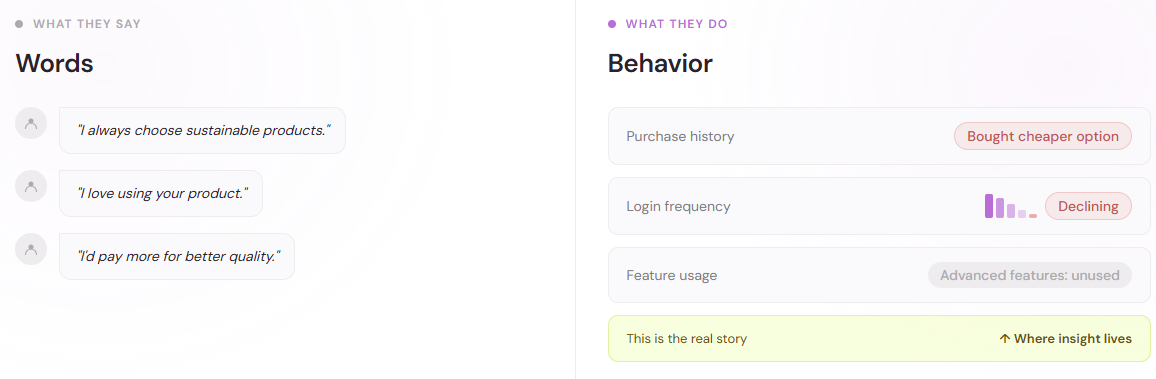
There's a fundamental gap between what people say they want and what they actually do. Someone might tell a researcher they value sustainability while clicking past your eco-friendly option to buy the cheaper product. A customer might say they love your service, yet their login frequency tells you they've stopped using it. That gap is where the real insight lives.
Behavior is honest. It's tied to real consequences—time, money, effort—so people think harder before acting than before speaking. When you track behavior, you're watching the decisions that matter.
This becomes especially important as trust shapes purchasing: 81% of consumers need to trust a brand to consider buying from it. But how do you build that trust? Not by what you claim about yourself, but by how you actually treat customers. The brands people trust most are the ones whose actions match their words.
Consider retention, too. Acquiring new customers costs five times more than retaining existing ones, and a five percent increase in retention can lead to a 25-95% increase in profits. You can't improve retention without understanding why customers stay or leave, and that understanding comes from tracking behavior over time.
What customer behavior data tells you
Customer behavior data falls into a few key categories, each revealing different truths.
Engagement patterns show how often people interact with your brand and in what ways. Are they logging in daily or monthly? Do they click through your entire onboarding or skip to the end? Which emails do they open? Which product features get used, and which collect dust? Engagement tells you what people actually value.
Purchase history reveals buying patterns: frequency, average order value, product preferences, seasonal trends. A customer who buys once a year on a specific date follows a different path than one who makes monthly micro-purchases. Those patterns let you anticipate needs and time offers when they're most likely to convert.
Navigation and flow tracks how people move through your website, app, or product. Where do they spend time? Where do they drop off? If 80% of visitors abandon your checkout on step three, that behavioral data is screaming for attention.
Support and complaint data shows friction points. If 30% of your support tickets come from confusion about one feature, your behavior data has flagged a UX problem before it becomes a retention crisis.
Loyalty signals include repeat purchases, referrals, reviews, and social sharing. These reveal your most valuable customers and their potential to become brand advocates.
How to gather behavior data
Behavior data comes from multiple sources, and the richest insights come from triangulating across them.
Product analytics track what people do inside your app or website. Tools log page views, clicks, feature usage, session duration, and funnel completion. You'll see which product categories people browse, which they skip, and where they convert.
Transaction data is straightforward: what did they buy, when, how much, how often? Over time, this builds a picture of customer lifetime value, seasonal trends, and product affinity.
Support and service interactions reveal pain points. A spike in refund requests, an uptick in support tickets about one feature, or repeated questions all signal behavior-level problems that surveys might never uncover.
Customer feedback (surveys, interviews, reviews, support chat) complements behavior data. When you combine survey responses with actual usage patterns, you get nuance. Someone might say they "love" your product while their behavior shows they've stopped using advanced features. That gap tells you either they don't know how to use them or they don't need them.
Modern customer feedback platforms integrate multiple data sources, combining surveys, reviews, support tickets, chat interactions, and in-app feedback with analytics to create a fuller picture of behavior and sentiment.

Reading your satisfaction scores
One concrete behavior metric is customer satisfaction (CSAT). When someone rates their experience, you're capturing a moment of opinion, but their future behavior will tell you if that opinion stuck.
Average CSAT across industries sits at 77%. Scores above 80 are considered excellent; below 70 suggests real problems. Full-service restaurants and banks lead at 82 and 80, respectively, while internet service providers lag at 73 and social media platforms at 74.
But here's what behavior data adds: a satisfied customer (CSAT of 9 or 10) who never buys again isn't as valuable as a moderately satisfied customer (CSAT of 7) who refers five friends. The score matters, but the behavior matters more.
Customer behavior analysis in practice
Step 1: Define what matters. Not all behavior is equally important. Decide upfront: What metrics tell you whether a customer will stay or leave? For SaaS, it might be feature adoption and login frequency. For e-commerce, it might be repeat purchase rate and average order value. For a media site, it might be session duration and return visits.
Step 2: Set baselines. What does "healthy" behavior look like? If your typical customer logs in three times per week and uses four core features, that's a baseline. When a customer drops to one login per week and uses only one feature, that's an early warning.
Step 3: Segment by behavior. Not all customers behave the same way. You might have power users who touch every feature daily, casual users who engage weekly, and inactive users who signed up but never returned. Each segment needs a different retention strategy.
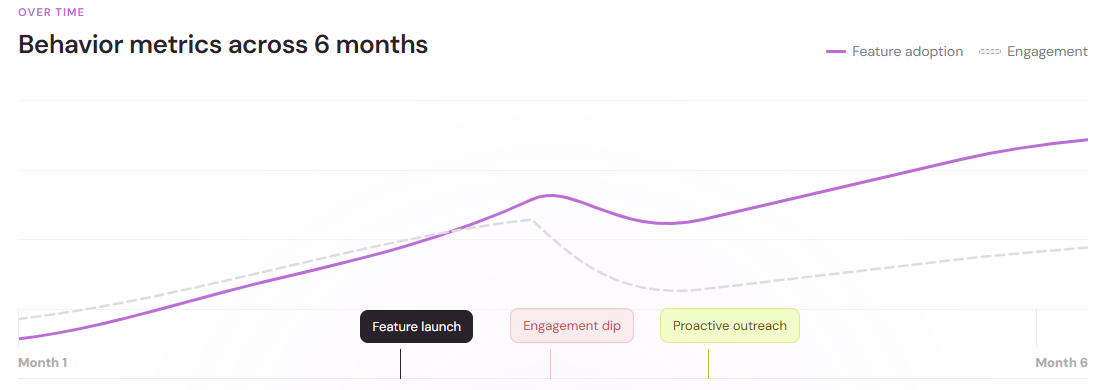
Step 4: Triangulate with feedback. When behavior changes, ask why. If engagement drops, send a quick survey to understand the cause. Are customers overwhelmed? Did they find a competitor? Their words will explain what their behavior shows.
Step 5: Act on patterns. The whole point is to change what you do. If churn spikes after three months, invest in better onboarding or a strong month-three check-in. If one feature is unused, either remove it or redesign it.
Why behavior beats opinion
People are not always reliable reporters of their own behavior. They overestimate how much they exercise, how often they read, and how much they value privacy, only for their actual behavior to contradict them. It's not malice; it's how human memory works.
That's why the best businesses layer behavior data under feedback data. You ask customers what they think, but you let their behavior be the tiebreaker. If 90% say they want a feature, but no one uses it when you build it, that tells you the demand wasn't as real as they thought. If customers are using a workaround to solve a problem, their behavior is shouting that the problem is real.
Building trust through behavioral insight
Trust is now equal to price and quality in brand purchase decisions. And 68% of people say it's very important that brands help them feel safe, confident, and inspired.
How do you do that across every touchpoint? By understanding customer behavior. When you know what customers do and what causes them to succeed, you can remove friction, personalize their experience, and make choices that show you understand them. That's respect, and respect builds trust.
The brands people trust most are the ones that listen to behavior, not just words. They watch where customers struggle and fix it. They notice when engagement drops and reach out proactively.
The retention imperative
Here's a behavioral reality: losing customers is costly. Acquiring new customers costs five times more than retaining existing ones. Customer churn costs US businesses $136 billion annually.
But here's the opportunity: brands with strong loyalty programs report a 12-18% revenue increase. Those programs work because they're built on behavioral insight. And 65% of revenue comes from existing customers, who spend 67% more than new customers. Behavior data helps you keep those customers happy.
Going deeper: Understanding your customer success strategy
To turn behavioral insights into action, many businesses build a formal customer success function. Customer success goes beyond support. It's about ensuring customers achieve their goals, which is exactly what behavior data enables. When you understand how customers actually use your product and where they struggle, you can design interventions that work.
For a deeper look at structuring this approach, Feedback vs. behavior: What do customers really want? explores how to integrate behavior and feedback data into your decision-making process. You'll also find a comprehensive resource in Customer Success: Nearly Everything You Need to Know, which covers how to build a customer success strategy centered on behavioral insights.
The bottom line
Customer behavior analysis isn't about surveillance or manipulation. It's about respect. When you take the time to understand customers' actions, not just their words, you show them you care enough to listen. You remove friction, while building products and services they want to use.
Start by defining the metrics that matter to your business. Gather data from multiple sources: product analytics, transactions, support, surveys, and feedback. Look for patterns. Segment by behavior. And always ask why when behavior changes.
The brands that win aren't the ones with the best guesses about their customers. They're the ones reading what customers are actually doing, and building on that truth.