Concept testing: how to validate ideas before you ship
Concept testing validates ideas before you build. Covers 5 methods, sample sizes, and the questions that turn early reactions into a go or no-go decision.
Before you build a product, redesign a website, or launch a campaign, there’s a critical question to ask: will your audience actually want this?
Concept testing answers that question. It’s a research method that lets you validate ideas with real people before you invest time and money into full development. Instead of crossing your fingers and hoping your concept resonates, you gather feedback early, spot problems, and refine your direction—all before launch day arrives.
The cost of getting it wrong after launch is steep. But the cost of getting it right upfront? That’s the intelligent investment.
This guide walks you through concept testing: what it is, why it matters, and how to run one that gives you actionable feedback.
What concept testing really is
Concept testing is a research method where you present an idea—in rough or polished form—to a sample of your target audience and gather their reactions. It’s deliberately done early, when changes are cheap, and momentum still exists to pivot.
The concept itself can be almost anything: a product mockup, a headline, a feature description, a visual design, a value proposition, or even a business model. The point is to understand whether your target audience sees value in what you’re proposing before you build it out fully.
Concept testing sits at the intersection of market research and user research. It borrows from both:
- From market research, it asks about demand, interest, and competitive positioning
- From user research, it focuses on usability, clarity, and experience
The key difference between concept testing and other research methods is timing and scope. You’re not testing a finished product; you’re testing an idea in its formative stage.
It also differs from later-stage usability testing. Usability testing assumes the concept is sound and asks whether the execution works. Concept testing asks the prior question: Is this idea worth executing at all?
Running these tests in the wrong order is a common mistake, and polishing the usability of an idea no one wants is a slow way to burn budget.
Why concept testing matters: the ROI of early validation
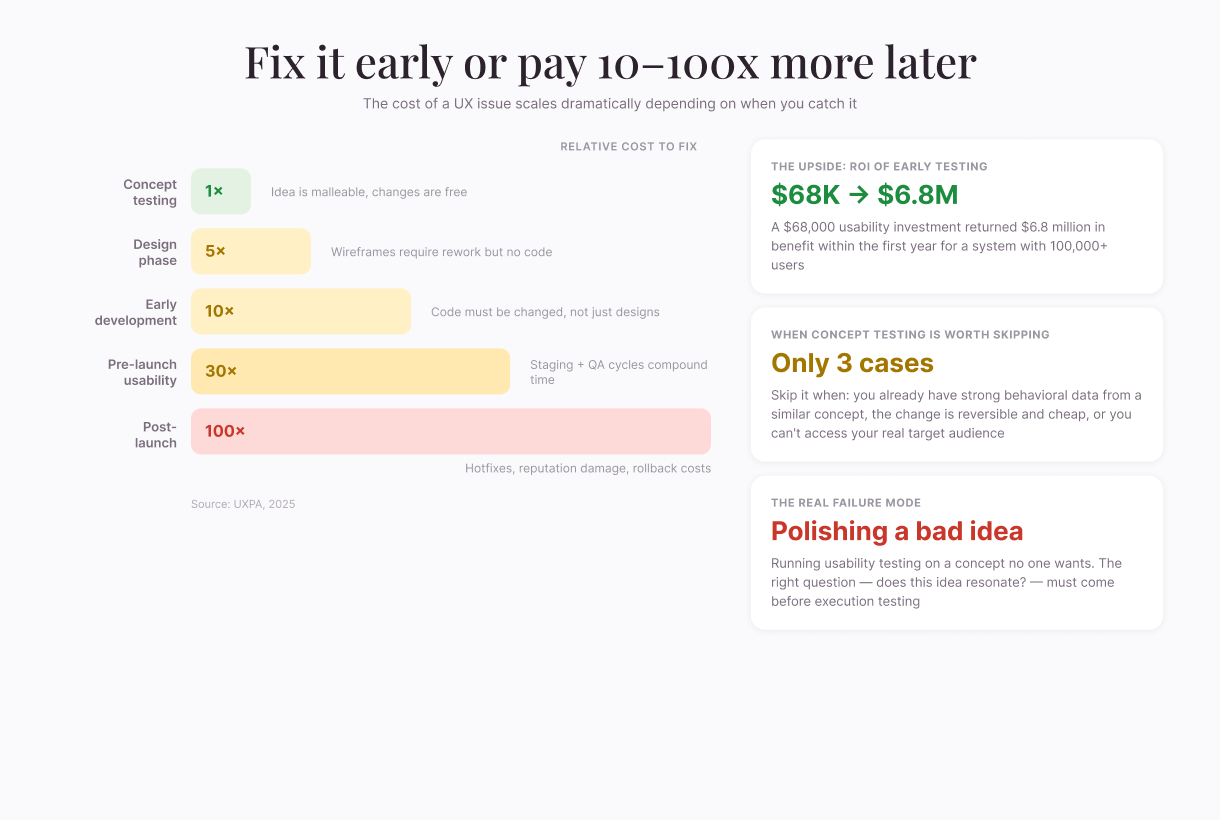
The financial case for concept testing is straightforward: One usability investment of $68,000 generated $6.8 million in benefit within the first year of implementation (UXPA, 2025). That’s real money saved by catching problems early.
Fixing a critical UX issue after launch costs 10 to 100 times more than catching it during early usability testing (UXPA, 2025). In other words, that $10,000 fix during the design phase becomes a $100,000 to $1,000,000 fix after thousands of users encounter it in production.
Concept testing prevents that scenario. By gathering feedback when your idea is still malleable, you can:
- Avoid wasting development resources on features no one wants
- Spot messaging problems early before they reach your market
- Refine your positioning based on how your audience actually understands your offering
- Build confidence that you’re solving a real problem
- Reduce launch risk by validating demand before full production
Beyond the numbers, concept testing gives your team permission to kill ideas. Killing a bad idea before it ships isn’t failure—it’s the entire point. If a concept doesn’t resonate with your target audience, learning that now beats learning it after launch.
Common concept testing methods
Concept testing can take many forms depending on your timeline, budget, and feedback needs:
Survey-based concept testing
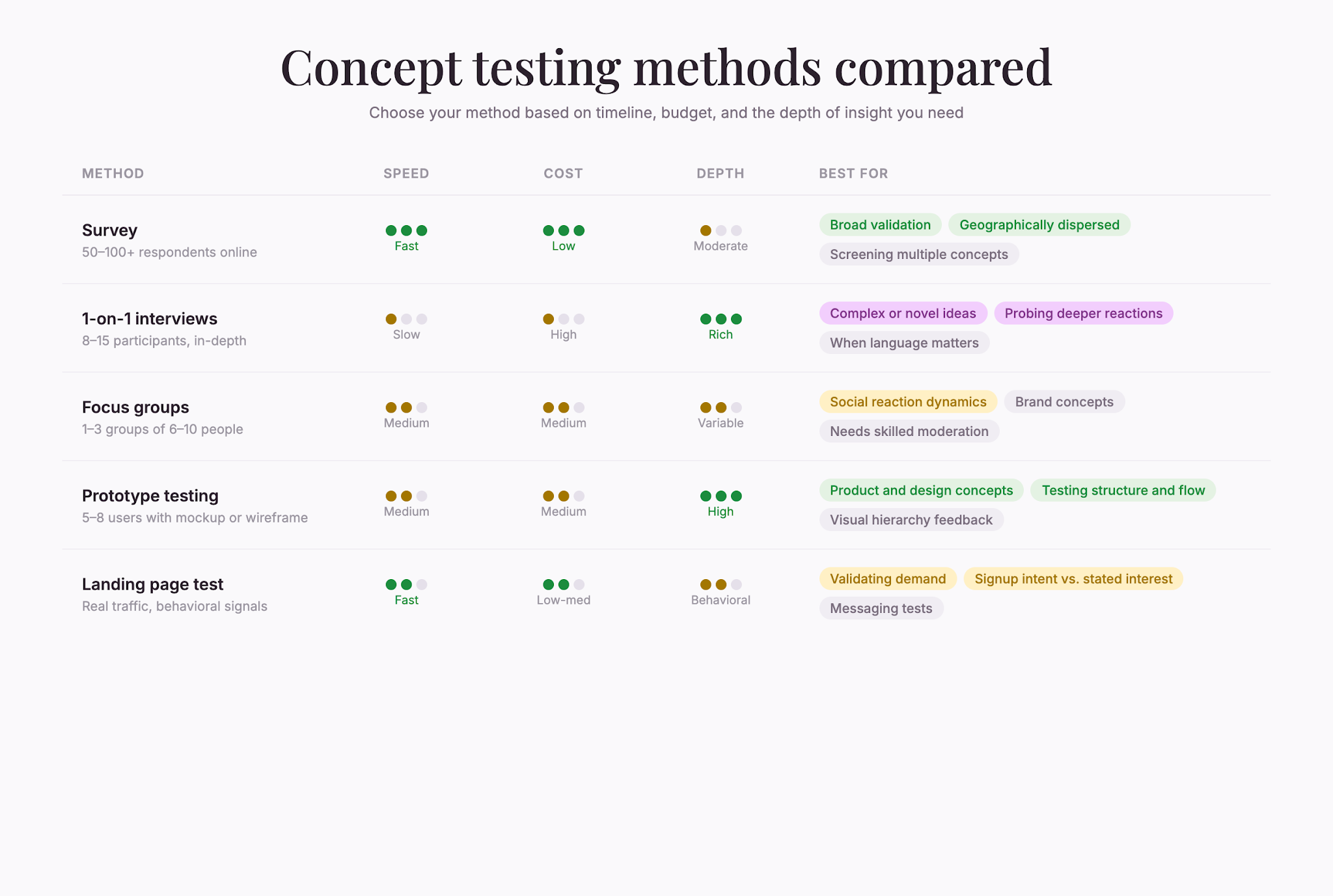
Present your concept via a survey with multiple-choice or open-ended questions about reactions, likelihood to use or buy, and specific concerns. This scales efficiently for large, geographically dispersed groups. The tradeoff is depth—survey responses are typically shorter than interviews.
One-on-one interviews
Show your concept to individuals from your target audience and ask open-ended questions about first impressions, concerns, and usage. Interviews are slower and more expensive but give rich qualitative insight and room to probe deeper. They’re especially useful for novel or complex ideas, where survey responses might miss the real reaction because respondents don’t have the language yet to describe what they’re seeing.
Focus groups
Gather 6 to 10 people from your target audience and facilitate a group discussion about your concept. The group dynamic surfaces unexpected reactions, but it can lead to groupthink and dominant voices drowning out quieter ones. Skilled moderation matters—an unskilled facilitator can produce data that says more about the loudest participant than about your concept.
Prototype or mockup testing
Show users a rough prototype, wireframe, or high-fidelity mockup and observe how they interact with it or gather reactions. This works particularly well for product concepts and design-heavy ideas. The fidelity of the prototype should match the question: low-fidelity wireframes are best for testing structure and flow, while higher-fidelity mocks help you test branding, tone, and visual hierarchy.
Landing page testing
Build a simple landing page describing your concept and measure responses through signups, click-through rate, or time spent on the page. This provides behavioral data, not just stated preferences—often the most reliable signal because people lie about intent more readily than they lie with their clicks.
Most teams combine methods. You might start with a survey to screen concepts, then run interviews with the most promising ones, then test a mockup with a subset of users.
When concept testing isn’t the right tool
Concept testing has limits. Skip it when:
- Your concept is too vague to evaluate. If you can’t describe the concept in a clear sentence, you’re not ready to test—you’re still ideating. Sharpen the idea first.
- You already have strong data. If you’ve shipped a similar concept before and have behavioral data showing demand, additional testing can be redundant.
- The decision is reversible and cheap. If the cost of being wrong is a one-week experiment, just run the experiment.
- Your audience is impossible to reach. Concept testing depends on speaking to your actual target users. If you can’t access them, the data you collect from a proxy may mislead more than it informs.
Recognizing when not to test is part of the discipline. The goal isn’t to test everything—it’s to test the decisions where being wrong is most expensive.
How to run concept testing that actually works
Running concept testing effectively requires a few critical steps:
1. Define your target audience clearly
Test with people who actually represent your intended users or customers. If you’re testing a B2B accounting tool, find accountants and finance managers. The more specific your definition, the more actionable your feedback.
2. Create a testable concept
Your concept needs to be clear enough for understanding, but shouldn’t oversell or guide reactions. Show a mockup, describe the core idea, explain the benefit, and stop.
Avoid this common mistake: pitching so hard that respondents feel obligated to like it, or filling in so many details that you’re testing execution rather than the core concept.
3. Ask the right questions
Good concept testing questions include:
- What’s your first impression of this idea?
- What problem, if any, do you think this solves?
- How likely would you be to use, buy, or try this?
- What would make this more appealing?
- What concerns do you have?
- How does this compare to other solutions you use?
Avoid leading questions (“Isn’t this a great idea?”) or vague ones (“What do you think?”). Mix in a behavioral signal where you can—“Would you click sign up if this were available today?” beats “Would you be interested?”
4. Test with adequate sample size
Sample size depends on your method:
- For surveys, aim for 50 to 100+ respondents for major decisions
- For interviews, 8 to 15 respondents often surface major themes
- For focus groups, 1 to 3 groups of 6 to 10 people each
- For prototype testing, 5 to 8 users often reveal critical issues
Testing with three people beats zero, but be honest about sample limits. A 5-person interview can tell you a concept is fundamentally broken; it can’t tell you which version of two strong contenders will win.
5. Analyze for patterns
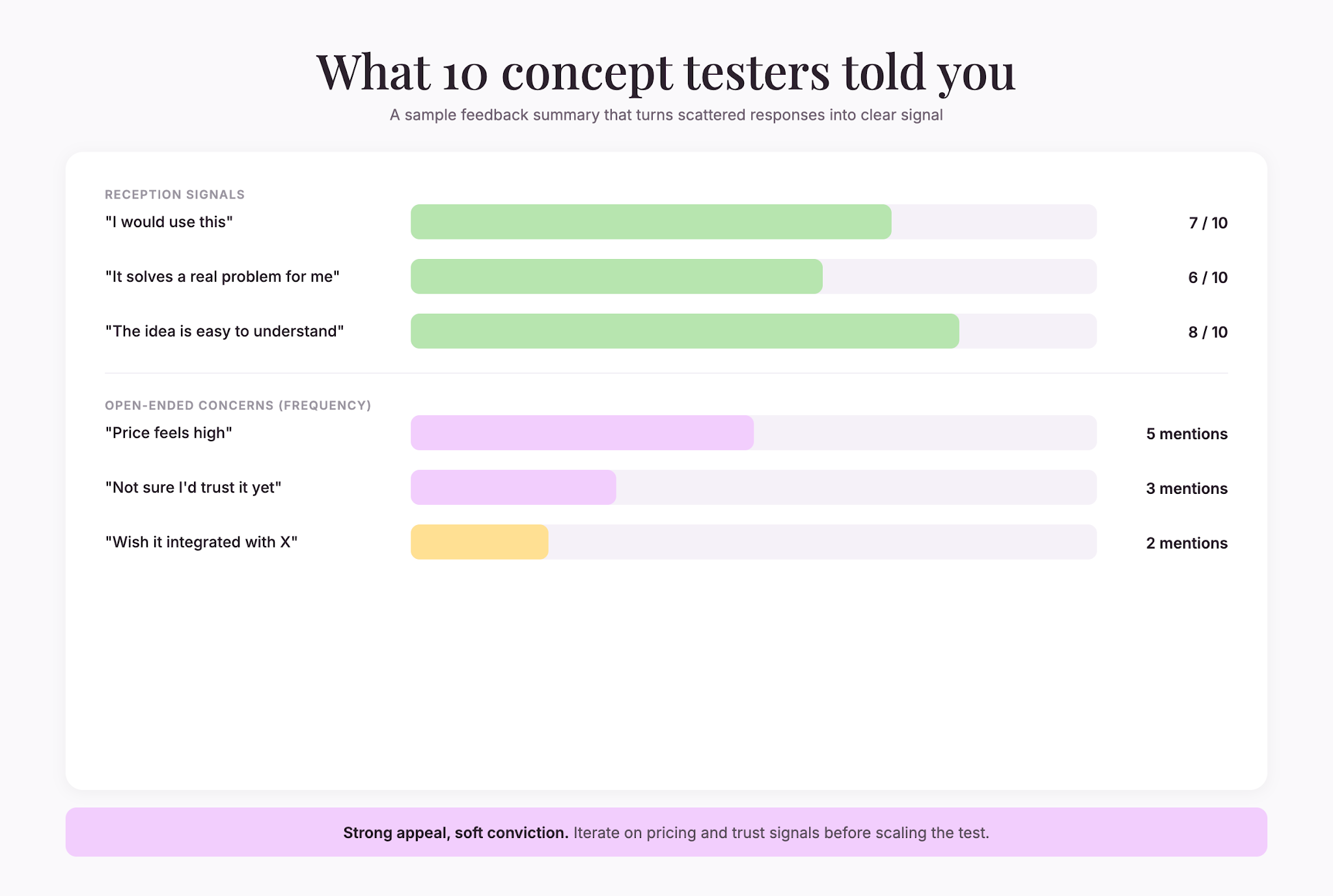
Look for themes and patterns, not individual comments. One person saying “I wouldn’t use this” is a data point. Three out of 10 saying the same thing is a pattern worth investigating.
Create tallies of key responses: how many said this solves their problem, how many would try it, what the most common concern was.
6. Close the loop with follow-up action
Document what you learned, which concepts passed or failed, and what changes you’ll make. Share results with your team and stakeholders, explaining what you tested, who you tested with, what you learned, and what you’re changing next.
Concept testing in practice: when to run one
Concept testing makes sense at specific moments:
- Before building a new product – Test whether your target market wants it and whether your positioning resonates.
- Before a major redesign – Validate the new concept before sinking months into building it.
- Before a campaign launch – See which marketing concepts land and which fall flat.
- When pivoting – Validate whether a new feature, market segment, or business model is worth pursuing.
- When uncertain about positioning – Learn how your target market actually interprets your value proposition
Tools and approaches for gathering concept feedback
Concept testing doesn’t require expensive software:
- Survey platforms create surveys, collect responses, and analyze results—scalable for broad feedback
- Interview and usability testing platforms help you conduct sessions and organize notes and recordings
- Prototyping tools often include built-in feedback features so you can test mockups directly
- Participant recruiting services find people matching your target audience, especially useful for niche groups
Many teams also use ad hoc approaches: email surveys to customers, quick calls with prospects, informal testing with colleagues. These aren’t rigorous, but they’re fast and cost nothing.
Making sense of concept testing results
Start with overall sentiment and likelihood metrics. If 70% would likely try your concept, that’s encouraging. If only 20% would, that’s a red flag.
Then dig into qualitative feedback. Look for patterns in what people like, what concerns them, and what they see as different. One complaint about price is a note; five mentions is a pattern to address.
Watch for the gap between stated interest and behavior. If 80% say they’d use your concept but only 20% click through to sign up, that gap tells you something—usually that your messaging is appealing in theory but doesn’t translate into action. The behavioral signal is almost always more honest than the stated one.
Be honest about what the data tells you, even when it contradicts your assumptions. That’s the whole point of concept testing.
Concept testing as a continuous practice
The most successful teams don’t run concept testing once. They use it as a recurring practice throughout product development.
New feature concept? Test it. New market? Validate first. Rethinking positioning? Get feedback before overhauling messaging.
By building concept testing into your workflow early and often, you reduce expensive surprises and build products and campaigns that resonate with your audience.
The upfront investment in validation pays dividends every time. Start small—even a 10-person survey surfaces major issues. Over time, you’ll develop instincts for what your audience wants, but concept testing keeps those instincts grounded in reality.
That cadence is easier to keep when survey design, qualitative analysis, and team review live in one workflow. And that’s exactly what ResearchFlow is built for.