How to ask customers for Google reviews (without being pushy)
Ask for Google reviews without seeming pushy. Timing within hours of a positive moment, a short ask, and direct links dramatically increase completion rates.
.png)
Key Takeaways
- Ask within hours of a positive moment, not days later: The window when a customer feels good about your business closes fast, and asking too early or too late lands flat.
- Make the request short and remove every extra step: A direct link, QR code, or in-app prompt gets more completed reviews than a generic form buried behind multiple clicks.
- Personalize the ask with one specific detail: Referencing their purchase, tenure, or resolved issue makes the request feel targeted instead of broadcast.
- Never ask for five-star reviews or offer rewards: Both violate Google's policies and signal you want flattery instead of honest feedback.
Google reviews shape how potential customers see your business. A stellar review can tip someone from "maybe" to "definitely buying." A string of mediocre ones sends people elsewhere. Yet asking for reviews feels awkward, like you're interrupting someone's day to ask for a favor.
The good news: there's a way to request reviews that feels natural, not demanding. It comes down to timing, tone, and giving people a reason to say yes.
Why Google reviews matter (and why asking is okay)
Google reviews aren't vanity metrics. They're social proof in motion. When someone searches your industry, they see your star rating before they see your name. Reviews answer the question every prospect silently asks: "Is this business worth my time and money?"
The catch is that most happy customers never leave a review unless you ask. They're busy, distracted, or they simply don't think about it. Asking isn't pushy; it's giving them permission to share an opinion they probably already have.
The difference between pushy and professional comes down to context. Pushy is interrupting someone mid-complaint with a link to your review page. Professional is catching them in a moment of genuine satisfaction and making it effortless to share that feeling.
Timing is everything
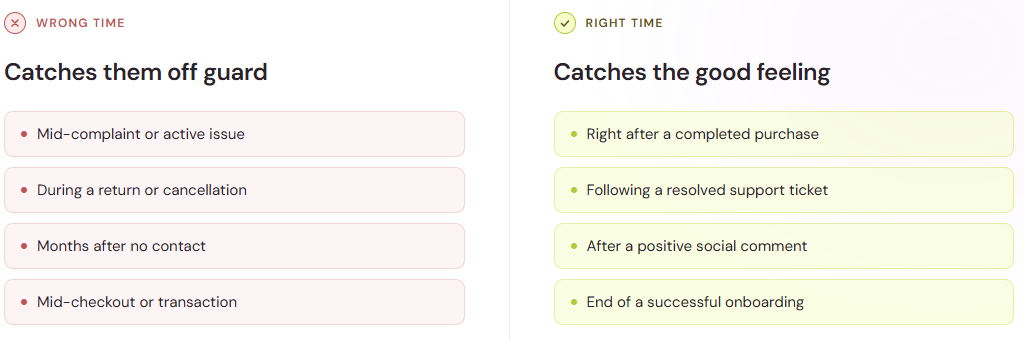
A customer’s window of becoming a promoter closes fast. It's right after a great customer service interaction, a successful purchase, or a resolved problem that people feel most positive about your business.
That’s your window to ask—and it’s narrower than most teams think.
Ask too early, and you're presumptuous. Ask too late, and the good feeling fades. The sweet spot is within hours of a positive experience, not days or weeks after.
Examples of high-intent moments:
- Right after a completed purchase or delivery
- Following a successful support ticket resolution
- When a customer leaves a positive comment on social media
- At the end of a positive in-person interaction (if you're a brick-and-mortar business)
- After they've used a key feature or completed an onboarding step (for SaaS products)
The wrong times to ask:
- During or immediately after a complaint or issue
- When they're canceling a subscription or returning an item
- In the middle of a busy checkout or transaction
- When you haven't heard from them in months and suddenly appear asking for reviews
Automation can help here. If you use a customer relationship management (CRM) system, you can trigger review requests at the right moments without manual effort. Just make sure the timing feels human, not robotic.
Keep the ask short and friendly
People are skimming. Your request for a review will get maybe 10 seconds of attention. Make those seconds count.
A good review request does three things:
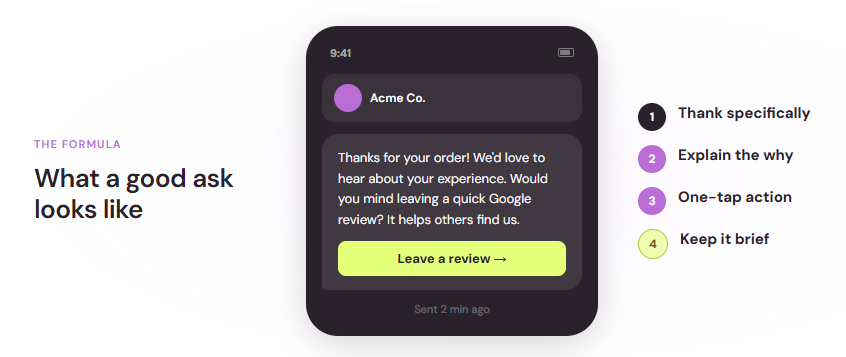
- Thanks the customer specifically (not generically)
- Tells them why their opinion matters
- Makes it ridiculously easy to leave a review
Example that works:
"Thanks for choosing us! We'd love to hear about your experience. If you found [what you bought / the service / the support] helpful, would you mind sharing a quick review on Google? It helps other people find us, and it means a lot to us."
This version:
- Opens with genuine gratitude
- Explains the why (helps others find you)
- Acknowledges that it's a small ask (quick review)
- Ends on a personal note (means a lot to us)
Example that falls flat:
"Please leave us a five-star review on Google."
This one is blunt, assumes a five-star rating, and offers no context. It reads like a demand, not a request.
The tone matters as much as the words. Sound like a real human asking a neighbor for feedback, not a faceless business angling for ratings.
Remove friction from the process
You want the easiest path from "I'd like to leave a review" to "Review posted." Every extra step you add is a reason for someone to give up.
On email or text: Include a direct link to your Google review page. People won't search for it themselves. They'll close the message and move on.
To get your Google review link:
- Open Google My Business (now called Google Business Profile)
- Go to your business listing
- Click "Customers" and then "Reviews"
- Look for the link option or copy your review URL
- Paste it into your request
On your website: Add a reviews section that lets people click straight to Google without leaving your site. A simple button that says "Leave a review on Google" with a link underneath does the job.
In person: A QR code is your friend. Point a phone camera at it, and people land directly on your review page. No typing, no thinking. Just one tap.
In apps or software: Use in-app prompts that link directly to your Google review page. The closer you can keep the request to where your customers already are, the higher your completion rate.
Test your links before you send them. Nothing kills momentum faster than a broken link that lands people in the wrong place.
Personalization increases completion rates
"You rated our service five stars. We're thrilled! Would you mind sharing that love on Google?" hits different than a generic form email sent to thousands of people.
Where can you personalize?
- By purchase or interaction type: "Thanks for your order of [item]. If it arrived in perfect condition, we'd love a Google review."
- By customer tenure: "You've been with us for two years now. Your loyalty means everything. If you'd like to share why you stick with us, Google reviews help new customers find places like ours."
- By specific moment: "Our team worked hard to solve that issue for you. If we nailed it, a quick Google review helps us keep doing more of the same."
Personalization doesn't have to be complicated. One variable—their name, their purchase, their issue—is enough to make a request feel targeted instead of broadcast.
Personalization also gives people a reason to act. "You seemed to love the fast checkout" is more compelling than "We'd appreciate a review."
Handle negative experiences with grace
Some customers will encounter problems. If they do, your approach to asking for reviews needs to shift.
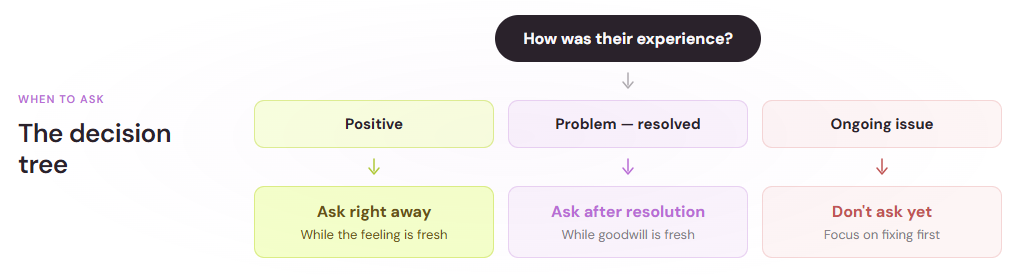
If someone had a bad experience but you fixed it, the timing becomes even more critical. Ask for a review right after you've resolved the issue, while goodwill is fresh. The message shifts, too:
"We know you had trouble with [specific issue], but we're glad we could make it right. If our team earned back your trust, we'd be grateful for a Google review. And if anything else comes up, you know how to reach us."
This approach acknowledges the problem, shows you remember it, and makes a gentle ask. It also signals that you're not afraid of honest feedback. Rather, you're confident enough to ask for it even after a stumble.
What not to do: never ask someone to delete or change a negative review. Never offer incentives (Google's policies explicitly prohibit paying for reviews or offering discounts in exchange). Never use guilt or pressure.
If someone leaves a negative review, respond professionally and publicly. Show other potential customers that you take feedback seriously and know how to fix problems. That response often matters more than the review itself.
The role of feedback collection in review requests
Before you ask someone to leave a public Google review, you might want to know what they're likely to say. That's where collecting feedback first becomes strategic.
A simple question sent via email or SMS—"How would you rate your experience with us?"—gives you a signal. If they respond positively, it's a green light to ask for a Google review. If they respond with hesitation or criticism, you've caught a problem before it becomes public feedback. You can address it directly instead of hoping it doesn't leak into a one-star review.
This two-step approach feels less aggressive. You're asking for permission (via feedback) before you ask for the public gesture (a review). Most people are more comfortable taking that first step.
Make reviews part of your routine
Asking for reviews once isn't a strategy. It's a one-time ask. Instead, weave review requests into the normal cadence of your business.
If you send a thank-you email after every purchase, add a soft ask for a review to that template. If you send a "How are you doing?" check-in email to long-term customers, include a review link. If you have an onboarding email series for new customers, end the series with a review request.
Consistency is what drives results. Some customers will ignore the first ask. A second ask weeks later, in a different context, might land. Third time's the charm for many.
Set a rhythm and stick to it. Monthly review requests to different customer segments, triggered by different events, all pointing to the same place: your Google review page.
What not to do when asking for reviews
A few things that backfire:
Asking for five-star reviews only. You're inviting people to lie or feel pressured. Ask for honest feedback. A four-star review with a thoughtful comment is more valuable than a five-star one that says "good."
Offering rewards. Free shipping, a discount code, or a gift card in exchange for a review violates Google's policies and looks like you're buying opinions. It also taints the authenticity of the review in potential customers' eyes.
Asking repeatedly on every channel. Email, text, in-app notification, social media DM, and a phone call all in one week feels like harassment. Pick two channels max and space them out.
Ignoring negative reviews. Silence signals that you don't care about criticism. Respond to every review, positive and negative, within 24-48 hours if you can. Show that you're listening.
Making the process complicated. If someone has to navigate more than two clicks to reach your Google review page, many will give up. Simplicity wins.
The payoff
Asking for reviews takes effort, but the payoff compounds. A business with 50 thoughtful reviews shows up differently in search results than one with five. New customers trust what they read from other real people far more than they trust your marketing copy.
When you ask the right way—at the right time, with genuine appreciation, and with zero friction in the process—most people say yes. They're not doing you a favor. They're sharing an opinion they already hold. You're just making it convenient to express it.
The key difference between pushy and professional comes down to respect: respecting their time, respecting their opinion, and respecting the genuine value their feedback brings to other people making decisions about your business.