How to improve employee retention: 14 proven strategies
How to improve employee retention: Clarity, manager quality, growth, and sustainable workload matter far more than perks or ping-pong tables.
Key Takeaways
- Retention starts with clarity, not perks: Only 46% of workers know what's expected of them, and that confusion is often what pushes people toward other offers.
- Managers determine most of the outcome: 70% of team engagement traces back to the manager, so preparing managers to have real conversations and build psychological safety pays off directly in who stays.
- Growth, recognition, and workload all signal whether someone has a future: People leave when they can't see a path forward, feel unrecognized, or hit burnout, even if the job itself is otherwise fine.
- Measurement only builds trust if you act on it: Surveys and stay interviews only help if you share what you learned and make visible changes, or employees stop believing feedback matters.
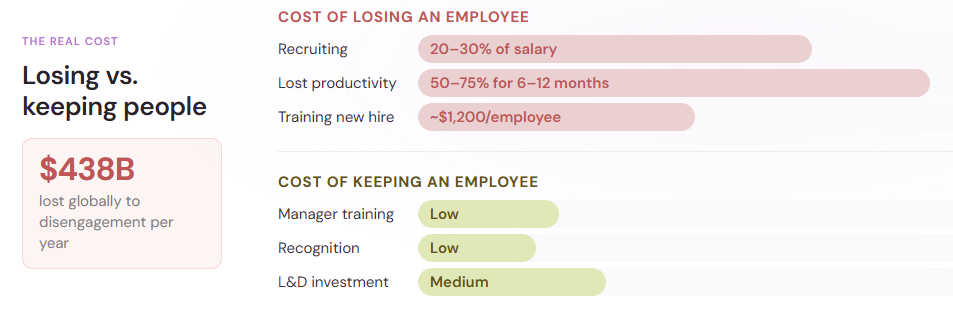
When an employee leaves, the cost goes beyond their final paycheck. You lose institutional knowledge, team morale dips, and you're back to square one with hiring and training. The numbers tell the story: globally, employee engagement fell to 21% in 2024, costing organizations $10 trillion in lost productivity. In the US alone, only 31% of employees are actively engaged.
Thankfully, retention is something you can influence. The strategies in this article aren't about perks or ping-pong tables. They're about creating conditions where people want to show up, do their best work, and stay. Understanding how to improve employee retention requires a systematic approach that addresses the root causes of why people leave in the first place.
Focus on clear expectations
When employees don't know what success looks like, they can't hit the target. Only 46% of workers clearly understand what's expected of them at work, down from 56% in 2020. That confusion breeds frustration and makes people vulnerable to job offers elsewhere.
Start by defining role expectations in writing. What are the three to five core responsibilities? What does good performance look like? Share these with new hires on day one and revisit them quarterly. Clear expectations reduce anxiety and help employees feel confident in their ability to succeed.
The clearer the picture, the more confident people feel. And confident employees are more likely to stay.
Invest in manager training
Here's a hard truth: 70% of team engagement comes down to the manager. When managers receive role-specific training, their reported well-being jumps from 28% to 50%.
Yet many organizations skip manager development because it feels like a soft skill or a nice-to-have. It's not. Managers are your frontline retention tool.
Effective manager training covers:
- How to have difficult conversations without shutting people down
- Setting goals that feel ambitious but achievable
- Recognizing effort and progress, not just wins
- Creating psychological safety so people feel okay admitting mistakes or asking for help
When managers improve, engagement improves. When engagement improves, retention follows.
Build a listening culture
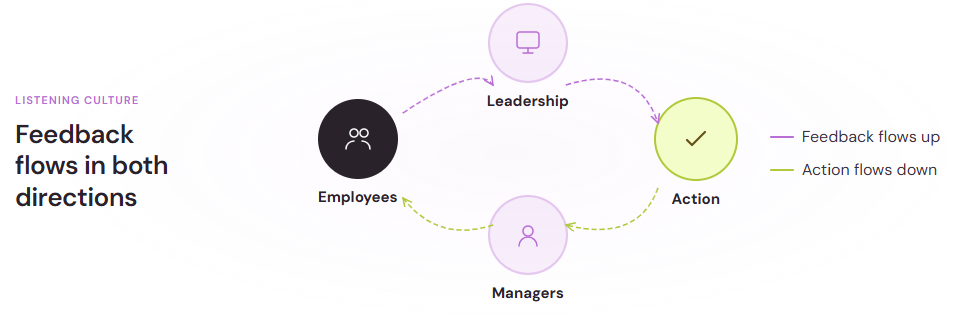
People leave jobs when they don't feel heard. Building a genuine listening culture—where feedback flows in multiple directions—changes that dynamic.
This doesn't mean annual engagement surveys (though those have a place). It means creating regular touchpoints where people can share what's working, what's not, and what they need.
Some approaches that work:
- Weekly one-on-ones where managers ask genuine questions and actually listen
- Skip-level conversations where employees can talk to their manager's manager
- Pulse surveys that take three to five minutes, run monthly, and show people their feedback leads to change
- Open office hours where leadership is available for questions and concerns
- Anonymous feedback channels for people who aren't comfortable speaking up in person
The key: collect feedback, then act on it. When people see change happen because of what they said, they believe you actually care.
Provide pathways for growth
Employees who see a future for themselves are more likely to build that future with you. Without growth opportunities, even great jobs feel like dead ends.
Map out development pathways for each role. What skills does someone need to move up or sideways? What training, mentoring, or projects would help them get there?
Then make that map visible. Share it in the hiring conversation, in onboarding, and revisit it in regular check-ins. When employees understand their trajectory, they invest more deeply in their role.
Growth doesn't always mean climbing. It can mean deepening expertise, taking on new projects, leading initiatives, or moving to adjacent teams. The point is movement, the sense that they're building something.
Recognize and reward good work
Recognition doesn't have to be expensive. It has to be genuine and timely.
Call out specific wins in team meetings. Write a personal note when someone goes above and beyond. Share their success with leadership. Celebrate milestones: first month, first year, promotions, or projects completed.
Public recognition works for some people; private recognition works for others. Know your team and adjust accordingly.
Reward systems should tie to performance and values, not just tenure. When people see that hard work and living the company's values actually matter, they invest more.
Offer competitive compensation and benefits
Money won't keep someone in a miserable job. But underpaying people relative to market rate will definitely make them leave.
Run compensation audits annually. Check what similar roles pay at comparable companies in your region. If you're below market, you're signaling that you don't value that role.
Beyond salary, look at benefits that matter to your workforce:
- Health insurance and mental health support
- Flexible work arrangements (remote, hybrid, flexible hours)
- Parental leave and family support
- Professional development budgets
- Retirement contributions
- Paid time off that people actually take
Different cohorts value different things. Ask your team what matters most and use that to shape your benefits package.
Make onboarding matter
The first 90 days set the tone. New employees are deciding whether they made the right choice. If onboarding is chaotic, scattered, or impersonal, they're already reconsidering.
Effective onboarding includes:
- A clear schedule for the first week and month
- A designated buddy or mentor, not just HR
- Introductions to key people and teams
- Training on tools, systems, and processes
- Clear wins they can achieve in their first month
- Regular check-ins asking how they're settling in
Onboarding that's this intentional signals: we planned for you, we want you to succeed, and we're invested in your experience. A strong onboarding process can meaningfully increase the likelihood that new hires will remain with your organization long-term.
Foster genuine inclusion
People stay where they feel they belong. Inclusion means more than diversity metrics. It means people feel seen, respected, and valued for who they are.
Look at whose voices get heard in meetings. Whose ideas get built on? Who gets the high-visibility projects? Are certain groups over- or under-represented at leadership levels?
Some concrete steps:
- Train teams on unconscious bias and inclusive leadership
- Create affinity or resource groups where people can connect
- Actively solicit input from quieter team members
- Address microaggressions and bias when you see it
- Celebrate the full humanity of your people: their backgrounds, perspectives, and experiences
Inclusion is continuous work, not a box to check. But the effort pays off in retention.
Create a sustainable workload
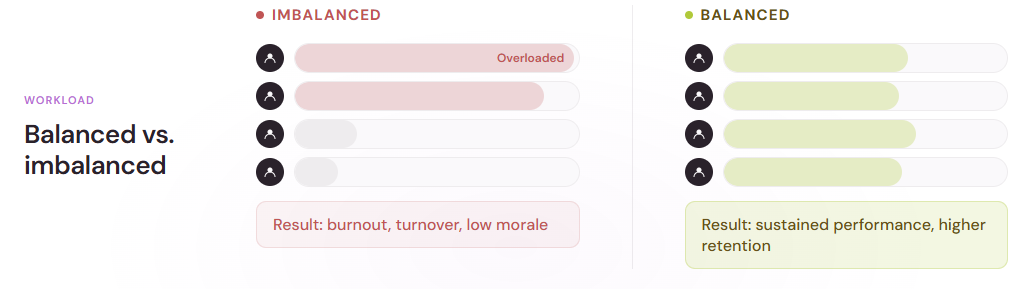
Burnout is a fast track to turnover. When people are constantly overwhelmed, exhausted, or on call, they leave, especially top performers who have options.
Help managers assess workload realistically. Are deadlines reasonable? Is the pace sustainable? Are people expected to work outside normal hours regularly?
Some ways to build sustainability:
- Set boundaries around after-hours communication and work
- Encourage people to take vacation time (and model it yourself)
- Build slack time into schedules for unexpected issues
- Rotate high-stress projects so no one carries them alone
- Be willing to say no to requests that would overload teams
Sustainable work isn't less ambitious. It's ambitious work, paced so that people can do it well without burning out.
Align values and culture
People stay when their personal values align with the organization's values. Misalignment creates constant friction.
Be clear about what your company stands for. How do you treat people? What matters more than profit? How do you show up in the community? What's non-negotiable?
Then live it. If you say you value work-life balance but promote the person who works 60-hour weeks, people notice. If you talk about integrity but cut corners to hit numbers, people notice. If you say you value diversity, but your leadership is homogeneous, people notice.
Alignment between stated and lived values builds trust. Misalignment erodes it, and drives turnover.
Enable skill development and learning
Stagnation breeds boredom, which breeds departure. People want to grow and learn.
Offer tuition reimbursement for relevant courses. Create internal training programs. Bring in guest speakers or experts. Support conference attendance. Create peer learning groups where people share skills.
Learning doesn't have to be formal. It can be lunch-and-learns, mentoring relationships, stretch assignments, or time set aside weekly to explore new tools or approaches.
The investment in learning signals: we want you to get better at what you do, and we're willing to invest in that.
Measure and respond to engagement
You can't improve what you don't measure. But measurement without action is worse than no measurement at all. It signals you don't actually care.
Use engagement surveys or pulse surveys to understand how people feel. Ask about clarity, autonomy, growth, support, and belonging. Disaggregate the results by team and level so you can see where problems are concentrated.
Then act. Share what you learned. Prioritize the top few issues and create visible change. Follow up to show progress.
This cycle—measure, share, act, follow up—builds credibility. People believe your engagement initiatives aren't just theater.
Support mental health and wellbeing
Work stress affects health. Health challenges affect work performance and retention. The two are inseparable.
Offer mental health benefits: counseling, coaching, or access to mental health apps. Train managers to recognize signs of burnout or struggle. Create space to talk about mental health without stigma. Offer wellness programs that people actually want to use.
This is especially important for young and female managers, who experienced the largest engagement declines in recent years.
Wellbeing isn't a perk. It's a foundation for showing up as your best self.
Build connection and community
Remote and hybrid work can leave people isolated. Even in-office teams need intentional connection.
Create space for informal interaction: virtual coffee chats, team meals, Slack channels for non-work topics, or regular in-person time for distributed teams.
Connection builds psychological safety and trust. It makes work feel less transactional and more relational. And when people feel connected, they're more likely to weather the hard days and stay through challenges.
Conduct stay interviews
Most organizations wait until someone quits to understand why they're leaving. By then, it's too late.
Stay interviews flip the script. Ask people why they're still there. What keeps them engaged? What would make them consider leaving? What do they need more of?
These conversations serve dual purposes: they help you understand what's working, and they make people feel valued and heard. Both boost retention.