How to improve employee engagement: 8 proven tactics
Improve employee engagement with 8 tactics that work. Managers drive 70% of outcomes - here's how to build clarity, recognition, listening, and trust.
Key Takeaways
- Managers drive most of the outcome: 70% of team engagement traces back to the manager, so training managers to coach and listen pays off across every team they lead.
- Clarity beats good intentions: Only 46% of employees know what's expected of them, so revisit role expectations and priorities regularly instead of assuming a single conversation is enough for people to remember and act on them.
- Measurement only matters if you act on it: Track engagement scores and retention, then show employees what changed because of their feedback, since collecting data without acting on it erodes the trust that made employees honest in the first place.
- Recognition works when it's specific, not generic: Naming the exact behavior you're praising teaches the rest of the team what excellence looks like.
Employee engagement isn't a nice-to-have anymore. It's fundamental to your organization's success. When employees feel invested in their work and valued by their company, they're more productive, stay longer, and do better work. The problem is clear: only 31% of employees in the US are actively engaged, and globally, engagement has fallen to just 20%. Disengaged employees contribute to an estimated $8.8 trillion in lost productivity globally.
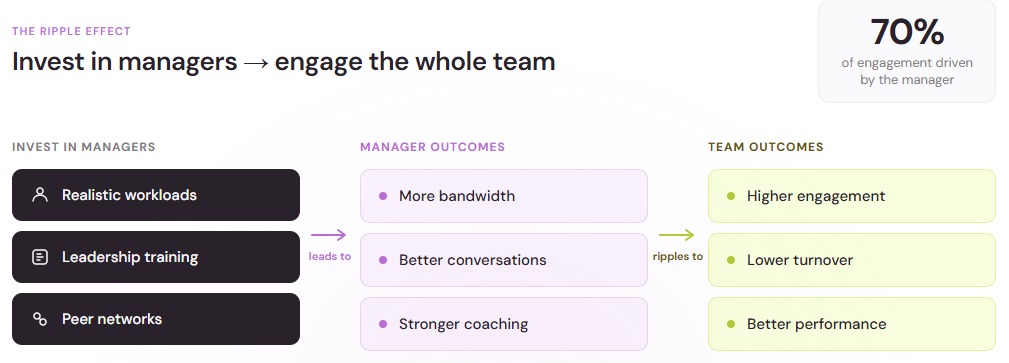
The good news is that engagement is built through deliberate action, starting with how managers lead their teams. In fact, 70% of team engagement is attributable to the manager. When organizations focus on building stronger manager-employee relationships and creating cultures where people feel genuinely valued, the results speak for themselves.
Let's walk through eight practical approaches that work.
1. Set crystal-clear expectations
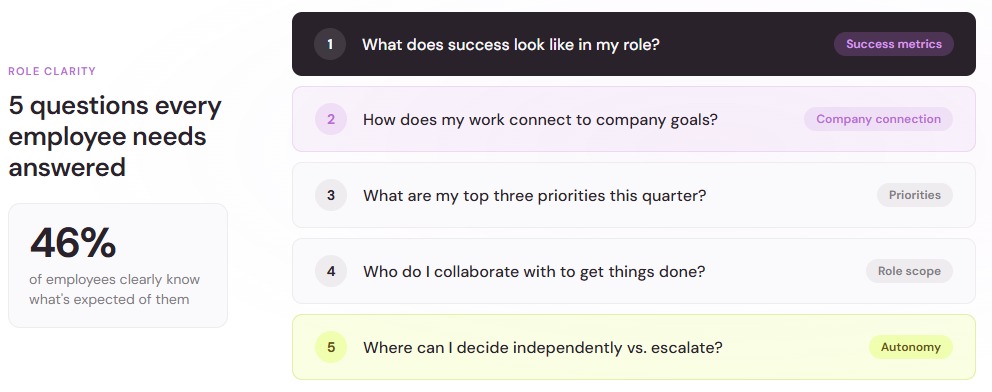
One of the biggest killers of engagement is confusion. If your team doesn't know what they're supposed to be doing or why it matters, they can't succeed. Only 46% of employees clearly know what's expected of them at work, down from 56% in 2020.
Start with role clarity. Sit down with each person on your team and make sure they understand:
- What does success look like in their role?
- How does their work connect to company goals?
- What are the top three priorities for the next quarter?
- Who do they need to collaborate with to get the job done?
- What decisions can they make independently, and where do they need approval?
Don't assume people remember this once you've told them. Revisit these expectations regularly, especially when priorities shift. Many organizations find it helpful to document these conversations and reference them during one-on-ones. When employees have clarity about their role and how it contributes to larger organizational goals, they're able to work with greater confidence and purpose. The difference is measurable: teams with clear expectations show stronger accountability, fewer misunderstandings, and greater autonomy in decision-making. Without this foundation, even well-intentioned employees struggle to understand what excellence looks like in their position, which inevitably leads to frustration and disengagement.
2. Train managers to lead engagement
Managers are the closest point of contact for most employees, and their influence is massive. When managers receive role-specific training, their reported well-being jumps from 28% to 50%.
This training should cover:
- How to have meaningful one-on-one conversations that go beyond status updates
- How to give feedback that builds people up instead of tearing them down
- How to recognize good work in real time rather than waiting for formal review cycles
- How to listen more than you talk, focusing on understanding employee needs and concerns
- How to coach employees through challenges rather than simply directing solutions
- How to navigate difficult conversations with empathy and clarity
Young and female managers experienced the largest engagement declines, so make sure training reaches everyone who needs it. Consider peer mentoring programs where experienced managers can support newer ones. When organizations invest in developing their managers as genuine leaders and coaches, the entire culture shifts. Managers who receive this training report greater confidence in their roles, feel more equipped to handle complex interpersonal situations, and ultimately create more stable, engaged teams. The training should be ongoing rather than a one-time event, with regular refreshers and opportunities to practice new skills in low-stakes environments before applying them in real situations.
3. Create a culture of listening, not just surveying
Too many companies treat employee feedback like a box to check. Real engagement comes from continuous, genuine listening that demonstrates you care about employee perspectives and are willing to act on what you hear.
This means:
- Regular pulse surveys or check-ins (monthly or quarterly, not just once a year)
- One-on-one conversations where managers listen without immediately jumping to solutions
- Transparent feedback loops where employees see what you learned and what you're changing
- Follow-up conversations where you explain decisions, even if employees disagree
- Focus groups or listening sessions where small groups can dive deeper into specific challenges
You need both the right questions and the right mindset. When employees see their feedback leads to visible changes—whether adjusting policies, improving processes, or shifting how teams work together—they're far more likely to continue sharing honestly. The consistency of listening matters as much as the quality of questions asked. Organizations that commit to regular feedback cycles demonstrate that employee input is valued, not merely tolerated. This approach also helps you catch emerging problems before they become organizational crises, allowing you to be proactive rather than reactive about workplace issues.
4. Be transparent about opportunities and growth
When employees see a clear path forward, they're more likely to stay and invest in their work. Many employees leave not because of their current role, but because they can't envision a future within the company.
Share:
- Career progression frameworks so people understand how they grow and what competencies matter
- Promotion timelines and the criteria leaders use for decisions
- Open job postings first to your team before posting externally
- What skill development looks like and what resources are available
- How compensation and benefits work, including how raises and bonuses are determined
- Stories of how other employees have grown within the organization
- Budget or time available for professional development and training
Employees don't need to like every decision you make, but they need to understand it. When people feel locked out of advancement conversations, they start looking elsewhere. Transparency removes that uncertainty and helps employees take ownership of their development. Furthermore, when internal advancement is prioritized and visible, it sends a powerful message to your entire workforce that loyalty and growth are rewarded. Creating documented career paths helps employees understand what competencies they need to develop, making professional growth less mysterious and more achievable. This also reduces the hidden frustration that comes from feeling invisible or undervalued.
5. Make recognition real and timely
Generic "great job" doesn't stick. Real recognition is specific, timely, and tied to behavior or outcomes you want to see more of.
Instead of: "You're doing great." Try: "You stayed late yesterday to help the support team sort through that customer issue backlog. That's exactly what we need, and I saw how much it meant to them."
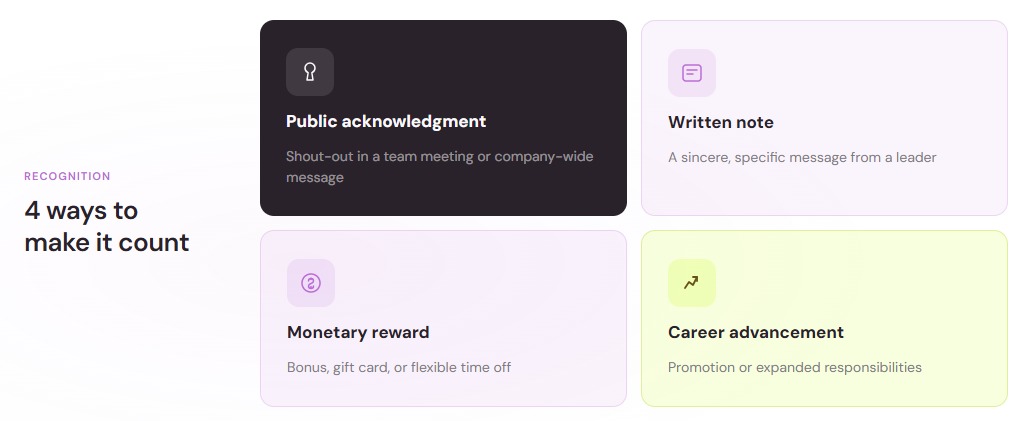
Recognition doesn't have to be monetary, though it can be. It can be:
- A public shout-out in a team meeting or company-wide communication
- A sincere note from a leader
- A small bonus or gift card for going above and beyond
- Time off or a flexible schedule as recognition
- A visible promotion or expanded responsibility
The key is making recognition feel genuine and earned. When recognition is scattered and inconsistent, it loses its power. The most impactful recognition often comes when it’s unexpected—a manager who takes time to write a personal note or calls out specific contributions in front of peers sends a message that this behavior is genuinely noticed and valued. Recognition also serves a secondary purpose: it teaches other employees what excellence looks like in your organization, modeling the behaviors and attitudes you want to reinforce across your team.
6. Measure engagement, then act on what you learn
You can't improve what you don't measure. But measurement only matters if you actually do something with the data. Too many organizations conduct surveys, see concerning trends, and fail to take action, which makes engagement worse as employees lose trust in the process.
Track metrics like:
- Engagement scores or eNPS over time to spot trends
- Retention rates and reasons people leave
- Participation rates in feedback initiatives
- Changes in employee satisfaction across departments or teams
- Time-to-hire and internal promotion rates
- Manager turnover, which often precedes broader engagement declines
Then share what you learned with your team and explain what you're changing. Create a dashboard or regular communication where you show the data and outline specific actions. If employees see their feedback leading to action, they'll keep giving you honest input. The accountability piece is critical: when you publicly commit to specific improvements based on employee feedback and then report back on progress, you build trust in the feedback system itself. This creates a virtuous cycle where increased transparency leads to more honest input, which enables better decision-making and more targeted improvements.
7. Build psychological safety into your culture
Employees who feel safe to speak up, make mistakes, and take interpersonal risks are more engaged. Psychological safety means they trust their manager won't punish them for being vulnerable or admitting when they don't know something.
Build it by:
- Admitting your own mistakes publicly and explaining what you learned
- Asking for input on decisions and actually using suggestions
- Following through on commitments consistently
- Protecting people who raise concerns from retaliation
- Responding to bad news with curiosity and problem-solving, not anger
- Asking "why" questions to understand problems rather than assigning fault
- Celebrating learning from failures
You can't build trust in a month, but you can erode it in a day. The organizations with the strongest psychological safety cultures typically have leaders who model vulnerability and create space for employees to do the same. This foundation is essential for innovation and problem-solving, as it enables employees to experiment, propose unconventional ideas, and flag problems before they escalate. Teams with strong psychological safety also tend to have better cross-functional collaboration and more effective learning from mistakes.
8. Invest in manager wellbeing and development
Managers can't engage their teams if they're burned out. When manager engagement fell from 30% to 27%, it rippled through their teams.
Support your managers by:
- Ensuring realistic workloads and adequate resources
- Protecting time for work that matters, like meeting with their teams
- Offering professional development and leadership training
- Creating peer networks where managers support each other
- Checking in on their well-being regularly
- Protecting them from unnecessary bureaucracy
- Celebrating their wins and recognizing their contributions
- Ensuring they're not expected to do the work of multiple roles
When you invest in your managers, you're investing in everyone they lead. This is one of the highest-ROI interventions organizations can make. Burned-out managers have less patience, less energy for meaningful conversations, and less capacity to recognize and develop their team members. By contrast, well-supported managers have the bandwidth to focus on what truly drives engagement: building strong relationships, providing meaningful feedback, and helping their teams grow. Consider this an investment that multiplies across your entire organization.
The bottom line
Disengaged employees cost your organization in lost productivity, high turnover, and missed opportunities. Engagement requires intentional leadership, clear communication, genuine listening, and a commitment to follow through.
Start with one or two of these tactics and get good at them. Over time, you'll build a culture where people genuinely want to be there, where they feel heard and valued, and like they’re part of something that matters. That's when engagement becomes real, and that's when your organization truly wins.