Contextual inquiry: How to do research in context
Contextual inquiry reveals real workflows, hidden workarounds, and friction points that surveys can't capture, here's how to plan, run, and analyze sessions.
Contextual inquiry is one of the most powerful—and misunderstood—research methods available to marketers, product teams, and UX researchers. Unlike surveys or focus groups, which pull people out of their natural environment, contextual inquiry happens where the action is: in the real world, at the moment someone’s actually doing something.
When you observe people in their actual context—whether that’s their office, home, or workplace—you see what they really do, not just what they say they do. You spot the workarounds they’ve built, the frustrations they’ve learned to live with, and the tiny moments that surveys miss entirely. That’s where the gold is.
This guide walks you through what contextual inquiry is, why it matters, how to run it properly, and how to turn what you learn into action.
What contextual inquiry really is
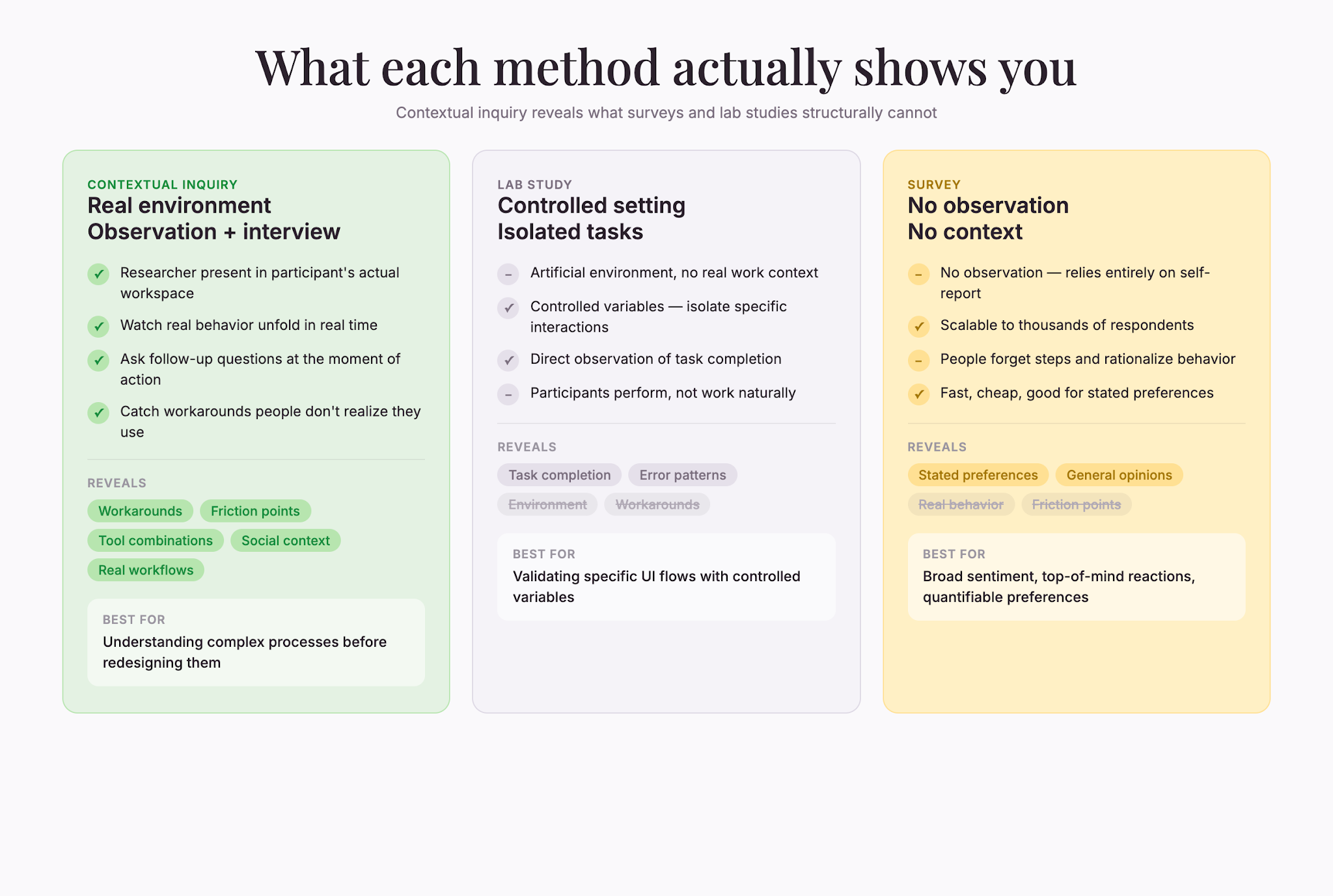
Contextual inquiry is a qualitative research method where you observe and interview people in their natural environment while they’re engaged in the activity you’re studying. The researcher is present, asking questions, and paying attention to not just what people say but how they work, what tools they use, and why they make certain choices.
It’s different from a lab study (controlled, artificial setting) and different from a survey (no observation, no context). Instead, you’re embedded in the person’s world. You watch them navigate their day and interrupt them at key moments to understand their thinking.
The method combines observation and interview in a single, integrated approach. You’re not watching silently like a fly on the wall. You’re actively engaged—asking clarifying questions, probing deeper when something surprises you, and helping the participant explain what’s happening in their head.
Why contextual inquiry uncovers what other methods miss
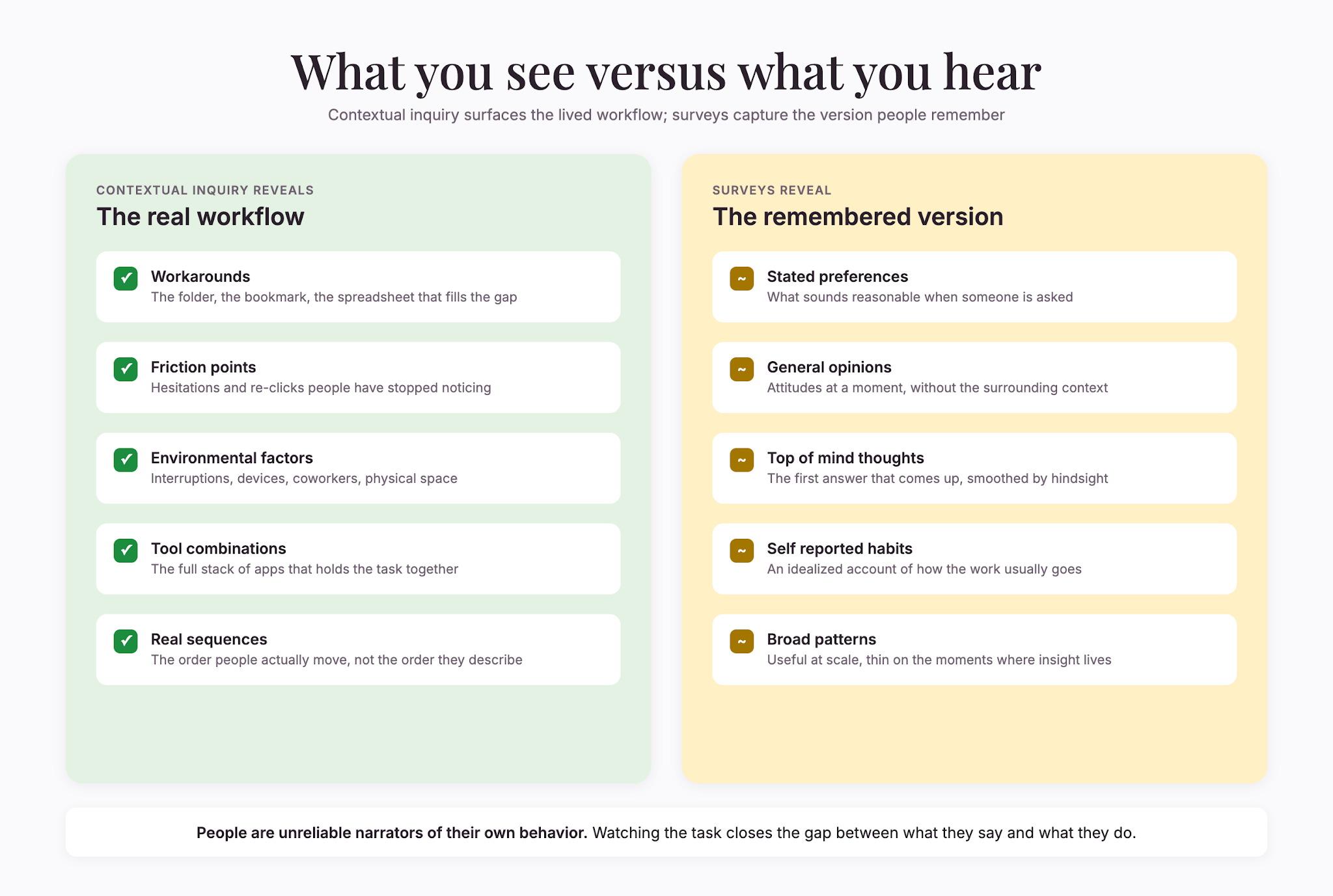
People are unreliable narrators of their own behavior. They forget steps, smooth over inefficiencies, and rationalize choices they don’t fully understand themselves.
When you ask someone in a survey, “How do you organize your research files?” they might say, “I use a folder structure.” But if you observe them in context, you’ll see they actually use a combination of folders, Google Drive, Slack bookmarks, and browser tabs—and they spend 10 minutes hunting for something every other day. They’ve normalized the friction so much that they don’t even mention it in a survey.
Contextual inquiry also reveals the social and physical environment around the activity. You see interruptions, the tools they use alongside your product or service, the constraints of their workspace, and how they collaborate with others. None of that shows up in survey responses.
Additionally, because you’re there in real time, you catch the moments when people show rather than tell. A person might say, “I’m pretty organized,” but you’ll watch them search through three different apps to find one piece of information. That gap between stated behavior and actual behavior is where insights live.
When to use contextual inquiry
Contextual inquiry works best when you need to understand how someone works, not just what they think.
Use it when you’re:
- Designing a product or feature and need to understand existing workflows before you redesign them
- Investigating a complex process with many steps, tools, and decision points
- Trying to understand why people make certain choices—the reasoning behind the behavior
- Looking for pain points that people don’t even recognize as problems
- Studying a professional or technical task where context and environment matter heavily
It’s less useful when you need broad statistical data, when your research question is simple (“Do people prefer A or B?”), or when you’re trying to reach a large, geographically dispersed audience quickly.
Contextual inquiry also requires more time and resources than surveys. You’re typically running 10 to 20+ sessions, each lasting 1 to 2 hours, and you’re in the field or on video calls with real people. That investment pays off in depth, but it’s not the right method for every question.
How to plan a contextual inquiry study
Define your research question
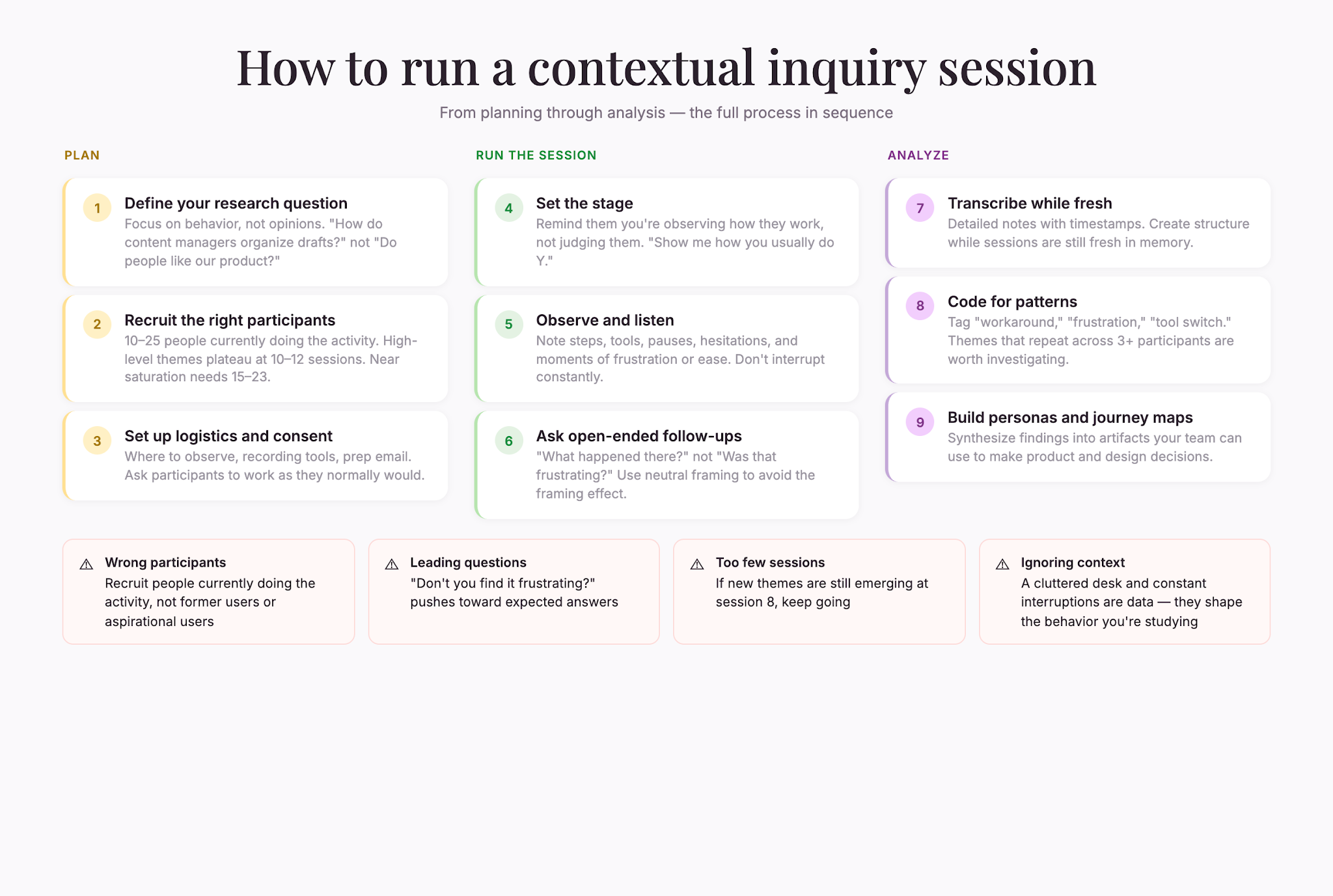
Start with a clear, specific question. Not “How do people use our product?” but “How do content managers currently organize their research and drafts before writing?” or “What happens when a customer tries to return an item?” The narrower your focus, the more useful your observations will be.
Your question should be about a behavior or process, not an opinion or preference.
Decide on your sample
Contextual inquiry usually involves 10 to 25 participants, depending on the complexity of the activity and your research goals. Research shows that high-level themes in qualitative studies plateau at 10 to 12 interviews (Journal of Medical Internet Research, 2024), though near saturation (90% of codes) typically requires 15 to 23 interviews. If you need complete saturation, plan for 30 to 67 interviews (Journal of Medical Internet Research, 2024). Theoretical saturation often requires roughly twice as many interviews as data saturation (Journal of Teaching in International Business, 2025), so factor that into your timeline and budget.
Your sample should represent the people you’re trying to understand. If you’re redesigning a tool for junior developers, recruit junior developers—not senior engineers or people who’ve never coded. Recruit people who are currently doing the activity you want to observe, not people who used to do it or might do it in the future.
Find your participants
Recruitment takes time. You might recruit through:
- Direct outreach to existing customers or users
- Professional networks and communities
- Recruitment agencies that specialize in your target demographic
- Social media or online forums where your target audience hangs out
- Snowball sampling (asking one participant to refer another)
Be transparent about what you’re asking people to do and how much time it will take. Offer an incentive—cash, gift cards, or early access to a new feature—appropriate to the time commitment.
Set up the logistics
Decide where you’ll observe. If the activity happens in a specific place—an office, a workshop, a retail store—go there. If it happens on a computer or happens at home, a video call can work, though you’ll miss some environmental context.
Send participants a prep email explaining what you’ll do, how long it will take, and what they should prepare. Ask them to do the activity as they normally would—don’t ask them to “optimize” or perform for the camera.
Set up your recording tools (with permission). You might use:
- Video recording (captures screen and participant behavior)
- Audio recording (less intrusive, easier to transcribe)
- Field notes (written observations)
Have all permissions and consent forms ready before the session.
Running a contextual inquiry session
Here’s how to run your contextual inquiry session, step-by-step:
Set the stage
Start by thanking the participant and reminding them of the consent and recording. Explain that you’re there to observe how they work, not to judge them or test them. Let them know it’s totally normal and helpful when they show you workarounds, shortcuts, or struggles. That’s exactly what you want to see.
Ask an opening question to get them started on the activity: “Can you walk me through how you’d approach X?” or “Show me how you usually do Y.” Then, let them work.
Observe and listen
Sit nearby (or share their screen if remote) and watch closely. Take notes on:
- The steps they take and the order they take them in
- The tools they use and why
- Where they pause, search, or hesitate
- What they say out loud and what they do silently
- Interruptions and distractions
- Moments of frustration or ease
Don’t interrupt constantly. Let them work in stretches. Interruptions break flow and change behavior.
Ask follow-up questions
When something catches your attention, ask about it. If you see them struggling, ask, “What’s happening here?” If they use a tool you didn’t expect, ask, “Why do you use that instead of X?” If they do something fast, ask, “Why did you do that so quickly?”
Use open-ended questions: “Tell me more about that,” “Why did you choose that approach?” Avoid yes/no questions. And avoid leading questions like, “That must have been frustrating, right?” Let them describe their own experience.
Watch for the framing effect
Be aware that how you phrase questions can influence how people answer. Research shows the framing effect causes people to avoid risk when options are positively framed but seek risk when negatively framed (Frontiers in Psychology, 2020). Keep your questions neutral and exploratory. Instead of “Did that slow you down?” ask “What happened there?”
Don’t perform your own product or service
The goal is to understand their current workflow, not to pitch yours or demonstrate what you’ve built. Save that for after the research is done.
Analyzing contextual inquiry data
After you’ve run all your sessions, you’ll have hours of video, audio, or notes. Here’s how to make sense of it.
Transcribe and document
Transcribe interviews or create detailed notes while the sessions are still fresh. Note timestamps for key moments so you can find them again in video.
Identify patterns and themes
Watch for patterns across participants. Do most people use the same workaround? Do they all struggle at the same step? Do they mention the same pain point unprompted?
Create a simple coding system. You might code for “workaround,” “frustration,” “collaboration moment,” “tool switch,” or whatever categories matter to your research question. As you code more sessions, you’ll see themes emerge.
Create personas and journey maps
Synthesize what you’ve learned into user personas (who they are, what they do, what they care about) and journey maps (the steps they take, where they struggle, where they succeed). These become your reference documents for design and product decisions.
Extract actionable insights
Ask: What surprised us? What changed how we think about this activity? What do we now know we didn’t know before? Where do people struggle most? What would make their lives easier?
This is where research becomes strategy. You’re not just documenting what people do—you’re identifying what needs to change.
Tools that support contextual inquiry
Doing contextual inquiry used to mean traveling to people’s homes or offices, camera in hand, notebook in pocket. Video calls have made remote research more feasible, but the core method is the same: observe, listen, ask, learn.
A tool like ResearchFlow helps you manage the logistical side of qualitative research: recruiting participants, scheduling sessions, capturing their responses and feedback, and organizing your findings in one place. That means less time on admin work and more time on what matters: understanding your participants and turning insights into action.
Common mistakes to avoid
Recruiting the wrong people. Don’t recruit people because they’re easy to reach. Recruit people who are actually doing the activity you want to study. A power user might not represent the typical person you’re designing for.
Asking leading questions. “Don’t you find it frustrating that X?” is a leading question. “What’s your experience with X?” is open. Leading questions push people toward answers you expect, not what they actually think.
Interrupting too much. Let people work in stretches. Constant interruptions break their natural flow and change how they behave.
Observing without exploring. Watching silently is only half the job. You need to ask why. Why did they do that? Why did they skip that step? The interview part is where understanding deepens.
Ignoring context. If you’re only listening to what people say, you’re missing the physical and social environment around the activity. A busy office, a cluttered desk, a coworker interrupting—these all matter.
Running too few sessions. If you’re seeing new themes emerge at session 8, you probably need more than 8 sessions. Keep going until you stop hearing new insights.
Making research work for your team
Contextual inquiry takes more time than a quick survey. It requires planning, coordination, and careful analysis. But the depth you get back is proportional to the investment.
The insights from contextual inquiry should shape product decisions, inform design, and reframe how your team thinks about your customers’ real lives. Share what you learn. Create artifacts—personas, journey maps, video clips—that make the research sticky and memorable.
When your whole team understands the context and complexity of what people actually do, better decisions follow.

Liked that? Check these out:
Opinions and Expertise
What’s actually slowing research teams down (Hint: it’s not the research)
From recruiting participants and scheduling interviews to building the actual surveys, the operational drag is taking researchers away from what they do best. See what's actually slowing them down and how Research Flow fixes it.
Read more