Focus groups explained: When they work and when they don't
Focus groups reveal why customers choose or leave. But group dynamics distort answers, and small groups can't measure market prevalence. Combine with surveys.
.png)
Key Takeaways
- Focus groups excel at exploring "why," not "how many": They reveal motivations and language you didn't anticipate, but a group of 10 people can't tell you what your broader market thinks.
- Group dynamics can distort honest answers: Dominant personalities, social pressure, and moderator bias mean that what people say in the room isn't always what they privately believe.
- Sensitive topics need a different method: People self-censor in front of others, so anonymous surveys or one-on-one interviews capture more candid responses.
- Pair focus groups with surveys for the full picture: Focus groups uncover the texture and reasons behind an issue, while surveys measure how widespread it actually is.
Focus groups have been a staple of market research for decades. They bring together a small group of people to discuss a topic, product, or idea in a guided conversation. The appeal is clear: you get rich, nuanced feedback directly from your target audience in real time.
But focus groups aren't a one-size-fits-all solution. Sometimes they deliver gold. Sometimes they waste time and money. Understanding when and why is crucial to getting real value from them.
What a focus group actually is
A focus group is a qualitative research method where 6 to 12 people (sometimes fewer or more, depending on context) sit down, either in person or virtually, to discuss a specific topic under the guidance of a moderator. The moderator asks open-ended questions, encourages conversation, and steers discussion toward the research objectives without leading participants to particular answers.
The goal isn't to gather statistics or measure something precisely. It's to understand attitudes, beliefs, motivations, and reactions. Why do people choose one brand over another? What frustrates them about a current product? How do they perceive a new concept? These are the kinds of questions focus groups are designed to answer.
The structure of a typical focus group usually lasts between 60 and 90 minutes. This timeframe allows enough space for meaningful conversation without exhausting participants or losing focus.
Smaller groups of six to eight people often generate more balanced discussion than larger ones, where quieter voices can get drowned out. The intimate scale of a focus group creates conditions for genuine dialogue. It’s large enough for diverse perspectives but small enough that everyone can participate meaningfully if the moderator manages the dynamic well.
Virtual focus groups have become increasingly common, especially since they eliminate geographic constraints and reduce recruitment costs. However, they sometimes lack the energy and spontaneous interaction of in-person sessions. The spontaneity of in-person gatherings—the body language, the natural laughter, the side comments that spark new thinking—can feel diminished on a video call, though skilled moderators can mitigate this limitation.
What distinguishes focus groups from other research methods is their interactive nature. Unlike surveys, where each person answers independently, or interviews, where the researcher talks one-on-one with a participant, focus groups deliberately encourage people to react to each other's ideas. This interaction can surface insights that wouldn't emerge in isolation: someone's comment sparks another person's memory or triggers a different perspective. One participant's story about struggling with a competitor's product might prompt another person to share a similar experience they'd forgotten about, creating a richer picture of shared frustration. The group dynamic is both the strength and the weakness of this method, as you'll see later.

When focus groups work well
Focus groups shine in specific contexts. Knowing these situations will help you decide if they're the right tool for your research.
Exploring new territory
If you're entering a market you don't understand or launching something entirely new, focus groups are excellent for initial exploration. They help you discover language, concerns, and decision-making factors you might not have anticipated. You're trying to understand the landscape, not prove a hypothesis. For instance, if a tech company is considering entering the healthcare space, focus groups with doctors, nurses, and patients can reveal regulatory concerns, workflow challenges, and user expectations that executives might never discover on their own. A healthcare-focused focus group might surface that doctors need integration with specific existing systems, that nurses care deeply about time-saving features, and that patients want simplified language and transparency about how their data is used. These insights—drawn from actual users in conversation—guide product development in ways that industry reports or market analysis alone cannot.
Understanding the "why" behind behavior
Surveys tell you what people do. Focus groups help you understand why. If your data shows customers are churning, a focus group can dig into the emotional and practical reasons. The conversation often reveals nuance that closed-ended survey questions can't capture. A customer might say they left because of price, but in conversation, you discover the real issue was feeling unsupported during implementation. That distinction matters enormously when you're deciding how to fix the problem. Perhaps the price concern is secondary. What really drove them away was poor onboarding, unclear documentation, or unresponsive support. If you address price but ignore implementation support, you've wasted your effort. A well-conducted focus group surfaces these layers of causation that surveys typically miss.
Testing concepts and messaging
Before you invest in a full campaign or product launch, focus groups let you pressure-test ideas. Show a concept, ask for reactions, and listen carefully to objections and enthusiasm. People often reveal their true concerns through conversation in ways they won't in a written survey. If you're testing a new positioning statement, a focus group can show you which phrases resonate and which ones confuse or alienate your audience. You might discover that the language you thought was clever actually lands as out-of-touch. A tech startup might test the phrase "breakthrough AI-powered solution" only to discover in a focus group that potential customers find such language off-putting and prefer straightforward descriptions of what the product actually does. This real-time feedback saves you from investing in messaging that doesn't work.
Generating ideas
Focus groups can be creative spaces. When people build on each other's comments, new ideas emerge. They're useful for brainstorming product improvements, naming campaigns, or refining positioning. The group setting creates a collaborative energy that individual brainstorming sometimes lacks. A comment from one participant sparks an association in another person's mind, leading to ideas neither would have generated alone. This collaborative ideation can be particularly valuable in early-stage product development when you're still exploring possibilities. A focus group designed around "how could we make this task faster?" might generate five practical suggestions, each building on previous comments. The evolution of ideas through group conversation often yields more practical and user-centered solutions than brainstorming sessions with only internal team members.
Building empathy and alignment
When a team watches or reviews a focus group, something shifts. Hearing a customer express frustration in their own words is more powerful than reading a research report. Focus groups create moments of genuine human connection that can align a team around a customer-centric direction. A product manager watching a frustrated customer describe their struggle with a competitor's product often gains more empathy in 90 minutes than from months of reading feedback tickets. This emotional resonance can be the catalyst that drives organizational change. When engineers see and hear users struggle with a feature their team spent months building, it creates a visceral understanding that abstract feedback summaries cannot. This shared human understanding across a team tends to drive more thoughtful decision-making than data alone.
When focus groups fall short
Focus groups have real limitations. Ignoring them leads to wasted resources and misleading conclusions.
You need numbers, not stories
If you need to know what percentage of your audience prefers option A over option B, or how many customers experience a specific problem, focus groups won't tell you. A focus group of 10 people tells you what 10 people think, not what your market thinks. For statistical validity, you need a survey with a larger, representative sample. This is a fundamental constraint of qualitative research. Even perfectly executed focus groups with ideal participants cannot reliably estimate prevalence or measure proportions. If leadership needs to know whether 30% or 60% of customers share a particular concern, focus groups cannot answer that question. You might run a focus group where seven out of ten participants mention a particular frustration, creating the impression that it's nearly universal. But when you follow up with a survey of 500 customers, you discover only 35% experience that frustration. The focus group gave you a misleading signal because the sample wasn't representative.
You're dealing with sensitive or controversial topics
People in a group setting often self-censor. If your question touches on something embarrassing, unpopular, or politically charged, group dynamics will suppress honest answers. Someone who privately feels one way might stay quiet in front of others. In these cases, anonymous surveys or one-on-one interviews capture truer responses. For example, if you're researching how employees feel about workplace culture or whether they're looking for new jobs, focus groups may yield diplomatically cautious answers. An anonymous survey allows people to be more candid without worrying about professional consequences. Similarly, if you're researching sensitive health topics, financial concerns, or personal preferences, focus groups often yield sanitized responses. People worry about being judged, or they don't want their views on record with colleagues or in a recorded session. The social pressure of a group setting makes candid discussion of sensitive topics genuinely difficult.
You need quick feedback on a straightforward question
If you need a yes-or-no answer or a quick read on a simple preference, focus groups are overkill. A fast poll or short survey gets you what you need in hours instead of weeks. Save focus groups for situations where depth matters more than speed. The recruitment, scheduling, moderation, and analysis of focus groups require time that simple preference questions don't justify. If you're just trying to pick between two logo designs, a quick online poll is far more efficient. Even a brief survey where you present both logos and ask people which they prefer generates data you can analyze in a single day. Focus groups for such decisions waste your participants' time and yours.
Your audience is hard to assemble
Recruiting focus group participants takes time and money. If your target audience is geographically scattered, niche, or busy (like C-suite executives), the logistics become expensive and slow. Online focus groups help, but recruitment challenges remain. Specialized audiences—such as rare disease patients, enterprise software engineers, or regulatory compliance officers—require focused recruitment effort that can stretch timelines and budgets significantly. Recruiting a focus group of hospital chief information officers might take weeks and cost thousands in incentives, while a survey of the same population might be achievable in days. Sometimes, the logistics of gathering specific people for a single session make alternative research methods more practical.
Group dynamics distort the truth
This is the most serious weakness seen with focus groups. Dominant personalities steer the conversation. Social desirability bias makes people agree with others or say what they think sounds good. Earlier comments anchor later ones. One strong opinion can silence dissent. The moderator's tone or questions can inadvertently push the group in a particular direction. These dynamics are often invisible to observers watching in real time. What emerges from discussion isn't always what each person genuinely believes. The loudest person in the room may not represent the majority opinion. Someone might enthusiastically agree with a suggestion during the focus group but behave completely differently when alone. This gap between what people say in a group and what they actually do or believe represents a fundamental validity challenge for the method. If one confident participant declares that they love a new product feature, others may nod in agreement even if they have doubts. Their public agreement doesn't reflect their private skepticism. When that product launches and adoption is lower than expected, the focus group's enthusiasm becomes a misleading memory.
The influence of moderator bias
Even well-intentioned moderators inadvertently shape outcomes. The questions you ask, how you phrase them, which comments you follow up on, and the tone you set all influence what participants say. If a moderator spends extra time exploring criticism of a competitor, the group may perceive that criticism as more important than they naturally would. If a moderator nods enthusiastically when someone endorses an idea, others may feel encouraged to agree. These subtle cues accumulate across 90 minutes and can shift the overall direction of a focus group. A moderator might ask, "What did you find frustrating about that product?" versus "What worked well and what didn't work?" The first phrasing primes participants to think about problems. The second invites more balanced reflection. Neither question is inherently wrong, but they create different conversational frames. Moderators don't intend this bias, but it's a consistent challenge in focus group research.
Mixing methods: focus groups plus other research
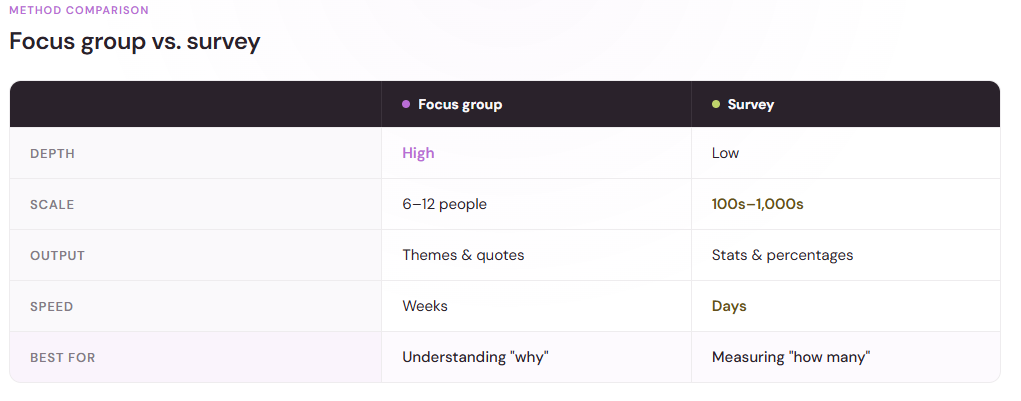
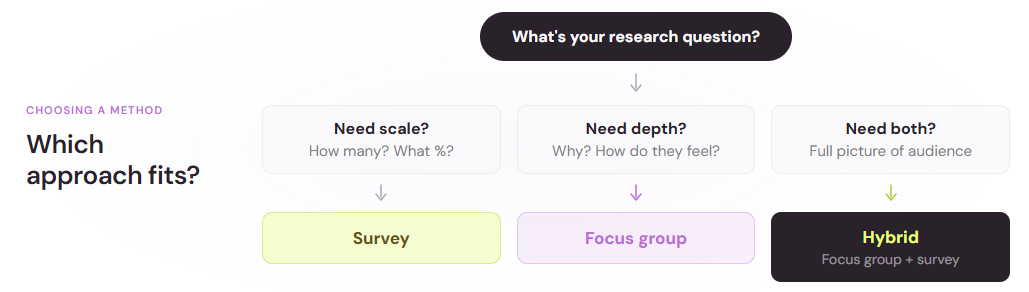
The most rigorous approach combines focus groups with other methods. Use focus groups to explore and understand, then validate findings with a broader survey. Or run a survey first to identify what questions matter most, then dig deeper with focus groups.
For example: Run a focus group to understand why employees are disengaged. Then follow up with an anonymous survey across your entire workforce to measure how widespread each concern is. The focus group gives you texture and honesty; the survey tells you scale. This mixed-method approach serves multiple purposes. The focus groups generate hypotheses and uncover the qualitative texture of employee experience. The survey tests whether those hypotheses hold true across the broader population and identifies which concerns are most prevalent. Employee engagement is critical to organizational health. When engagement falls, costs rise. Disengaged employees create friction and drag down productivity. Organizations with highly engaged workforces tend to see stronger retention, customer satisfaction, and profitability than those with disengaged teams. A mixed-method approach—combining conversational feedback with broader measurement—helps you identify root causes and track whether interventions work.
You might also reverse the order. Start with a survey to identify which issues matter most to your audience, then use focus groups to explore the highest-priority issues in depth. This approach ensures your focus groups concentrate on what actually matters rather than exploring tangentially interesting but ultimately less important topics. Survey data provides a roadmap for focus group discussion. If a survey reveals that 72% of customers cite poor customer service as their main complaint, you know your focus groups should dig deeply into service experiences rather than spending time on other topics that affect fewer people.
Another common approach is to conduct multiple rounds of focus groups at different stages. Early-stage focus groups explore possibilities and uncover language and concerns. Later-stage focus groups test refined concepts or messaging. This iterative approach lets you evolve ideas based on feedback while continuously validating assumptions with real audience input. You might run initial focus groups to explore pain points, then develop a prototype, then run additional focus groups with that prototype to test whether your solution addresses the issues you identified.
Running a focus group that actually works
If you decide a focus group is the right move, a few principles improve outcomes.
Recruit carefully
Don't grab whoever is convenient. Recruit participants who match your target audience and have relevant experience. Mix perspectives (different roles, backgrounds, tenure) to avoid groupthink, but keep the group coherent around the core criteria. Screening questions during recruitment help ensure participants have the knowledge and experience to contribute meaningfully. If you're running focus groups about a software product, make sure participants have actually used similar products. If you're exploring customer service experiences, recruit people who've recently interacted with your company or competitors. Over-recruiting by about 20% accounts for no-shows. People commit to focus groups and then cancel for legitimate reasons. Having a few extra screened participants ready means you won't suddenly have a focus group of five people, which is too small for dynamic discussion.
Brief your moderator clearly
The moderator sets the tone. A good moderator asks open-ended questions, lets conversation flow, notices when someone is quiet, and gently redirects when the group drifts. A poor moderator leads participants toward predetermined answers or dominates the discussion. Clear written guidelines help, such as a documented moderator guide that outlines key topics, anticipated questions, and how deep to probe on each topic. However, the best moderators also have flexibility to follow interesting threads that weren't anticipated. Moderator training matters. Someone facilitating their first focus group will often ask leading questions without realizing it, or fail to probe when an answer feels incomplete. Experienced moderators know how to handle awkward silences, when to gently interrupt someone dominating the conversation, and how to bring quiet participants into discussion without making them uncomfortable. Investing in a skilled moderator often determines whether a focus group yields actionable insights or just records people talking.
Create psychological safety
People are more honest when they feel safe to disagree. Thank people for different viewpoints. Make it clear there are no "right" answers. Start with easier questions before moving to sensitive topics. Consider whether anonymity (like written feedback cards) helps for certain topics. The physical and emotional environment matters. Comfortable seating, refreshments, and a relaxed opening help people settle in. Some moderators open with a few minutes of conversation about something neutral, like the weather or venue, before diving into research questions. This warm-up period helps people relax and builds rapport with the moderator and other participants.
Record and document carefully
Audio or video recording lets you review nuance later. Assign someone to take detailed notes on what was said, by whom, and in what context. Themes often become clearer on reflection than they do in real time. Always get participant consent to record, and explain how recordings will be used. Transcription of focus groups, though time-consuming, creates a searchable record that makes it easier to find specific quotes or examples later. Some researchers use transcription software to create rough transcripts, then clean them up for accuracy. The investment in thorough documentation pays off when you're analyzing results weeks later and need to remember exactly how someone phrased something or whether multiple people mentioned a similar concern.
Don't over-interpret small data
A focus group of 10 people is 10 data points. Interesting patterns might emerge, but they're not proof. Use them as hypotheses to test, not as conclusions to act on without further validation. If all 10 participants in a focus group mention the same frustration, that's noteworthy, but it doesn't tell you whether 30% or 80% of your broader audience shares that frustration. Test the hypothesis with broader research before investing in solutions. This discipline prevents focus groups from becoming expensive sources of confirmation bias. The danger is that vivid stories from a focus group feel more real and compelling than they deserve to. A customer describing a painful customer service experience creates an emotional impact that's hard to ignore. But one detailed story doesn't tell you it's a widespread problem. Validate findings before acting on them.
The bottom line
Focus groups are a powerful tool when used for the right purpose: exploring, understanding, and empathizing. They're poor tools when you need statistical power, quick answers, or measurement across a full audience. And they're risky when you treat a handful of vivid stories as representative truth.
The strongest research strategies mix qualitative and quantitative methods. Use focus groups to understand the landscape and uncover the "why." Use surveys and polling to validate what you've learned and measure how widespread it is across your audience. When employee satisfaction, customer sentiment, or market understanding matters—and you have the time and budget—this blend of methods delivers insight you can trust and act on with confidence. That combination of depth and scale, storytelling and statistics, gives you a complete picture of your audience and the decisions they make.

Liked that? Check these out:
Opinions and Expertise
What’s actually slowing research teams down (Hint: it’s not the research)
From recruiting participants and scheduling interviews to building the actual surveys, the operational drag is taking researchers away from what they do best. See what's actually slowing them down and how Research Flow fixes it.
Read more