Friend quizzes: how to build viral, shareable content
A good friend quiz makes people feel seen and want to share. Here’s how to write the questions, results, and distribution plan that help it spread.

There’s something suspenseful about taking a friend quiz.
Who knows the group chat best? Which friend would survive a zombie apocalypse? Are you the planner, the peacemaker, or the one sending “On my way” from the shower?
Key takeaways
- A shareable friend quiz makes people feel seen, gives them something worth comparing, and turns the result into a natural conversation starter.
- Start with the audience and sharing moment, then work backward to your quiz concept, questions, and outcomes.
- Keep the experience quick, conversational, mobile-friendly, and accessible.
- Treat the results page as your distribution engine, with a memorable outcome, share-ready copy, and a clear next step.
- Measure completion, sharing, lead quality, and downstream action (not just clicks), and use those numbers to improve the quiz over time.
These quizzes work because they do more than fill a few spare minutes. They turn familiar relationships into an exciting game, and give people a reason to bring their friends into it.
For marketers, that creates a useful loop: one person takes the quiz, receives a result, and shares it with someone else. That friend takes it too, and the conversation keeps moving.
Virality isn’t guaranteed, but you can design a friend quiz that’s easy to enjoy, hard to resist sharing, and useful to your business. Here’s how.
What is a friend quiz?
It’s an interactive quiz built around friendship, shared experiences, or social identity. It may test how well two people know each other, assign someone a role in their friend group, or help friends compare preferences.
Common formats include:
- Knowledge quizzes: “How well does your best friend know you?”
- Personality quizzes: “What kind of friend are you?”
- Compatibility quizzes: “What’s your friendship dynamic?”
- Group superlatives: “Who’s most likely to book a spontaneous trip?”
- Preference comparisons: “Could you and your bestie agree on the perfect weekend?”
Brands can adapt these formats without intruding on the friendship. A travel company may ask, “What kind of travel duo are you?” A streaming platform could ask, “Who controls movie night?” A productivity brand may build, “Which coworker-friend duo are you?”
The subject is friendship. The real hook is self-discovery with a social payoff.
Why friend quizzes get shared
People don’t share content because a handy button is close by. They share when the content helps them express something, connect with someone, or start a conversation.
Research published in the Journal of Marketing Research found that content evoking high-energy emotions, like anger, anxiety, or awe, was more likely to be shared. The study also notes the role of useful, interesting, and surprising content as a driver of virality. A playful friend quiz can combine multiple qualities at once.
Friendship also gives the content a built-in recipient. The quiz taker doesn’t have to wonder who may care about the result. They know this already: the friend this reminds me of.
This kind of connection matters online and off. In a Pew Research Center study, 39% of U.S. adults with a close friend said they interact with that friend on social media at least a few times a week.

What makes a friend quiz strong? It taps into four sharing motivations:
- Identity: “The result is so me.”
- Recognition: “This is definitely you.”
- Comparison: “I got the organizer. What did you get?”
- Invitation: “Take this and let’s see if we match.”
Your quiz needs at least one of these. The most shareable quizzes often have all four.
Begin with the sharing moment
Before writing questions, think about the moment right after someone finishes.
What result would make them laugh? What would they happily post on social media? What would they send to a friend right away without any explanation beyond “US”? This helps you avoid a common mistake: building a decent quiz with a forgettable ending. The result isn’t a receipt. It’s the product.
Define your intended sharing behavior first. Here’s what you would want participants to do:
- Challenge a friend to beat their score
- Compare personality types
- Tag the friend described by the result
- Post a result card to a social platform
- Send the quiz privately to a group chat
Then choose the format that supports that action. A scored knowledge quiz works well for a challenge. An outcome quiz is better for comparison and self-expression. Our guide to outcome quizzes explains how answers can be connected to distinct endings.
Choose a concept people will instantly understand
If you need a paragraph to explain the idea, continue brainstorming.
A strong concept makes 3 things clear:
- What the quiz is about
- What the participant will discover
- Why a friend should take it too
Try a title formula like:
- “How well do your friends really know you?”
- “Which role do you play in the group chat?”
- “What’s your friendship love language?”
- “Who are you on a group vacation?”
- “Could you and your best friend run a business together?”
Specificity always helps. “What kind of friend are you?” is too broad. “Who are you when the group leaves the group chat?” creates a scene people will recognize and want to enter.
Need a little inspiration? Start with a personality quiz template and adapt the outcomes to your audience.
Write questions that feel like a conversation
No one opens a friend quiz hoping to finish an assessment. Keep the experience fun.
Ask one clear question at a time, use contractions, and write the way your audience actually talks. Our tips for creating better forms recommend opening with a quick question. Cut the jargon, keep the copy concise, and make sure each question earns its place.
A question like “Select the interpersonal function you most frequently perform within your social group” feels like paperwork.
Try: “The group chat goes quiet. What do you do?”
Then offer vivid answers:
- Send a dangerously specific meme
- Start planning dinner
- Ask if everyone’s mad at me
- Enjoy the peace
Good answers are distinct enough to map to outcomes and be relatable enough to make choosing fun. Avoid any answers that are obviously correct unless you are building a knowledge quiz.
6 to 10 questions often give you enough information to create a satisfying result without making the quiz feel like homework. Use branching logic when a response should open a different path, but don’t add complexity simply because you can.

Create results worth claiming
The best outcomes feel accurate, generous, and specific. People rarely share results that insult them or say nothing.
Compare these two:
The Reliable Friend: You are dependable and organized.
The Human Calendar: You know the reservation time, have the confirmation email, and already checked the weather. Your friends may tease you for sending reminders, but their weekend plans would collapse without you.
The second result gives someone a recognizable identity. It also gives their friends something to confirm or debate.
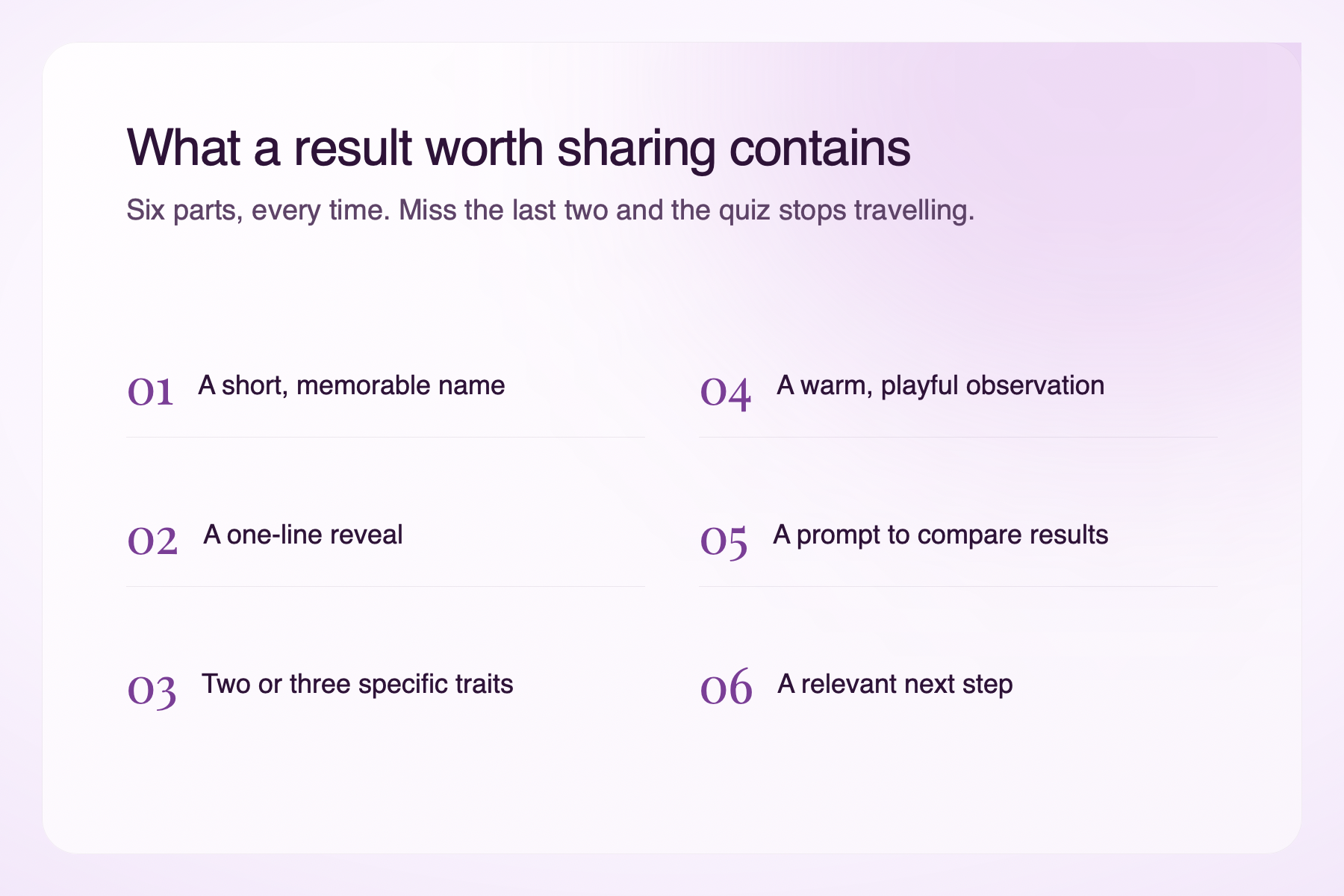
Aim for 3 to 6 outcomes with clearly different personalities.
Keep the tone positive without making every outcome suspiciously perfect. A small, affectionate flaw makes a result more believable.
Make sharing effortless
A participant who enjoys the result may still leave without sharing it. Remove the work.
Give each outcome a short piece of prewritten share copy, like:
I’m “The Human Calendar.” Apparently, this group trip would fall apart without me. What role do you play?
Pair that with a clear invitation: “Send this to the group chat,” “Challenge your best friend,” or “Compare your result.”
Design matters. Use readable type, strong contrast, and imagery that still makes sense on a small screen. Add descriptive text to important visuals, and don’t rely on color alone to explain a score or outcome. The W3C recommends clear labels and instructions so people know what information an interactive form expects.
Preview the entire experience on your mobile device, including the result page and every share link. Your quiz should feel complete wherever someone encounters it.
Connect fun to a useful business goal
A friend quiz can build awareness, collect insights, grow an email list, or direct people to relevant content and products. Pick one main goal.
If you collect an email address, explain the value of sharing it. “Enter your email” is a demand. “Where should we send your friendship profile?” is a fair exchange.
Ask only for the information you’ll use. The Federal Trade Commission advises businesses not to collect personal information without a legitimate need, and to keep it only as long as necessary. Be careful when a quiz encourages someone to provide information about another person.
Once people opt in, use their results to make follow-up more relevant. The planner may receive a group-trip checklist, while the spontaneous friend gets a last-minute getaway guide. This is where a playful experience can become genuinely useful conversational marketing.
Launch, learn, and improve
Start with a small audience before pushing your quiz everywhere. Ask your testers:
- Did any question feel confusing?
- Did the result feel accurate?
- Would you share it? Why or why not?
- Who should you send it to?
- Where did the experience slow down?
Then watch what they actually do, not just what they say.
Track starts, completion rate, drop-off by question, result distribution, share clicks, referral traffic, lead conversion, and the action people take after seeing their outcome. Add campaign parameters to distribution links so you can compare channels.
If one result appears a lot more often than the others, revisit your answer mapping. If people finish but don’t share, strengthen the outcomes and sharing prompt. If they abandon the quiz halfway through, remove questions before adding incentives.
For additional ideas on channel selection and promotion, explore our social media marketing strategy guide.
Build the conversation people want to join
A viral friend quiz isn’t viral because it asks people to share. It’s shareable because it gives them something meaningful, or exciting and silly, to say to each other.
Start with a familiar friendship truth. Turn that into a quick conversation. Deliver a result people recognize themselves in, then make comparing it with a friend the obvious next move. You can’t manufacture virality. You can, however, create the conditions for it: relevance, emotion, identity, ease, and a reason to invite one more person in.
And sometimes, the invitation is as simple as: “This is absolutely you.”