What is a quiz? Definition, types, and examples
What is a quiz? Learn the definition, the main types of quizzes, real-world examples, and how to build an online quiz people actually finish.
Ever taken a quick quiz to see which fictional character matches your personality? Or tested your knowledge with a few trivia questions? Maybe you’ve answered a few questions to find the right skincare or haircare routine.
Quizzes are everywhere, and they’re not just for fun anymore.
Key takeaways
- Quizzes are more than fun questions. They test knowledge, assess preferences, recommend products, and help businesses connect with their audiences.
- Different quizzes serve different purposes. Personality, trivia, assessment, and lead generation quizzes each fit a different goal.
- Shorter forms get finished more often. Typeform’s data shows that forms with 1-3 questions have a 75.68% completion rate, compared with 54.04% for forms with 11 or more questions.
- A great quiz feels like a conversation. Keep questions engaging, design for mobile, and give people personalized results that make finishing worthwhile.
Businesses use quizzes to recommend products, teachers use them to check understanding, and marketers use them to connect with potential customers. And there’s something satisfying about answering a few questions and getting results made just for you.
But what counts as a quiz? And how is it different from a survey or a test?
This guide covers what a quiz is, the main types, and how to make one that people actually want to finish.
What is a quiz?
A quiz is a short series of questions designed to test someone’s knowledge, assess their preferences, or help them discover something about themselves.
Unlike a traditional exam, a quiz is typically shorter, less formal, and more interactive. Some quizzes have right and wrong answers, while others use responses to deliver personalized results.
Think about a history quiz versus a personality quiz.
- A history quiz could ask: “In what year did the first moon landing take place?” There’s one correct answer: 1969.
- A personality quiz might ask: “How do you prefer to spend your weekends?” There’s no wrong answer, because the goal is to learn about the person taking it.
That’s what makes quizzes so versatile. They can educate, entertain, collect information, or guide decisions.
And thanks to online tools, you don’t need technical skills to create one. Typeform’s quiz maker makes it easy to build interactive quizzes with customized questions and results.
What are the different types of quizzes?
Not all quizzes work the same way. Some challenge what you know, while others help you figure out what you like.
Here are 6 common types of quizzes and how they’re used.
1. Knowledge quizzes
Knowledge quizzes measure how well someone understands a subject. You’ve probably taken lots of these in school, but they’re useful outside the classroom, too.
For example, a company might create a cybersecurity quiz to see whether employees can spot common phishing attempts. A teacher could use a short quiz after a lesson to find topics students need to review.
And there’s research behind this approach.
A study published in Psychological Science found that retrieving information through testing improved long-term retention compared with restudying the same material.
In other words, answering questions helps people remember what they’ve learned.
Example: “How much do you know about digital marketing?”
2. Personality quizzes
Personality quizzes are all about self-discovery. Instead of testing knowledge, they ask about preferences, habits, and behaviors. The answers determine which personality category or result best matches the participant.
You’ve probably seen quizzes like “What type of traveler are you?” or “Which coffee matches your personality?”
They’re entertaining, but they also give businesses useful insights. A clothing retailer, for example, can create a style quiz to understand customers’ fashion preferences. Just remember that a fun personality quiz isn’t the same as a scientifically validated psychological assessment.
Example: “What’s your personal style?”
3. Trivia quizzes
Who doesn’t enjoy some friendly competition?
Trivia quizzes test general knowledge or expertise in a specific subject. They’re popular in classrooms, at social events, and across social media, with topics ranging from sports and entertainment to geography and history.
Businesses can also use trivia to introduce their audience to a topic without making the experience feel like a sales pitch. A sustainable clothing brand might create an environmental trivia quiz to teach customers about textile waste.
Example: “Can you answer these 10 surprisingly tricky geography questions?”
4. Product recommendation quizzes
Ever feel overwhelmed by too many shopping options?
Product recommendation quizzes help narrow things down. They ask about someone’s needs, preferences, or challenges and use the answers to suggest suitable products or services.
For example, a skincare company might ask about skin type, concerns, and daily routines before recommending products. Instead of searching through dozens of options, customers get suggestions tailored to their responses.
For businesses, these quizzes also reveal what customers are looking for.
Example: “Find your perfect skincare routine in 5 questions.”
5. Assessment quizzes
Assessment quizzes evaluate someone’s skills, abilities, or understanding.
They’re mainly used in employee training, professional development, and education. Unlike casual trivia quizzes, assessments will usually have a specific learning or evaluation objective.
A marketing agency might use an SEO assessment to identify where employees could benefit from more training.
Well-structured quizzes can also support learning. A classroom study in Psychological Science found that weekly quizzes mixing different concepts (known as interleaved retrieval practice) improved science learning among high school students.
Example: “How strong are your project management skills?”
6. Lead generation quizzes
Lead generation quizzes combine interactive content with marketing.
Instead of immediately asking visitors to fill in a contact form, businesses invite them to answer questions and get something valuable in return: a personalized recommendation, a score, or a useful assessment.
For example, a financial planning company could offer a retirement readiness quiz. Participants answer questions about their goals and receive a general assessment of how prepared they are. The company can then invite them to share their email address for more resources.
The key is making the quiz useful even if someone never becomes a customer.
Example: “Is your business ready to scale?”
What’s the difference between a quiz, a survey, and a test?
It’s easy to confuse quizzes with surveys and tests because they all involve answering questions. But their purposes are different.
- A quiz typically tests knowledge, assesses preferences, or delivers personalized results.
- A survey collects information about people’s experiences, opinions, or behaviors. For example, a restaurant might ask customers to rate their dining experience.
- A test usually evaluates knowledge or ability against set criteria. Tests often involve formal scoring, passing requirements, or certifications.

There’s some overlap, of course. A knowledge quiz can work like a test, and a personality quiz might collect information much like a survey. The easiest way to tell them apart is to ask what the participant gets out of it.
With a quiz, there’s usually a clear result, score, or discovery waiting at the end.
Why do people enjoy taking quizzes?
There’s a reason quizzes keep popping up in classrooms, social feeds, and marketing campaigns. They invite people to participate instead of just consuming information.
So what makes them so appealing?
They make learning interactive
Reading about a topic is one thing. Trying to answer questions about it is another.
Quizzes encourage people to actively recall information, which strengthens their learning. A review in the Annual Review of Psychology found that practicing retrieval shortly after learning can slow forgetting, and that the benefit holds across different materials, ages, and types of tests.
That’s a good reason to build quizzes into educational content.
They offer personalized experiences
People appreciate content that feels relevant to them.
A quiz that recommends a product based on someone’s preferences feels more personal than a generic list of best sellers. And a personality quiz with an interesting result gives participants something to think about, discuss, or share.
They satisfy our curiosity
Sometimes the appeal is simple: we all want to know the answer.
Whether it’s discovering our leadership style or finding out how much we remember about 90s movies, quizzes create a little mystery. That curiosity gives people a reason to keep going.
How to create a quiz people actually want to finish
Now that you know what a quiz is and how each type works, let’s discuss creating one.
A good quiz doesn’t need dozens of questions or complicated technology. It needs a clear purpose, interesting questions, and a result worth reaching.
Here’s how to make that happen.
1. Start with a clear goal
Before writing any questions, decide what you want your quiz to accomplish.
Are you trying to educate your audience? Recommend products? Generate leads? Or just entertain? Your goal shapes everything, from the questions you ask to the results people receive. A product recommendation quiz should focus on customer needs, for example, while a knowledge quiz should measure understanding.
2. Keep your quiz short
No one wants to spend 20 minutes answering questions when they expected a quick, fun quiz experience.
Typeform’s data shows why keeping things concise matters. According to Typeform’s form performance data, based on 882,461,930 form starts between September 2025 and August 2026:
- Forms with 1-3 questions have a 75.68% completion rate.
- Forms with 4-6 questions have a 67.69% completion rate.
- Forms with 7-10 questions have a 58.86% completion rate.
- Forms with 11 or more questions have a 54.04% completion rate.
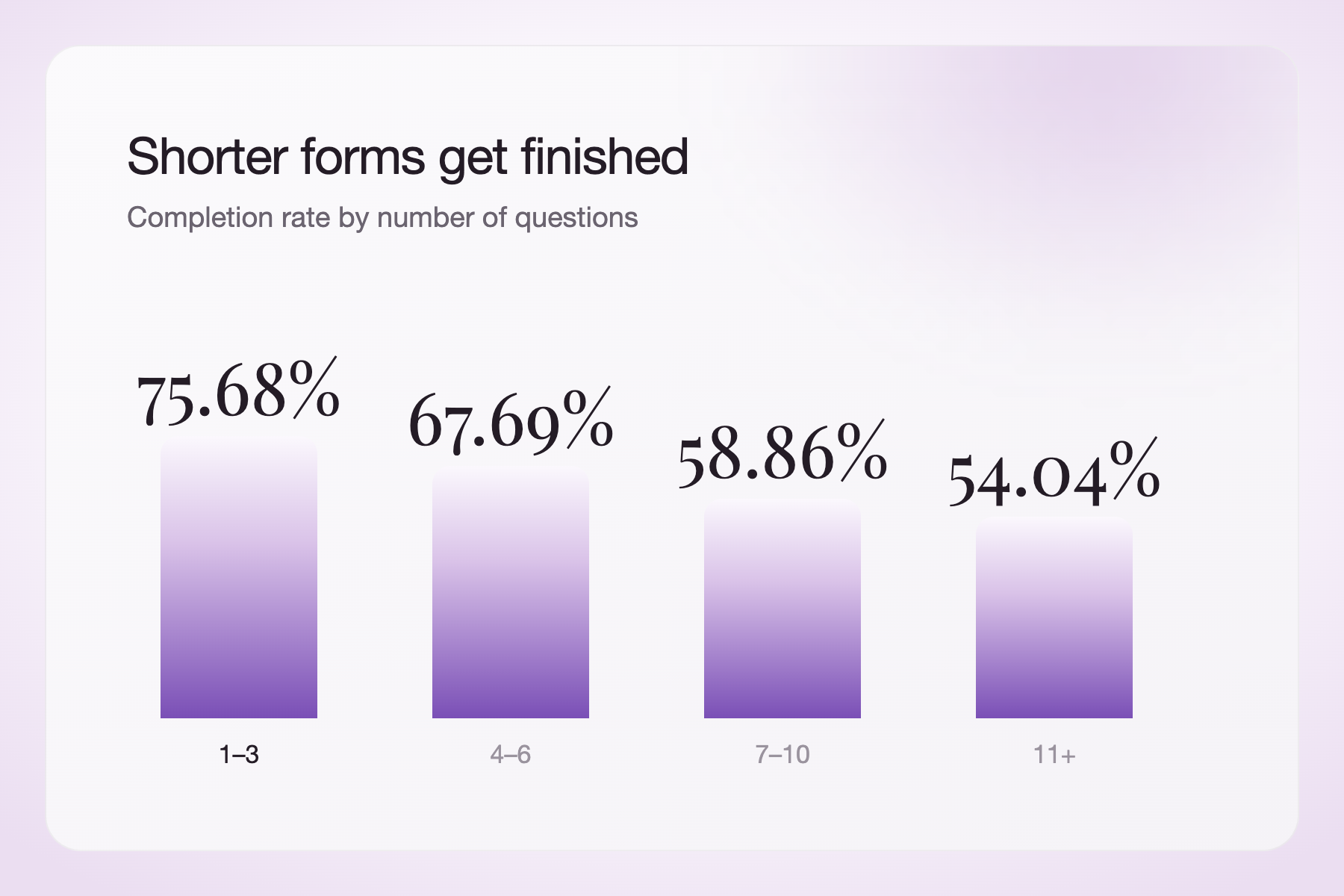
That’s a gap of more than 21 percentage points between the shortest and longest forms. The steepest single drop comes between 6 and 7 questions, where completion falls from 67.69% to 58.86%. These figures cover all forms, not quizzes specifically. For reference, forms classified as quizzes or tests complete at 62.20% across 124.6 million starts. Either way, the lesson holds: every question should earn its place.
Start with 5 to 6 thoughtful questions, and add more only when you need them.
3. Make your questions interesting
Here’s a quick comparison. Which question sounds more appealing?
“Select your preferred beverage category.” Or: “What’s your go-to drink when you need an afternoon pick-me-up?”
Both collect similar information, but the second sounds like something a friend would ask. Keep questions conversational, skip unnecessary jargon, and make answer choices easy to understand.
You can also mix multiple-choice questions with images and other interactive elements. For inspiration, browse the various quiz templates to see different approaches.
4. Design for mobile users
Your quiz might look great on a desktop, but how does it work on someone’s phone?
That’s worth checking. Typeform’s data shows that 69.8% of form starts happen on mobile devices. Forms started on mobile also have a 58.75% completion rate, compared with 62.53% on desktop.

Those numbers don’t prove that mobile devices cause lower completion rates, but they show why mobile-friendly design deserves attention. Keep questions readable, use clear answer choices, and avoid layouts that require excessive scrolling.
5. Give people a result worth waiting for
Imagine finishing a personality quiz only to see “Thanks for participating.”
Pretty disappointing, right? The result is often the best part of the experience. For knowledge quizzes, share scores and explain incorrect answers.
For personality quizzes, write result descriptions that feel relevant. And for product recommendation quizzes, explain why each suggestion matches someone’s needs. You can also add a next step, like exploring a recommended product or reading a related article.
6. Test your quiz before sharing it
Before publishing, take your own quiz.
Better yet, ask a few friends or colleagues to try it. Are any questions confusing? Do the results make sense? Does everything work on mobile?
Small fixes can make a big difference. For more help, explore research-backed tips for writing better questions to make your quiz clearer and more engaging.
Ready to create your own quiz?
Quizzes have come a long way from classroom worksheets and magazine personality tests.
Today, they’re a way to educate audiences, uncover preferences, recommend products, and make digital experiences more interactive. And creating one doesn’t have to be complicated.
Start with a goal, ask questions people enjoy answering, and deliver something valuable at the end.
Trivia challenge, personality quiz, or product finder, the same rule applies: a quiz should feel like a conversation, not an interrogation.
Ready to try it? Create your own interactive quiz with Typeform and turn a few simple questions into an experience worth completing.