How to establish and measure brand affinity
Why do shoppers choose one brand over another when prices and features match? Discover what brand affinity is and how to build and measure it.

We’ve all been there. We’re comparison shopping, and the prices, convenience, and even most features of the product we’re examining seem relatively even, but we still feel a pull toward a certain brand. We might not even know why, but it’s most likely due to what marketers call “brand affinity.”
Key takeaways
- Brand affinity starts with an emotional connection. Shared values and positive experiences give customers a reason to choose your brand beyond price or convenience.
- Know your audience to build stronger relationships. Understanding what customers value helps you create relevant content, meaningful conversations, and a recognizable brand personality.
- Every interaction shapes how customers feel about your brand. Consistent communication and helpful customer service build connections, but those connections need ongoing attention.
- Give customers a community worth joining. Useful content, opportunities to connect, and exclusive perks can turn enthusiastic customers into brand advocates.
- Measure brand affinity through multiple signals. Combine customer feedback with NPS, brand mentions and sentiment, content engagement, and customer lifetime value to understand how customer connections change over time.
What is brand affinity?
The career website Indeed defines brand affinity as “the notion that a corporation has the same values as its consumers. Customers become more attached to a business if they believe it values the same ideas as them, and this loyalty remains for a long time. Each customer's company affinity remains unique, as it's based on their personal views and feelings about the company.”

Brand affinity is crucial to your company’s success, and its benefits include things like: organic advocacy for your brand by influencers and ambassadors, higher retention, and resilience in the face of things like cost fluctuations, leadership changes, and more. Brand affinity helps to establish loyal customers for many years, if not for life, so we’re sharing how to establish and measure it below.
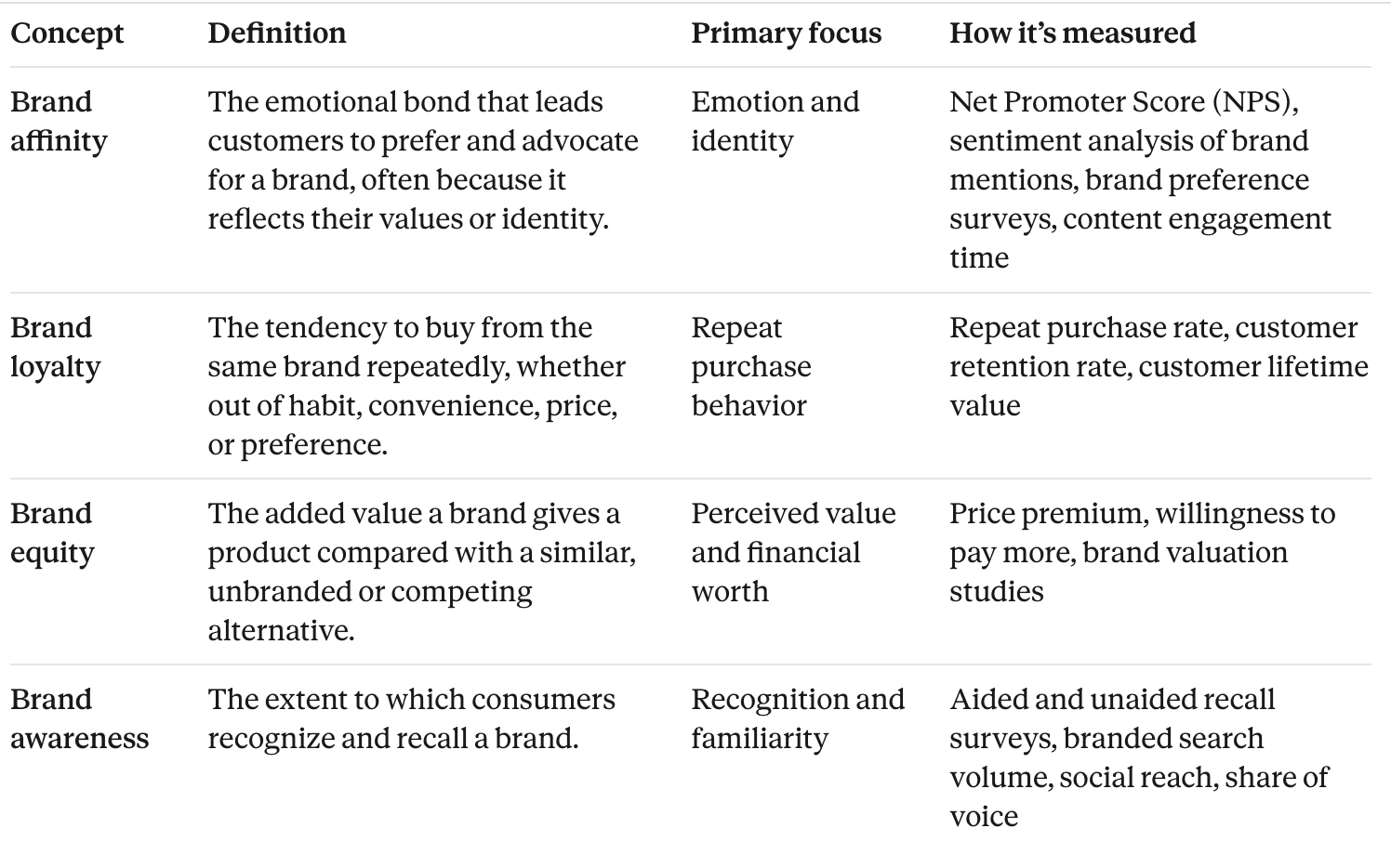
Brand affinity vs. brand loyalty, brand equity, and brand awareness
Brand affinity, which evokes emotion in the consumer, is not to be confused with brand loyalty, though they are similar marketing concepts. Shopify defines the latter as “often transactional or habit-driven; a customer might buy a product repeatedly out of convenience, routine, or price.” Brand equity, on the other hand, is defined by Survey Monkey as “the added value a brand gives to a product over a competing alternative.” Lastly, brand awareness is generally how many consumers are aware of your brand. Brand awareness is part of brand affinity, as if a consumer already likes your brand and shows a preference for it, that person already has brand awareness.
Brand affinity is a powerful concept, as it could very well lead to a person choosing your product even when it’s more expensive than a competitor’s. Brand affinity is also a driving factor behind praise of a product or service being spread by word of mouth and on social media. Research shows that71% of consumers who’ve had a good experience with a company on social media are likely to recommend the brand. It’s obvious how valuable brand affinity is to companies, which is why we’ll explore how to establish and measure it below.
How to build brand affinity
Target your audience
This step is no surprise to marketers, who know this is the first step in just about any marketing campaign. They typically do this by identifying the following: demographic (gender, ethnicity, job, etc.), geographic (where the audience is located), psychographic (what your audience thinks and values), and behavioral (consumer behavior, engagement, etc.).
Build and nurture customer relationships
There’s no such thing as “set it and forget it” when it comes to launching your brand. You need to stay in touch with customers to find out what’s working and what isn’t. Use social listening tools like Meltwater or Netbase Quid to gather intel on your brand. As Brand Master Academy points out in this YouTube video, “You need to meet your audience where they already gather—whether through a dedicated forum, a Slack/Circle/Discord channel, a private social group, or an app.”
Once you’ve found ways to reach your customers, you must continue to nurture that relationship to maintain brand affinity. It would be worth it to establish an entire customer support team to remain in charge of continuing to ensure nothing goes awry with the way a loyal client views your brand. Brand affinity can boost customer satisfaction levels through their strong emotional connection to your brand. When clients are satisfied with the products and customer service, they often share their experiences with others.
Define and adhere to your brand personality
Your brand persona directly impacts your brand affinity. As Survey Monkey notes, “People want to engage with a brand that is distinctive and has a memorable, recognizable voice. Spend some time developing your brand personality and make sure to use the same tone of voice throughout all of your content from social media to advertisements to your website.” Again, it’s not a “set it and forget it” concept, so you’ll want to revisit your brand persona regularly to ensure that the entire company is maintaining it in all things content and more.
Improve customer service
Customer service that goes above and beyond has a significant impact on how customers view your brand. According to Salesforce research cited by Nextiva, 88% of customers are more likely to make an additional purchase after a positive customer service experience. There are various tools your company can use to measure the success of your customer service team. If these results aren’t top-notch, honing customer service to establish brand affinity could be the order of the day.
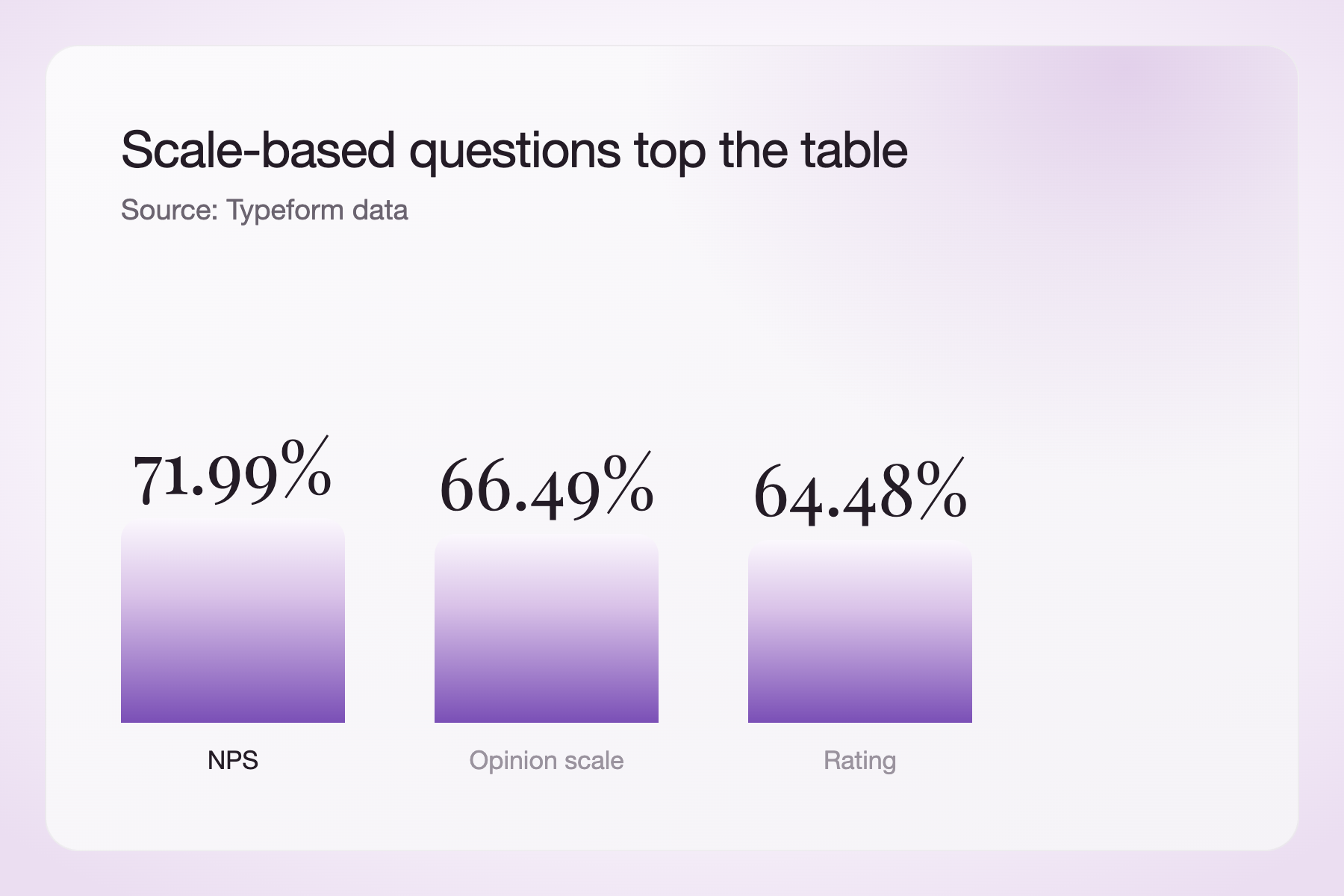
If you’re looking for a way to collect this type of data about your customer service, Typeform’s own data shows scale-based questions perform well: NPS questions averaged 71.99%, opinion scale 66.49%, and rating 64.48%.
Create value-driven content
To achieve brand affinity, you must establish your company as a subject matter expert on your products and services. In order to do so, you need to publish entertaining, educational, or episodic content (such as videos, podcasts, or community resources) that people want to enjoy for quality’s sake instead of forcibly being led down a sales funnel.
Build a community
If you’re passionate about a TV show that’s part of the zeitgeist, like The Pitt or Off Campus, you might even have joined an online forum to share your thoughts and read those of others on something that means a lot to you. The same can exist for products and services, and the ensuing discussion can be beneficial to your brand.
As this LinkedIn article notes of user generated content (UGC), “Studies show that UGC drives 6.9x higher engagement than brand posts and generates 50% more trust than traditional advertising.” It’s pretty awesome when you consider this is your brand loyalists doing the work for you. That’s why you should reward these insiders with exclusive perks like private events, ambassador opportunities, early access to sales, loyalty programs, and the like.

Brand ambassadors can be celebrities, influencers, or simply customers who are passionate about your products and services. They’re typically social media-savvy and they understand how to reach others to spread the good word about your brand. As Mail Chimp points out, “Brand ambassadors may be paid, receive free products and invitations to events, or get early access to new items. In exchange, they post on social media or brand community forums to help promote your business.” These ambassadors provide the social proof that you can use as a metric to show to investors and shareholders (more on metrics below!).
How do you measure brand affinity?
As with anything in marketing, lip service only goes so far. The proof is in the pudding, as the saying goes, so we need a way (or ways!) to measure brand affinity to ensure it’s doing its job. Brand affinity can’t be captured by one number. Instead look at a mix of metrics and survey results that together show how customers feel about your brand. Here’s what to track.
Customer lifetime value
The customer lifetime value metric reflects your customer retention and loyalty. It’s a critical component, as it estimates the total revenue a customer is likely to generate over their relationship with your brand.
Brand mentions
Check your social media analytics to track brand mentions. When customers tag you or use a hashtag related to your brand or product, you gain insight into their thoughts on your brand. This can and should incorporate a sentiment analysis, which means that sentiment analysis reveals whether customers express positive, neutral, or negative feelings about your brand.
Net promoter score® (NPS)
Your Net Promoter Score® (NPS) is an indication of customer loyalty. It’s a standardized measure that provides you with a quantifiable way to track your brand’s performance.
Time spent consuming content
If your marketing firm is already established on social media, you likely already have a team that measures your reach on Meta Business Suite, YouTube Analytics, X Analytics, TikTok Analytics, and Instagram Insights. These insights can also help measure brand affinity, such as tracking content consumption time, meaning how long users spend engaging with your content. You can also send out customer surveys to ask customers how they feel about your brand compared to your competitors.
Turn customer connections into lasting brand affinity
Your brand is only as successful as your reputation and the way your clients view your products, services, and customer service. Establishing brand affinity and then measuring it to ensure its effectiveness is essential to turning browsers into buyers and lifelong fans.