Moderated Usability Testing: When and Why to Use It
Learn what moderated usability testing is, when to use it, and how live research sessions uncover insights to improve products, websites, and prototypes.
Key takeaways
- Moderated testing reveals the "why": A live researcher can probe hesitations and wrong turns in real time, capturing context that unmoderated recordings miss.
- Use it for complex, high-stakes, or hard-to-recruit scenarios: Novel designs, accessibility testing, and major redesign decisions justify the added time and cost.
- Small samples reveal patterns, not proof: Five to eight sessions are enough to surface usability problems, but findings should inform decisions rather than make hard claims.
- Test early and often: Moderated sessions deliver the most value on wireframes and prototypes, and a regular testing cadence compounds insights over time.
Usability testing comes in many shapes and sizes. You can test asynchronously, run unmoderated sessions, or A/B test two versions side-by-side. But when you need to dig deeper—when you want to watch someone think through a problem in real time and ask follow-up questions—moderated usability testing shines.
Moderated usability testing puts a researcher in the room (physically or virtually) with a participant while they interact with your product, website, or prototype. It's slower than unmoderated methods, but it unlocks insights that observational data alone can't capture.
What is moderated usability testing?
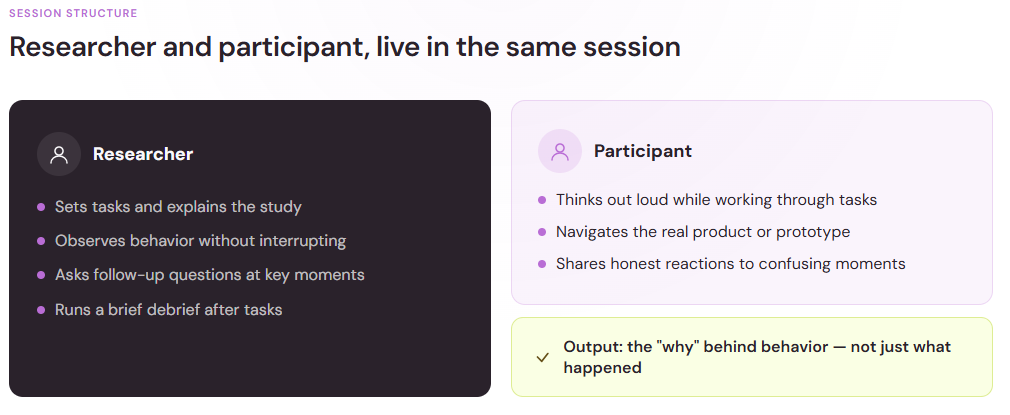
Moderated usability testing is a qualitative research method where a researcher facilitates a one-on-one session with a user as they interact with a product or service. The researcher guides the participant through specific tasks, observes their behavior, and asks clarifying questions in real time.
Unlike unmoderated testing—where participants complete tasks on their own and submit recordings—moderated sessions are live. The researcher can pivot mid-session, probe deeper into confusing moments, and adapt tasks based on what they see.
The setup typically looks like this: the researcher explains the study goals, gives the participant a task (like "find the return policy on this website"), and watches as they work through it. Afterward, a brief interview explores what worked and what frustrated them.
Why moderated usability testing matters
The global usability testing tools market was valued at $1.51 billion in 2024 and is projected to reach $10.41 billion by 2034. Organizations are waking up to the value of testing user behavior.
Moderated sessions offer something no recording or automated test can provide: context and nuance. When a participant hesitates before clicking a button, you're there to ask, "What made you pause?" When they take a wrong turn, you learn whether it was confusing labeling, poor information architecture, or a momentary distraction.
Moderated testing also builds empathy within your team. When designers, product managers, and engineers watch someone struggle with their creation, priorities clarify.
When to choose moderated usability testing
Moderated testing isn't always the right answer. It's slower and more expensive than unmoderated methods, so you need a good reason. Here's when it's worth the investment:
You're testing something novel or complex
If you're redesigning navigation or introducing an unfamiliar interaction pattern, moderated testing helps you understand how people make sense of it. You can watch where they get stuck and ask what they expected instead.
You need to understand the "why"
Unmoderated sessions tell you what happened. Moderated sessions tell you why. A participant might abandon a checkout because the shipping cost shocked them, because they got distracted, or because they weren't confident the site was secure. Those are three different problems, and only moderated research lets you confirm which one it was.
Your target audience is hard to recruit
If you're testing with a specific demographic—users over 65, small business owners, or users with assistive technology needs—every session counts. Moderated testing lets you build rapport, which often leads to more candid feedback.
You're testing accessibility or assistive technology
Understanding how someone using a screen reader navigates your interface often requires moderated testing. The researcher can observe in detail and understand the workarounds the participant uses.
You're making a high-stakes decision
When you're about to invest six months in a redesign or launch a new product, moderated testing gives you confidence before you commit.
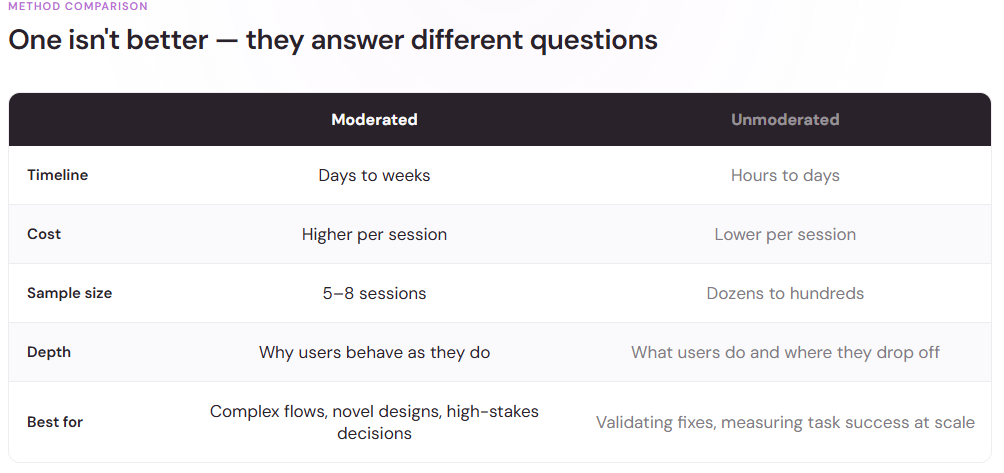
How moderated usability testing differs from unmoderated testing
Unmoderated testing runs on autopilot. Participants log in, complete tasks, and submit recordings or survey responses. It's cheaper, faster, and reaches many participants easily.
Moderated testing is different. You schedule live sessions, recruit weeks ahead, and spend two to four hours per participant. You typically run 5-8 sessions, giving you enough information to spot patterns, but not enough to claim statistical significance.
One isn’t better, just different. If you need to know how many users struggle with a feature, unmoderated testing across a large sample answers that. If you need to know why, moderated testing is your tool. Many teams run both: moderated early to understand behavior deeply, unmoderated later to validate fixes.
Running a moderated usability testing session
A solid moderated session follows a clear structure:
Recruit the right participants
Your findings are only as good as your participants. You need people who match your target user in behavior, goals, and context, not just demographics.
Write a clear screener, a short questionnaire that filters out people who don't fit your target user profile. Plan to recruit more people than you'll test, since some will no-show or disqualify.
Prepare a realistic task
Ask participants to do something concrete. Instead of "How would you sign up?" try "Imagine you want to switch email providers. Walk me through what you'd do to get started." Open-ended tasks protect you from leading participants.
Set the participant at ease
Spend five minutes explaining the study and reassuring the participant that you're testing the product, not them. A calm opening helps them behave naturally.
Observe and ask follow-ups
As the participant works, resist the urge to help. Take notes on what they do, not what they say. Their actions tell the truth. When they pause, ask open-ended questions: "What are you looking for right now?" or "What made you click there?"
Conduct a brief debrief
After the task, spend a few minutes asking about their overall impression. "Was anything confusing?" "What would you change?" A short debrief often surfaces issues you missed during the task itself.
Common pitfalls to avoid
Recruiting the wrong participants
Testing with internal stakeholders, friends, or "tech-savvy" people who don't match your actual user base gives false confidence. Invest in proper recruitment.
Asking leading questions
"Isn't this button really easy to find?" biases the response. Ask instead, "What did you notice when you first looked at this page?"
Over-interpreting small samples
Five moderated sessions reveal patterns, not truth. If three out of five participants missed a button, that doesn't mean 60% of all users will. Use findings as an initial starting point.
Testing too late
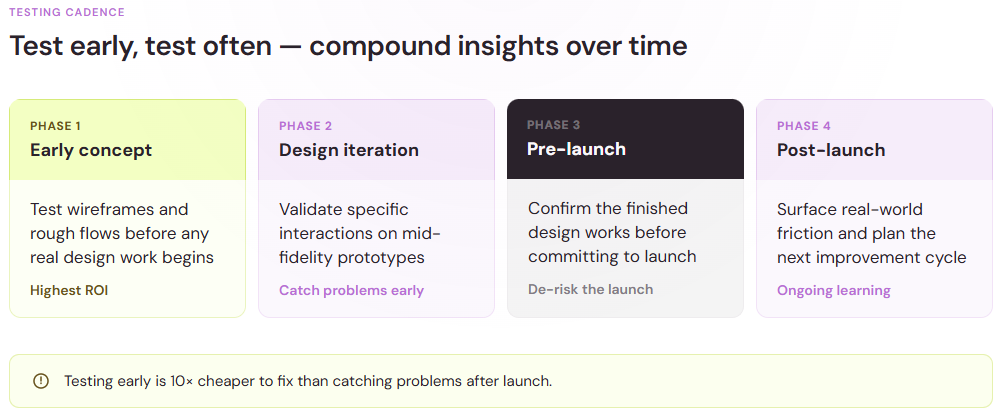
The best time to run moderated testing is early, when you're testing wireframes, prototypes, or initial designs. Testing after launch means paying to confirm problems you can't easily fix.
Make testing a habit
One-off sessions are useful, but a regular program—running sessions quarterly or bi-monthly—compounds insights over time. When testing is baked into your process, you catch problems before they reach thousands of users.
The supporting materials matter too. If you're designing forms or surveys to support your research, craft well-phrased questions that encourage honest feedback—whether you're asking them live in a session or collecting written responses afterward.
The best moderated testers stay curious, resist defending their design, and listen more than they talk. Over time, you internalize user mental models and start designing with their voices in your head. That's when usability testing really pays off.

Liked that? Check these out:
Opinions and Expertise
What’s actually slowing research teams down (Hint: it’s not the research)
From recruiting participants and scheduling interviews to building the actual surveys, the operational drag is taking researchers away from what they do best. See what's actually slowing them down and how Research Flow fixes it.
Read more