Questionnaire examples and templates for every goal
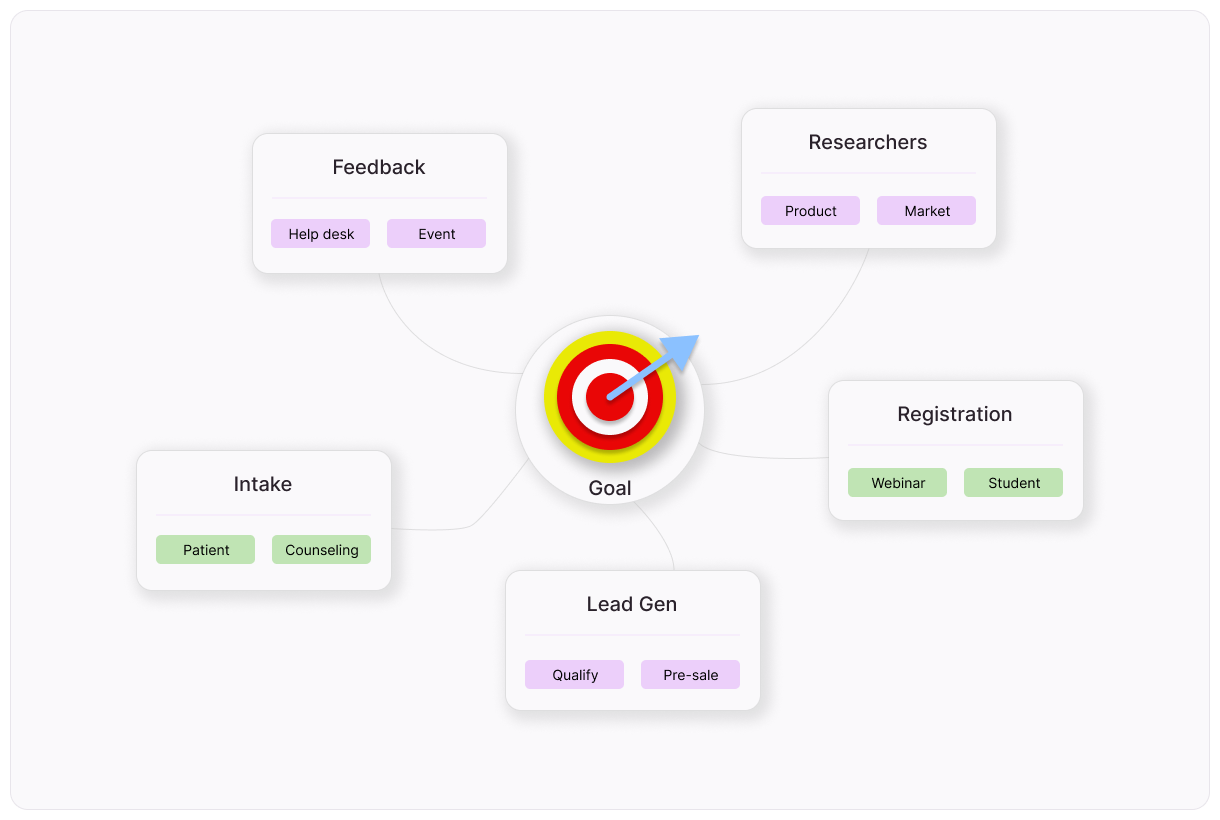
The first step in building an effective questionnaire is to establish a goal. Identify yours, then find questionnaire examples in this guide.
Share
Latest posts on
Free online trivia maker: custom trivia quizzes in minutes
|
September 4, 2026
Read more
AI survey builder: create smart surveys in minutes
|
September 4, 2026
Read more
How to make a test online: tips and tricks
Typeform
|
September 4, 2026
Read more
How to build a landing page that converts
Typeform
|
September 4, 2026
Read more
Share
The most effective questionnaires don’t begin with a list of questions; they start with a clear outcome. Without identifying the purpose of a questionnaire, you’ll end up with one that’s too long, asks the wrong things, or collects unusable data. When you know exactly what you’re trying to learn, you can create every question with purpose.
In this guide, you’ll learn how to establish your questionnaire goals, then find questionnaire examples for every possible outcome. Discover when to use each questionnaire type and what types of questions to ask. Then, get free templates to help collect feedback, conduct research, and achieve other goals.
What are Questionnaire Goals?
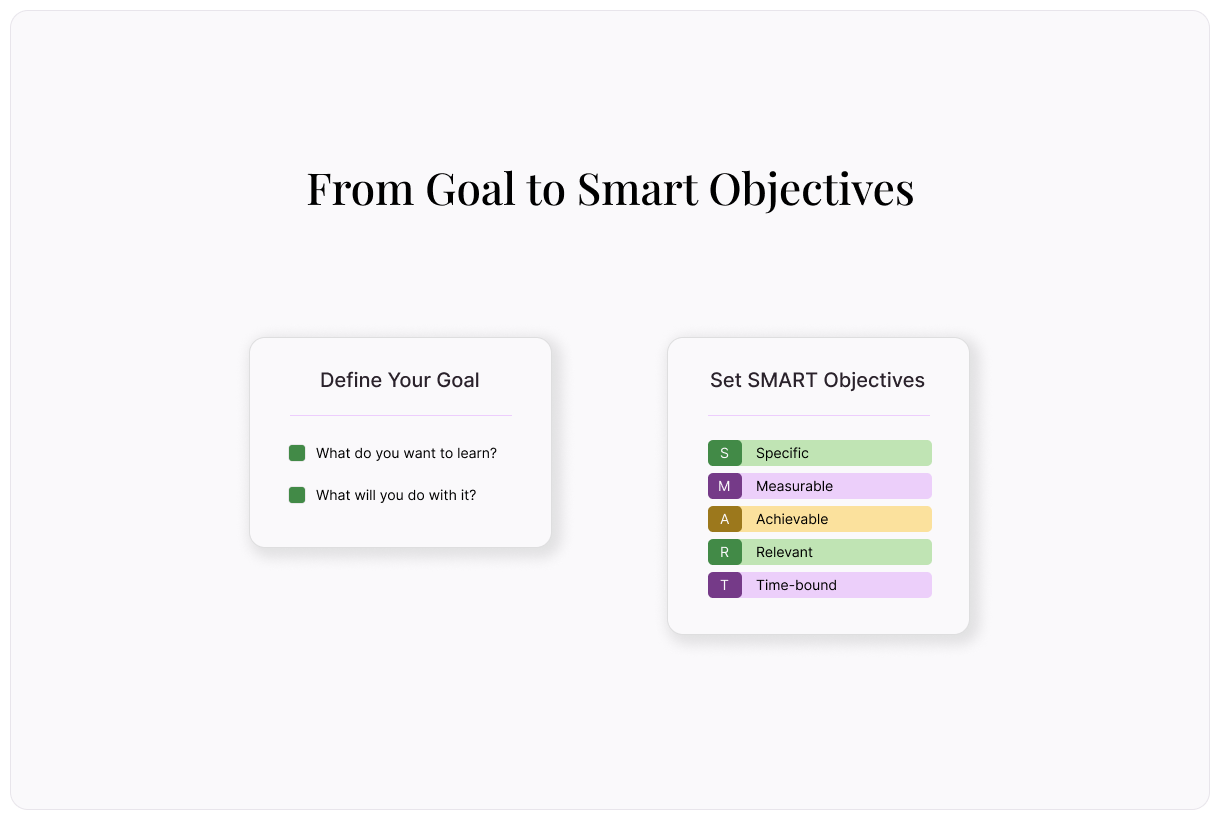
The first step in creating any questionnaire is to define your goal. Your questionnaire goal explains what you’re hoping to achieve through this process and why. Each question you include should get you closer to achieving your goal.
There are two main questions involved in defining your questionnaire goal:
What are you looking to learn?
What will you do with that information?
Say you’re the head of a customer service department with a high customer churn rate. Your questionnaire goal may be:
I’m looking to learn why customers are leaving at such a high rate in order to lower our customer churn rate.
Setting Questionnaire Objectives
Once you’ve defined your goal, it’s time to lay out your questionnaire objectives. Objectives are more specific, measurable actions that help you achieve your goal. In other words, they’re the things you need to learn to reach your goal.
When setting questionnaire objectives, it’s a good idea to follow the SMART framework:
Specific: Your objectives should be clearly defined.
Measurable: There needs to be a concrete way to measure their results.
Achievable: Your objectives should be realistic and achievable given your resources.
Relevant: They should be relevant to your questionnaire goal and greater long-term goals.
Time-bound: You need to set a deadline.
Using the above example, your questionnaire objectives may include:
Identifying the top three reasons customers cancelled your service in the past 30 days.
Understanding who the customer is (industry, company size, which services they used)
Determine how long customers were active before churning.
Defining where they were in the customer lifecycle at the time of churn.
Understanding if the customers asked for support before cancelling.
Determining if customers switched to a competitor after cancelling with you.
It’s easy to see how goals and objectives work in tandem. Your goal is the final destination, while your objectives are the map that helps you get there.
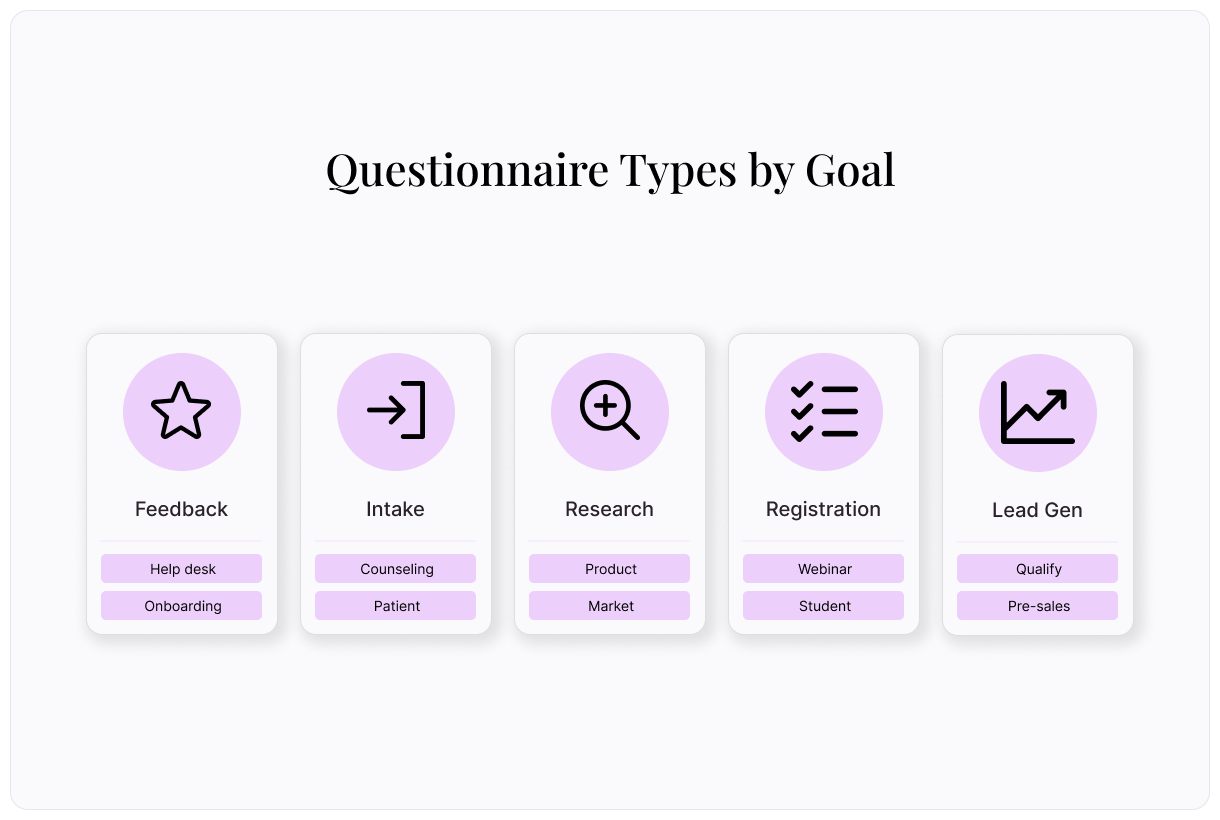
Feedback Questionnaires
As a business, one of the easiest ways to improve is by asking customers for feedback. Whether a customer sought out support, purchased a new product, or attended a recent event, feedback about their experience is invaluable. Stop guessing about your customers’ experiences and start hearing what they have to say with a feedback questionnaire.
Be prompt about collecting feedback; it’s most revealing when the experience is still fresh. Immediately follow up a customer service interaction with a feedback questionnaire, or send one in the days following an event.
Common Questions for Feedback Questionnaires
Questions that collect feedback ask about what the customer liked, what they didn’t, and how you can improve. They include:
Rate your satisfaction on a scale of 1-10.
What were your favorite parts?
What were your least favorite parts?
What did you feel was missing?
On a scale of not likely to very likely, how likely are you to recommend to a friend?
Questionnaire Examples for Collecting Feedback
Need to collect feedback? Get a headstart with these free feedback questionnaire templates:
Some questionnaires are used to gather information about new clients, customers, or patients in order to serve them better and keep relevant information on file. These are intake questionnaires.
For the best possible outcome, provide them before an appointment, service, or other engagement begins. That way, you can personalize their experience without any delays or disruptions.
Common Questions for Intake Questionnaires
Intake questionnaires ask questions about your customer, their past experiences, and what they’re hoping to achieve. Common questions include:
What is your age/gender/location?
What is your contact information?
What is your budget?
What brings you here today?
What are you hoping to get out of this experience?
Have you worked with someone like us before?
Questionnaire Examples for Intakes
A good intake questionnaire asks the essential information you need to know to provide a great service. These questionnaire templates are a good place to get started:
Counselling intake questionnaire: Learn about your new client’s mental health background and what they’re hoping to achieve through counseling.
Member intake questionnaire: Learn about new members’ backgrounds, what brings them to you, and what could make their experience great.
Research Questionnaires
Researchers use questionnaires to uncover patterns and trends in a population. Questionnaires reveal insights about behavior, market demands, or users’ needs. When conducted correctly, research questionnaires collect unbiased information that can be used to better understand an entire population.
Common Questions for Research Questionnaires
To prevent bias, research questionnaire questions should always be neutral, never leading. For market research, consider adding these questions to your next questionnaire:
How often do you use our service?
What problem were you trying to solve when you chose it?
Which alternatives did you consider?
For behavioral research, you can ask questions like:
In the past 7 days, how often did you…
On a scale of strongly disagree to strongly agree, do you agree with this statement..
How frequently do you…
Questionnaire Examples for Conducting Research
With the help of a research questionnaire, you can better understand the needs and desires of your target audience. Then, you can create better solutions to meet their needs. Check out these questionnaire examples for conducting research:
Product research questionnaire: Learn about how your target audience engages with products like yours to refine your product offering.
Competitor research questionnaire: Discover how you stack up to the competition by asking your target audience about their experiences.
Registration & Sign Up Questionnaires
Questionnaires are a great way to streamline a signup or registration process. For your team, they help keep each registrant’s information organized and accessible. For your registrants, they provide an easy, self-led process that can be completed from anywhere. Use the findings from your registration questionnaires to tailor the experience to each participant and inform future offerings.
For an even better experience, integrate your registration questionnaires with your payment processor. Registrants can sign up and pay without ever leaving your questionnaire.
Common Questions for Registration and Signup Questionnaires
Questions for registration and signup questionnaires commonly cover contact information, specific needs, and expectations. They include:
What is your name and email address?
Do you have any accessibility or dietary needs?
How did you hear about us?
What do you expect to get out of this?
Questionnaire Examples for Collecting Registrations and Sign Ups
These registration and signup questionnaire templates can get you started:
Make your sales pipeline more efficient by qualifying leads before investing ample time in them. Lead generation and qualification questionnaires help you understand whether prospects fit with your service offerings before launching into a sales conversation. They’ll save you time, money, and effort.
Common Questions for Lead Generation and Qualification Questionnaires
What’s your budget?
What problem are you trying to solve?
What’s the biggest challenge you're facing?
How are you currently handling it?
What’s your timeline for making a decision?
What is your role in the decision-making process?
Questionnaire Examples for Generating and Qualifying Leads
Strong lead generation and qualification questionnaires are helpful, not interrogative. Use these questionnaire examples to get started:
Pre-sales questionnaire template: Learn about potential leads’ challenges, how they’re currently solving them, and what would help.
Questionnaire Design Best Practices
Setting goals and objectives for your questionnaire is a great place to start, but there’s plenty more to know. Follow these best practices to get more responses and higher-quality answers.
Ask easy questions first: You may have noticed each of these questionnaire examples starts with the easiest questions first. That’s by design. Ask easy questions first to encourage participation.
Use simple language: Don’t overwhelm or confuse your respondents with jargon or overly complex questions. The more simple your language, the more useful their answers will be.
Ask one question at a time: When a single question asks more than one thing, we consider that a double-barreled question. Avoid these question types at all costs. They’re impossible to answer simply and muddy your responses. Instead, break them into two questions.
Allow respondents to skip questions: Unless every question is absolutely essential, allowing respondents to skip questions will improve your questionnaire outcomes. If a respondent is forced to answer an irrelevant question, one of two things can happen: they pick a random answer and mess up your data, or they quit the questionnaire altogether.
Test first: Before sending your questionnaire out to your entire audience, pick a small sample to test it on. They can identify confusing questions and other potential concerns so you can get on top of them.
Achieve Your Questionnaire Goals With Typeform
For an easy-to-use questionnaire maker with tons of free templates to help get you started, choose Typeform. We offer questionnaire examples for every goal, from gathering feedback to conducting research, generating leads, organizing events, and more. Our intuitive form builder harnesses AI to help you create forms that are fast to build, convert better, and unlock deeper insights. Start creating your first questionnaire today.
About the author
We're Typeform - a team on a mission to transform data collection by bringing you refreshingly different forms.
Questionnaire examples and templates for every goal
Free online trivia maker: custom trivia quizzes in minutes
Trivia is engaging. People love testing their knowledge, competing with friends, and proving they know random facts nobody asked them to memorize. That’s why trivia works as a learning tool, a marketing hook, an event activity, and just plain fun.
AI survey builder: create smart surveys in minutes
Creating effective survey questions is easier said than done. You need to ask the right things, in the right order, to the right people—and do it in a way that actually makes people want to answer. Most survey builders make this harder, not easier. You’re staring at a blank form, second-guessing every word, wondering if your logic flows or if you’ll get useful data back