How generative AI is transforming marketing: For better or worse
From creating highly personalized customer experiences to freeing up resources for more complex tasks, generative AI has something to offer every marketer—but approach with caution and handle with care.
Generative AI isn’t coming to marketing. It’s already here. Every day, more marketers experiment with AI for content creation, audience insights, copywriting, and campaign optimization.
The promise is enormous: create more content faster, personalize at a larger scale, test ideas instantly, and make better-informed decisions. The concern is real, too. Will AI homogenize marketing? Will it replace human creativity? Will it erode trust?
The answer is neither doom nor utopia. AI is a tool. Like any powerful tool, its impact depends on how you use it.
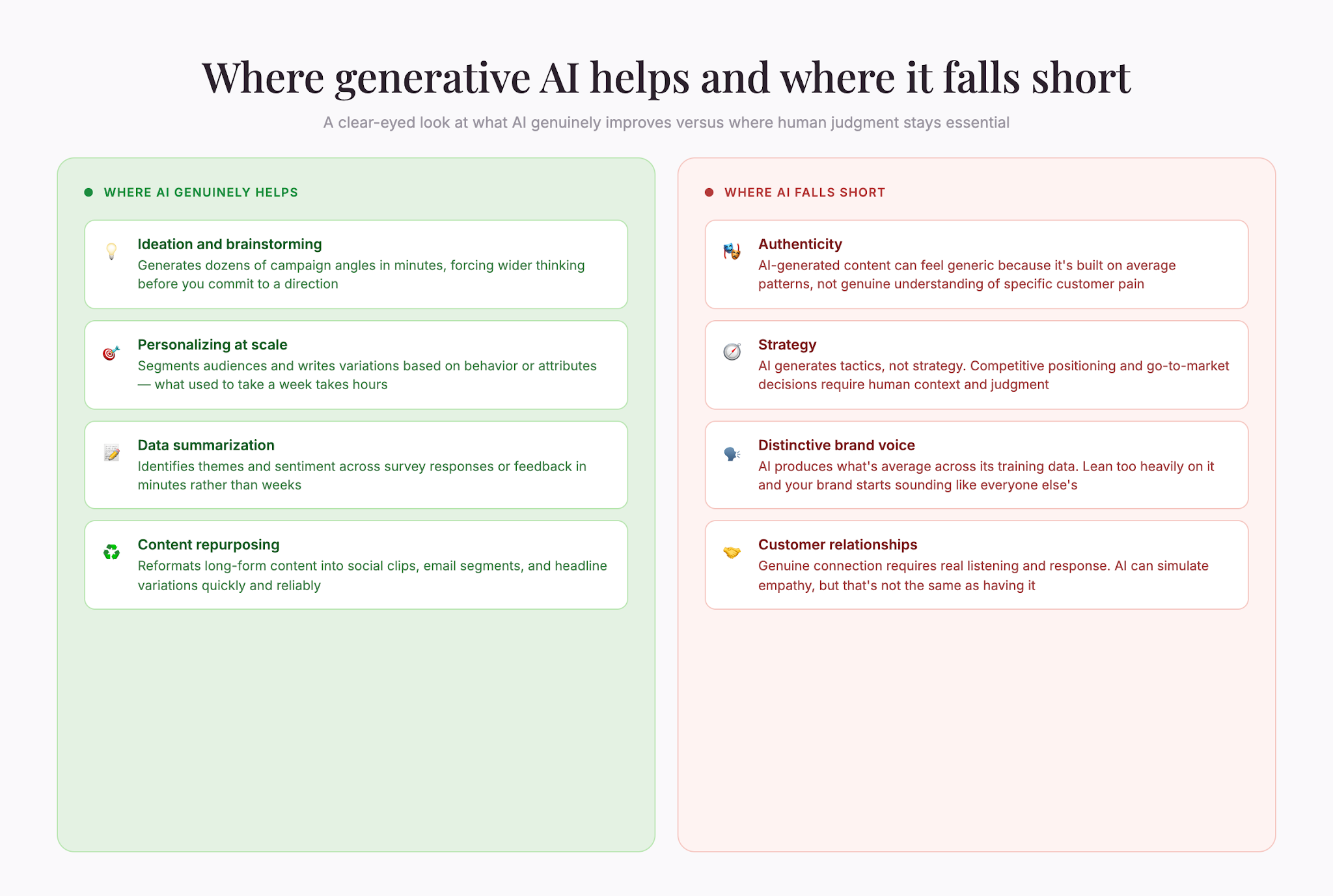
Where AI is genuinely helping
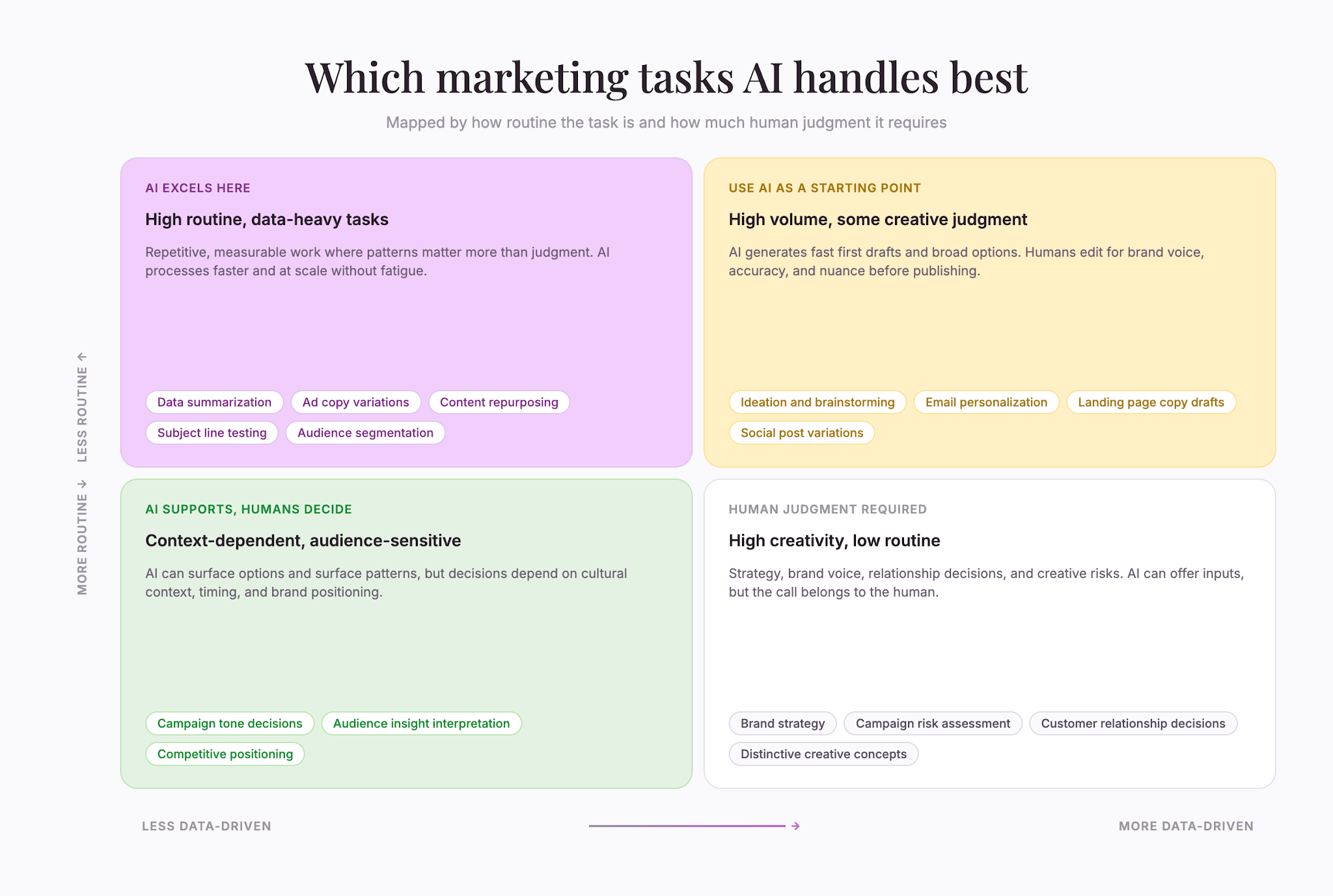
AI excels at certain marketing tasks right now.
Ideation and brainstorming. Stuck on campaign concepts? AI can generate dozens of angles in minutes. Not all will be gold, but it forces you to think wider and faster than you would alone. It’s a starting point, not the finish line.
Personalizing across larger audiences. Sending 10,000 people the same email is wasteful. AI can help segment audiences, write variations, and personalize subject lines or body copy based on user behavior or attributes. This isn’t magic—it’s math. But it works.
Data summarization. After running a survey or collecting feedback, you have mountains of text. AI can quickly identify themes, sentiment, and key insights that would take a human weeks. You still need to interpret and act on those insights, but AI speeds up the heavy lifting.
Content repurposing. Turn a long-form blog post into social clips, email segments, and headline variations. AI can handle the mechanical work of reformatting while you focus on quality and accuracy.
Ad copy testing. AI can generate multiple versions of ad copy, email subject lines, or landing page headlines. You test them, measure results, and learn which angles actually resonate with your audience.
Where AI falls short
AI also has clear limitations—and pretending otherwise will hurt your marketing.
Authenticity. AI-generated content can feel generic because it’s built on patterns in training data. People detect when something sounds like it was written by a machine, not by a human who actually understands their pain. Authenticity is hard to fake, and it’s what drives trust.
Strategy. AI can generate tactics but not strategy. Strategy requires understanding your competitive position, your customers’ deeper motivations, market trends, and your business goals. These are human decisions. AI can support them, but it can’t make them.
Judgment calls. Is a risky campaign worth the potential backlash? Should you lean into humor or stay serious? Will your audience respond to this angle or feel talked down to? These decisions require empathy and judgment. AI can simulate both, but that’s not the same as having them.
Brand voice. If your brand’s voice is a distinctive point of difference, AI will dilute it. AI generates what’s average across its training data. Your voice is probably specific to you. Lean too heavily on AI-generated copy, and you start sounding like everyone else.
Customer relationships. The best marketing creates genuine connection. A person who feels personally understood will trust you more than a person who feels they got a template. Connection requires real listening and real response.
The risk of over-reliance
Here’s where things get tricky. If every marketer in your space adopts content creation AI, everyone’s messaging starts to converge. Different brands end up sounding similar because they’re all using the same tools trained on the same data.
That’s bad for you and your customers. You lose differentiation. Customers lose the ability to tell brands apart.
There’s also the risk of spreading false information. AI is prone to “hallucination”—confidently generating false or misleading claims. An AI tool might cite a study that doesn’t exist, or misrepresent data. If you don’t fact-check and you publish that content, you’ve lost credibility.
Finally, there’s the efficiency trap. AI makes it easier to produce more content faster. But more isn’t always better. Marketers often end up drowning in tactical execution and losing sight of strategy. AI can accelerate this race to the bottom.
A more disciplined approach
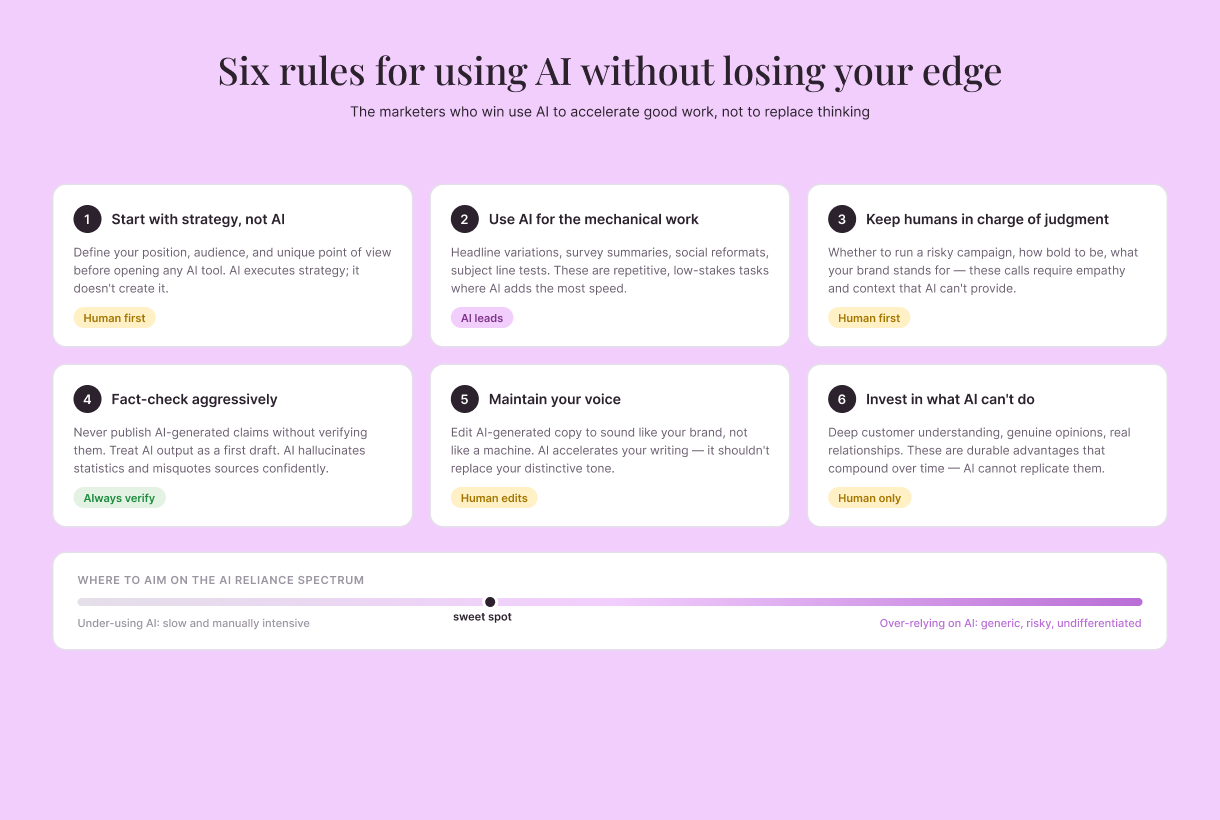
The marketers who win in our AI-enabled world will be the ones who use AI as a tool, not a replacement for thinking.
Here’s how to do that:
Start with strategy, not AI. What’s your position? Who’s your customer? What do they actually need? What’s your unique point of view? Answer those questions first. Then use AI to execute the strategy faster.
Use AI for the mechanical stuff. Generating headline variations? Perfect for AI. Summarizing survey responses? Great use. Formatting social clips? Absolutely. These are repetitive, low-stakes tasks where AI shines.
Keep humans in charge of judgment calls. Whether to run a risky campaign. How bold to be. Which customer insight matters most. What your brand stands for. These are human decisions. Use AI to give you options, then decide.
Fact-check aggressively. Never publish AI-generated claims without verifying them. Treat AI output as a first draft, not a finished product.
Maintain your voice. Edit AI-generated copy to sound like you, not like a machine. Let AI accelerate your writing, but make sure it still sounds like your brand.
Invest in what AI can’t do. Understand your customers’ real motivations through research, interviews, and deep listening. Develop genuine opinions about your market. Build relationships. Create things that only your team could create because they understand your specific context and audience.
The honest outlook
Generative AI will only continue to improve. It’ll get faster, cheaper, and more capable. Some tasks you do today will be fully automated in two years.
That’s okay. Because it’ll free up your time to do what actually moves the needle: strategy, insight, and authentic connection.
The marketers who thrive in the next few years won’t be the ones who are best at using AI. They’ll be the ones who are clearest about their strategy, most deeply connected to their customers, and most disciplined about using AI to accelerate good work instead of replacing thinking.
AI is a multiplier. It magnifies what you’re already good at. If you’re strategic and clear, AI makes you faster. If you’re confused and reactive, AI just makes you confused and reactive faster.
Use it as a tool for speed and reach. But keep thinking like a human.

Liked that? Check these out:

Opinions and Expertise
What’s actually slowing research teams down (Hint: it’s not the research)
From recruiting participants and scheduling interviews to building the actual surveys, the operational drag is taking researchers away from what they do best. See what's actually slowing them down and how Research Flow fixes it.
Read more