Preference testing: how to evaluate what users prefer
Learn what preference testing is and when to use it, as well as how building effective tests reveal genuine insights.
Key takeaways
- Preference testing replaces assumptions with evidence: Presenting people with two or more options and asking them to choose reveals what your audience actually wants.
- Fair presentation is everything: Consistent order, equal visual weight, and open-ended follow-ups turn raw choices into insight you can act on.
- The reasoning matters more than the split: Segment responses by user type, measure how strong the preference is, and check for order effects before you act.
- Cross-reference before you commit: Preference results should line up with support tickets, analytics, and other feedback data before they drive big decisions.
When people make choices, they're rarely indifferent. They prefer one option over another, but it’s not always clear why that selection rose above the others. Preference testing helps you uncover those choices and the thinking behind them.
Whether you're designing a product, refining messaging, or planning a customer experience, preference testing cuts through guesswork. It tells you what your audience actually wants, not what you assume they want.
This guide explains what preference testing is, when to use it, and how to build effective tests that reveal genuine insights.

What is preference testing?
Preference testing is a research method where you present people with two or more options and ask them to choose the one they prefer. The goal is simple: identify which option your audience favors and gather context about their decision.
It's not about right or wrong answers, but about the behavior that’s driving those decisions.
The method works because it mirrors real-world decision-making. People constantly compare alternatives when deciding what products, services, and experiences they want to do. Rather than asking abstract questions about features or benefits, preference testing asks people to do what they do every day: choose.
Why preference testing matters
User preferences can be difficult to predict. Even experienced teams can make incorrect assumptions about what will appeal to customers, which leads to wasted development time, ineffective messaging, or poor user experiences.
Preference testing provides evidence behind decisions by showing what users actually choose and what factors include those choices. Preference testing produces several important benefits:
It reduces assumption risk. Teams often build around hunches. A preference test replaces "I think users will prefer X" with data showing "users chose X 73% of the time."
It improves trust. When you design around user preference data, people feel heard. 81% of consumers say trust in a brand is a deciding factor in their purchasing decisions. Preference tests build that trust by centering user choice.
It validates before you invest. Preference testing is a low-cost way to validate directional decisions before you commit resources.
It uncovers nuance. A test might show 60% prefer option A while 40% prefer option B, but the reasoning differs between groups. That nuance helps you refine your approach for different segments.
When to use preference testing
Preference testing is most valuable when teams are choosing between more than one viable option. It works best when the goal is understanding user preference rather than measuring task completion or usability.
Common uses cases include:
Product design and features. Test whether users prefer a modal popup or a slide-out panel, single-step or multi-step setup flows.
Marketing and messaging. Run preference tests on headlines, value propositions, imagery, tone, or call-to-action buttons.
User experience optimization. Before conducting a full usability study, use preference tests to narrow the field and see which direction users lean.
Trade-off analysis. Preference testing reveals which trade-off resonates most: speed versus customization, simplicity versus control, or cost versus features.
Personalization and segmentation. Preference tests help you identify which user segment favors which approach.
Decision support. When leadership is split between two directions, feedback from your actual audience can break the tie.
How to structure a preference test
A well-designed preference test offers more than asking users to choose an option. The way choices are presented, the questions asked, and the audience selected all influence the quality of the results.
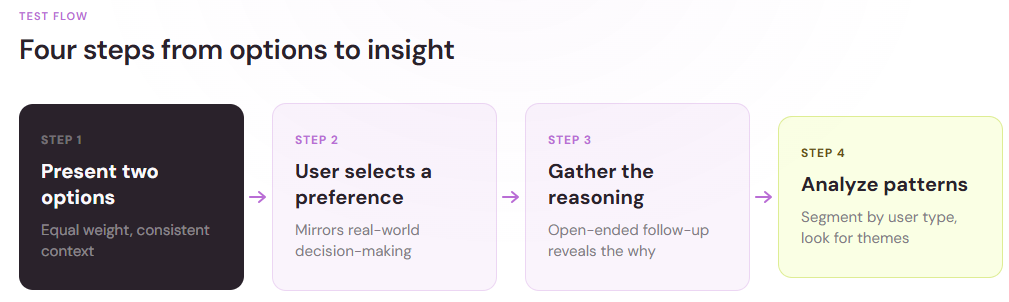
Follow these best practices to create more reliable tests:
Present two or more clear options. Show users each option side by side when possible, and make sure both are fully formed enough to fairly represent the choice.
Keep the context consistent. Present options in the same order, on the same background, with equal visual weight. Small presentation details can sway choices without reflecting genuine preference.
Ask why. After users choose, ask an open-ended follow-up: "What drew you to that option?" or "What would make the other option appealing?" These responses turn raw choice data into actionable insight.
Avoid forcing yes/no. Binary questions are fast, reduce respondent fatigue, and produce categorical data that's easy to quantify. But they can oversimplify and cause respondents to rush, which hurts reliability. Relying solely on binary choice without context means missing important nuance.
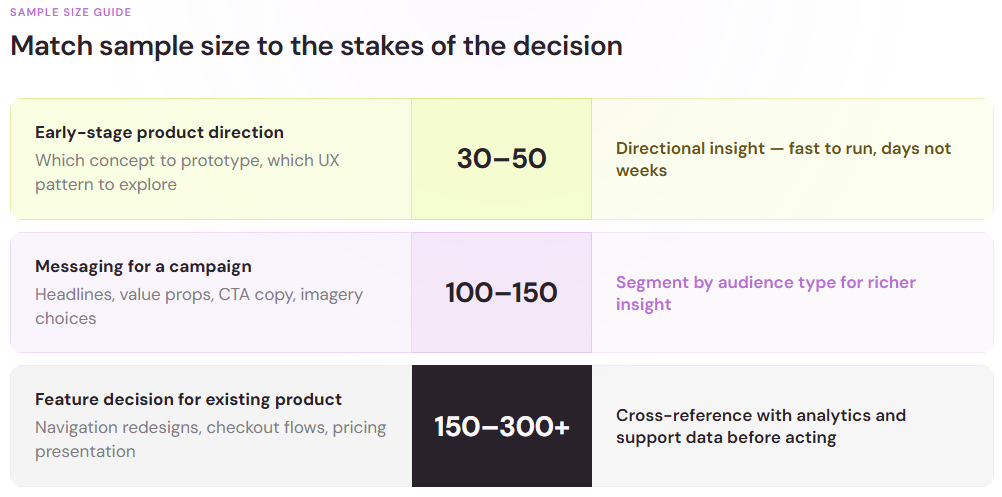
Set a sample size target. For directional insight, 30-50 respondents is often enough. For confidence in decisions affecting a large user base, aim for 100-200 or more, applying the same rigor you'd bring to a full market research survey.
Common preference testing formats
Preference testing can take several forms depending on the decision that’s being evaluated. The right format depends on whether you’re testing functionality, messaging, visuals, or the overall experience.
Side-by-side visual comparison. Show two designs, layouts, or prototypes next to each other. This is the ideal format for visual, spatial, or interaction choices.
Sequential or card-sort format. Let users interact with option A, then option B, then ask which they preferred.
Moderated testing. A researcher observes users with each option and asks follow-up questions in real time. The results are often richer, but it’s slower and more costly to run.
Unmoderated testing. Users interact with options remotely and answer follow-ups in writing or via rating scales. This is faster and more cost-effective.
Ranking or forced-choice. Present three or more options and ask users to rank them, revealing how preferences stack against each other.
How to analyze preference test results
Preference testing results can appear straightforward: one option receives more votes than another. However, the percentage split alone doesn’t tell the full story.
For example: 60% chose A, 40% chose B. This is a starting point, not a conclusion. The real insight lives in the reasoning.
In fact, the strongest analysis combines quantitative results with qualitative feedback to understand both what users chose and why.
Look for patterns in open-ended feedback. Group "why" responses by theme. Did users choosing option A cite speed, aesthetics, or clarity? Themes reveal the values driving preference.
Segment by user type. Did power users prefer one option while novices preferred another? Cross-reference choices against demographic or behavioral data.
Measure confidence. If the split is 51% versus 49%, preference is weak. If it's 80% versus 20%, preference is strong. Weak preference may mean both options are viable.
Test for order effects. Run a subset with reversed option order. If preference flips, presentation order had more impact than option quality.
Compare it to the other data. Preference test results should align with support tickets, customer feedback, usage analytics, or prior research. If they conflict, that's worth investigating.
Building trust through preference data
The strongest preference tests tie results back to real outcomes. If implementing the winning option improves your conversion rate, that's proof. If it doesn't, that's important too. It could even signal an issue with your test methodology.
Mature teams run preference tests continuously as part of a larger feedback loop alongside brand awareness surveys, support data, and behavioral metrics. The combination of qualitative insight and quantitative validation is where confident decisions come from.
Starting small is often enough to uncover valuable insights. A preference test with 30-50 respondents takes days to run and can save weeks of building in the wrong direction. The next time you're torn between two approaches, don't decide on gut feel. Test it. Your users’ preferences point you toward the choices they'll actually make in the real world.

Liked that? Check these out:

Opinions and Expertise
What’s actually slowing research teams down (Hint: it’s not the research)
From recruiting participants and scheduling interviews to building the actual surveys, the operational drag is taking researchers away from what they do best. See what's actually slowing them down and how Research Flow fixes it.
Read more