Market research survey: how to create one that works
From defining your objective to analyzing results, here's how to create a market research survey that leads to real, actionable insights.
Share
Latest posts on
Free online trivia maker: custom trivia quizzes in minutes
|
September 4, 2026
Read more
AI survey builder: create smart surveys in minutes
|
September 4, 2026
Read more
How to make a test online: tips and tricks
Typeform
|
September 4, 2026
Read more
How to build a landing page that converts
Typeform
|
September 4, 2026
Read more
Share
How to create a market research survey
Most businesses think they know their customers. They've read the reviews, tracked the analytics, and sat through the strategy meetings. But there's a gap between what data dashboards tell you and what people actually think, feel, and want. A market research survey bridges that gap.
Market research surveys aren’t about asking people if they like your product. They’re about understanding the full picture—what drives customer decisions, what frustrates them, what they wish existed, and where they'd go if you disappeared tomorrow.
When you ask the right questions, you stop guessing and start knowing.
When to use a market research survey
Not every question needs a survey. But certain moments call for direct input from the market.
Before a product launch – Validate demand before you invest. Do people actually want what you're building? How much would they pay? What features matter most? A survey at this stage can save months of building something nobody asked for.
Entering a new market – You know your current customers, but a new audience might think differently. Surveys help you understand unfamiliar demographics, regions, or industries before you commit resources.
After a competitor shakes things up – Imagine a rival launches a new feature, drops their prices, or runs an aggressive campaign. A survey will tell you how your audience feels about it—and whether your position has shifted.
During a rebrand or repositioning – Before you change your messaging, find out how people currently perceive you. The gap between your intended brand and your perceived brand is where the real work happens.
When retention dips – If customers are leaving and you're not sure why, a survey is faster and more reliable than internal speculation. Exit surveys, in particular, capture candid feedback that ongoing relationships often don't surface.
Types of market research surveys
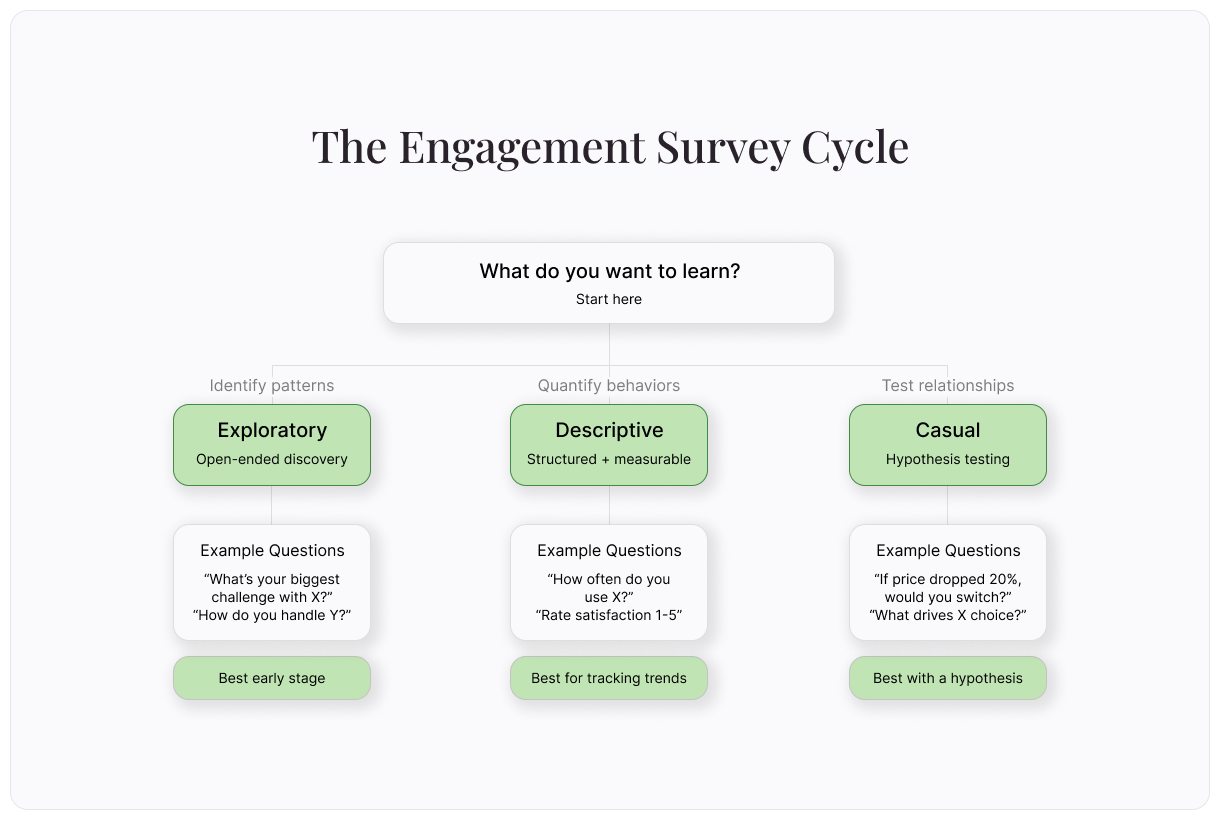
Different questions require different approaches. Choosing the right type of survey before you write a single question saves time and improves the quality of what you learn.
Exploratory surveys
Used when you're in the early stages of understanding a topic. The questions are broad and often open-ended: "What's your biggest challenge with X?" "How do you currently handle Y?" Exploratory surveys help you identify patterns and generate hypotheses worth testing. They're best used when you don't yet know enough to ask specific questions.
Descriptive surveys
Used to quantify attitudes, behaviors, or characteristics. These rely on structured questions—multiple choice, rating scales, and ranking—that produce data you can analyze statistically. Examples might look like: "How often do you use X?" "Rate your satisfaction from one to five."
Descriptive surveys are the workhorses of market research. They give you numbers you can track over time and compare across segments.
Causal surveys
Used to test cause-and-effect relationships. A question on this survey might be: "If we lowered the price by 20%, would you switch from your current provider?"
These surveys isolate variables to understand what drives specific outcomes. They're more complex to design but produce some of the most actionable insights. Use them when you have a specific hypothesis to test.
How to design your survey
To ensure high-quality, actionable responses, you need an effective survey. Here’s how to create one:
Step 1: Define your research objective
Start with one clear question you want to answer, and be specific. For example, "What factors influence purchasing decisions for our target demographic?" is a research objective. "Learn stuff about customers" isn't.
Your objective determines which audience you survey, what questions you ask, and how you analyze the results. Write it down and keep coming back to it as you design. Every question in your survey should serve this objective—if it doesn't, cut it.
Step 2: Identify your target audience
Who has the answers you need? Current customers? Potential customers? Lost customers? People who've never heard of you?
Define your audience by demographics (age, location, income), behaviors (purchasing habits, product usage), or firmographics (company size, industry, role), depending on what's relevant to your objective. The more precisely you define your audience, the more useful your results will be.
Step 3: Choose your question types
Mix structured and open-ended questions, but lean heavily toward structured ones for easier analysis. Question types include:
Multiple choice – Best for categorical data ("Which of these features is most important to you?")
Rating scales – Best for measuring attitudes ("How satisfied are you with X, on a scale of one to five?")
Ranking – Best for understanding priorities ("Rank these features from most to least important")
Open-ended – Best for capturing nuance ("What's one thing you wish we did differently?"). Use these sparingly—two or three per survey is plenty. Place them at the end so they don't cause early drop-off.
Step 4: Write questions that don't bias responses
Survey design is deceptively tricky. A poorly worded question doesn't just give you bad data—it gives you confidently wrong data. Here are a few common traps to avoid:
Double-barreled questions – "How satisfied are you with our pricing and customer service?" asks about two things at once. Split them into separate questions. Each question should measure exactly one thing.
Leading questions – "Don't you agree that our product is easy to use?" nudges respondents toward a specific answer. Rephrase neutrally: "How would you rate the ease of use of our product?"
Loaded language – "How much do you love our new feature?" assumes a positive opinion. Try: "How would you describe your experience with our new feature?"
Vague scales – "Rate from bad to good" leaves too much room for interpretation. Define your anchors clearly: "one = very dissatisfied, five = very satisfied."
Step 5: Determine your sample size
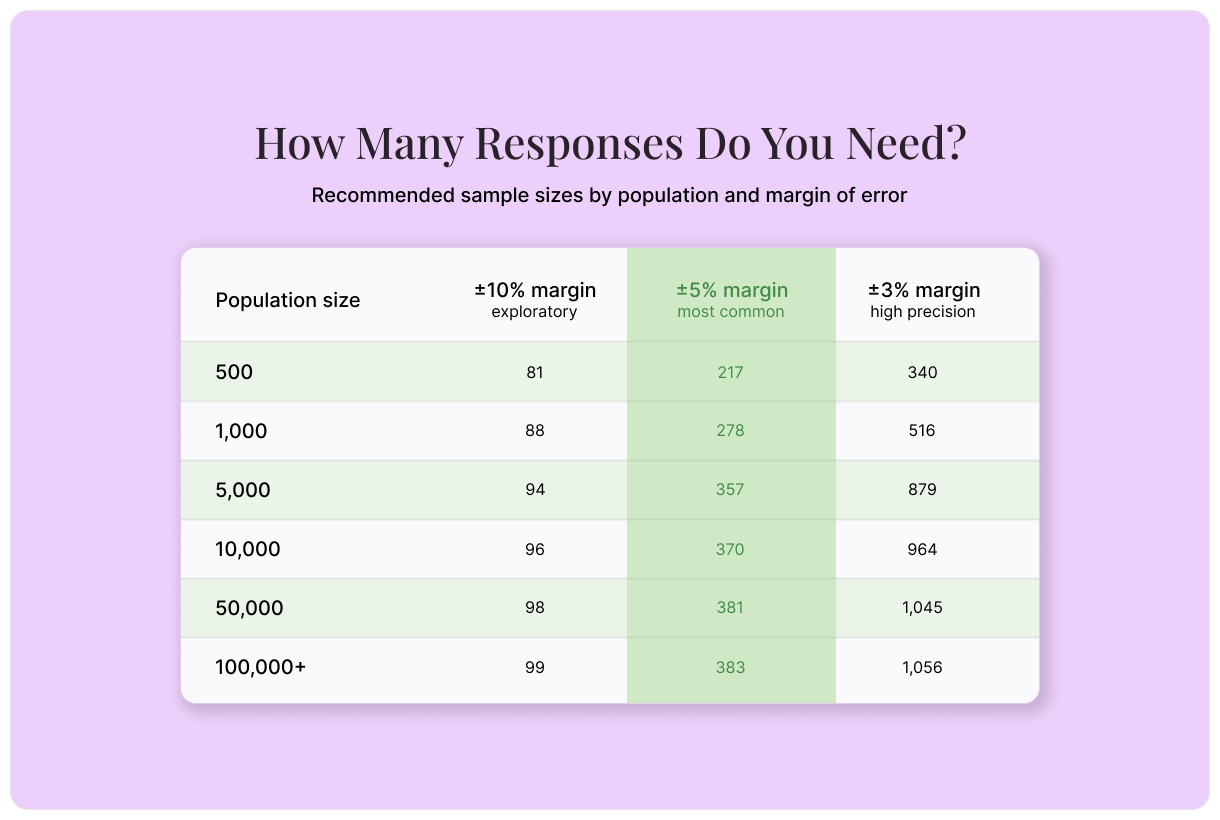
How many responses do you need? It depends on your population size, your desired confidence level, and your margin of error.
For most market research purposes, 200-400 responses give you a statistically meaningful dataset. If you're segmenting by subgroups (age brackets, regions, product lines), you'll need more—at least 50-100 per segment to draw reliable conclusions within each group.
Distributing your survey
Getting enough responses means putting your survey in front of the right people through the right channels. The channel you choose affects both response rate and response quality.
Email – Highest response rates, especially for existing customers. Personalize the subject line and keep the preview text short and compelling. Sending from a real person's name rather than a company address tends to improve open rates.
Website intercept – Best for short surveys (three to five questions). A pop-up or embedded survey on your website captures feedback from visitors in the moment. Time the trigger carefully—showing a survey before someone has engaged with your content feels intrusive.
Social media – Effective for reaching broader audiences, especially when boosted with paid promotion. Response quality can be lower, so consider screening questions to filter out respondents who don't match your target audience.
Panel providers – If you need responses from a specific demographic you don't have access to, third-party panels let you target by age, income, location, industry, and more. The responses are fast but come at a cost per response.
In-product – If you have a digital product, triggering a survey after a key interaction (completing a purchase, finishing onboarding, canceling a subscription) captures feedback at the most relevant moment. Context-triggered surveys tend to produce the most honest, specific responses.
Analyzing your results
Once you have your answers, it’s time to interpret what they mean and how to put them to work.
Look for patterns, not just averages
An average satisfaction score of 3.5 out of five sounds decent. But if half your respondents scored five and the other half scored two, you have a polarized audience—and a very different problem to solve. Distribution matters as much as central tendency. Always look at the shape of your data, not just the midpoint.
Cross-tabulate your data
Break results down by segments: age, location, product tier, tenure as a customer. The insights often live in the differences between groups, not in the aggregate. A satisfaction score that looks stable company-wide might reveal that new customers are thrilled while long-term customers are quietly frustrated.
Read every open-ended response
Quantitative data tells you what. Qualitative responses tell you why. So, read open-ended responses carefully. Look for recurring themes, unexpected language, and the emotions behind the words. Quote respondents directly when presenting findings—real words carry more weight than summary statistics.
Prioritize actionability
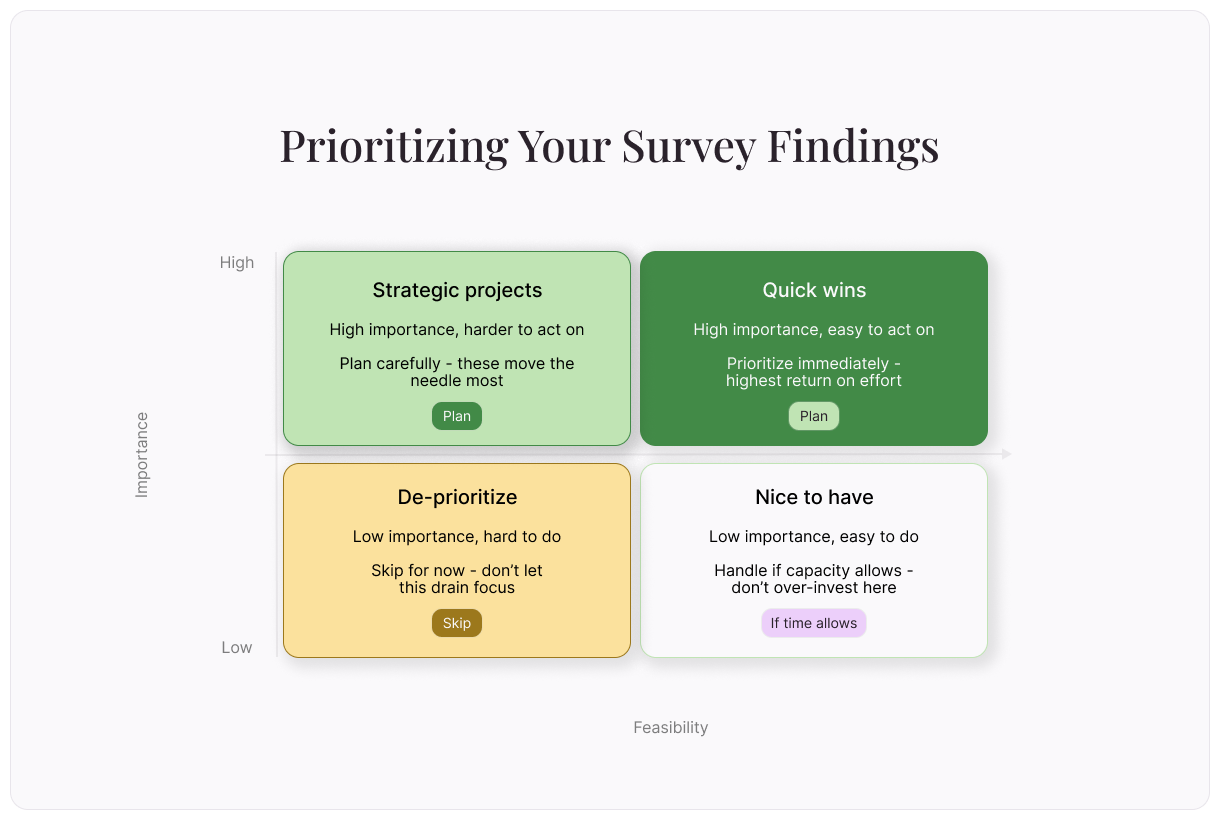
Not every insight requires action. Focus on findings that are both important (they affect revenue, retention, or growth) and actionable (you can actually do something about them). Here’s a useful framework: Plot findings on a two-by-two matrix of importance versus feasibility and focus on the high-importance quadrants.
Common mistakes to avoid
If you want people to actually complete your survey and provide you with accurate data, you don’t just need to know what to do—you also need to know what not to do. Here are a few common pitfalls to avoid:
Writing the survey before defining the objective. It's tempting to jump straight into questions. But without a clear research objective, you'll collect data you can't use. Define the objective first—everything else follows from it.
Making it too long. Aim for a completion time of five to eight minutes. Anything beyond 10 minutes and you'll see abandonment rates climb. Respect your respondents' time, and they'll respect your survey with thoughtful answers.
Asking questions you could answer with existing data. If your analytics platform already tells you how often customers use a feature, don't waste a survey question on it. Reserve the survey for things only your audience can tell you—their feelings, preferences, and unmet needs.
Ignoring response bias. The people who respond to your survey aren't always representative of your full audience. Satisfied customers and very dissatisfied customers are both more likely to respond than people in the middle. Acknowledge this limitation when interpreting results, and consider whether non-respondents might have told a different story.
Evidence over intuition
You don't need a research team or a six-figure budget to run a useful market research survey. Define one objective, write 10-15 focused questions, and send it to a group of people whose opinions matter to your business.
The insights you get might confirm what you already suspected—or they might reveal something you never considered. Either way, you'll be making decisions based on evidence. And evidence has a way of cutting through the noise.
About the author
We're Typeform - a team on a mission to transform data collection by bringing you refreshingly different forms.
Market research survey: how to create one that works
Free online trivia maker: custom trivia quizzes in minutes
Trivia is engaging. People love testing their knowledge, competing with friends, and proving they know random facts nobody asked them to memorize. That’s why trivia works as a learning tool, a marketing hook, an event activity, and just plain fun.
AI survey builder: create smart surveys in minutes
Creating effective survey questions is easier said than done. You need to ask the right things, in the right order, to the right people—and do it in a way that actually makes people want to answer. Most survey builders make this harder, not easier. You’re staring at a blank form, second-guessing every word, wondering if your logic flows or if you’ll get useful data back