Product discovery: What it is and why it matters
Product discovery tests assumptions before building. Interviews, surveys, and behavioral data reveal what customers actually need.

Key Takeaways
- Discovery validates before you build: Testing ideas through conversations and prototypes costs a fraction of what a finished, unwanted feature costs in wasted development time.
- Match the research method to what you're testing: Interviews answer "why," surveys answer "how many," and user testing reveals where a design confuses people.
- What customers say and what they do can differ: Behavioral data and analytics reveal whether a feature people claim to want actually gets used.
- Discovery only works if you seek out honest, uninvested feedback: Talking only to existing customers or asking leading questions produces validation, not truth.
Product discovery sounds like something only big tech companies worry about. In reality, it's the backbone of every successful product, whether you're launching a mobile app, refining a SaaS tool, or rolling out a new service line. From early-stage startups testing their first hypothesis to established companies entering new markets, product discovery shapes everything that comes next.
Product discovery is the process of understanding what your customers actually need before you build it (or after, if you're playing catch-up). It's where you ask questions, listen to answers, and uncover the gap between what you think people want and what they really want. Skip this step, and you risk pouring months of work into features nobody asked for. You might build something technically impressive that solves a problem nobody has, or you might create a solution that's good but misses the mark on what would truly delight your audience.
The stakes are high. Organizations that miss the mark on customer needs waste resources, frustrate their teams, and watch their competitors capture market share. The ones that get discovery right build products people love. They earn customer loyalty. They reduce time-to-market because they're building the right thing from the start. They also build internal confidence. Teams move faster when they know they're solving a real problem.
Let's explore what product discovery actually entails, why it matters, and how to do it in a way that generates real insights.
What is product discovery?
Product discovery is the investigative phase where you test assumptions, validate ideas, and gather evidence about what your customers need. It answers questions like: are we solving a real problem? Who exactly are we solving it for? What would make them choose our solution over alternatives? Is there enough demand to justify the investment?
This isn't about guessing. It's about collecting concrete feedback from real people in your target market, not from hunches or internal debates. Discovery is grounded in evidence, not opinions. When a stakeholder says, "I think customers want this," discovery is the process that proves or disproves it.
Product discovery typically involves talking to potential customers, running experiments, observing behavior, and analyzing data to build a clearer picture of market opportunity. The output isn't a finished product; it's clarity. You emerge knowing which direction to move, which ideas to kill, and which problems are worth solving. You also understand the constraints—budget, timeline, technical feasibility—that shape what's actually possible to build.
Why product discovery matters
It saves money and time
Building the wrong thing is expensive. Every hour spent developing features nobody wants is an hour not spent on what customers actually need. Product discovery forces you to validate before you build broadly. You test ideas cheaply—through conversations, prototypes, or small experiments—rather than betting the whole roadmap on assumptions. Consider the math: if a feature takes three months to build and nobody uses it, you've lost three months of potential progress on something customers actually care about. Discovery prevents this waste by proving demand before development begins.
The cost difference is dramatic. A conversation costs an hour. A prototype costs a day or two. A full-featured build costs weeks or months. By testing at the conversation and prototype stage, you avoid massive sunk costs on ideas that won't gain traction.
It reduces risk
Every product launch carries risk. But launching without discovery amplifies it. You're essentially blindfolded, making decisions in the dark. Discovery gives you visibility. You understand the competitive landscape, the size of your potential market, and whether your solution actually solves a problem people are willing to pay for. You also understand objections: why people might not choose you, and what would need to change to convince them.
Risk reduction matters most when resources are scarce. Startups can't afford to build the wrong thing. Enterprise teams can't afford to waste budget on features that won't drive adoption. Discovery shrinks the cone of uncertainty, making every investment decision smarter.
It aligns your team
Product teams, engineering, marketing, and leadership often disagree on priorities. One person thinks a feature is essential. Another thinks it's nice-to-have. These debates drag on because everyone's operating from different assumptions. Discovery creates a shared fact base. When everyone has heard directly from customers—not filtered through one person's interpretation—it's harder to argue about what matters. Alignment happens naturally because the evidence is there.
This alignment extends beyond the product team. When marketing hears directly from customers about their pain points, marketing messages write themselves. When sales listens to objections that customers actually raise, they can adjust their pitch. When support understands why customers are struggling, they can anticipate problems. Discovery cascades across the organization.
It improves your product
Products built on discovery are simply better. They solve real problems in ways that feel natural to users. They avoid the trap of feature bloat, adding complexity that nobody asked for. The result is a leaner, more focused product that customers actually adopt and recommend. You also build features in the right order. Instead of building what seems logically important, you build what solves the most pressing problem first.
Better products also have better unit economics. When you understand customer needs deeply, you can price appropriately, reduce churn, and increase lifetime value. Customers stick around because you're solving problems that matter to them.
It unlocks trust
Trust matters more than most companies realize. Eighty-one percent of consumers need to trust a brand to consider buying from it. Product discovery deepens trust because it shows customers you're listening. When people see that their feedback shaped the product, they feel heard. They become advocates, not just users. They recommend you to peers. They forgive occasional missteps because they know you're genuinely trying to solve their problems.
Trust is especially critical in product discovery itself. When you conduct interviews or surveys, you're asking people to invest their time and share honest feedback. If they don't trust you, they'll give surface-level answers or skip participating altogether. The discovery process itself builds trust with early adopters, who then become your best customers.
Key activities in product discovery
Product discovery is a mix of techniques, not a single activity. Here's what effective discovery typically includes:
Customer interviews
One-on-one conversations with potential users or existing customers. You ask open-ended questions, listen for pain points, and understand their workflow. Interviews are messy and rich: you pick up on tone, hesitation, and unexpected insights that surveys miss. They're also time-intensive, so you don't do dozens. You do enough to see patterns. A common rule of thumb is that patterns emerge around five to eight interviews, though the exact number depends on how similar your participants are.
Interviews also reveal the "why" behind behaviors. Someone might say, "I use three different tools to manage my workflow." An interview lets you explore why. What's missing from existing tools? What would need to change for them to consolidate? Those insights are gold.
Surveys and questionnaires
Cast a wider net than interviews allow. Surveys reach hundreds or thousands of people and help you quantify what you heard in interviews. Did six people mention a problem, or is it widespread? Surveys answer that question. The trade-off is breadth with less nuance. You can't ask "why?" the way you can in a conversation.
Well-designed surveys also let you segment responses. You can compare what different customer groups think, what different company sizes prioritize, or how needs differ by industry. That segmentation helps you understand which problems are universal and which are niche.
User testing and prototyping
Show people a mock-up or prototype and watch them interact with it. Do they understand the flow? Where do they get stuck? What confuses them? User testing reveals gaps between what you designed and what people actually do. It's invaluable for catching confusing UX before you code. You discover that users don't see your call-to-action, or they misunderstand a feature's purpose, or they try to do something your design doesn't support.
Prototypes don't need to be polished. A sketch, a wireframe, or a clickable mockup is enough. The goal is to test concepts, not impress with design. This keeps the cost of testing low and lets you test faster.
Behavioral data and analytics
What people say and what people do are sometimes different. Analytics reveal the truth. Which features do users spend time on? Where do they drop off? When do they churn? This data points to what actually matters versus what people say matters. Someone might say a feature is important, but if they never use it, what does that tell you?
Analytics also reveal unexpected patterns. You might discover that a small percentage of users drive most of your revenue, or that a feature you thought was niche is widely used. That data shifts priorities.
Competitive analysis
Who else is solving this problem? What are they doing well? What are they missing? Understanding the competitive landscape helps you spot opportunities and avoid reinventing a worse wheel. It also reveals what customers are currently doing instead of using a solution like yours. They might be using spreadsheets, manual processes, or competing products. Understanding the status quo shows you the bar you need to clear.
Market research
Is there even a market for this? How big is it? Who's in it? Market research answers the "is this worth doing at all?" question. It's especially important before entering a new segment or launching a new category entirely. You want to know if you're pursuing a large, growing market or a niche with limited upside. Market research can include industry reports, analyst insights, or surveys about market size and growth.

How to structure a product discovery process
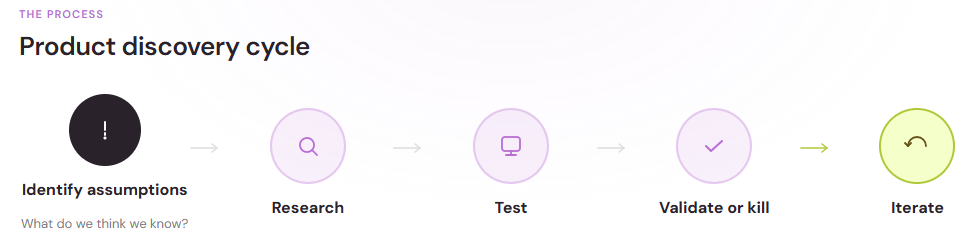
Discovery doesn't happen in one conversation. It's iterative: you learn, test, refine, and learn again. Here's a rough structure:
Define your assumptions
Write down what you think you know. "Our target customer is a marketing manager in a B2B SaaS company." "They struggle with data inconsistency in their tools." "They'll switch solutions if we integrate with their existing stack." Make assumptions explicit. You're about to test them. This forces clarity. Sometimes the act of writing down an assumption reveals how shaky it actually is.
Assumptions come in layers. Some are about the customer (who they are, what they do). Some are about the problem (does it exist, how big is it, how much does it hurt). Some are about the solution (does this approach work, will customers pay for it, can we build it). Different assumptions carry different risks, so prioritizing them matters.
Identify what you need to learn
Not all assumptions are equal. Which ones carry the most risk if they're wrong? Which ones are easiest to disprove? Prioritize. You might need to learn whether your customer segment actually exists, or whether your proposed solution is better than what they currently use. The riskiest assumptions—the ones that would kill the project if wrong—deserve the most attention.
Choose your research methods
Pick the right tool for what you're testing. If you're exploring "why" questions, interviews work well. If you're checking "how many people" questions, surveys are better. If you're testing interaction patterns, user testing is key. Mix methods for a fuller picture. The best discovery combines qualitative insights (from interviews and observation) with quantitative validation (from surveys and analytics).
Recruit participants
Talk to real people in your target market. Not friends. Not people who already like you. Seek out neutral or skeptical users. The feedback stings more, but it's more honest. You're not looking for validation. You're looking for truth. People who don't have a relationship with you are more likely to tell you what they actually think.
Analyze and synthesize
Raw data is noise. Turn it into insights. Look for patterns across interviews. Quantify themes in survey responses. Map user journeys. Identify where assumptions held and where they broke. Write down what you learned in a format your team can understand and act on.
Make decisions and iterate
What did you learn? Does the idea still make sense? Do you need to pivot? Kill it? Double down? Use discovery to make informed decisions about what to build next. Not every discovery round will reach a definitive conclusion. Sometimes you'll need another round of testing to clarify something. That's normal. The goal is to reduce uncertainty, not eliminate it entirely.
Common discovery mistakes to avoid
Asking leading questions
"Don't you think our new feature would be helpful?" leads people to say yes. Instead: "What's your biggest frustration with [problem area]?" Let them lead. Leading questions feel efficient—you think you already know the answer—but they destroy the value of research. You'll hear what you want to hear instead of what's true.
Talking only to existing customers
Your current users are already bought in. They're less likely to spot fundamental problems. They've also adapted their workflows to work with you. Mix in potential customers and people who chose competitors. These outsiders see your blind spots more clearly than your fans do.
Skipping the "why"
"Users want feature X" is incomplete. Why do they want it? What problem does it solve? What would they do if the feature didn't exist? Understanding the "why" often reveals a better solution than the one users proposed. Sometimes people ask for a specific feature when what they really need is something different. Only the "why" uncovers that.
Treating discovery as a one-time event
Discovery isn't a project you finish. Markets shift, competitors move, customer needs evolve. The best companies make discovery continuous. Around 47% of researchers worldwide now use AI regularly in their market research activities, reflecting how the tooling landscape is evolving. But the principle remains: discovery is never truly done. Even after launch, you should keep listening. New customer segments might have different needs. Your solution might solve one problem but create another. Continuous discovery keeps you responsive.
Ignoring data quality
61% of organizations report data inconsistency issues that impact decision-making. Garbage data leads to bad decisions. Before you act on findings, ask: Is this data reliable? Did we talk to the right people? Is the sample size large enough? Are there biases at play? A single strong insight from a well-conducted interview beats a weak pattern from poorly collected data.
Letting internal preferences override customer feedback
It's tempting. Your CEO loves an idea. Your designer is attached to a direction. But if customers don't validate it, it doesn't matter. Let the evidence win, even when it's uncomfortable. The companies that struggle most are those where internal politics trump customer truth. Discovery is only valuable if you actually act on it.
Tools that help with product discovery
You don't need fancy software to do discovery. Pen and paper work. But a few tools can make the process easier:
- Surveys and forms – for reaching larger groups and quantifying feedback, with the option to use branches of follow-up questions based on early responses
- Scheduling tools – for coordinating user interviews and managing calendar logistics
- Analytics platforms – for understanding user behavior, tracking which features get used, and identifying where people drop off
- Prototyping tools – for testing ideas before building, from simple wireframes to interactive mockups
- Collaboration tools – for organizing findings and sharing them with your team, so insights spread across the organization
The specifics matter less than the discipline. Pick tools that fit your workflow, then actually use them. Consistency beats perfection. A simple survey run every month teaches you more than a perfect research project you never complete.

The link between discovery and product success
Products that succeed share a common trait: they were built on a foundation of real customer insight. The companies behind them—whether they're scaling rapidly or iterating on a mature product—treat discovery as non-negotiable. They know that skipping discovery might save time upfront, but it costs far more later when you're building something nobody wants.
Discovery also fuels your competitive advantage. When you understand your customers better than anyone else, you make bolder, smarter bets. You spot opportunities competitors miss. You build loyalty because customers feel heard, not just sold to. And you iterate faster because you know where to focus your energy.
The brands customers trust most are those that listen. 80% of people trust the brands they use more than they trust business, media, government, or NGOs. That trust comes from consistent delivery on promises, and those promises should be rooted in what customers actually want. When you skip product discovery, your promises become guesses. When you invest in it, your promises reflect real needs.
Getting started with product discovery
You don't need a massive budget or a dedicated research team. Start where you are. If you're running a startup, conduct a dozen customer interviews. If you're in a larger organization, layer interviews, surveys, and analytics. The size of your operation matters less than the commitment to actually listen.
Pick one assumption you want to test. Design a simple way to test it. Get feedback from three to five people. Look for patterns. Adjust. Repeat. This cycle—small, fast, continuous—is the foundation of good discovery. You don't need to be perfect. You need to be consistent.
Product discovery turns guesses into facts. It transforms "we think customers want X" into "customers told us they want X." That shift from assumption to evidence is what separates products that thrive from those that fade. And it's what makes every moment spent on discovery an investment, not an expense.
The best time to start discovery was yesterday. The second-best time is today.

Liked that? Check these out:

Opinions and Expertise
What’s actually slowing research teams down (Hint: it’s not the research)
From recruiting participants and scheduling interviews to building the actual surveys, the operational drag is taking researchers away from what they do best. See what's actually slowing them down and how Research Flow fixes it.
Read more