Public opinion research: Modern methods for faster polling
Modern public opinion research doesn't take months. Compare polling methods by response rate, avoid sampling bias, and get same-day results faster.

Public opinion research sounds formal and intimidating. But it’s really just a structured way to understand what people think, feel, and believe about topics that matter to your business, organization, or cause.
Whether you’re a political campaign testing messaging, a nonprofit validating community needs, or a brand checking product sentiment, public opinion research gives you data with real weight. The challenge isn’t understanding the concept—it’s getting reliable results without burning months and budgets.
Modern polling methods have changed the game. Speed, accuracy, and cost-effectiveness are now achievable for organizations of any size. Here’s how to run public opinion research that actually works.
What public opinion research does
At its core, public opinion research answers a simple question: what do people think? But the applications run deep.
You might use it to gauge voter sentiment before an election. You might test whether customers would embrace a new product feature. You might understand community attitudes toward a proposed policy change. You might validate assumptions before investing in a major campaign. Organizations across sectors—from healthcare systems evaluating patient satisfaction to retailers testing pricing strategies—rely on this methodology to ground decisions in evidence rather than assumption.
The goal is always the same: replace guesswork with data. Opinion matters because it drives behavior. When you know what people think and why, you can make smarter decisions, craft more persuasive messaging, and predict outcomes with greater confidence.
Why speed matters in polling today
Traditional polling took weeks or months. You’d hire a firm, brief them on your question, wait for fieldwork, then analyze results. By then, circumstances had often shifted.
Modern public opinion research flips this timeline. Digital tools let you launch surveys in hours and get results the same day. This speed matters because:
News cycles move fast. If you’re running a campaign or managing a brand, waiting weeks to understand public sentiment means missing the moment to respond.
Markets shift quickly. Consumer opinion about a product or feature can change as competitors launch or trends evolve. Slow research becomes outdated research.
Decisions can’t wait. Most organizations need data to inform high-stakes choices, whether to launch, pivot, or double down. Months of delay means months of uncertainty.
That urgency is why online surveys have become the dominant research method. Among market research professionals, 85% use online surveys regularly (Backlinko, 2026). Online and mobile quantitative research now accounts for 35% of worldwide market research revenues (Backlinko, 2026).
The shift isn’t just about speed, though. It’s also about access and cost. You can reach diverse audiences across geographies without field teams. You can run multiple iterations quickly and cheaply.
Core methods in modern public opinion research
Not all polling approaches are the same. Your choice depends on your question, audience, timeline, and budget.
Email surveys
Email surveys reach people in their inbox. They’re straightforward to set up and cost-effective to send across teams.
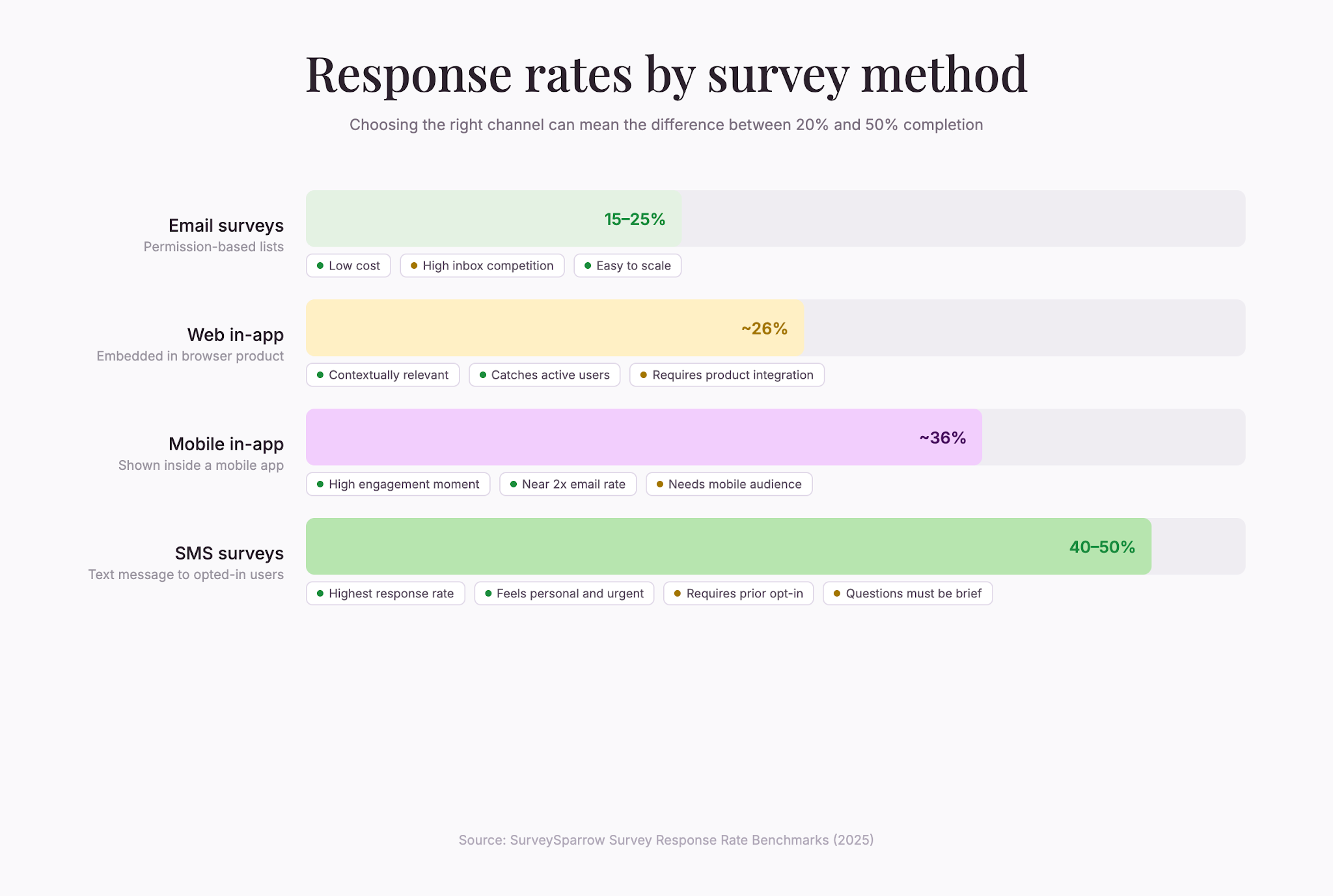
The tradeoff: response rates hover between 15% and 25% (SurveySparrow, 2025). People delete emails. Inboxes are crowded. You’re competing for attention. But if you have a permission-based list of interested respondents—existing customers, newsletter subscribers, event attendees—email can still deliver solid data.
In-app surveys
If you run a mobile or web application, in-app surveys appear to users while they’re already engaged with you. The context is perfect. They’re already in your ecosystem.
In-app surveys see much higher engagement. Mobile in-app surveys average 36.14% response rates, while web in-app surveys average 26.48% (SurveySparrow, 2025). That’s nearly 2x better than email. The reason: you’re asking at the moment of relevance, not months after they signed up.
SMS surveys
SMS (text message) surveys are short, direct, and surprisingly effective. They command attention because texts feel personal and urgent.
Response rates for SMS surveys range from 40% to 50% (SurveySparrow, 2025). That’s the highest of any mainstream method. The catch: you need a legitimate reason to text people (permission, prior relationship) and your question must be short enough for a text screen.
Traditional phone polling
Phone surveys were the benchmark for decades. A trained interviewer calls a person, reads questions, and records answers. The approach captures nuance—tone, hesitation, clarification—that written surveys miss.
But phone polling is expensive and time-intensive. Response rates have declined. People screen calls. It’s rarely the first choice anymore, except for very high-stakes research where depth matters more than speed.
Quizzes and interactive formats
Some organizations frame research as quizzes or games. It feels less like an interrogation and more like engagement.
Quizzes can drive surprising response. Users engaged with quizzes shown via social media newsfeed reported 82% engagement (BuzzSumo, via LeadQuizzes, 2024). This works especially well if you’re trying to reach audiences on social platforms or if your research topic maps naturally to a quiz format.
The case for shorter surveys
One of the most actionable findings in modern polling: length matters.
Short surveys with just 1 to 3 questions achieve completion rates of 83.34% (SurveySparrow, 2025). Add more questions and completion drops. Respondents also give shorter, less reliable answers as they fatigue.
This doesn’t mean you can only ask one question. It means you should be ruthless about prioritization. Ask the one or two questions that unlock the decision you’re trying to make. Save secondary questions for a follow-up.
Many teams overthink their surveys. They add “nice to know” questions alongside “need to know” ones. The result is lower completion, noisier data, and slower turnaround.
The modern approach: run frequent, short surveys. One research question at a time. Then follow up with a second poll if you need depth on something new. You’ll get cleaner data and faster insights.
Sampling and bias: the hidden challenge
Polling gives you numbers, but numbers can lie if your sample is wrong or your questions are biased.
The most famous example is the Literary Digest poll of 1936. The magazine sent 10 million ballots and received 2.4 million back. They predicted Landon would win 57% to 43%, but Roosevelt won 62% to 37% (Emory University Mathematics Center). Why? The sample came from phone, car, and club membership lists—which excluded lower-income voters who favored Roosevelt. The magazine folded within 18 months.
That disaster taught researchers a hard lesson: who answers your poll shapes the results as much as their actual opinions.
Today’s digital methods make sampling easier. You can reach across geographies and demographics without field teams. But you need to be intentional. If you only email existing customers, you’re missing non-customers. If you only poll your social media followers, you’re missing people who don’t follow you.
Response rates also matter. The typical response rate for external digital questionnaires sits between 20% and 30% (SurveySparrow, 2025). That’s respectable—but if only 20% of people respond, the 80% who don’t might have different opinions. Are they busier? Less interested? More skeptical? You won’t know.
The safest approach: triangulate. Combine multiple survey methods (email, in-app, SMS) to reach different segments. Oversample groups you care about. And always acknowledge your sample’s limitations in how you interpret results.
Common biases to watch for
Even with a good sample, the way you ask questions shapes the answers.
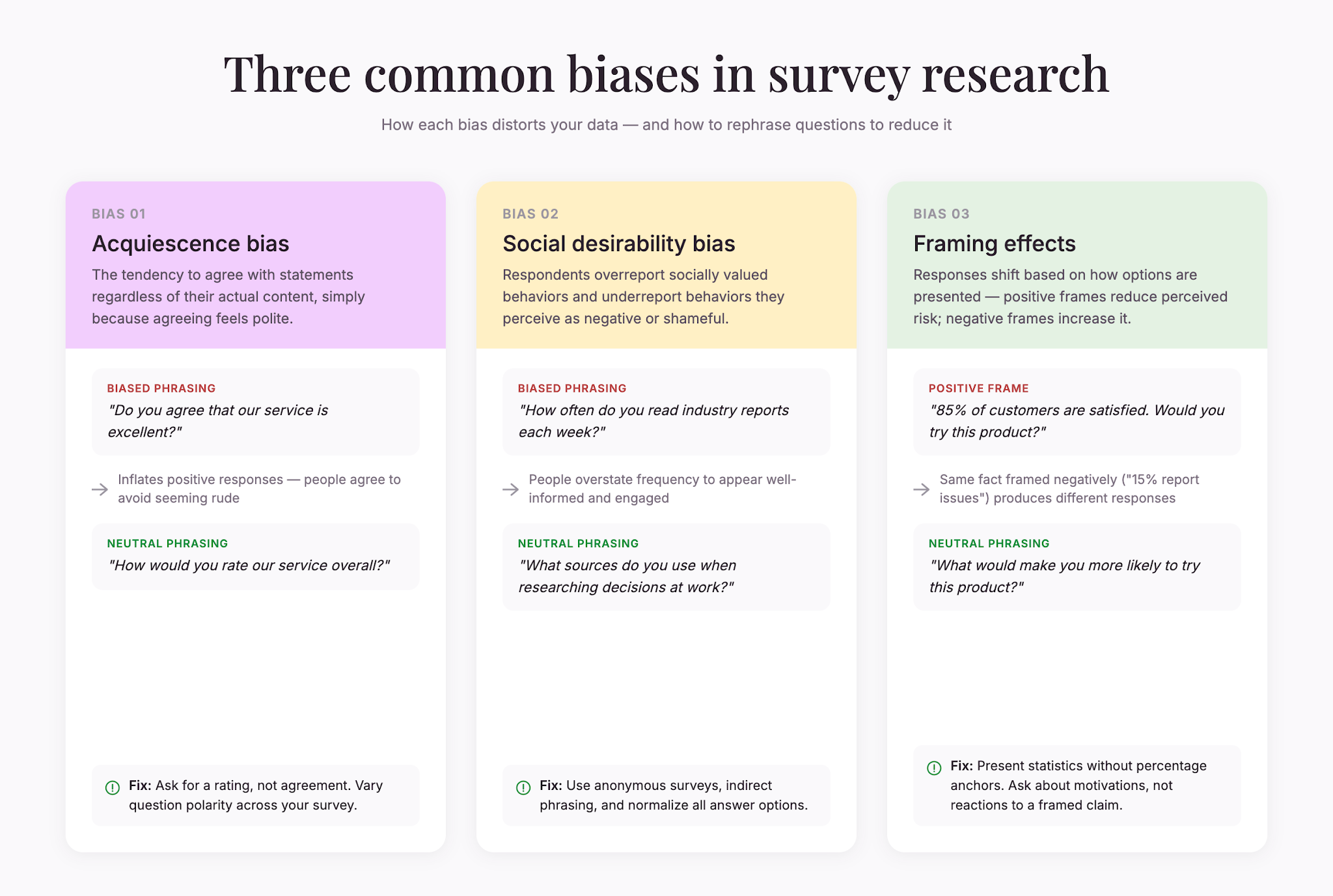
Acquiescence bias is the tendency to agree with statements regardless of content. If you phrase a question as “Do you agree that our service is good?”, many people will say yes simply because agreeing feels polite or safe (Qualtrics, 2025).
Social desirability bias is when people overreport good behavior and underreport bad behavior, especially when facing sensitive questions. Someone might overstate how much they exercise or how often they give to charity (Qualtrics, 2025).
Framing effects shape responses based on how you present options. If you frame a choice positively (“85% of people who use this product are satisfied”), people avoid risk. If you frame it negatively (“15% of people report issues”), people seek risk. Consumer knowledge weakens this bias—people with more expertise in a domain are less swayed by framing (Frontiers in Psychology, 2020).
None of these biases are disqualifying. You can minimize them by phrasing questions neutrally, avoiding leading language, and knowing your audience’s sophistication. But awareness matters. A great survey design acknowledges bias rather than ignoring it.
Building your polling workflow
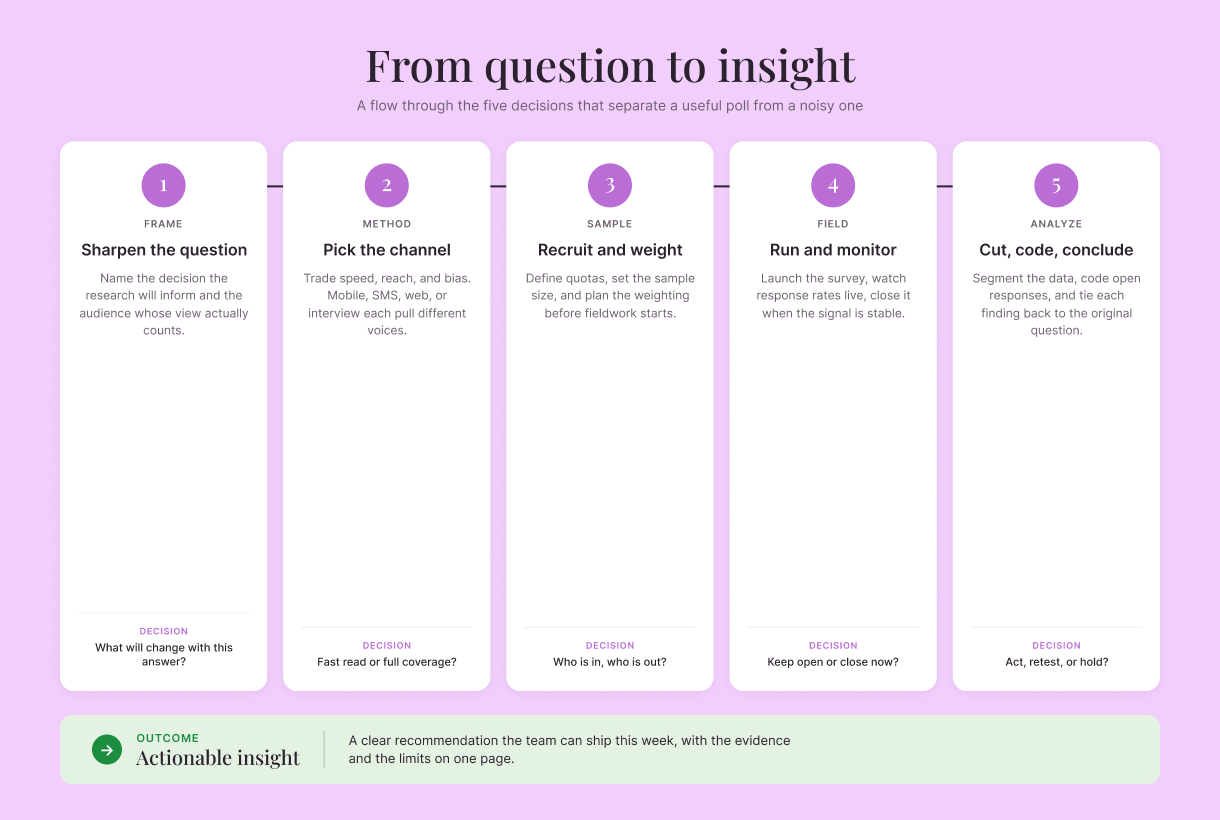
Modern public opinion research doesn’t have to be complicated. A simple workflow works:
Define your research question. Get specific. “What do people think?” is too vague. “Do voters in swing states support our candidate’s healthcare plan?” is actionable.
Choose your audience. Who do you need to hear from? Existing customers? Prospective buyers? A specific demographic? Random sampling of the general public? Your answer shapes your method and success.
Pick your method and channel. Based on your audience and timeline, decide whether email, in-app, SMS, or another format makes sense. Multi-channel approaches often yield better results than relying on a single delivery method.
Design your questions. Keep it short. Avoid leading language. Test for bias. Get a colleague to review—fresh eyes catch awkward phrasing and hidden assumptions that might skew responses.
Set a timeline. How quickly do you need results? That timeline guides whether you use slow but reliable methods or faster approaches.
Launch and monitor. Send your survey and watch response rates. If they’re lagging, consider a reminder or follow-up. Early response quality can also hint at whether questions are resonating or if wording needs adjustment.
Analyze and act. Once you have enough responses, look for patterns. What’s the majority view? Are there big differences by demographic? What decision does this data unlock?
Tools like ResearchFlow can streamline this workflow, automating the repetitive parts so you focus on the research questions that matter. The ability to move from question to insight in hours—not weeks—is where modern polling wins.
When to run public opinion research
Not every decision needs a poll, but many do.
Before a major campaign. Test messaging with your target audience. Which angle resonates? Which concerns come up? A 48-hour poll can validate your strategy before you spend money rolling it out.
After a major event. Did your campaign land? Did the debate shift sentiment? Polling in real time lets you adjust and respond.
Before launching a new product or feature. Gauge demand. Test messaging. Understand objections. A quick poll is cheaper than a failed launch.
When you’re unsure of your audience. Assumptions are dangerous. If you don’t know what your audience thinks, a poll costs less than most marketing campaigns and gives you certainty.
When stakeholders disagree. Internal debates about what customers want can spiral endlessly. A poll settles it with data.
Periodically, as a health check. Sentiment shifts. Polling quarterly or semi-annually lets you track trends, catch emerging issues, and stay aligned with your audience.
Key takeaways
Public opinion research is no longer a luxury for large organizations and big campaigns. Digital tools, faster methodologies, and lower costs put polling within reach for almost anyone.
The fundamentals matter: choose the right sample, ask unbiased questions, keep surveys short, and acknowledge limitations. Speed is valuable, but accuracy is everything.
The organizations winning today aren’t running one big survey every year. They’re running frequent, focused polls that answer the specific question they need answered right now. They’re using data to build confidence and make smarter decisions.
Public opinion research, done well, isn’t about proving what you already believe. It’s about understanding what your audience actually thinks and having the courage to act on it.

Liked that? Check these out:
Opinions and Expertise
What’s actually slowing research teams down (Hint: it’s not the research)
From recruiting participants and scheduling interviews to building the actual surveys, the operational drag is taking researchers away from what they do best. See what's actually slowing them down and how Research Flow fixes it.
Read more