Pulse surveys: A faster way to track employee sentiment
Pulse surveys use 1–5 questions sent weekly or monthly to track employee sentiment in real time, with 80%+ response rates and early warning on morale.

Employee engagement is slipping. Only 31% of employees are actively engaged at work, and that number keeps falling (Gallup, 2025). But here’s the thing: you don’t need a full-scale annual survey to understand what’s happening on your team. You need something faster, lighter, and more frequent.
That’s where pulse surveys come in.
A pulse survey is a short, targeted check-in—typically just a handful of questions—sent out regularly to track how employees feel in the moment. Instead of waiting for the yearly engagement survey to drop, you get ongoing snapshots of sentiment, morale, and specific concerns. You spot problems early. You catch wins in real time. And you show your team that their voice matters right now, not in 12 months.
This article walks you through what pulse surveys are, why they work, and how to set one up so your organization can stay in sync with its people.
What is a pulse survey?
A pulse survey is a brief, focused feedback tool designed to measure employee sentiment on specific topics at regular intervals. Think of it as a quick health check instead of a full physical exam.
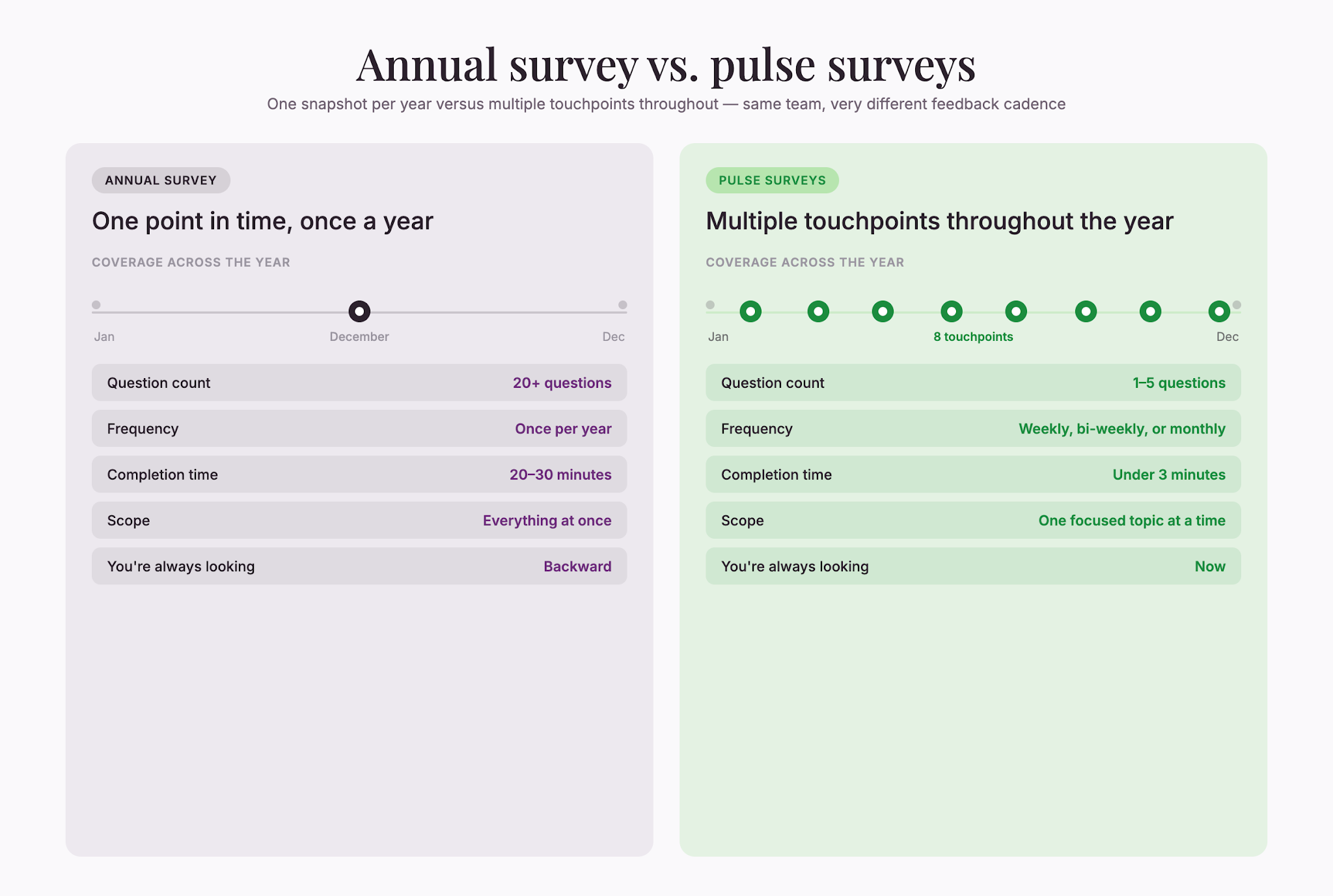
Unlike traditional engagement surveys, which are long, infrequent, and cover broad ground, pulse surveys are:
- Short – Usually 1 to 5 questions, rarely more
- Frequent – Sent weekly, bi-weekly, or monthly
- Targeted – Focused on one or two themes (morale, workload, management support, etc.)
- Low-friction – Takes 2 to 3 minutes to complete
The goal is simple: get real feedback fast without burning people out.
Why pulse surveys work better than annual surveys
Annual engagement surveys are a relic. They ask for 20-plus questions at once, demand a big time commitment, and by the time you analyze results, months have passed. You’re always looking backward.
Pulse surveys flip the script.
Higher response rates
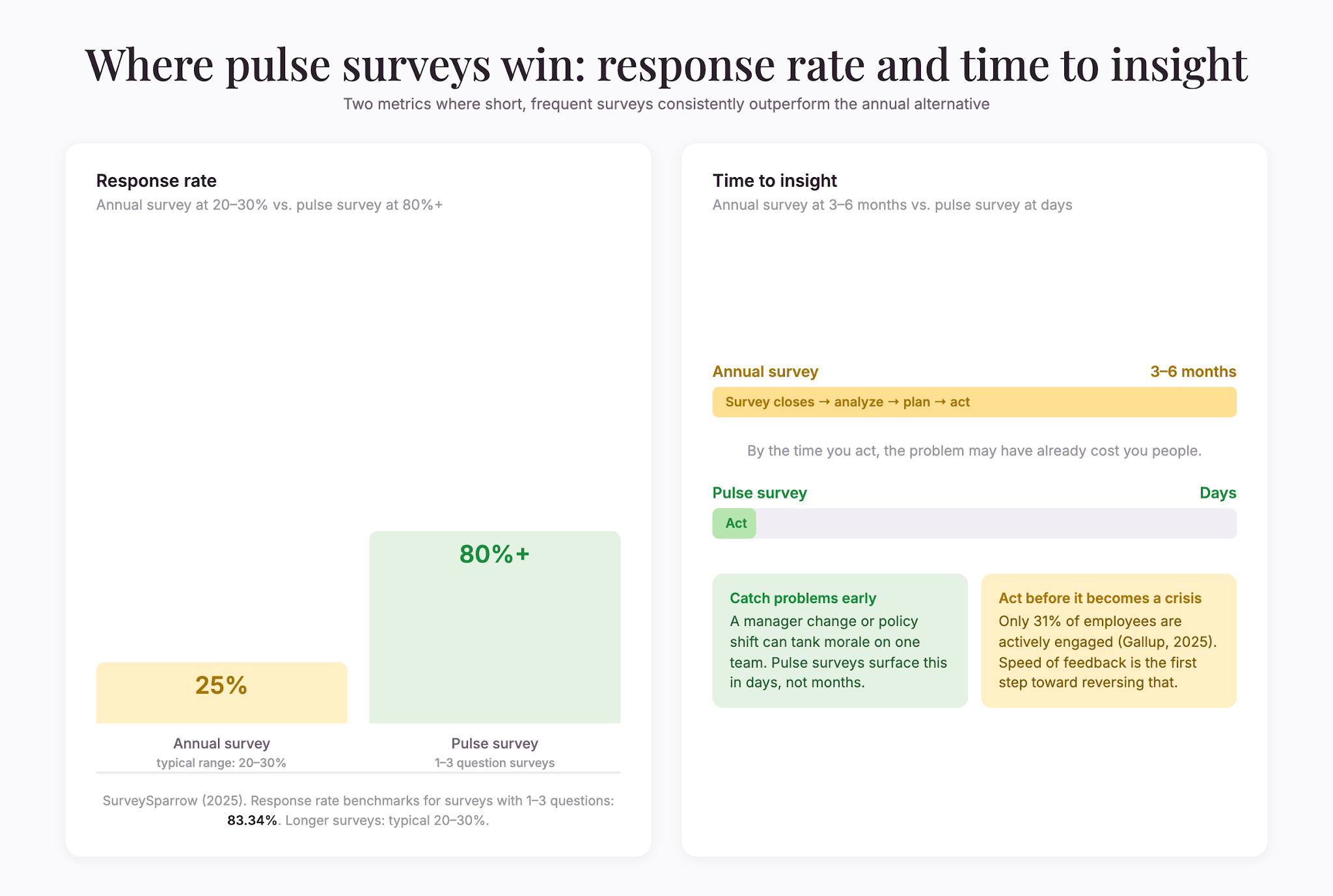
People are more likely to complete a short survey. When you ask for 1 to 3 questions, response rates jump to 83.34% (SurveySparrow, 2025). Compare that to the typical 20% to 30% response rate on longer external questionnaires (SurveySparrow, 2025). That’s not a small difference—it’s a fundamental shift in how much data you collect and how representative that data actually is.
Short surveys also lead to higher-quality responses. When respondents aren’t fatigued, they give you honest, reliable feedback. People who are tired of clicking through 50 questions tend to rush or drop out.
Real-time insights
Annual surveys tell you what happened last year. Pulse surveys tell you what’s happening now. That matters when business moves fast. A manager change might tank morale on one team. A policy shift might create confusion. Launching a new product might spike stress levels. With pulse surveys, you catch these things days or weeks after they happen, not months later.
Lower burden on employees
Your team is busy. They don’t have time for a 30-minute survey every December. But they can answer three quick questions during a coffee break. Because pulse surveys are low-friction, completion becomes a habit rather than a chore. And when people see that their feedback actually leads to change, they’re even more likely to participate next time.
Easier to act on results
When you survey employees on one specific topic, you get actionable data. If your pulse survey focuses on “How supported do you feel by your manager right now?” and the scores dip, you know exactly where to focus. With a sprawling annual survey covering job satisfaction, work-life balance, compensation, benefits, and career development all at once, the insights get muddled. You don’t know what to fix first.
How pulse surveys boost retention and engagement
Here’s the business case: actively disengaged employees cost your organization in lost productivity, turnover, and morale drag. And disengaged employees are far more likely to leave (Gallup, 2025).
But pulse surveys help you intercept that trend before it becomes a crisis.
When you’re checking in monthly or weekly on how people feel, you surface problems early. An employee who’s burnt out might not mention it in a casual conversation, but they’ll answer honestly in an anonymous pulse survey. Once you know they’re struggling, you can have a real conversation. Maybe they need a different project, a lighter workload, or clearer career direction. You retain someone you would have lost.
Beyond that, regular feedback loops signal to your team that you care about their experience. It’s not lip service—it’s consistent action. You ask, you listen, and you share what you’re doing about it. That’s how you build trust.
Engagement is directly linked to retention. When employees feel heard and supported, they stay. Pulse surveys are how you stay connected.
How to design a pulse survey
Keep it brutally short
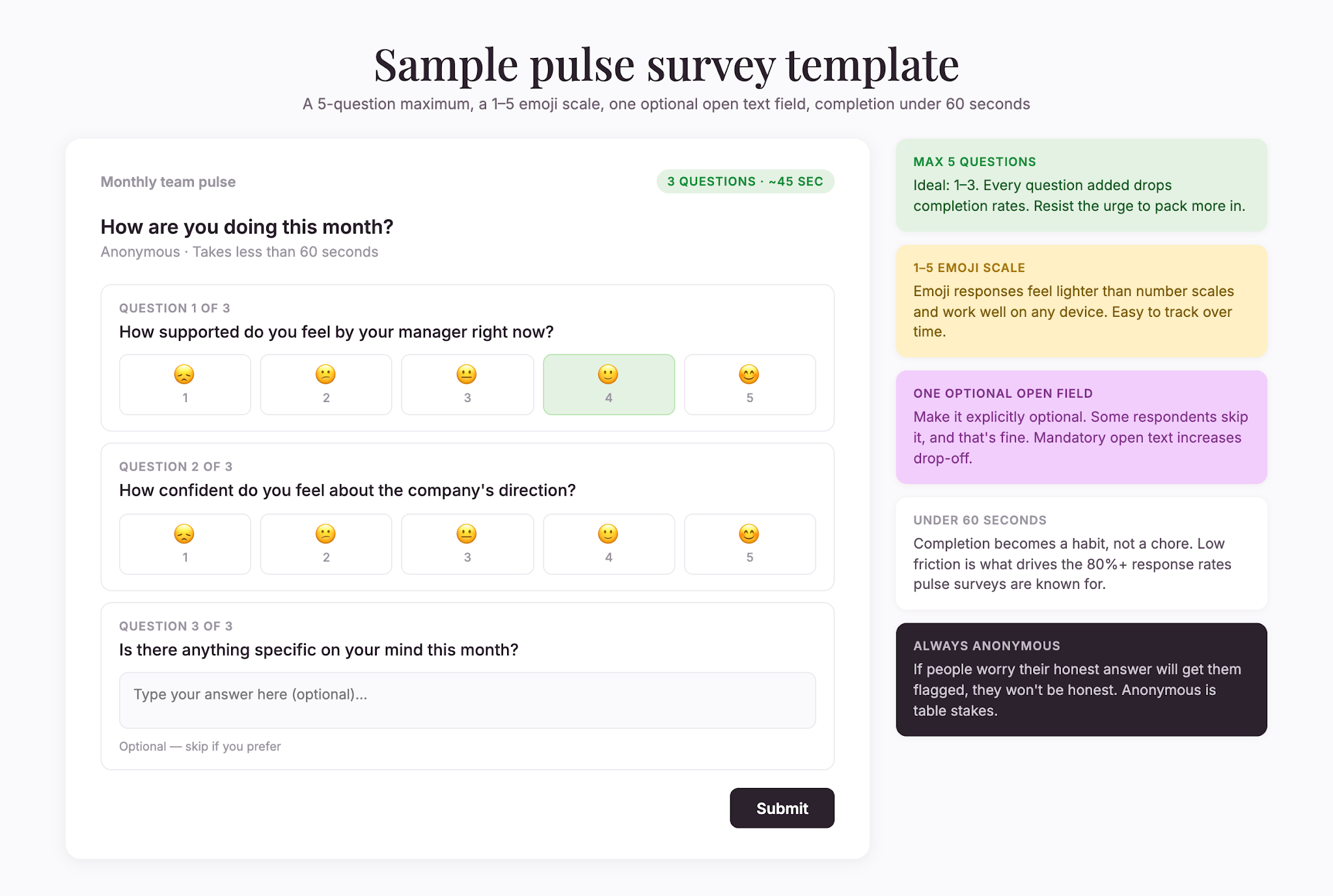
One to three questions is ideal. Pick the metric that matters most right now. If you’re focused on morale after a restructure, ask about confidence in the future. If workload is the concern, ask about bandwidth and support. Resist the urge to pack in extra questions. Every question you add drops completion rates.
Good pulse questions are clear, unbiased, and answerable in seconds. Avoid leading language. Instead of “How satisfied are you with your manager’s excellent support?” try “How supported do you feel by your manager right now?”
Choose the right frequency
Weekly is common for high-velocity teams or crisis management. Bi-weekly or monthly works for most organizations. Quarterly is too long—you lose the “pulse” part and slip back into slow feedback. The sweet spot depends on your business. If you’re in hypergrowth and managing big changes, weekly might make sense. For a stable team, monthly is usually enough.
Pick a delivery channel
In-app surveys average a 27.52% response rate on web and 36.14% on mobile (SurveySparrow, 2025). Email surveys typically get 15 to 25% (SurveySparrow, 2025). SMS surveys perform even better, hitting 40 to 50% (SurveySparrow, 2025). If your team is always in a Slack or Teams channel, send the pulse there. If they’re remote and scattered, SMS might work best. If you have an internal employee app, use that.
Make responses optional but encouraged
Don’t mandate completion. That breeds resentment. Instead, create a culture where feedback is valued. Share results with the team. Show them what you heard and what you’re doing about it. When people see that their voice leads to change, participation climbs on its own.
Use a simple rating scale or open text sparingly
A 1-to-5 scale works. Emoji responses (😞 😐 😊) work too and feel lighter. If you ask one open-ended question, keep it optional—some people will skip it, and that’s fine. Data from quick multiple-choice questions is easier to track and compare over time anyway.
Common pulse survey topics
Here are themes you might track depending on your organizational priorities:
- Morale and confidence – “How confident do you feel about the company’s direction?”
- Workload and wellness – “Do you feel you have the support and resources to do your job well?”
- Management and leadership – “How supported do you feel by your direct manager?”
- Collaboration and team dynamics – “How well is your team working together right now?”
- Career growth – “Do you see opportunities to develop new skills in your role?”
- Clarity and alignment – “Do you understand how your work connects to the company’s goals?”
- Work environment – “How is your experience working remotely/in-office/hybrid?”
Rotate topics each pulse so you’re building a picture over time without overwhelming people with the same questions. One month, you focus on management. The next month, workload. The third month, career growth. By cycling through, you learn which issues matter most to your team and where to focus your energy.
What to do with the results
Collecting feedback is only half the job. The other half is acting on it.
When your pulse survey closes, analyze the data quickly. Don’t wait a week. Share high-level results with your team within days. Be transparent: “Here’s what we heard. Here’s what surprised us. Here’s what we’re doing about it.” If you asked about workload and scores were low, announce how you’re addressing it—hiring, restructuring, cutting less critical work. If management scored high, recognize those managers and talk about what they’re doing right.
Close the loop. That’s what makes people keep answering next time.
If you spot a red flag—say, one team’s morale scores are consistently lower than others—dig deeper. Have a conversation. The pulse survey is a signal. Your job is to understand what’s driving it.
A few final best practices
Keep the survey truly anonymous
If people worry that their honest answer will get them flagged, they won’t be honest. Anonymous is table stakes. The only exception is if you segment by team or department, and even then, individual responses should stay confidential.
Compare trends, not single responses
One low score doesn’t mean panic. Look at the direction. Are scores trending down month over month? That’s worth investigating. Is this month lower than last month but still within normal range? Could be normal variation.
Don’t ask too many different things
Stick to a handful of core metrics you’ll track consistently. This lets you spot real trends over time. If you change the question every pulse, you’re not tracking anything—you’re just collecting random feedback.
Share what you’re changing
This is the most important best practice of all. If pulse surveys are a one-way street where employees answer questions and nothing ever changes, they’ll stop answering. They’ll also become more disengaged. Feedback loops work only when people see their voice leads to action.
The speed advantage
Here’s the real win: pulse surveys compress the feedback cycle. Instead of waiting until next year’s annual survey to learn that your team is burnt out, you know in week one. Instead of losing months to analysis and planning, you act in days. You shape your culture in real time.
In a world where employee engagement is already slipping, that speed matters. It’s the difference between a small problem you can fix and a retention crisis you’re fighting to contain.
So, start small. Pick one simple question. Send it this week. Analyze and share results by Friday. Then, do it again next month with a different question. Build the habit. You’ll be surprised by how much you learn.