20 brand perception survey questions with template
Get 20 brand perception survey questions organized by trust, awareness, emotional connection, and differentiation, plus a template to launch today.

Understanding how your audience perceives your brand is essential to building loyalty and staying competitive. Brand perception surveys help you uncover what customers think about your company, products, and messaging—and where you might be falling short.
This guide walks you through 20 proven brand perception survey questions, organized by topic, plus a ready-to-use template you can customize and launch today.
Why brand perception matters
Brand perception is the collection of beliefs, feelings, and associations people hold about your company. It shapes whether they buy from you, recommend you to others, and stay loyal over time.
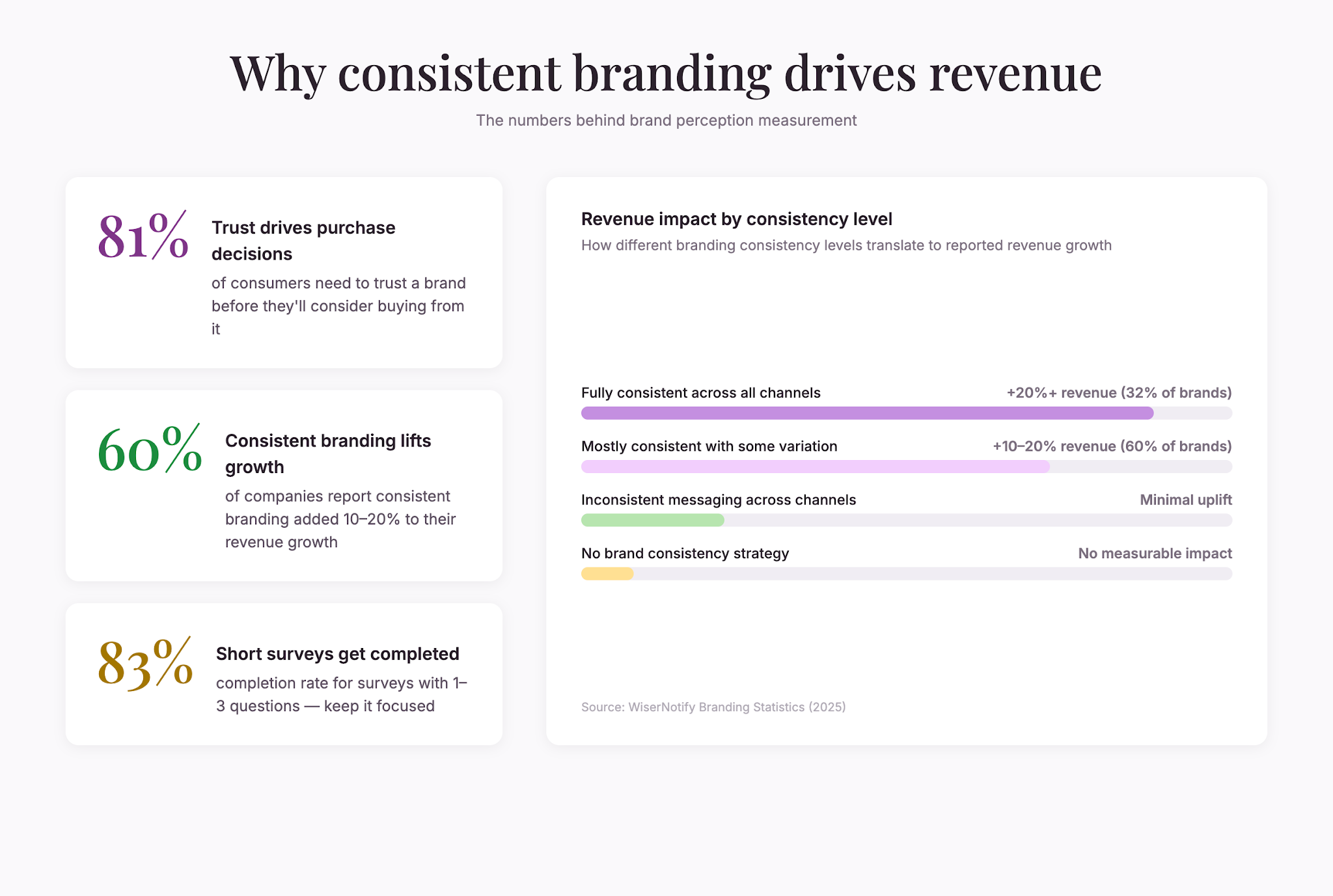
The numbers tell the story: 81% of consumers need to trust a brand to consider buying from it (WiserNotify, 2025). That trust isn’t automatic—it’s built through consistent messaging, reliable products, and genuine engagement. When you measure brand perception regularly, you catch problems early and reinforce what’s working.
Brand consistency amplifies this effect. Companies that maintain consistent branding across channels see real revenue impact: 60% of companies report that consistent branding added 10-20% to their revenue growth, and 32% of brands state that consistent messaging increased brand revenue by 20% (WiserNotify, 2025).
How to structure your brand perception survey
Before you ask questions, decide on your survey length and format. Keep in mind that short surveys outperform longer ones. In fact, surveys with 1-3 questions are completed by 83.34% of respondents (SurveySparrow, 2025). If you need more depth, consider breaking your survey into multiple shorter sessions or using follow-up questions selectively.
For brand perception specifically, pair different question types to capture both quick reactions and nuanced feedback. A dichotomous question is a close-ended question with exactly two answer options—Yes/No is the most common pair, but Agree/Disagree, True/False, and Satisfied/Unsatisfied are also widely used (SurveySparrow, 2024).
Yes/No questions are fast to answer, reduce respondent fatigue and dropout, and are well-suited to screening and quick assessments (piHappiness, 2024). However, binary questions can oversimplify and miss variance on a continuum (Zonka Feedback, 2024). That’s why researchers commonly pair dichotomous questions with open-ended or Likert-scale questions to capture richer detail alongside fast quantitative data.
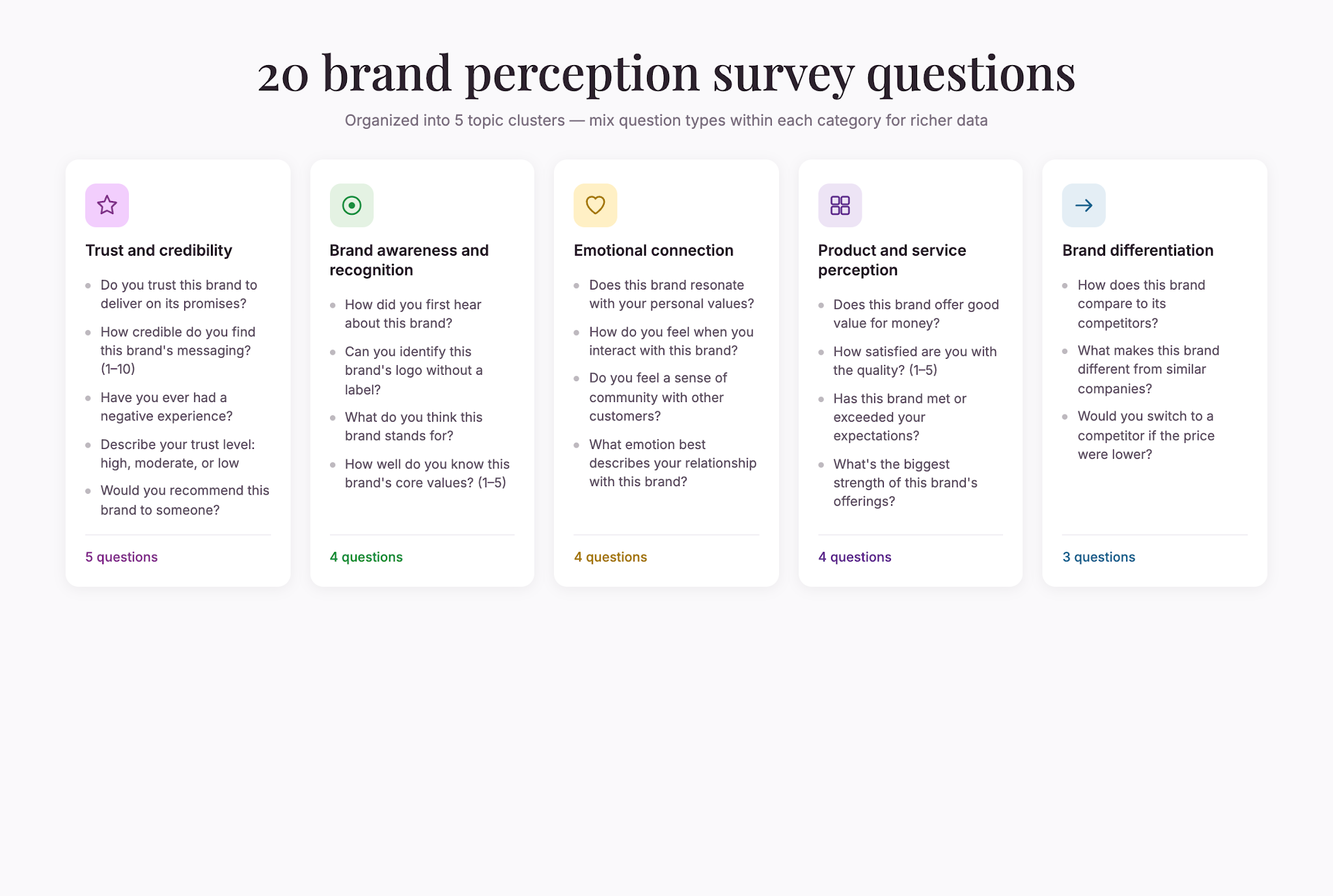
20 brand perception survey questions
Trust and credibility (5 questions)
- Do you trust this brand to deliver on its promises? (Yes/No)
- On a scale of 1–10, how credible do you find this brand’s messaging?
- Have you ever had a negative experience with this brand? (Yes/No)
- Which of these words best describes your trust in this brand: high, moderate, or low?
- Would you recommend this brand to a friend or colleague? (Yes/No)
Brand awareness and recognition (4 questions)
- How did you first hear about this brand?
- Can you identify this brand’s logo without a label? (Yes/No)
- What do you think this brand stands for?
- On a scale of 1–5, how well do you know this brand’s core values?
Emotional connection (4 questions)
- Does this brand resonate with your personal values? (Yes/No)
- How do you feel when you interact with this brand? (Select: happy, neutral, frustrated, other)
- Do you feel a sense of community or belonging with other customers of this brand? (Yes/No)
- What emotion best describes your relationship with this brand?
Product and service perception (4 questions)
- Do you believe this brand offers good value for money? (Yes/No)
- On a scale of 1–5, how satisfied are you with the quality of this brand’s products or services?
- Has this brand met or exceeded your expectations? (Yes/No)
- What’s the biggest strength of this brand’s offerings?
Brand differentiation (3 questions)
- How does this brand compare to its competitors? (Better, about the same, or worse)
- What makes this brand different from similar companies?
- Would you switch to a competitor if the price were lower? (Yes/No)
Tips for asking brand perception questions effectively
Once you’ve chosen your questions, phrase them carefully. Avoid leading language that nudges respondents toward a particular answer. “Don’t you think our customer service is exceptional?” leads; “How would you rate our customer service?” doesn’t.
If your survey includes sensitive topics—like past complaints or competitive preferences—note that social desirability bias can skew results. People tend to overreport good behavior and underreport bad behavior when facing sensitive questions. Assure respondents that their answers are anonymous and that honest feedback drives improvement.
Also, pay attention to survey fatigue. When respondents tire, they give shorter answers and are less reliable overall. Keep your survey focused and test it with a small group before launching to a larger audience.
Building your survey template
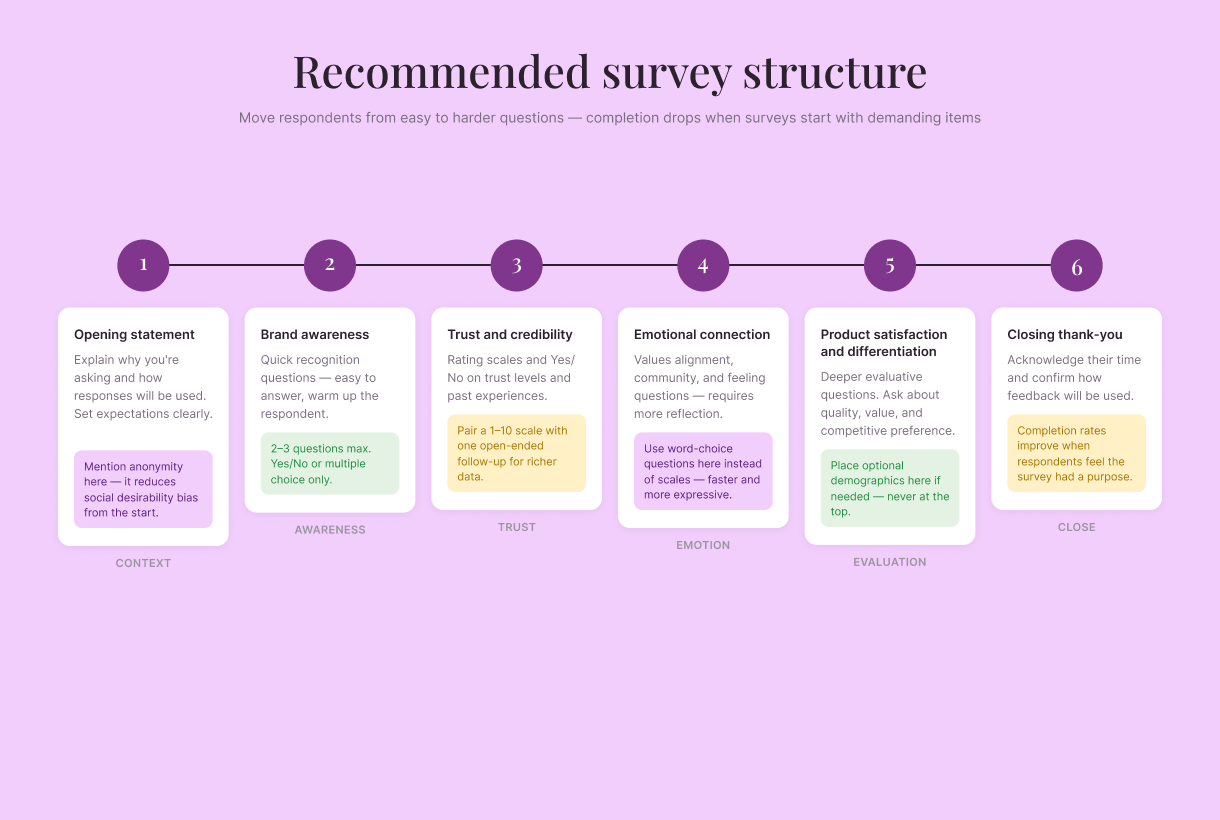
A solid template includes an opening statement explaining why you’re asking, a logical flow from easy questions to harder ones, and a closing thank-you. Start with demographic questions only if you need to segment results; many respondents skip demographic fields, so place them at the end if they’re optional.
Consider your margin of error. An acceptable margin of error is typically 3-6% at the 95% confidence level, though social research accepts around 5% while medical research requires 1-2% (Qualtrics, 2025). To survey a population of 500,000 at 95% confidence with a 5% margin, you’d need a sample of 384 responses (Qualtrics, 2025). Plan your respondent target accordingly.
Launching and analyzing results
Once you’ve built your survey, distribute it through channels where your target audience spends time: email, social media, your website, or a customer research panel. Track response rates and completion rates as proxies for survey quality. If many people drop out partway through, your questions may be too long or unclear.
When results come in, segment your findings by customer type, geography, or other relevant factors. Perception often differs between long-time customers and new users, so comparing those groups reveals where your messaging is strongest and where it needs work.
Use the qualitative feedback from open-ended questions to explain why perception differs. A 7 out of 10 satisfaction rating says something went wrong—the open-ended response tells you what it was.
Next steps
Brand perception surveys work best when you run them regularly—quarterly or semi-annually—so you can track trends and measure the impact of any changes you make. Each survey is a chance to refine your messaging, strengthen trust, and keep your brand aligned with what your audience thinks.
Start small with 5-10 core questions, test your survey with a sample group, and expand once you’ve found what resonates. Your brand’s perception is under your control—measuring it is the first step to improving it.

.png)