User research plan template: How to set up your study
Build a user research plan that works: set clear goals, choose qual or quant methods, define your sample, and pre-plan your analysis before collecting data.

If you’re planning a research project, you already know that structure matters. Without it, you’ll waste time collecting data that doesn’t answer your questions—or worse, you’ll make decisions based on assumptions instead of facts.
A user research plan is your roadmap. It lays out why you’re researching, what you want to find, who you’ll talk to, and how you’ll analyze what you learn. This guide walks you through building one, step by step.
Why a research plan matters
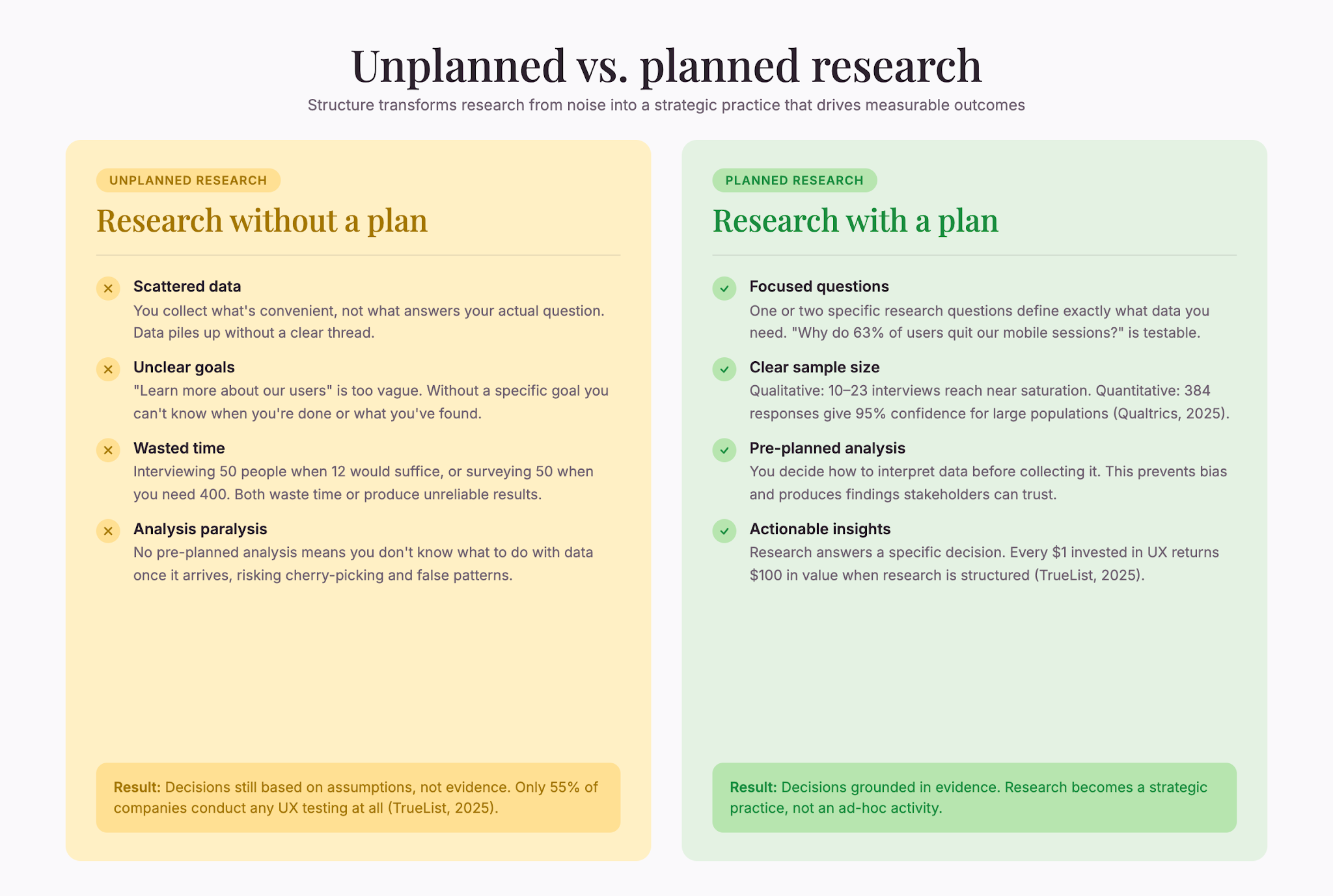
Before you send out a single survey or schedule a single interview, you need a plan. Here’s why: research without structure is just noise.
A good plan:
- Clarifies your actual research questions (not just your hunches)
- Defines who you’re studying and how many people you need
- Sets expectations for budget, timeline, and resources
- Keeps your team aligned on what success looks like
- Prevents you from collecting data you don’t need
The stakes are real. User experience improvements deliver significant returns—every $1 invested in UX returns $100 in value (TrueList, 2025). But only 55% of companies actually conduct UX testing (TrueList, 2025), meaning most teams are missing out on these gains simply because they lack a structured approach. Having a user research plan in place transforms research from an ad-hoc activity into a strategic practice that drives measurable business outcomes.
Before you start: define your research goals
Your research plan begins with a single question: What do you need to know?
This isn’t about collecting data for its own sake. It’s about identifying the specific decisions or problems your research will inform. Are you trying to understand why users abandon your mobile app? Validate a new product feature before launch? Learn what messaging resonates with your target audience? Each of these requires a different research approach, which is why clarity at the outset matters so much.
Write down your research goal in one or two sentences. Make it concrete. “We want to understand customer needs” is too vague. “We want to learn why 63% of users quit our mobile sessions and what friction points cause them to leave” is specific and testable.
Once you have your goal, break it into research questions—the smaller questions your study needs to answer. If your goal is understanding mobile abandonment, your research questions might include:
- At what point in the journey do users drop off?
- Is the friction technical (slow load times, confusing navigation) or behavioral (they lost interest)?
- Does abandonment differ by device type or user demographics?
Each research question should be answerable through data. That clarity matters because it shapes every choice you make next—your methodology, your sample size, who you recruit, and how you analyze results. When your research questions are clear, you avoid the common trap of collecting interesting data that doesn’t actually inform your decisions.
Choose your research method
Different questions need different methods. There’s no single “best” way to do user research—it depends on what you’re trying to learn.
The most common approaches break down into two categories: qualitative and quantitative.
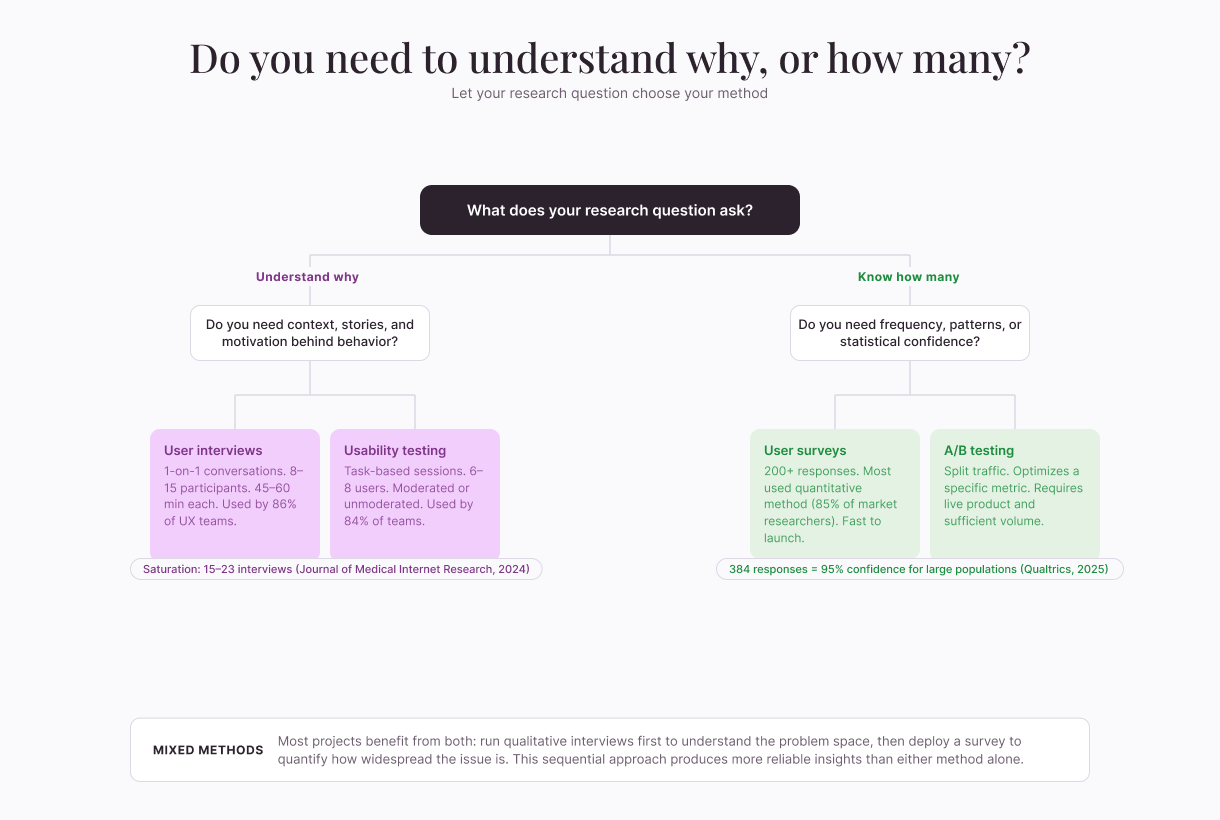
Qualitative research goes deep. You’re aiming for context, nuance, and stories. User interviews (86% of UX professionals use them regularly) and usability testing (84%) are the workhorses here (TrueList, 2025). You talk to fewer people but learn more about why they behave the way they do. This approach is especially valuable when you’re exploring unfamiliar territory or trying to understand the reasoning behind user behaviors that might seem irrational on the surface.
Quantitative research goes wide. You’re measuring frequency, patterns, and statistical significance. Online surveys rank as the most used quantitative method among market research professionals, with 85% using them regularly (Backlinko, 2026). You gather data from larger samples so you can spot trends and make confident generalizations. Quantitative research is particularly powerful when you need to validate findings across a broad population or measure the prevalence of a behavior or preference.
Many teams use both. You might run qualitative interviews first to understand the problem space, then deploy a survey to quantify how widespread an issue is. This sequential approach—moving from exploration to validation—often produces more reliable insights than either method alone.
Here’s the practical reality: most projects don’t need to be either-or. A user research plan often combines methods—qualitative interviews to explore, a survey to validate across teams, maybe usability testing to refine a solution. This mixed-methods approach leverages the strengths of each methodology while minimizing their individual limitations.
Define your sample
How many people do you need to talk to? This is one of the most common questions, and the answer depends on your method.
For qualitative research, you’re looking for saturation—the point where new interviews stop revealing new themes. Research shows that near saturation (where you’ve captured about 90% of unique insights) occurs around 15 to 23 interviews, while reaching full saturation requires 30 to 67 interviews (Journal of Medical Internet Research, 2024). For many projects, you can identify high-level themes with as few as 10 to 12 well-chosen participants (Journal of Medical Internet Research, 2024). The number often surprises teams who assume they need dozens of conversations to spot patterns.
The key: choose your participants carefully. Five interviews with the right people beats 30 with the wrong ones. This is why your screening criteria matter—they ensure every conversation counts toward your actual research question.
For quantitative research, you need a larger, statistically representative sample. Sample size depends on three things: your population size, your confidence level, and your acceptable margin of error.
Most research aims for a 95% confidence level with a 3% to 6% margin of error (Qualtrics, 2025). At these settings, surveying a population of 500,000 requires a sample of just 384 people (Qualtrics, 2025)—far smaller than most teams assume. Medical research is stricter (1% to 2% margin of error), while social research accepts 5%. Understanding these thresholds prevents you from overshooting your sample size, which saves time and money without sacrificing rigor.
Fortunately, there’s a calculator in most research platforms that handles this math for you. So do the math, and you’ll know exactly how many responses you actually need.
Create your participant criteria
Who are you studying? Be specific.
Write down the characteristics that matter for your research. If you’re studying mobile app abandonment, relevant criteria might include:
- Has used the app at least once in the last three months
- Attempted a key task (like completing a purchase)
- Uses iOS or Android (or both, if comparing)
- Age range, location, or profession (if relevant to your product)
This is called a screener. It ensures every participant fits your research question and saves you from collecting useless data. A tight screener is the difference between signal and noise—it’s one of the highest-leverage investments you can make in research quality.
One warning: watch for common survey biases that creep in here. Acquiescence bias occurs when respondents agree with statements regardless of their actual opinion, especially on sensitive topics. Social desirability bias leads people to overreport good behavior and underreport bad behavior when they’re aware they’re being measured (Qualtrics, 2025).
Your screener and question design need to account for these tendencies. Building awareness of these biases into your user research plan helps protect the validity of your findings.
The more precise your screening criteria, the more trustworthy your results.
Plan your data collection and timeline
Now map out the logistics. This includes:
- When will you launch recruitment and data collection?
- Where will you find participants (your own user base, a panel service, social media)?
- How long will data collection take? (A survey might run one week; interviews spread over two weeks; usability testing over one month.)
- What tool will you use to collect and organize responses?
Timeline matters because it affects sample quality. Rushing recruitment often means lower-quality participants. Spreading it out gives you time to recruit thoughtfully and ensures you get people who genuinely fit your criteria.
For larger studies, consider using a research platform that streamlines recruitment and data organization. A platform like ResearchFlow can help you manage participant screening, data collection, and organization all in one place—especially valuable if you’re running multiple studies or need to track participant progression through a research pipeline.
Document your analysis plan
Before you collect a single response, decide how you’ll analyze it.
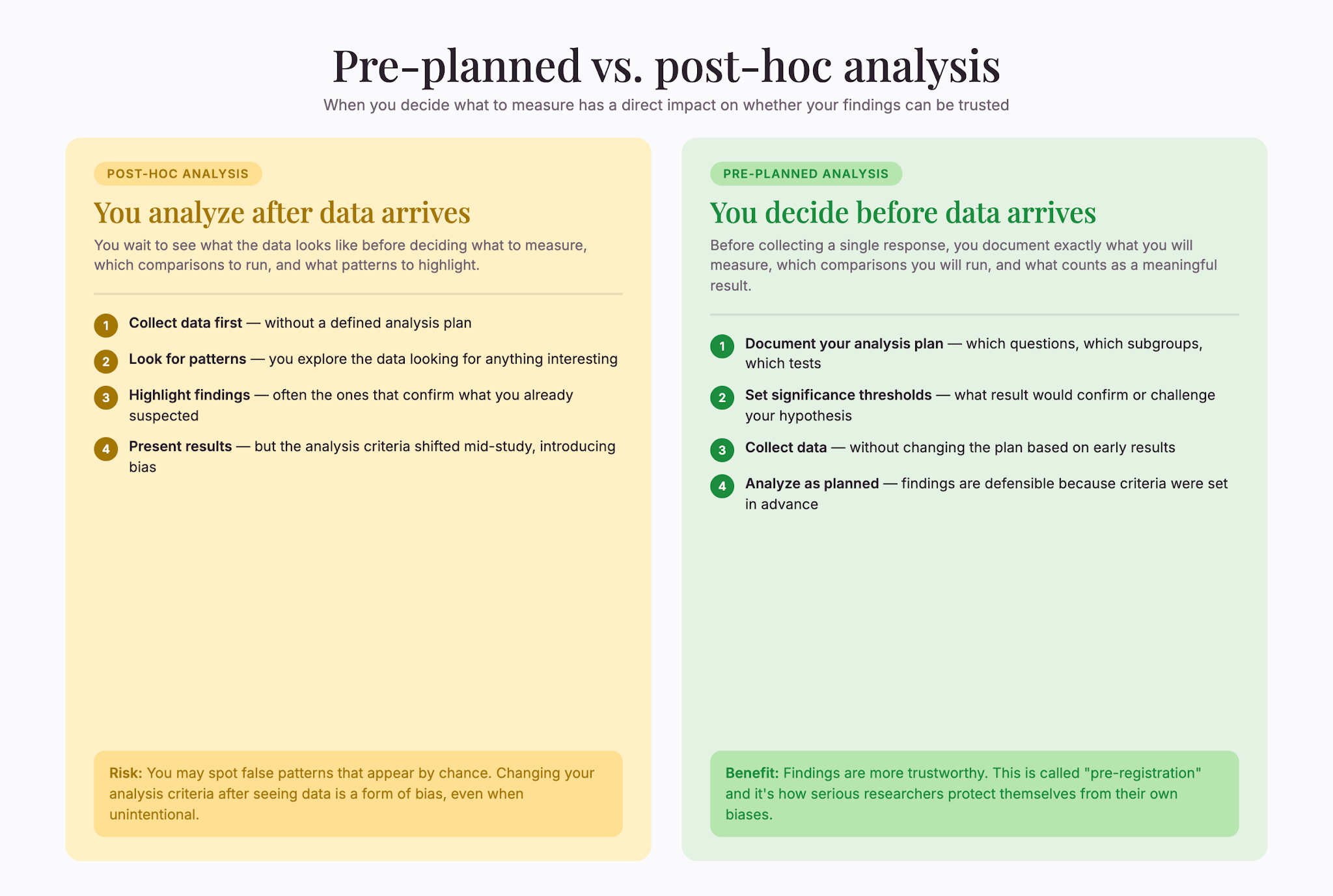
For qualitative data, write down your approach: Will you code responses by hand or use software to identify themes? What themes are you looking for? Will you use a framework (like Jobs to be Done or the Jobs Framework)? Having these decisions documented prevents you from changing your analysis criteria midway through, which can introduce bias.
For quantitative data, decide in advance: Which questions will you analyze first? Are you looking for differences between subgroups? Will you run statistical tests? What’s your threshold for significance? This upfront planning is crucial for maintaining research integrity.
This step—analysis planning before data collection—prevents you from cherry-picking results or spotting patterns that aren’t really there. It’s called “pre-registration,” and it’s how serious researchers protect themselves from their own biases. When you document your analysis plan as part of your user research plan, you create accountability and ensure your findings are defensible.
Build your research plan document
Bring it all together in one document. A solid research plan should include:
- Research goal: One or two sentences on what you’re trying to learn
- Research questions: The specific questions your study will answer
- Methodology: Which method(s) you’re using and why
- Sample size and criteria: How many people, who they are, how you’ll recruit them
- Timeline: When recruitment starts, how long data collection runs, when analysis begins
- Analysis approach: How you’ll interpret the data and what you’re looking for
- Success criteria: What results would confirm your hypothesis or show your product is on the right track?
- Resources and budget: Who’s involved and what it’ll cost
This document becomes your reference. When someone asks, “Why did we decide to interview 20 people instead of 50?” you have an answer. When priorities shift midway through, you can make intentional choices instead of reactive ones.
Common pitfalls to avoid
A few things will derail your research faster than you’d expect:
Vague goals. “Learn more about our users” sounds good until you’re drowning in data and can’t figure out what it means. Specificity saves you.
Wrong sample size. Surveying 50 people when you need 400 means your results aren’t statistically sound. Interviewing 50 when 12 would suffice wastes time and money.
Mismatched methods. Using a survey when you need interviews, or vice versa. A survey tells you what people do; interviews tell you why. Choose the method that answers your actual question.
No screening. Collecting data from anyone and everyone sounds inclusive but often means your results reflect noise, not insight. Tight screening criteria produce clearer signals.
Analysis paralysis. Collecting data and then not knowing what to do with it. A pre-planned analysis approach prevents this.
Next steps
Once your plan is solid, you’re ready to execute. Start small if you’re new to user research—a plan for 10 interviews or 100 survey responses teaches you the rhythm and surfaces issues before a bigger study.
Share your research plan with stakeholders before you begin. It takes 15 minutes and often surfaces assumptions you didn’t realize you were making. It also builds buy-in: when people understand why you’re researching a specific way, they trust the results more.
Then collect, analyze, and share what you learn. The research plan that started as a document becomes the foundation for decisions that actually move your product and business forward.