What is customer experience (CX)? A complete overview
Customer experience is perception, not intention. CSAT, NPS, CES, and CLV measure different aspects, understanding them shapes retention.
%20A%20complete%20overview.png)
Key Takeaways
- Customer experience is perception: Two customers can have identical interactions and feel completely differently about them, based on their expectations and prior experience.
- The last interaction often outweighs the earlier ones: A great purchase experience followed by a frustrating cancellation process tends to define how a customer remembers the whole relationship.
- CSAT, NPS, CES, and CLV each answer a different question: CSAT (customer satisfaction) measures satisfaction with a specific moment, NPS (net promoter scores) measures loyalty, CES (customer effort score) measures friction, and CLV (customer lifetime value) measures how much a customer is actually worth over time.
- Usability is where CX succeeds or fails: A polished interface that's hard to use damages customer experience more than a plain one that works, since customers forgive appearances but not wasted time.
Customer experience encompasses every interaction a person has with your company, before, during, and after a purchase. It's the sum of how your brand makes people feel at each touchpoint, whether that's browsing your website, chatting with support, or receiving a product.
CX matters because it directly shapes loyalty, retention, and revenue. Companies that prioritize it don't just keep customers longer. They turn them into advocates who recommend the brand to others. In today's competitive landscape, where switching costs are lower than ever, customer experience has become a primary differentiator. When products and prices are similar across competitors, the quality of customer experience is often what determines whether a customer stays or leaves.
This guide walks you through what customer experience really means, why it's critical to business success, and how to start measuring and improving it.
Understanding customer experience
Customer experience (CX) is fundamentally about perception. It's not what you intend to deliver; it's what customers actually feel when they interact with your company. This distinction matters because two customers could have identical interactions but perceive them completely differently based on their expectations, prior experiences, and emotional state.
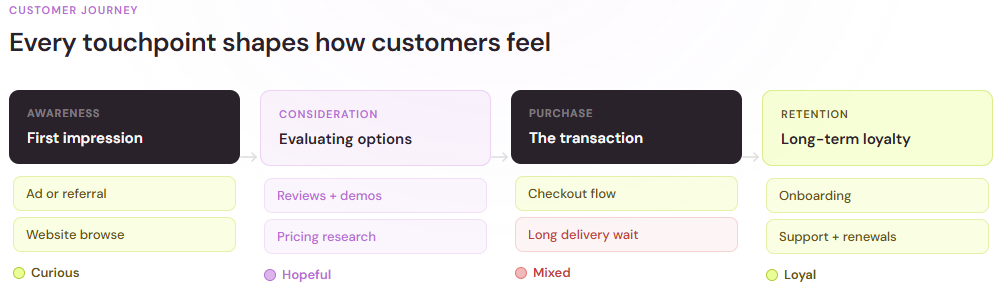
Think of a simple example: a customer places an order online. They might have a smooth checkout experience (positive), but then wait three weeks for delivery with no updates (negative). The final impression depends on all of those moments combined. That's CX. If the checkout took 10 minutes but the customer expected five, they might feel frustrated despite completing the purchase. Conversely, a longer checkout process that clearly shows progress and offers multiple payment options might feel smooth and reassuring.
Customer experience is shaped by both functional and emotional elements. The functional side includes whether your product works, whether your website loads quickly, and whether your support team solves problems. The emotional side includes whether customers feel valued, understood, and respected. Both matter equally.
CX includes:
- Product or service quality – Does it work as promised? Is it reliable? Does it deliver the outcomes customers expect?
- Ease of use – Can customers figure out how to use it without frustration? Is the interface intuitive?
- Support quality – When people need help, how quickly and effectively do you respond? Do support staff understand their issues?
- Emotional connection – Does the brand feel trustworthy, friendly, and aligned with customer values? Do customers feel like partners or just transactions?
- Consistency – Do customers get the same quality experience across channels (online, mobile, in-person, phone)? Are brand promises kept consistently?
Every interaction—whether it's obvious or behind the scenes—contributes to how customers perceive your brand. A clunky checkout process, slow email responses, or unclear product documentation all shape CX, not just the product itself. Even small details matter. A typo in an email, a confusing error message, or a form that requires information customers already provided can all accumulate, creating friction and eroding the overall customer experience.
The concept of customer experience extends beyond individual transactions. It encompasses the entire relationship lifecycle. A customer might have a great experience buying your product, but a terrible experience trying to cancel their subscription. That final negative interaction often overshadows the earlier positive ones, a phenomenon known as the recency effect. This is why exit experiences matter just as much as onboarding experiences. When customers feel trapped or encounter obstacles when trying to leave, it damages trust permanently and often results in negative reviews that persist long after the relationship ends.
Why customer experience drives business results
The link between CX and money is direct. Better experiences lead to higher retention, increased spending, and stronger word-of-mouth growth. This relationship is backed by substantial evidence across industries.
Retention pays better than acquisition. Acquiring a new customer costs five times more than retaining an existing one. This is because acquisition requires marketing spend, sales effort, and often incentives to convince someone to try a new brand. Retention, by contrast, leverages existing relationships and trust. A five percent increase in retention can lead to a 25–95% increase in profits, depending on the industry. The variation across industries reflects how much customers are worth over time. In high-margin or high-frequency businesses, retention has an outsized financial impact.
Existing customers also represent greater lifetime value. They account for 65% of revenue and spend 67% more than new customers. This means your existing customer base is the most profitable segment you have. Yet many companies invest heavily in acquisition while neglecting retention. The math is simple: if you're spending five times more to acquire customers than to retain them, and existing customers generate two-thirds more revenue, retention is where your resources should flow.
This is why churn—customers leaving—is so expensive. Customer churn costs US businesses $136 billion annually. Even in smaller companies, a single lost customer represents months of marketing investment evaporating. But brands with strong loyalty programs report a 12–18% revenue increase, and 79% of millennials stay loyal to brands with great loyalty programs. Loyalty programs work because they acknowledge the ongoing relationship and reward it, which strengthens customer experience and creates friction to leaving.
Good CX also protects your reputation. When customers have a positive experience, they share it. When they don't, they share that too—often loudly and to many people. In a world where word-of-mouth travels fast online through reviews, social media, and referral networks, CX can be your best marketing tool or your biggest liability. A single viral negative review can damage your brand perception far more than traditional advertising can repair it. Conversely, enthusiastic customer testimonials and referrals generate new business at a fraction of marketing costs. Research shows that 92% of customers trust recommendations from friends and family more than they trust advertising, making word-of-mouth generated through excellent CX one of your most powerful acquisition channels.
Beyond revenue and retention, strong CX reduces support costs. Customers who feel heard and valued are less likely to escalate complaints or churn. They're also more likely to answer feedback requests, giving you the data you need to improve further. They're more patient when problems occur, understanding that a brand that listens and acts will make things right. Additionally, when customers understand your product well and feel supported, they submit fewer support tickets in the first place, creating a virtuous cycle. Self-service resources and proactive communication reduce the volume of inbound support requests while paradoxically improving satisfaction. Customers feel enabled rather than abandoned.
Measuring customer experience
CX is intangible, but it's measurable. The most common metrics give you a snapshot of how customers feel and where to focus improvement efforts. Without measurement, you're making decisions based on assumptions rather than evidence.
Customer Satisfaction (CSAT) asks a simple question: "How satisfied are you with [product/service/interaction]?" Respondents rate it on a scale, often 1–5 or 1–10. CSAT is quick, easy to implement, and tracks short-term satisfaction after specific moments (e.g., after a purchase or support interaction). Because it measures satisfaction with particular events rather than overall sentiment, CSAT is useful for identifying exactly which touchpoints need improvement. If your post-purchase CSAT is high but your support CSAT is low, you know where to focus.
Industry benchmarks help you understand how you're doing relative to competitors and industry standards. The average CSAT across industries is 78%, with scores above 80 considered excellent and scores below 70 indicating problems (American Customer Satisfaction Index, 2024–2025). However, benchmarks vary significantly by industry. Full-service restaurants lead at 84, banks at 80, and e-commerce at 80, while ISPs lag at 68 and social media at 73 (American Customer Satisfaction Index, 2024–2025). This variation reflects both customer expectations and the competitive intensity within each sector. In highly competitive industries with frequent switching, customers expect higher satisfaction levels. In industries with entrenched players and fewer alternatives, customers may accept lower satisfaction simply because alternatives don't exist.
Net Promoter Score (NPS) measures loyalty: "How likely are you to recommend us to a friend or colleague?" It ranges from 0–10 and tells you whether customers are promoters (9–10), passives (7–8), or detractors (0–6). NPS is widely used because it connects customer willingness to advocate with deeper satisfaction and trust. If customers won't recommend you, it signals fundamental issues with customer experience. Tracking NPS over time helps you see whether changes you're making are moving sentiment in the right direction. Companies with NPS scores above 50 are considered world-class, while negative NPS indicates serious problems requiring urgent attention.
Customer Effort Score (CES) measures friction: "How easy was it to resolve your issue?" Lower effort correlates with higher loyalty. CES is particularly useful for support and onboarding touchpoints. Customers remember whether interactions required effort or felt frictionless. When you make things easy—like allowing password resets without calling support or enabling quick returns without forms—you improve customer experience. CES helps you identify where to eliminate friction and often predicts future behavior more accurately than satisfaction scores alone.
Customer Lifetime Value (CLV) calculates the total profit a customer generates over their entire relationship with your company. It helps you identify which segments are most valuable and where to invest. CLV is typically calculated by multiplying average order value by purchase frequency by customer lifespan, then subtracting acquisition and service costs. Customers with high CLV deserve more investment in their experience. Understanding CLV also helps you make retention decisions. It's worth spending more to keep a high-CLV customer than to retain a low-CLV customer. Segmenting your customer base by CLV ensures that premium customers receive premium treatment.

To measure these effectively, you need to collect feedback at the right moments: after a purchase, following support interactions, during onboarding, or when customers use a new feature. The timing matters because customer emotions are freshest immediately after key moments. Asking for feedback days or weeks later risks losing important details and genuine emotional response. The best approach is multi-channel collection: surveys, support tickets, chat feedback, reviews, and in-app prompts all provide different angles on customer sentiment. Some customers prefer text feedback, others prefer numeric scales, and some prefer conversations. Offering multiple formats increases participation and data quality.
Modern feedback tools integrate AI-powered analytics, multi-channel collection, and case management automation, making it easier to gather insights, identify patterns, and act on them. These tools can automatically route feedback to relevant teams, flag urgent issues, and help you track trends over time. They reduce the friction in the feedback process for both companies and customers.
The relationship between CX and usability
One often-overlooked driver of CX is usability: how easily customers can accomplish their goals. A beautiful interface means nothing if customers can't figure out how to use it. In fact, an interface that looks great but functions poorly damages customer experience more than a plain interface that works well. Customers forgive aesthetics; they don't forgive wasted time and frustration.
Investing in usability research and design pays off measurably. A usability investment of $68,000 on a system used by over 100,000 people generated $6.8 million in benefit within the first year of implementation. That's a 100x return on investment. The benefits came from reduced training time, fewer support tickets, higher productivity, and improved customer retention. These returns compound over time as the improved system serves customers year after year.
Usability problems create friction that damages CX:
- Confusing navigation makes customers work harder to find what they need, extending task duration and frustration
- Unclear instructions frustrate people and spike support tickets, raising costs and further damaging experience
- Slow load times feel unresponsive and careless, reflecting poorly on your brand
- Mobile-unfriendly designs exclude people on phones and tablets, a critical oversight given mobile traffic dominance
- Forms that ask for redundant information signal that you don't value the customer's time
When you remove these obstacles, CX improves naturally. Customers spend less time struggling and more time achieving what they want. They feel respected and valued. This directly impacts satisfaction, loyalty, and word-of-mouth. Usability is where the functional and emotional sides of customer experience meet. Good usability makes interactions feel effortless and thoughtful.
Building a customer experience culture
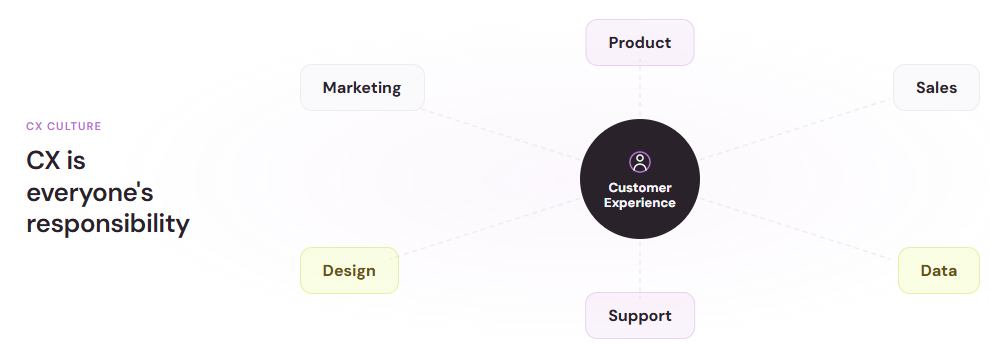
Improving CX requires more than tools. It warrants a mindset shift across the organization. CX must become everyone's responsibility, not just a customer service function.
Listen to customers. Make feedback a habit, not a one-off survey. Collect it from multiple sources: direct surveys, support conversations, product usage data, and reviews. The goal is to hear what customers actually need, not to confirm what you already think. Listening requires humility and openness to being surprised by what you learn. The best CX improvements often come from unexpected customer feedback that challenges internal assumptions. How listening to your customers builds a better business walks through how to set up a structured Voice of the Customer program that systematizes listening.
Map the journey. CX doesn't happen in isolation. Customers move through distinct phases: awareness, consideration, purchase, and retention. Each phase has multiple touchpoints, and each touchpoint is an opportunity to impress or disappoint. Understanding the full journey helps you prioritize improvements and ensures you're not optimizing one moment at the expense of another. A frictionless checkout means little if onboarding is confusing. How to map your customer journey (and build a better customer experience) provides a step-by-step framework for doing this work systematically.
Align your organization. CX improves when teams work toward the same goal. Support, product, marketing, and sales all touch customers and influence their experience. If those teams operate in silos—with different metrics, conflicting priorities, and limited communication—CX suffers. A support team focused on speed might provide terse responses that feel uncaring. A sales team focused on closing deals might overpromise on capabilities. A product team focused on features might ignore usability. Breaking down those silos through shared metrics, regular communication, and collaborative customer research makes a measurable difference. Cross-functional CX working groups that meet regularly and share customer insights ensure that all teams understand how their decisions affect the customer experience.
Measure consistently. You can't improve what you don't measure. Establish baseline metrics and track them over time. Which touchpoints cause the most friction? Where do customers get stuck? Where do they feel delighted? Use these insights to guide priorities. Regular measurement also keeps CX top of mind across the organization. When metrics are published and discussed regularly, it signals that CX matters.
Act on feedback. Collecting feedback without acting on it is worse than collecting nothing at all. It signals to customers that you don't care. Close the loop: let customers know what you changed based on their input. This creates positive reinforcement and shows that customer voice drives decision-making.
Starting your CX improvement journey
You don't need to overhaul everything at once. Start with these steps:
- Define what "good CX" means for your business. Is it fast support response? Easy product adoption? High quality? All of the above? Be specific about what matters to your customers and what differentiates you competitively.
- Identify your most important touchpoints. Where do customers interact with you most? Where do they get stuck or frustrated? Start there. Prioritize based on frequency and impact.
- Measure current state. Conduct a CSAT survey or NPS poll. Ask about friction points. Observe how customers actually use your product. Create a baseline so you can track progress.
- Prioritize the highest-impact improvements. You'll uncover more problems than you can fix immediately. Focus on the ones that affect the most customers or have the biggest financial impact, factoring in implementation complexity.
- Test and iterate. Make a change, measure the result, and adjust. CX improvement is ongoing, not a one-time project. Small continuous improvements compound into meaningful change.
- Share results. When metrics improve, celebrate with your team. When they don't, use the feedback to learn and adjust course. Transparency builds momentum and keeps CX visible.
The beginner's guide to building a customer success strategy covers the eight key components of a retention-focused strategy that keeps customers happy and engaged after the initial sale, extending customer lifetime value and reinforcing loyalty.
The bottom line
Customer experience is the totality of how your brand makes people feel. It encompasses every interaction, from awareness through retention and beyond. It drives loyalty, reduces churn, and generates revenue, both directly and through word-of-mouth. Measuring customer experience through CSAT, NPS, CES, and CLV gives you clarity on where you stand and what to improve. Building a culture that listens, learns, and acts on customer feedback is what turns measurement into continuous improvement and competitive advantage.
Start by listening to your customers, mapping their journey, and measuring the moments that matter most. The rest follows.

Liked that? Check these out:
Opinions and Expertise
What’s actually slowing research teams down (Hint: it’s not the research)
From recruiting participants and scheduling interviews to building the actual surveys, the operational drag is taking researchers away from what they do best. See what's actually slowing them down and how Research Flow fixes it.
Read more