Customer satisfaction: a definition with examples
Customer satisfaction definition: expectations vs. reality, CSAT benchmarks, how it differs from NPS and CES, and real examples from e-commerce to healthcare.
Customer satisfaction is straightforward: it’s the degree to which a customer feels their experience with a company, product, or service meets or exceeds their expectations. When someone buys something, and it works the way they hoped—or better—that’s satisfaction. When it falls short, they’re dissatisfied. But the customer satisfaction definition extends beyond this simple description. Understanding satisfaction means recognizing that it encompasses the entire customer journey, from initial awareness through post-purchase support and beyond.
That simple definition masks a lot of nuance. Satisfaction isn’t binary. It exists on a spectrum. A customer might be thrilled with one part of your service and frustrated by another. They might feel satisfied today and change their mind next week. A shopper could love your product but resent your return policy. A software user might praise your features while criticizing your onboarding process.
Understanding where your customers actually land on that spectrum, and why, is what separates companies that keep customers from those that lose them. The nuances matter because they tell you exactly where to focus your improvement efforts.
Why customer satisfaction matters
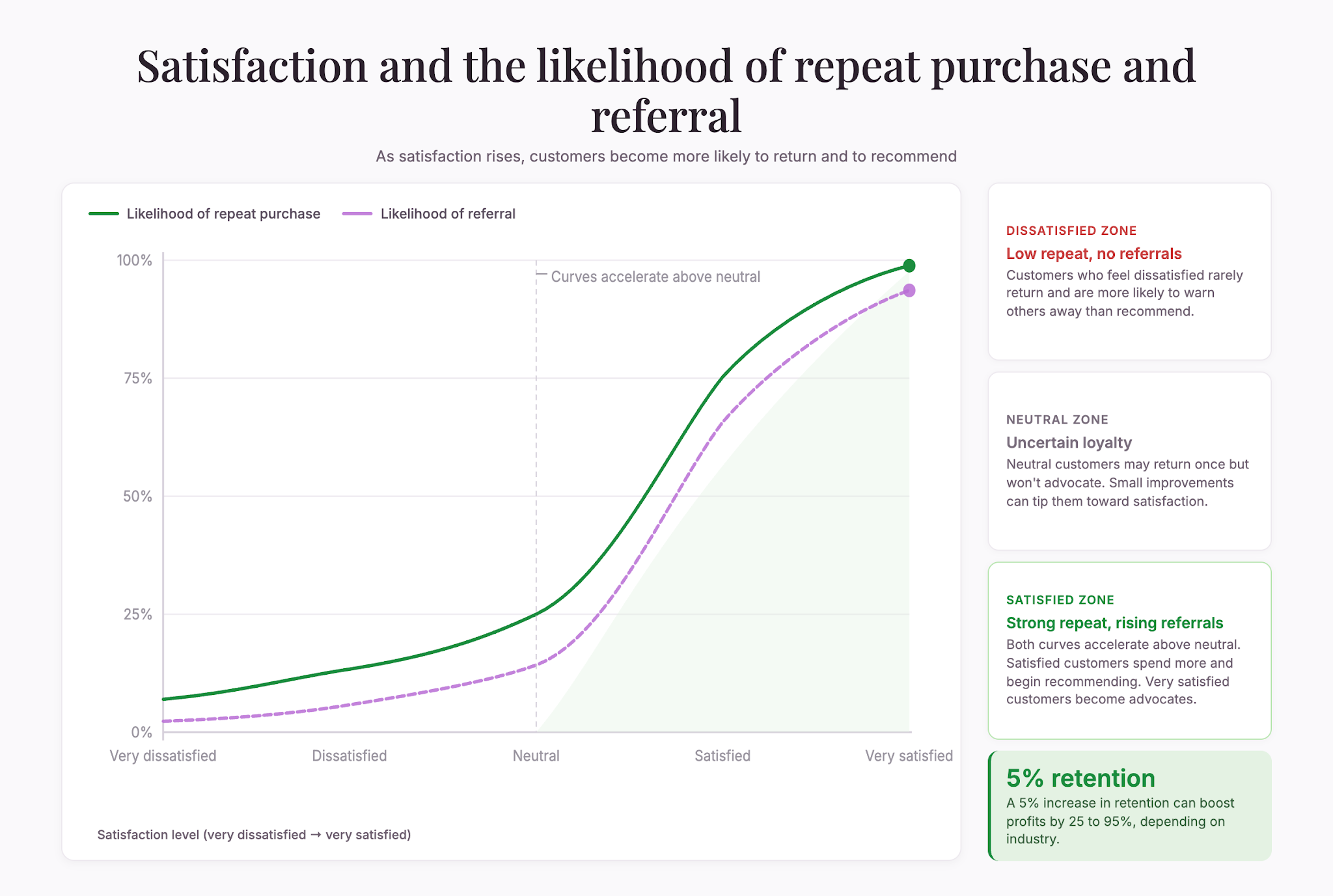
Satisfied customers are the foundation of any sustainable business. It’s not just feel-good logic—the numbers back it up.
Acquiring a new customer costs roughly 5 times more than keeping an existing one. And when you do manage to retain customers, the payoff is massive: a 5% increase in retention can boost profits by 25 to 95%, depending on your industry (Firework, 2025). That’s because existing customers spend about 67% more than new customers, and they account for 65% of your revenue (Firework, 2025). These numbers reveal why customer satisfaction definition and measurement matter so critically to your bottom line. When you improve satisfaction, you’re not just making customers feel better—you’re building a more profitable business.
Beyond the financial case, there’s trust. Eighty-one percent of consumers need to trust a brand before they’ll even consider buying from it (WiserNotify, 2025). Satisfaction and trust are linked: when customers feel their needs were met, they begin to trust you. That trust is what turns a one-time buyer into a repeat customer, and a repeat customer into an advocate who recommends you to others. In fact, satisfied customers are far more likely to become brand ambassadors, voluntarily promoting your business through word-of-mouth—a form of marketing no amount of advertising can replicate. The relationship between satisfaction and trust also means that one negative experience can undo months of building goodwill, which is why consistency matters so much.
How customer satisfaction is measured
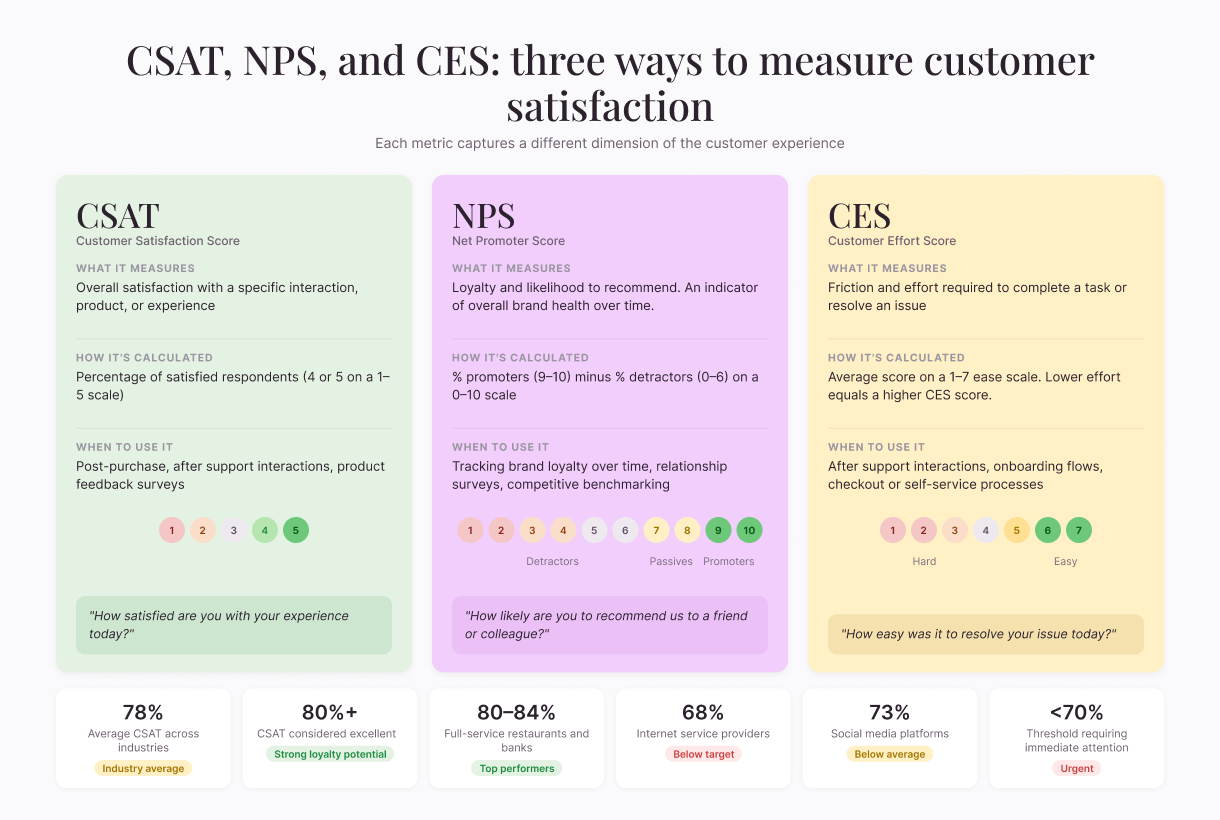
Most companies measure satisfaction using a metric called CSAT, short for Customer Satisfaction Score. The typical approach is straightforward: ask customers a simple question—usually something like “How satisfied are you with your experience?”—and let them rate their answer on a numerical scale, often 1 to 5 or 1 to 10.
The results are converted into a percentage. If 78 out of 100 respondents report satisfaction, your CSAT is 78%. That number becomes your benchmark. The appeal of CSAT is its simplicity: it’s easy to administer, interpret, and compare over time. You can track whether your satisfaction score is climbing, falling, or staying flat, which gives you a clear signal of whether your efforts are working.
What counts as good? The average CSAT across industries hovers around 78% (American Customer Satisfaction Index, 2024-2025). Scores above 80% are considered excellent and indicate strong customer loyalty potential. Anything below 70% signals real problems that demand immediate attention. In practice, this varies significantly by industry. Full-service restaurants and banks both score around 80 to 84%, while internet service providers lag at 68% and social media platforms average 73% (American Customer Satisfaction Index, 2024-2025).
This variation reflects how different industries face different customer expectations and competitive pressures. A financial services company must maintain high satisfaction because customers are entrusting it with their money, while a social media platform might face lower satisfaction because users have many free alternatives.
CSAT works because it’s simple and fast. It doesn’t require long surveys or complex analysis. A single question or a handful of quick questions can tell you whether your customers are happy. Short surveys with just 1 to 3 questions see an 83.34% completion rate, whereas longer surveys exhaust respondents and produce less reliable data (SurveySparrow Survey Response Rate Benchmarks, 2025). The key is respecting your customers’ time by keeping surveys brief and focused. When customers know a survey will take only 30 seconds, they’re far more likely to complete it honestly rather than rushing through or abandoning it.
Other satisfaction metrics exist, too, like Net Promoter Score (NPS), which asks how likely customers are to recommend you, or Customer Effort Score (CES), which measures how easy it was to do business with you. Each metric captures a different dimension of the customer experience. NPS focuses on loyalty potential, CES identifies friction points, and CSAT measures overall contentment. But CSAT remains the most direct measure of whether customers feel satisfied, making it the starting point for most satisfaction measurement programs.
Real-world examples of customer satisfaction
Satisfaction looks different depending on the context. Here are a few scenarios:
E-commerce: A customer orders a jacket online. It arrives in 3 days, fits perfectly, and matches the product photo. They feel satisfied. If it arrived damaged, they’d be dissatisfied—even if the company replaced it quickly, the initial experience left a mark. The customer set an expectation based on the product listing and delivery timeframe, and reality matched it. But if the item had arrived three weeks later, satisfaction would suffer regardless of the final quality, because the shipping experience undermined everything else.
Software: A marketing team subscribes to a tool to manage their campaigns. The interface is intuitive, customer support responds within hours, and the tool actually solves their problem faster than their old solution. Satisfaction is high. If the interface was confusing and support took days to answer, satisfaction would tank. Software satisfaction depends heavily on how well the product onboards new users and how quickly problems are resolved, because users often have alternatives they can switch to easily.
Hospitality: A guest checks into a hotel. The room is clean, the staff is friendly, and breakfast is included as promised. They leave a positive review and book again next year. That’s satisfaction in action. A dirty room or rude staff would flip it entirely. Hospitality satisfaction is particularly dependent on consistency across every touchpoint: one dirty corner or one dismissive staff member can overshadow ten positive interactions.
Healthcare: A patient schedules a doctor’s appointment and waits 20 minutes past their appointment time in a crowded waiting room. The appointment itself goes fine; the doctor listens and addresses their concern. Is the patient satisfied? Partly. The service itself was good, but the waiting experience undermined it. Satisfaction is contextual and cumulative, shaped by the sum of all interactions, not just the main one. A healthcare provider’s satisfaction score depends on scheduling ease, wait times, provider attentiveness, and follow-up communication.
The common thread across all these scenarios: customers form expectations, have an experience, and compare the two. When reality matches or beats expectations, they’re satisfied. When it falls short, they’re not.
The difference between satisfaction and other metrics
Satisfaction gets lumped together with similar terms, but they’re distinct concepts that serve different purposes.
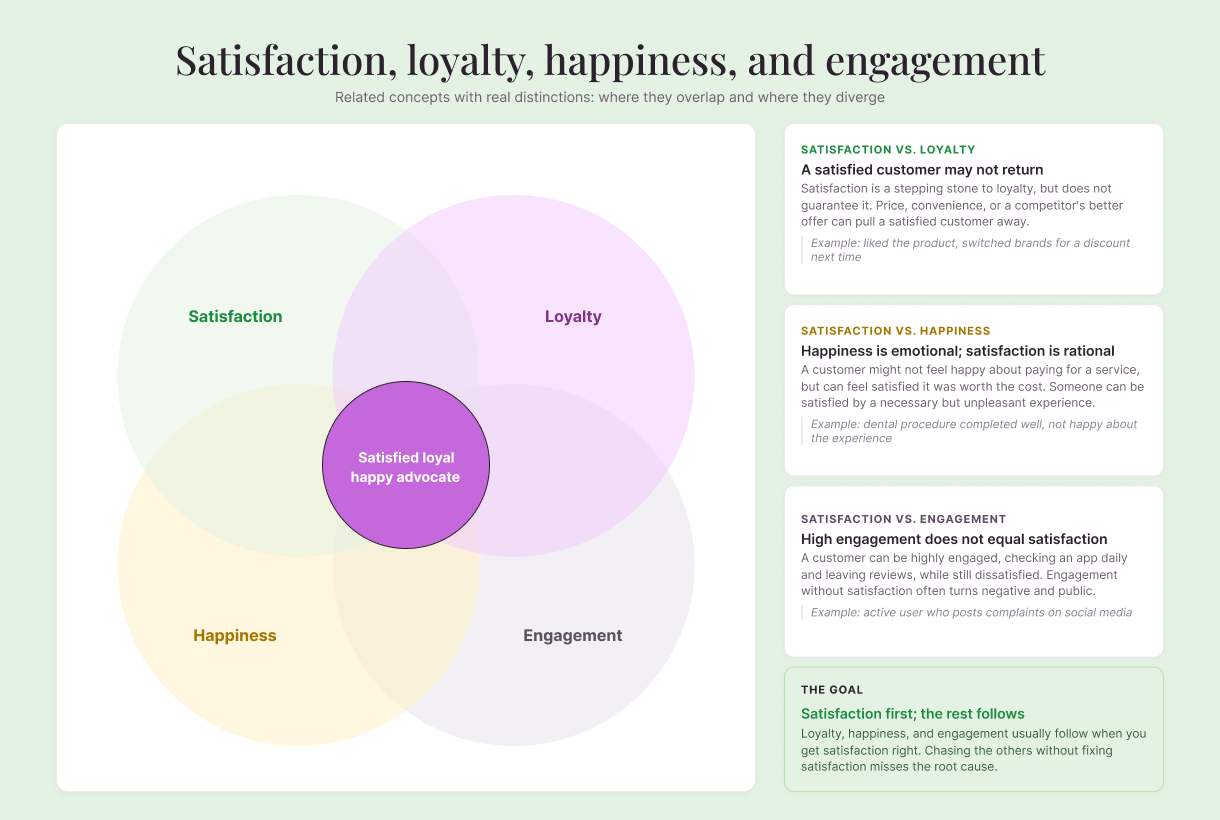
Satisfaction vs. loyalty: A customer can be satisfied with a single purchase but never return. They liked that one experience and moved on. Loyalty is different—it’s the commitment to come back repeatedly and choose your company over competitors. Satisfaction is a stepping stone to loyalty, but it doesn’t guarantee it. Price, convenience, or a competitor’s better offer might pull a satisfied customer away. You can maintain high satisfaction scores while losing customers to better deals elsewhere, which is why loyalty programs and exclusive benefits matter alongside satisfaction initiatives.
Satisfaction vs. happiness: Happiness is emotional. Satisfaction is more rational. A customer might not feel happy about paying for a service, but they can feel satisfied that the service was worth the cost. These overlap, but they’re not the same. Someone could be satisfied with a necessary but unpleasant experience, like a dental procedure, while not being happy about it.
Satisfaction vs. engagement: Engagement is about how much a customer interacts with your brand. Satisfaction is about how they feel about those interactions. A customer might be highly engaged—checking your app daily, leaving reviews, posting on social media—but still dissatisfied if those interactions highlight problems. Engagement without satisfaction often turns negative, with dissatisfied customers publicly criticizing your company online. Conversely, satisfied customers might be less engaged but more stable and profitable over time.
Understanding these differences helps you avoid the trap of chasing the wrong metric. A satisfied customer base is the goal. Loyalty, happiness, and engagement usually follow when you get satisfaction right.
How to improve customer satisfaction
Satisfaction improves when you close the gap between expectations and reality. That can happen in two ways: deliver better experiences, or set clearer expectations (ideally both).
Listen to feedback. Ask your customers what they think. Use short, focused surveys to gather input without exhausting them. When you see patterns—multiple people mentioning the same pain point—that’s a roadmap for improvement. Feedback is most valuable when it’s frequent and actionable. Monthly surveys that track satisfaction trends give you early warning signals before problems become serious.
Prioritize responsiveness. Customers want to feel heard. When someone reaches out with a problem or question, speed matters. A fast, thoughtful response builds trust even if the solution takes longer. Responsiveness signals that you value their time and their concerns, which directly translates to higher satisfaction scores across follow-up surveys.
Be consistent. If your product or service works well sometimes and poorly other times, satisfaction suffers. Consistency—doing what you promise, every time—is foundational. This is why standardized processes and staff training matter so much. Customers expect the same quality experience whether they interact with your company on Monday or Friday, whether they’re a new customer or a long-term one.
Reduce friction. Look for unnecessary steps, confusing processes, or barriers between customers and what they want. Every obstacle you remove makes satisfaction more likely. This might mean simplifying checkout, reducing form fields, improving documentation, or streamlining your support process. Small friction points accumulate, so even seemingly minor improvements can meaningfully boost satisfaction scores.
Own your mistakes. When something goes wrong, acknowledge it, apologize, and fix it. Customers often give second chances to companies that handle problems with transparency and sincerity. In fact, how you recover from failures often matters more than whether failures happen—many satisfied customers have experienced problems but were impressed by how they were resolved.
The takeaway
Customer satisfaction is simple to define but complex to achieve. It’s the alignment between what customers expect and what they experience. When that alignment is strong, customers return, refer others, and become the backbone of your business.
Measuring satisfaction gives you clarity. Acting on it gives you growth. Start with a simple question, listen to the answers, and let that feedback guide where you focus next.