Static content gets scrolled past. An online quiz maker helps you create interactive experiences that educate, entertain, and convert at 40% rates.
Share
Latest posts on
Free online trivia maker: custom trivia quizzes in minutes
|
September 4, 2026
Read more
AI survey builder: create smart surveys in minutes
|
September 4, 2026
Read more
How to make a test online: tips and tricks
Typeform
|
September 4, 2026
Read more
How to build a landing page that converts
Typeform
|
September 4, 2026
Read more
Share
The ultimate guide for an online quiz maker
Picture this: A clothing brand publishes a "What's your style personality?" quiz on their website. Within a week, 12,000 people have taken it. Each one answered questions about their preferences, shared their email to see results, and received a personalized product recommendation.
That's not a hypothetical—it's how some of the most effective marketing campaigns work today.
Quizzes tap into people’s natural desire to learn more about themselves. Whether you're a marketer looking to grow your email list, an e-commerce brand guiding shoppers to the right product, or even a teacher checking comprehension, quizzes give you something most content can't: active participation.
An online quiz maker puts that power in your hands, letting you create interactive experiences that educate, entertain, and convert—without writing a line of code.
What an online quiz maker actually does
At its core, a quiz maker is a tool that lets you build interactive, scored questionnaires. You create questions, define answer options, set up scoring logic, and design results pages, all through a visual interface.
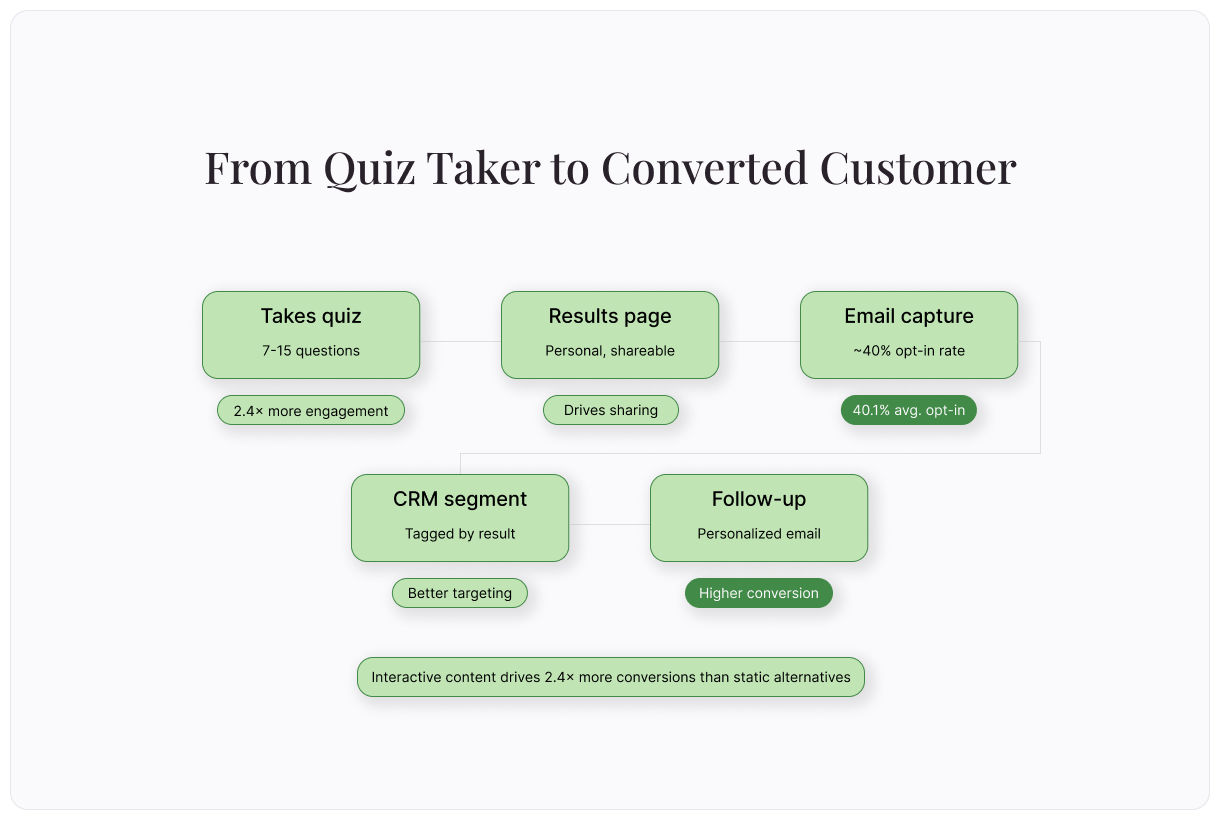
But modern quiz makers go well beyond multiple choice. Most now support image-based answers, timed questions, branching paths, personality scoring, and integrations with email platforms and CRMs. The quiz itself becomes a two-way exchange: the person taking it gets something valuable (knowledge, entertainment, a recommendation), and you get data and engagement. That combination of value for both sides explains why interactive content drives 2.4x more conversions than static alternatives.
Types of quizzes you can create
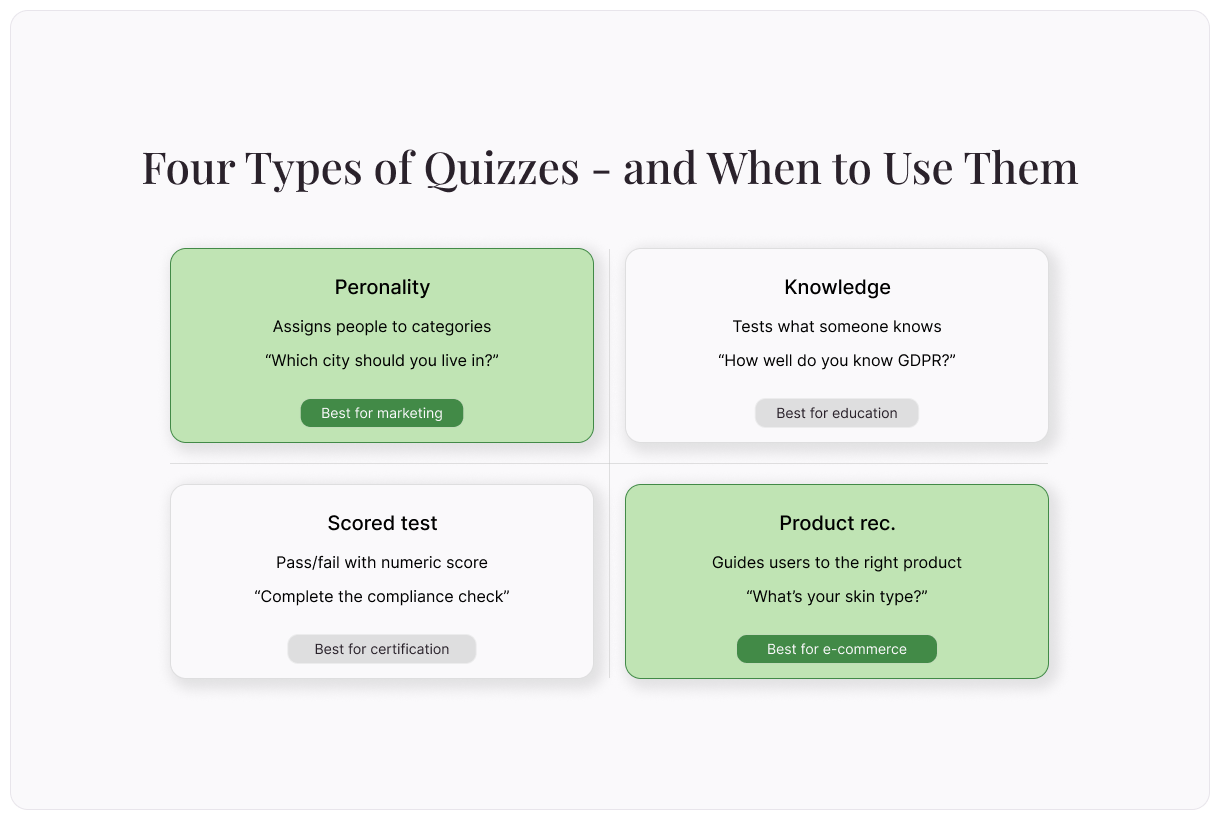
Not all quizzes serve the same purpose, and choosing the wrong format can mean wasted effort. The right format for you depends on what you want to accomplish and who your audience is.
Personality quizzes
"Which city should you live in?" "What type of leader are you?" Personality quizzes assign people to categories based on their answers. They're wildly shareable—people love comparing results—and they work well for marketing, team building, and audience segmentation.
What makes them effective is the mirror they hold up. People want to see themselves reflected back, and a well-crafted personality quiz delivers that in under three minutes.
Knowledge assessments
These test what someone knows about a topic. They're useful in education (checking comprehension), onboarding (verifying training completion), and content marketing (positioning your brand as an authority). A well-placed knowledge quiz also gives the quiz taker something concrete: a score they can benchmark against and improve.
Scored tests
These quizzes are similar to knowledge assessments, but with a numerical score and often a pass/fail threshold. Common in certification programs, course evaluations, and compliance training, scored tests tend to feel more formal and are often paired with time limits or randomized question pools.
Product recommendation quizzes
These guide users to a specific product or service based on their responses. A skincare brand might ask about skin type, concerns, and routine to recommend a personalized regimen. A bookshop might ask about reading habits to suggest a curated list.
The conversion rates on recommendation quizzes can be remarkable because the results feel tailored, not generic.
How to build a quiz that people actually finish
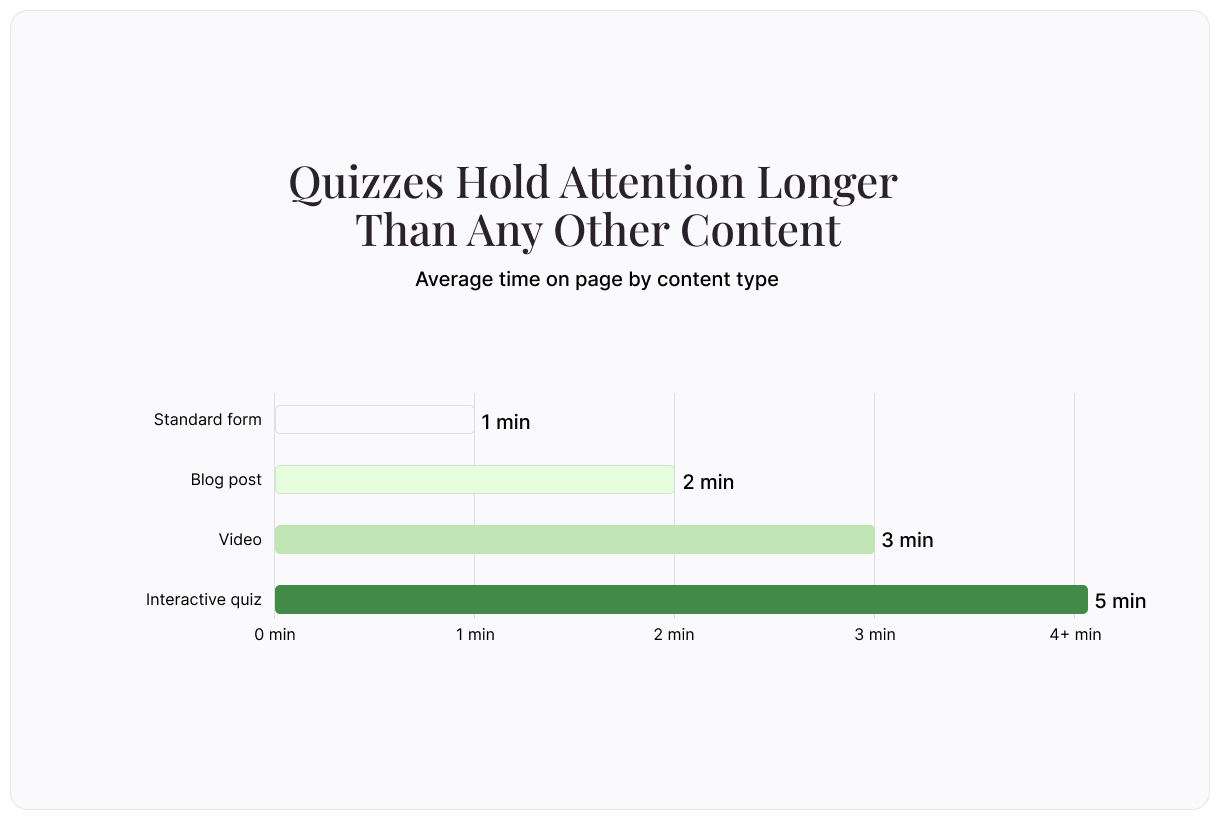
Creating a quiz is easy. Creating one that holds attention, delivers value, and drives results takes more thought. The difference usually comes down to a few best practices.
Know your outcome
What do you want to happen after someone takes your quiz? More email subscribers? Better-trained employees? Product sales? Your answer shapes every decision that follows—the questions, the scoring, the results page, and how you follow up. A quiz without a clear outcome is entertainment without a destination.
Write questions that feel effortless
Each question should take no more than a few seconds to understand. Keep them to one sentence when possible and avoid jargon. Make sure every answer option is also clearly distinct—ambiguous choices frustrate people and muddy your data.
The best quiz questions feel like a conversation, not an interrogation. "What's your go-to weekend activity?" lands differently than "Select your preferred leisure category."
Keep it between 7-15 questions
Fewer than seven questions, and the results feel shallow. More than 15, and people start dropping off. The sweet spot depends on your audience and topic, but aim for the range where each question earns its place. If you're unsure, start with 10 and trim based on completion data.
Design results pages worth sharing
The results page is your payoff moment. Don't waste it with a generic "You scored 8 out of 10." Instead, give people a rich, detailed result—a personality description, a tailored recommendation, or a benchmark comparison. The more specific and personal the result, the more likely someone is to share it.
Speaking of, include a share button on the results page. People who enjoyed the quiz will want to challenge friends or compare results—that's free distribution for you. Some of the most viral quizzes owe their reach entirely to results pages that people couldn't resist sharing.
Connect the quiz to your workflow
A quiz that lives in isolation is a missed opportunity. Connect it to your email platform so new quiz takers automatically receive a follow-up sequence.
Pipe the data into a spreadsheet or CRM for analysis. Use the results to segment your audience based on their answers, so future communication is more relevant.
Where quizzes deliver real results
Quizzes aren't just for entertainment. Across industries, they consistently outperform static content for engagement and data collection. Here's where they make the biggest impact:
Education and training – Teachers use quizzes to check understanding. Corporate trainers use them to verify that employees absorbed key material. In both cases, quizzes make learning active rather than passive. They also highlight knowledge gaps early, so you can address them before they become problems.
Marketing and audience growth – The average quiz conversion rate is 40.1%. That’s because people are far more willing to share their email when they're getting a personalized result in return. The data you collect from quiz answers also helps you understand your audience at a level that basic signup forms never reach.
Recruitment and HR – Pre-screening quizzes help hiring managers filter candidates early in the process. Skills assessments and cultural fit quizzes save hours of interview time by surfacing the strongest applicants before anyone schedules a call.
Healthcare and wellness – Symptom checkers, risk assessments, and wellness quizzes help people understand their health—and they help providers triage more efficiently. These quizzes work because they give people actionable information rather than vague reassurance.
E-commerce – Product recommendation quizzes reduce decision fatigue and guide shoppers toward products they'll actually love. The result? Higher conversion rates and fewer returns. In fact, 91% of consumers are more likely to shop with brands that recognize, remember, and provide relevant offers and recommendations.
Community engagement – Nonprofits, media outlets, and community organizations use quizzes to spark conversations, test knowledge about causes, and increase participation. A quiz about local history or environmental impact can drive more meaningful engagement than a dozen standard social media posts.
Five tips for better quizzes
Want to create the most engaging and impactful quizzes possible? Here’s how to ensure a memorable, high-quality experience for both your respondents and you.
1. Lead with curiosity
Your quiz title should make someone stop scrolling. "How much do you really know about nutrition?" works better than "Nutrition quiz." Spark curiosity and make the reward clear. The title is your first impression, so make it count.
2. Use images when possible
Visual answer options—photos, illustrations, icons—make quizzes more engaging and faster to complete. They also reduce the cognitive load of reading through text-heavy options. For product recommendation quizzes, especially, images let people respond instinctively rather than analytically.
3. Personalize the results
Generic results feel lazy. Use the quiz taker's name, reference their specific answers, and tailor recommendations to what they told you. The more personal it feels, the more it resonates—and the more likely they are to act on it.
4. Test on mobile first
Most quiz takers will be on their phones. Design for a small screen first, then make sure it scales nicely on desktop. Pay special attention to image sizing and button tap targets. If a button is hard to tap, people will leave.
5. Iterate based on data
After your quiz has been live for a week, check the analytics. Where are people dropping off? Which questions have suspiciously even answer distributions (suggesting people are guessing)? Use those signals to refine your questions and improve completion rates. The best quizzes are never finished—they're always being fine-tuned.
Beyond the first quiz
Quizzes sit at a rare intersection: They're fun for the person taking them and valuable for the person creating them. Whether you're an educator, a marketer, or a team lead, an online quiz maker gives you a way to connect with your audience that static content simply can't match.
To get started with your first quiz, simply pick a topic you know well, write 10 questions, and publish it—you don't need a perfect design or a polished results page for your first attempt. With this guide’s tips and best practices, you’re already well on your way to becoming an online quiz-making pro.
Free online trivia maker: custom trivia quizzes in minutes
Trivia is engaging. People love testing their knowledge, competing with friends, and proving they know random facts nobody asked them to memorize. That’s why trivia works as a learning tool, a marketing hook, an event activity, and just plain fun.
AI survey builder: create smart surveys in minutes
Creating effective survey questions is easier said than done. You need to ask the right things, in the right order, to the right people—and do it in a way that actually makes people want to answer. Most survey builders make this harder, not easier. You’re staring at a blank form, second-guessing every word, wondering if your logic flows or if you’ll get useful data back