A bad test gives you wrong answers. Learn how to choose the best test maker and write questions that measure what they're supposed to measure.
Share
Latest posts on
Free online trivia maker: custom trivia quizzes in minutes
|
September 4, 2026
Read more
AI survey builder: create smart surveys in minutes
|
September 4, 2026
Read more
How to build a landing page that converts
Typeform
|
September 4, 2026
Read more
How to make an online form: the ultimate guide
Typeform
|
September 4, 2026
Read more
Share
The best test maker (tips + tricks)
A bad test doesn't just waste time—it gives you wrong answers. When questions are confusing, and formats stress test takers more than they assess them, you end up with data you can't trust and people who feel frustrated rather than fairly evaluated.
Whether you're a teacher building end-of-term exams, an HR team screening job applicants, or a compliance officer verifying that employees understand new regulations, the stakes are the same. The test needs to measure what it claims to measure—accurately, consistently, and fairly.
A good test maker is the answer. It can help you build assessments that are clear, fair, and genuinely useful, regardless of whether you're grading students, certifying professionals, or evaluating job candidates. This guide covers how to find the right tool and how to use it well.
What sets a test maker apart from a quiz maker?
The two overlap, but they serve different purposes. A quiz maker is built for engagement—personality results, shareable outcomes, and audience interaction. A test maker is built for assessment. It's focused on accuracy, scoring, and evaluation.
That means test makers tend to offer features that quiz makers don't:
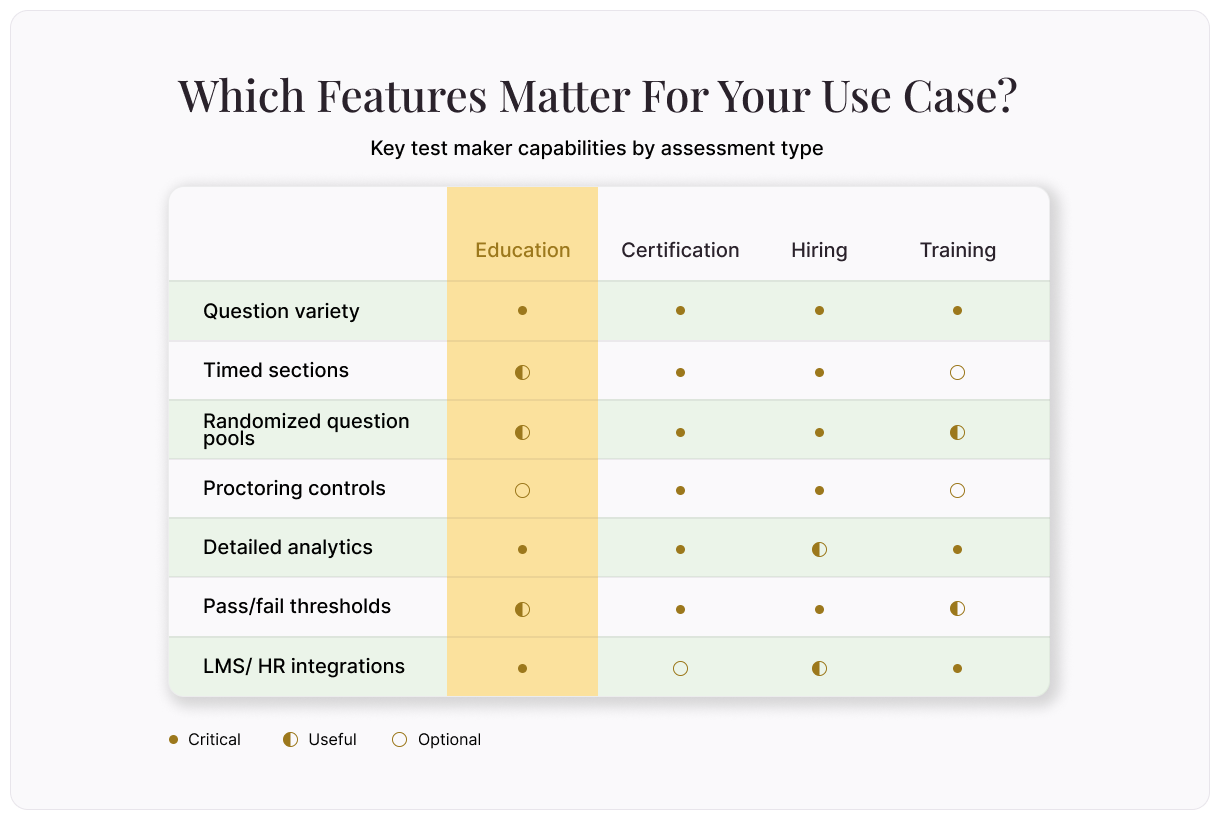
Timed sections – Set time limits per question or for the entire test
Randomized question pools – Pull from a bank of questions so no two test takers see the same exam
Weighted scoring – Assign different point values to different questions based on difficulty or importance
Pass/fail thresholds – Define minimum scores for certification or advancement
Proctoring controls – Prevent tab switching, copy-pasting, or screen sharing during the test
Detailed analytics – See which questions most people got wrong, how long they spent per section, and where knowledge gaps exist
If you need to measure what someone knows—and act on that measurement—a test maker is the right tool. The features above are what separate a serious assessment platform from a basic quiz builder, and they're worth prioritizing when you're evaluating your options.
Choosing the right test maker
The best test maker for you depends on what you're assessing, who you're assessing, and what happens after the results come in.
For education
Teachers and professors need a tool that integrates with their learning management system (LMS), supports various question types (multiple choice, short answer, essay, matching), and provides grade exports. Automatic grading saves enormous amounts of time, especially for large classes.
Look for tools that also support rubric-based grading for essays and open-ended responses, since not everything can be scored automatically.
For certification and compliance
If you're certifying professionals—in healthcare, finance, IT, or any regulated field—security is paramount. Look for proctoring features, audit trails, randomized question banks, and the ability to set strict pass/fail criteria. You'll also want reporting that can satisfy regulatory requirements, including individual score records and completion certificates.
For hiring and recruitment
Pre-employment assessments need to be fair, legally defensible, and relevant to the role. The best test makers for hiring include role-specific templates, scoring rubrics, and candidate comparison dashboards. Look for tools that let you assess practical skills (coding challenges, writing samples, scenario responses) alongside traditional knowledge checks.
For corporate training
After a training session, you need to verify that employees retained the material. Look for tools that support pre- and post-training assessments, track individual progress over time, and integrate with your HR systems. The most useful training assessments don't just test recall—they present scenarios that mirror real on-the-job decisions.
How to write test questions that actually work
The quality of your test depends almost entirely on the quality of your questions. Even the most well-designed test will give you misleading results if you’re asking poorly written questions.
With that in mind, here’s how to write test questions that actually work:
Use clear, direct language
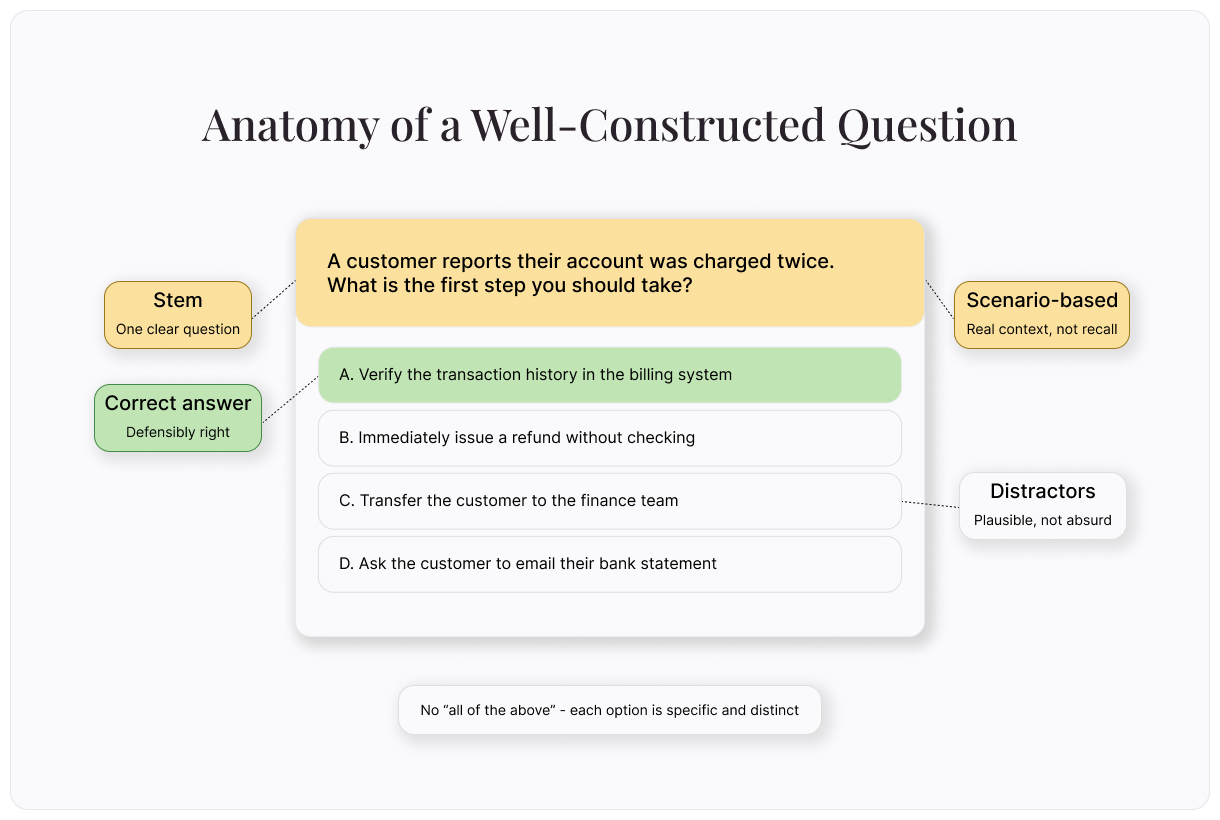
If a question confuses someone, you're testing their reading comprehension—not their knowledge. Keep sentences short. Avoid double negatives ("Which of the following is NOT incorrect?"). And make sure each question asks exactly one thing.
To know whether your questions are clear, read each one as if you're encountering the subject for the first time. If you have to re-read a question to understand what it's asking, your test takers will too. Clarity is the single most important quality of a good test question.
Align questions to objectives
Every question should map to a specific learning objective or skill. If you can't articulate what a question measures, it probably shouldn't be on the test. This alignment also makes it easier to diagnose results—when someone fails, you can see exactly which objectives they missed.
Write plausible distractors
In multiple choice questions, wrong answers (distractors) should be genuinely plausible—not obviously absurd. Good distractors reflect common misconceptions, which helps you identify where understanding breaks down. If one distractor is chosen far more often than others, it's highlighting a specific misunderstanding you can address in future training.
Mix question types
Different skills require different formats. Use multiple choice for factual recall, short answer for application, and essay or scenario-based questions for critical thinking. A well-balanced test covers multiple levels of understanding—from basic recall to analysis and problem-solving.
Consider including scenario-based questions that mirror real situations. "A customer reports that their account was charged twice. Walk through the steps you'd take to resolve this" reveals far more than "What is the refund policy?"
Avoid "all of the above" and "none of the above"
These options are testing shortcuts that often introduce ambiguity rather than clarity. They also make it easier for test takers to guess correctly through elimination rather than knowledge. Replace them with specific, distinct answer options.
Five tips for better assessments
1. Pilot your test before launching
Have a small group take the test first. Note any confusing questions, unexpected time issues, or scoring errors. A 15-minute pilot can save you from hours of cleanup later. Pay special attention to the questions that everyone gets right (too easy), or everyone gets wrong (possibly confusing).
2. Randomize question order
When possible, shuffle the sequence of questions for each test taker. This reduces the chance of collaboration and ensures that the difficulty isn't front-loaded or back-loaded. Most test makers support this with a single toggle.
3. Set realistic time limits
Too little time creates anxiety that masks real knowledge. Too much time invites overthinking. Here’s a common benchmark to follow: Allow 60-90 seconds per multiple-choice question and 5-10 minutes per short-answer or essay question. After your pilot run, you can adjust based on how long people actually needed.
4. Provide immediate feedback when appropriate
For training and education contexts, showing the correct answer immediately after each question reinforces learning. For certification or hiring tests, hold results until the end to prevent gaming. The right approach here depends on the purpose. If the test is about learning, immediate feedback helps; if it's about evaluation, hold feedback until later.
5. Review question-level analytics
After giving the test, look at the data. If 95% of people got a question right, it's too easy and isn't helping you differentiate. If 90% got it wrong, it might be poorly worded or covering material that wasn't taught well. Use these signals to improve future tests. The best assessments evolve over time.
Common mistakes to avoid
Even experienced test creators fall into these traps. Recognizing them early saves you from collecting data that looks useful but isn't:
Testing memorization instead of understanding. Recall-based questions ("What year did X happen?") rarely tell you whether someone can apply their knowledge. Focus on scenarios and problem-solving instead. The goal is to see whether someone can use what they know, not just repeat it.
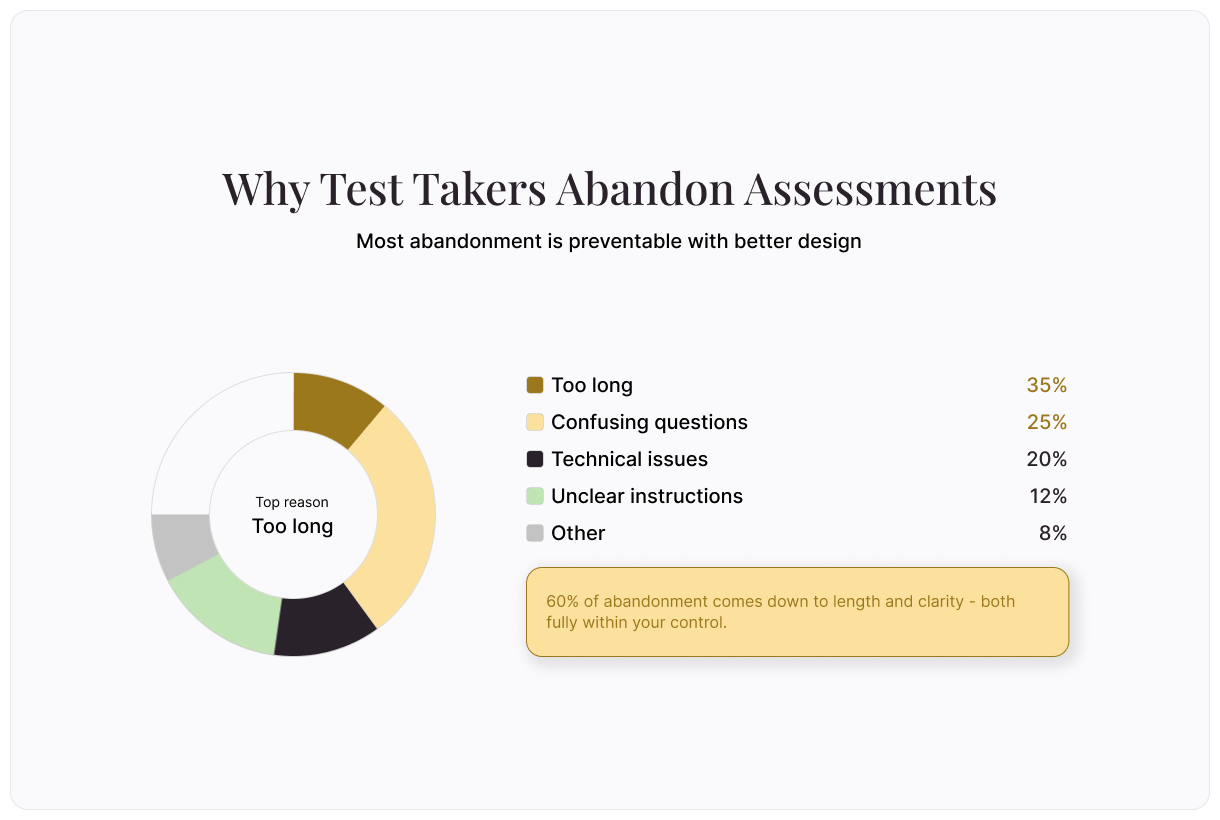
Making tests too long. Fatigue sets in. Performance drops. You end up measuring stamina rather than competence. Test only what matters. A focused 30-minute test tells you more than a grueling 90-minute marathon.
Ignoring accessibility. Make sure your test works with screen readers, offers sufficient contrast, and allows extra time accommodations. Fair testing is accessible testing. If your test excludes people because of how it's built rather than what it measures, the results are meaningless.
Skipping the review cycle. Every test should be reviewed and refined after each administration. Questions that performed poorly should be rewritten or replaced. Think of each test as a draft that gets better with use.
Using the same test repeatedly without changes. If the same test circulates long enough, the answers will too. Refresh your question bank regularly and use randomized pools to keep each test session unique.
Tests that earn trust
The purpose of any test is to learn something—about a student's understanding, a candidate's skills, or an employee's readiness. When you invest time in writing clear questions, choosing the right format, and analyzing the results, you end up with an assessment that's fair, useful, and respected.
The best tests don't feel adversarial. They feel like a chance for someone to show what they know. When test takers walk away feeling that the assessment was fair and relevant, they trust the outcome—even if they didn't score as well as they hoped. That trust is what makes a test worth taking and worth building.
Build yours with that spirit, and the results will speak for themselves.
About the author
We're Typeform - a team on a mission to transform data collection by bringing you refreshingly different forms.
Free online trivia maker: custom trivia quizzes in minutes
Trivia is engaging. People love testing their knowledge, competing with friends, and proving they know random facts nobody asked them to memorize. That’s why trivia works as a learning tool, a marketing hook, an event activity, and just plain fun.
AI survey builder: create smart surveys in minutes
Creating effective survey questions is easier said than done. You need to ask the right things, in the right order, to the right people—and do it in a way that actually makes people want to answer. Most survey builders make this harder, not easier. You’re staring at a blank form, second-guessing every word, wondering if your logic flows or if you’ll get useful data back