Damage Claim Form
Get a damage claim filed with the photos, the value, and a signature attached, not a follow-up email away. Collect what the adjuster needs in one submission instead of three.



Damage claims rarely arrive complete. Someone describes what broke but forgets the date, or attaches one photo out of three, or signs a printed form that gets scanned in sideways. Whoever processes the claim spends the first pass just tracking down what's missing, then waits on a reply before the file can move.
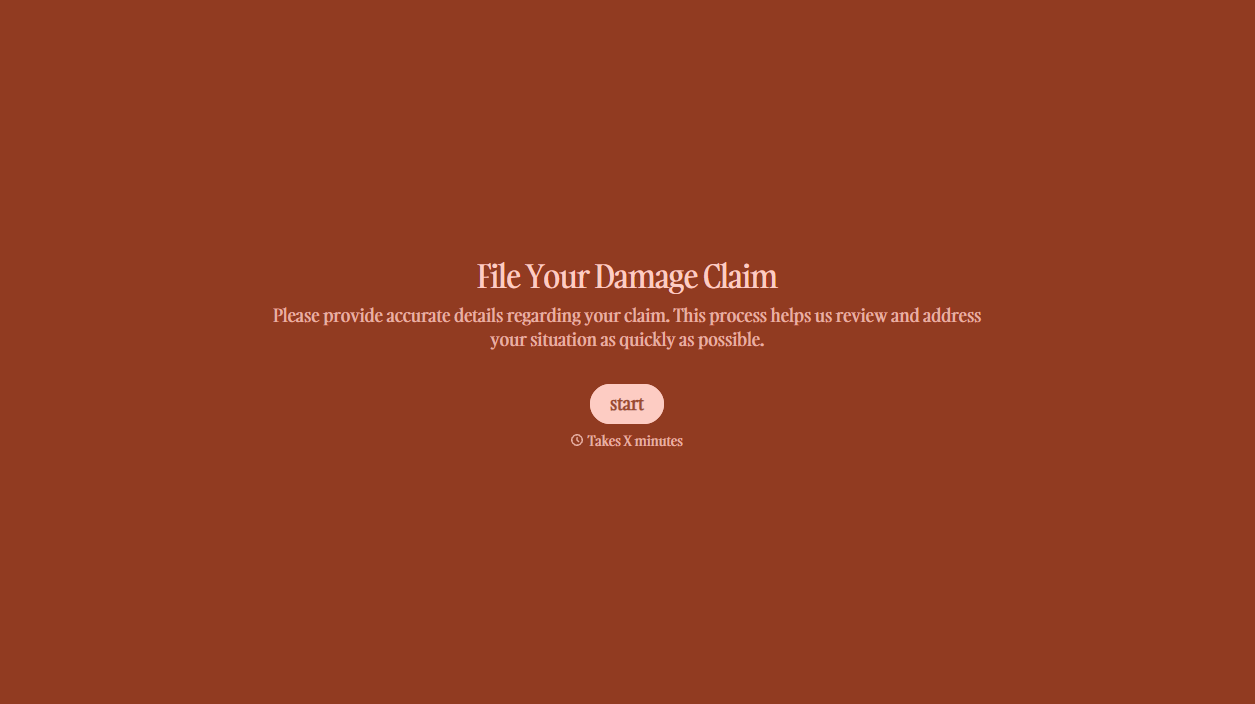
Typeform's damage claim form asks for the same information every time, in the order that gets a claim approved: who's filing, what happened, what it's worth, and what proves it. Conditional logic keeps the questions relevant—a shipped item asks for a tracking number and packaging condition, a property claim asks for the location and any repair estimate already in hand. Photos and receipts attach directly to the submission with File Upload, so the evidence travels with the claim instead of arriving in a separate email.
Every claim comes in dated, itemized, and signed, ready to hand to an adjuster without a follow-up call. Nobody reopens the file to ask what a blank field meant, and the person filing only has to explain what happened once.
A damage claim form is an online form someone fills out to report and document damage to property, goods, or a vehicle, so an insurer, landlord, or business can process a claim. It collects who's filing, what happened and when, the value of what was damaged, and any evidence (photos, receipts, witness details) that supports the claim.
A PDF attachment gets filled in inconsistently. One person lists a repair estimate, the next leaves it blank because they don't have one yet. A damage claim form asks the same questions in the same order every time, so whoever reviews it isn't reading three different formats for the same information. You get a complete claim on the first submission instead of chasing details after.
Capture what a claim needs to move forward without a follow-up:
- Claimant name and contact details
- Date, time, and location of the incident
- Description of what was damaged and how
- Estimated value or cost to repair or replace
- Supporting photos, receipts, or witness information
- Signature confirming the claim is accurate
Not always. Some insurers require their own claim form, an adjuster's inspection, or documentation beyond what you collect up front, and a form response doesn't substitute for that. Use this to gather the details accurately and completely, then confirm what the specific policy or claim requires before you treat the form as the final word.
Yes. Add a Signature question and claimants can type, draw, or upload a signature directly in the form, no separate document to print, sign, and scan back in. It covers basic electronic signature standards (ESIGN, UETA, eIDAS), though it's not built for cases that need identity verification or a notarized signature, like real estate or court filings. It's available on Growth Flow, Growth Custom, and Enterprise plans.
Get inspired by relevant templates and categories
3200+ Templates, 300+ Integrations




With Typeform, you can customize everything
Change text, colors, and even logos to match the look and feel of your brand. Then embed forms smoothly onto web and email.
Make forms feel effortless to fill out. Pace questions, call people by their name, and adapt the flow based on the data they share.
Stay efficient by connecting forms to your workflow. Typeform integrates with 300+ tools including Slack, Zapier, and HubSpot.