11 employee onboarding tools that ramp new hires faster
Not all employee onboarding software works the same. Compare 11 platforms by automation, personalization, feedback, integrations, and team size.
Key Takeaways
- Choose software that fits your priorities: Automation, personalization, feedback, integration, and mobile access matter, but which one matters most depends on your team’s size and structure.
- Match the tool to your organization's scale: All-in-one platforms like BambooHR and Paycor suit smaller teams, while Workday and SAP SuccessFactors fit large enterprises with heavier compliance needs.
- Solve for your specific pain point: Rippling streamlines IT provisioning, Deel handles global compliance, and Culture Amp ties onboarding to ongoing engagement data.
New hires hit the ground running when they understand what's expected of them and feel welcomed by the team. Yet only 46% of employees clearly know what is expected of them at work, down from 56% in 2020. That gap costs organizations real money in lost productivity and retention. Companies with strong onboarding practices tend to see faster ramp-up in the first year and better retention during the critical early months.
The right onboarding tool won't fix everything, but it removes friction at a critical moment. Whether you're automating paperwork, building connections, collecting feedback, or creating interactive training, the software you choose shapes how new hires experience their first weeks. From your company's perspective, effective onboarding also reduces the time hiring managers and team members spend on administrative tasks, freeing them to focus on mentorship and relationship-building. Here are 11 tools that help teams ramp faster and build stronger foundations.
What to look for in employee onboarding software
Before diving into specific platforms, know what separates a good tool from a time-waster. The investment you make in onboarding software pays dividends only if it aligns with how your organization actually operates and where new hires need the most support.
Automation and workflow
Paperwork is nobody's idea of a good first impression. Look for software that automates routine admin tasks—collecting personal details, assigning logins, scheduling training—so your team has more time to focus on connection and culture fit. Automation also reduces human error in critical processes like benefits enrollment or IT provisioning, where mistakes can delay a new hire's ability to work effectively. The best employee onboarding software handles these repetitive tasks without requiring manual intervention at each step, creating consistency across every new hire's experience regardless of which department processes them.
Personalization and interactivity
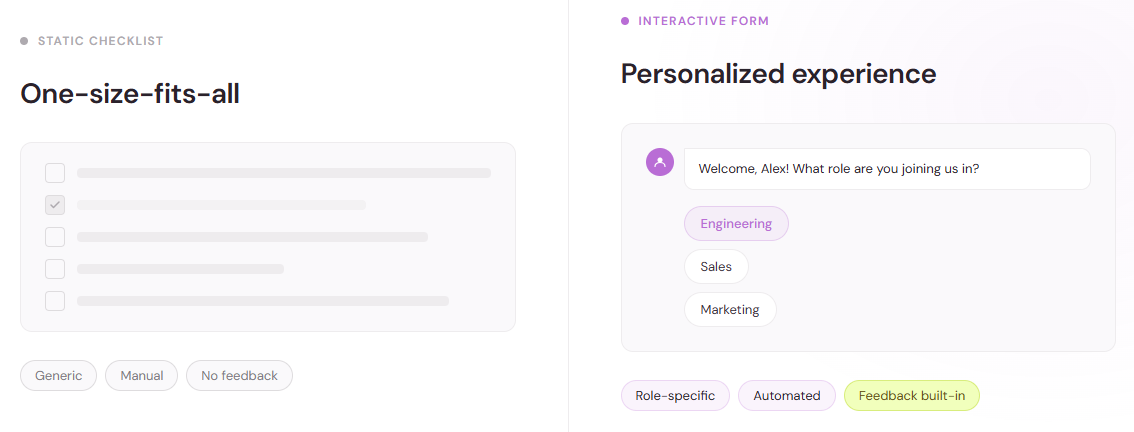
Static checklists feel cold. The best tools let you create personalized, conversational experiences that reflect your company's voice and make new hires feel seen, not processed. Personalization might mean tailoring the onboarding path based on role, department, location, or seniority level. Interactive elements—like welcome videos from leadership, one-on-one meeting schedulers, or culture-focused activities—turn onboarding from a checklist into an experience that signals your organization's values.
Feedback collection
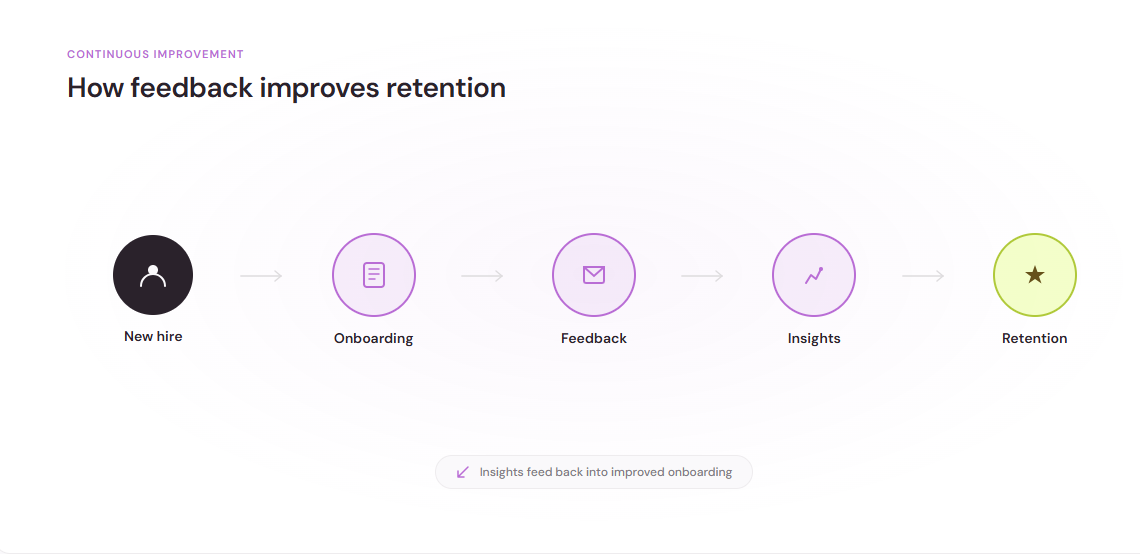
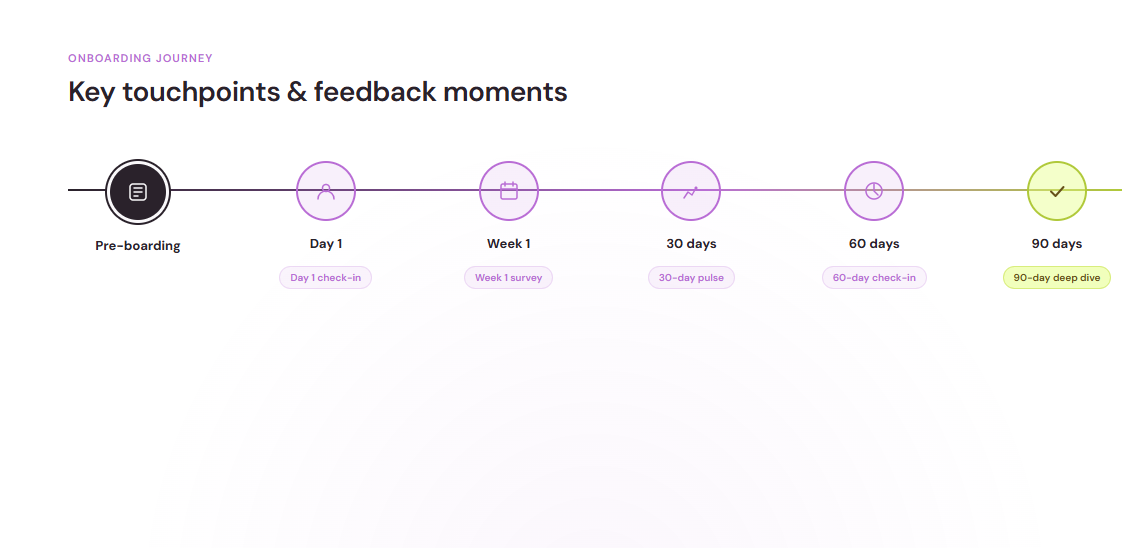
You can't improve what you don't measure. Look for tools that make it simple to gather feedback from new hires about their experience—and turn that feedback into action. This might include surveys at key milestones (end of week one, 30-day mark, 90-day check), one-on-one feedback forms, or open-ended questions about what went well and what could improve. Tools that combine feedback collection with analytics help you spot patterns. For instance, if multiple new hires mention confusion about certain processes, that's actionable intelligence you can use to refine your onboarding.
Integration with your stack
Onboarding doesn't happen in isolation. Choose software that plays nicely with your HR platform, Slack, document management system, and any other tools your team relies on. If your onboarding software requires data to be manually entered into multiple systems, you've added friction instead of removing it. The best integrations automatically pass information between systems, so a new hire's start date in your HR system automatically triggers onboarding tasks, learning assignments, or Slack introductions without manual handoffs.
Mobile accessibility
Many new hires need to complete onboarding tasks before their first day or outside of traditional office hours. Mobile-friendly onboarding software ensures new employees can fill out forms, review materials, and check their progress from a phone or tablet. This is especially critical for distributed or remote teams, where the entire onboarding experience may happen on mobile devices.
1. Bamboo HR
BambooHR combines core HR tasks (payroll, benefits, time tracking) with dedicated onboarding workflows. New hires get guided through a personalized checklist, tasks auto-assign to team members, and you can track progress in real time. It integrates with Slack, email, and most major HR tools, so information flows without manual handoffs. The platform also includes eSignature capabilities for offer letters and other documents, reducing time spent on paperwork before the new hire even starts.
BambooHR's onboarding module allows you to create role-specific workflows, so a software engineer's onboarding looks different from a sales representative's. You can attach documents, links, and training materials directly to tasks, and new hires see their personalized path from day one. Managers get visibility into which tasks are complete and which are pending, making it easy to follow up if something stalls.
Best for: mid-sized companies with centralized HR teams that want all-in-one HR plus onboarding.
2. Rippling
Rippling treats onboarding as part of a larger IT and HR ecosystem. It handles device provisioning, account creation, access permissions, and employee data management in one place. New hires get a dashboard showing their pre-boarding checklist, first-day schedule, and team introductions. Rippling's strength is reducing the number of manual touchpoints IT and HR need. Instead of submitting separate requests to IT for a laptop, email account, and software licenses, everything happens through one workflow, and physical devices can even be shipped to arrive on the new hire's first day.
Rippling also automates background check integration, so hiring teams can see status updates without chasing vendors for information. For IT-heavy organizations, this automation saves hundreds of hours per year that would otherwise be spent on device setup and access provisioning. The platform includes a mobile app so new hires can access their onboarding checklist and important documents anywhere.
Best for: tech-forward companies with strict IT security and compliance needs.
3. Workday
Workday is an enterprise-grade HR system that manages the full employee lifecycle, from recruiting through onboarding, performance, and payroll. Onboarding includes customizable workflows, mobile-friendly checklists, and deep integrations with other Workday modules. It's powerful but requires significant setup and training. Organizations typically work with implementation partners to configure Workday for their specific workflows and compliance requirements. The payoff is significant for large organizations: Workday can handle complex scenarios like international hiring, multiple legal entities, and intricate compliance rules that smaller platforms can't touch.
Workday's onboarding module feeds directly into performance management and learning systems, so a new hire's training assignments, manager relationships, and career development conversations all exist in one ecosystem. This integration is particularly valuable for large enterprises that need to track onboarding completion as part of regulatory compliance.
Best for: large enterprises with dedicated HR technology teams.
4. Monday.com
Monday.com is a project management platform that HR teams often adapt for onboarding. You can build custom workflows, assign tasks to multiple team members, set deadlines, and track progress visually. It's flexible and visual, though you'll need to build your own onboarding structure from scratch rather than using pre-built templates. The advantage is that if your organization already uses Monday.com for other projects—marketing campaigns, product development, sales pipelines—your HR team can leverage the same platform and keep onboarding in one place alongside other team workflows.
Monday's visual interface makes it easy for non-technical people to build and iterate on onboarding workflows. Automation rules let you create conditional logic (for example, "if the new hire is remote, assign these additional tasks"), and custom fields let you track role-specific requirements. The platform also supports timeline views, so you can visualize the entire onboarding process from pre-boarding through 90-day check-in.
Best for: teams that already use Monday for other projects and want to consolidate tools.
5. Culture Amp
Culture Amp combines employee listening (surveys and feedback) with onboarding tools. New hire onboarding includes interactive modules, team connection features, and automated check-ins. The real differentiator is the feedback loop. Culture Amp makes it simple to collect onboarding feedback and surface insights your team can act on. After your first cohort of new hires completes onboarding, you'll have actionable data about what worked and what didn't, so you can continuously refine the experience.
Culture Amp's platform includes pulse surveys and engagement scores, so you can track how new hires' engagement trajectories compare to your broader employee base. This data helps you identify whether engagement dips are happening during onboarding specifically or later in the tenure. You can also segment feedback by role, department, or manager to spot which teams are particularly strong at welcoming new hires and which could use support.
Best for: companies that prioritize employee engagement and want onboarding tied to broader listening efforts.
6. Guidepoint
Guidepoint is a knowledge management and employee onboarding platform designed to create self-serve learning paths for new hires. You can build interactive guides, video modules, and FAQs that new employees can access anytime. It's particularly strong for roles with complex procedures or high volumes of new hires. The platform uses search functionality, so if a new hire has a question about expense reporting or how to submit a time-off request, they can find the answer in seconds rather than asking a colleague or manager.
Guidepoint also includes analytics showing which guides are being accessed most, which suggests where new hires are spending their time and what questions they have. You can use this data to improve documentation or identify gaps. For instance, if everyone is watching the "how to access the VPN" guide multiple times, that might indicate the process needs clarification.
Best for: organizations with many new hires or roles that require extensive procedural training.
7. LinkedIn Learning
LinkedIn Learning combines curated online courses with onboarding workflows. New hires can be assigned role-specific learning paths on day one, track their progress, and complete courses at their own pace. It's less focused on HR admin tasks and more focused on skills development and continuous learning. You can use LinkedIn Learning to assign foundational courses (like communication skills or software training) that every new hire should take, plus role-specific tracks for engineers, salespeople, or managers.
LinkedIn Learning integrates with most major HR platforms, so new hires see their assigned courses within their onboarding portal. The platform also tracks completion, so managers can see whether a new hire has finished their assigned training and how long it took. For organizations that value continuous learning, assigning LinkedIn Learning courses during onboarding sets the tone early that skill development is ongoing.
Best for: companies prioritizing skills development and career growth conversations during onboarding.
8. SAP SuccessFactors
SAP SuccessFactors is an enterprise HR platform that handles onboarding as part of a broader suite that includes talent management, performance, and succession planning. Onboarding workflows are customizable, mobile-friendly, and integrate with SAP's other modules. Like Workday, it requires significant implementation effort. The advantage for large organizations is that onboarding data flows seamlessly into performance management, so a manager can see how a new hire's early assignments align with their longer-term development goals.
SAP SuccessFactors also includes the SuccessFactors Learning module, so you can embed training and development directly into onboarding workflows. The platform can handle complex organizational structures, international hiring, and multi-language onboarding experiences, which are essential for global enterprises.
Best for: large enterprises already invested in the SAP ecosystem.
9. Deel
Deel specializes in HR and payroll for distributed and remote teams. Its onboarding flows handle work agreements, tax documentation, and compliance for employees across multiple countries. Deel's strength is managing the complexity of global employment law and reducing friction for remote hires. If you're hiring in 10 different countries, Deel automatically manages the compliance, tax withholding, and benefits eligibility that would otherwise require extensive manual work.
Deel also streamlines payment for remote employees, so there's no confusion about pay schedules or currency conversion. New hires can see their contract, compensation, and benefits information in one place, and everything is documented for compliance purposes. This is particularly valuable for startups and scale-ups expanding globally but lacking the infrastructure of multinational corporations.
Best for: companies with distributed or international teams.
10. Greenhouse
Greenhouse is a recruiting platform with integrated onboarding tools. The onboarding module picks up where recruiting ends, so information flows seamlessly from interview to offer to the first day. You can create role-based onboarding tasks, send automated reminders, and collect feedback—all within the same system where your hiring managers already work. This continuity is powerful: a hiring manager can see a candidate's interview notes and hiring rationale, then design onboarding that addresses any gaps or builds on particular strengths.
Greenhouse's onboarding includes eSignature integration, background check monitoring, and task automation. You can also build feedback surveys that automatically launch at key milestones, so you're collecting data about the new hire's experience without having to remember to send emails.
Best for: organizations using Greenhouse for recruiting who want to extend it into onboarding.
11. Paycor
Paycor is an all-in-one HR platform that combines payroll, benefits, compliance, and onboarding. The onboarding module includes pre-boarding tasks, e-sign workflows, and role-specific checklists. Paycor also integrates with learning platforms and tracks compliance to ensure nothing falls through the cracks. For small to mid-sized companies, Paycor's all-in-one approach is attractive because it eliminates the need to manage multiple vendor relationships and ensure integrations work correctly.
Paycor's onboarding module is intuitive and doesn't require extensive customization to get started, which appeals to HR teams without dedicated IT support. The platform also includes built-in templates for common roles and industries, so you can launch onboarding quickly rather than building everything from scratch. Compliance tracking ensures that required documents are signed, training is completed, and certifications are kept current.
Best for: small to mid-sized companies looking for comprehensive HR software without the enterprise price tag.
Making onboarding work
The best tool in the world won't matter if your onboarding process itself is weak. A few fundamentals apply no matter which employee onboarding software you choose:
Start before day one
Send welcome materials, team introductions, and logistics details before the new hire walks in the door. Pre-boarding reduces anxiety and lets you use the first day for connection, not paperwork. This might include a welcome video from leadership, an organizational chart, introductions to their manager and peers, or details about parking, IT equipment, and where to go when they arrive. Even small touches—like a welcome gift or a note from the team—signal that the organization is glad they're joining.
Assign an onboarding owner
One person should shepherd each new hire through the process, coordinate tasks, and check in regularly. It prevents important tasks from falling through the cracks and gives the new hire a trusted go-to person. This onboarding owner might be the hiring manager, a dedicated onboarding coordinator, or a peer buddy. Whoever it is, they should be explicitly responsible for checking in with the new hire at the end of each week, asking what's going well and what's confusing, and addressing blockers immediately.
Build in feedback loops
Ask new hires how their first week, first month, and first 90 days went. Use that feedback to improve your process. You might learn that a particular module is confusing, that certain team introductions should happen sooner, or that role expectations need to be clearer. Structure your feedback collection so it's easy for new hires to respond—a short survey takes five minutes, while a lengthy form gets ignored.
Extend onboarding beyond the first week
Real onboarding doesn't end on day five. Check in at 30 days, 60 days, and 90 days to see if the new hire feels integrated, understands their role, and has the support they need. Early disengagement often signals onboarding gaps that can still be fixed. At 90 days, conduct a more thorough review: Has the new hire hit key milestones? Are they confident in their role? Do they feel part of the team? Use this check-in to identify whether additional training, mentorship, or support is needed.
The real impact of thoughtful onboarding
When new hires feel welcomed, understand what's expected of them, and have the tools to succeed, they're more likely to stay. US employee engagement hit a 10-year low in 2024, with only 31% of employees engaged. That downward trend starts in onboarding, or gets reversed there. The software you choose is just a vehicle for the experience you build. Employees who feel welcomed and supported during their first 90 days tend to stay longer and contribute more confidently than peers who slogged through a weak onboarding experience.
A thoughtful onboarding process, supported by the right employee onboarding software, signals to new hires that your organization invests in people. It cuts time to productivity, improves retention, and gives your team a foundation for sustained engagement. The 11 tools above each take a different approach, so pick the one that matches your team's size, budget, and priorities, then focus on the human work of welcoming people well. The technology removes friction and automates repetition, but the real onboarding magic happens in the relationships your team builds with new employees from day one.