30 random questions to ask for fun, depth, and real conversation
There’s a moment in almost every conversation when things plateau. You’ve covered the weather, work, and the weekend. Then, there’s silence. You want to dig deeper, but jumping straight to “What’s your greatest fear?” feels jarring.
There’s a moment in almost every conversation when things plateau. You’ve covered the weather, work, and the weekend. Then, there’s silence. You want to dig deeper, but jumping straight to “What’s your greatest fear?” feels jarring.
This is where random questions can shine.
With the right random questions to ask, you can make people think without demanding a therapy session. You can break the ice without being cheesy, spark laughter without trying too hard, and create real connection—even with people you’ve just met.
This guide covers 30 questions you can ask in almost any setting: a first date, a long car ride, or a dinner party that needs new energy. Each one is accessible enough that anyone will answer, but thoughtful enough that the answer tells you something real.
Why ask random questions at all?
Random questions bypass the small talk script.
Most conversations follow a predictable pattern. You ask about someone’s job, they ask about yours. You mention the weather, they agree it’s unseasonably warm. It’s safe, efficient, and forgettable.
When you ask a question that hasn’t come up in the usual rotation, people have to actually think. They can’t pull a rehearsed answer. That moment of genuine thought is where real conversation begins.
Random questions also level the playing field. On a first date or at a networking event, the dynamic can feel uneven—one person feels like they’re being interviewed. A good random question creates an equal exchange. You’re both answering, both revealing, both curious.
There’s a practical benefit too: they’re memorable. A week later, nobody remembers agreeing that the coffee was good. But they do remember the time you asked what superpower they’d choose, or what they’d do if they had no fear.
Questions for getting to know someone new
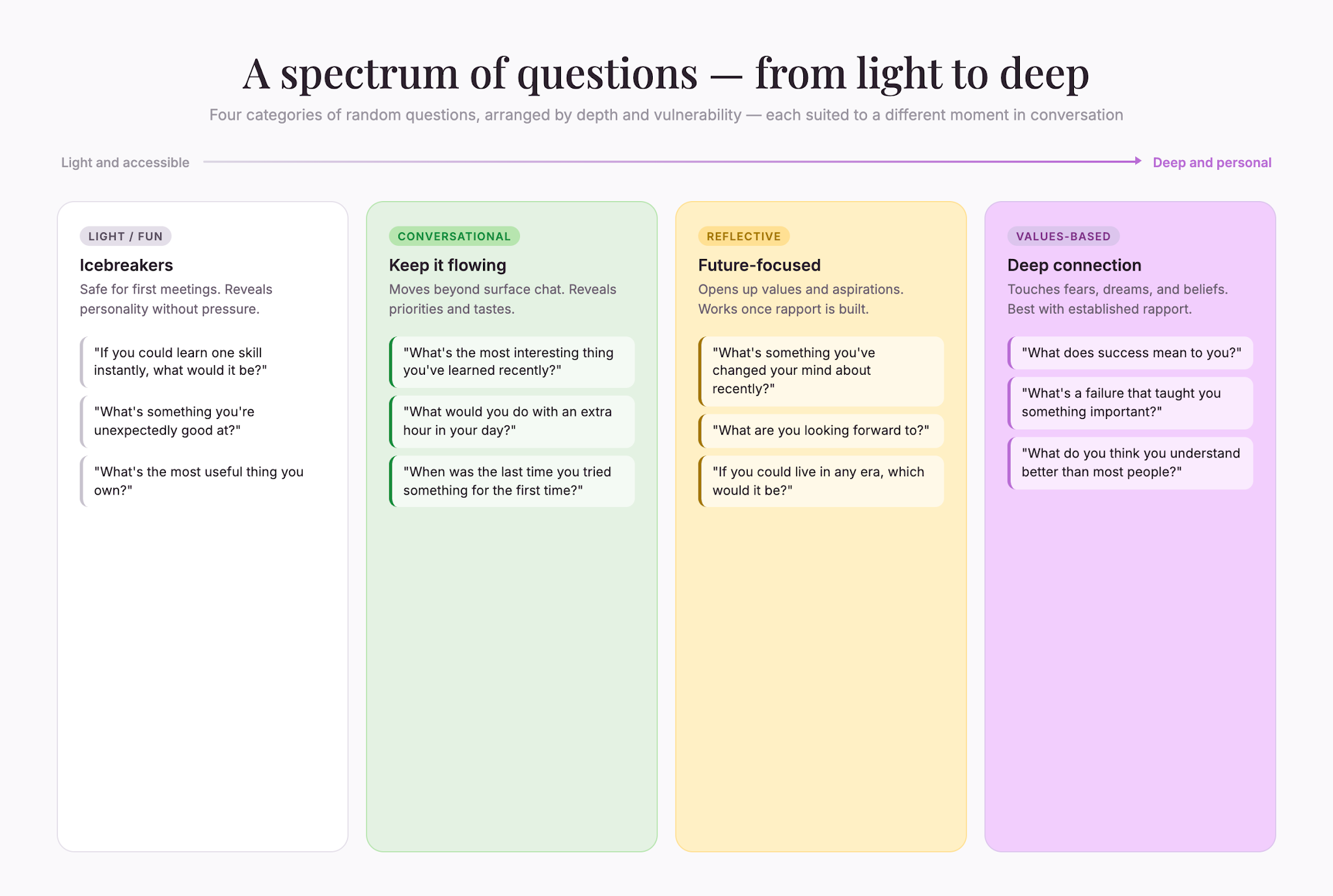
Safe enough for a first date or professional setting, these open-ended random questions to ask can reveal something genuine.
1. If you could learn one skill instantly, what would it be? This cuts through the usual “What do you do?” and tells you what someone actually wants to develop. Whether the answer is fluent Spanish, piano, or advanced coding, it signals what matters to them right now.
2. What’s something you’ve learned about yourself in the last year? Self-reflection is a sign that someone is paying attention to their own growth. The answer often reveals what they’ve been wrestling with or working toward. It’s personal without being invasive.
3. What’s the best advice you’ve ever received? A shortcut to someone’s values. The advice they remember and treasure tells you what they prioritize—kindness, resilience, ambition, or something else entirely.
4. If you could have dinner with anyone, who would it be? You’ll learn about their interests and inspirations. The person might be a historical figure, a family member, someone living, or a fictional character. Each answer is revealing.
5. What’s a hobby you picked up recently? Hobbies show curiosity and how people spend their free time. Their enthusiasm—or lack of it—tells you whether they’re genuinely interested or just passing time.
6. What’s something you’re unexpectedly good at? This one tends to make people light up. It surfaces a hidden skill or passion that doesn’t come up in normal conversation. The answer usually surprises both of you.
7. If you could live in any era, which would it be? Period preference reveals a lot about someone’s values—drawn to great innovation, social progress, or simpler times. It opens up a conversation about why.
8. What’s the most useful thing you own? This tells you what someone values practically. Is it a tool? A book? A coffee maker? The answer is a window into how they solve problems and spend their time.
9. What do you think you’re really good at explaining to others? People enjoy talking about what they know well. The answer often reveals a passion or expertise they don’t get to use enough. It’s also a compliment wrapped in a question.
10. What’s something you’ve changed your mind about in the last few years? This signals intellectual flexibility. People who can shift their views are usually more open to new experiences. The specific topic tells you what matters to them.
Questions for keeping conversation flowing
Use these random questions to deepen an existing conversation or move beyond surface-level chat.
11. What’s the most interesting thing you’ve learned recently? Works when the conversation is moving, but lacking depth. Most people have something they’ve recently discovered—through a podcast, an article, a friend.
12. What would you do with an extra hour in your day? Time is currency. The answer reveals priorities and what feels missing.
13. What’s something you’ve been putting off? This one’s vulnerable enough to create a connection, but not so deep that it feels like prying.
14. If you could change one thing about your daily routine, what would it be? Opens up conversation about lifestyle without feeling accusatory. It often leads to practical advice-sharing.
15. What’s a book, show, or movie that stuck with you? What someone chooses to revisit tells you about their taste and what moves them.
16. When was the last time you tried something for the first time? Novelty-seeking reveals curiosity levels. Either answer opens a follow-up about why.
17. What’s something you think more people should talk about? Often leads to genuine conversation about issues the person cares about, but feels are overlooked.
18. What’s a compliment you received that stuck with you? The compliments people remember are usually unexpected or specific. The answer reveals what they value in themselves.
19. What’s something you’re looking forward to? Anticipation is contagious. This shifts the energy toward the future.
20. If you could only keep five of your possessions, what would they be? Forces prioritization. Answers are usually a mix of practical and sentimental.

Questions for deeper connection
These random questions to ask work better once you’ve established some rapport. They touch on values, fears, and dreams.
21. What’s something you believe that most people don’t? Contrarian beliefs reveal independent thinking. This question uncovers convictions people don’t usually share. It’s a statement of what makes someone unique.
22. What does a good day look like for you? More poetic than “How was your day?” It opens up what contentment actually means to the person—productivity, rest, time with others, solitude.
23. If you had zero financial constraints, what would you do differently? Money conversations are usually avoided, but this frame makes it safe. The answer reveals dreams that have been postponed by economic reality.
24. What’s something you’re afraid of? Fear is universal, which makes this question humanizing. People often feel relieved to name something they’re worried about. Listen without judgment.
25. What’s a failure that taught you something important? Resilience and learning capacity shine through here. People who can talk about failure without shame are usually secure and self-aware.
26. What does success mean to you? Success is deeply personal and often misunderstood by others. The answer reveals whether they’re driven by achievement, security, meaning, relationships, or something else entirely.
27. Who’s someone you admire and why? Admiration is aspirational. The person they choose and the qualities they highlight reveal who they want to become or who they value most.
28. What would you want people to remember about you? Legacy questions get at purpose and identity. They often spark a thoughtful silence before genuine answers emerge.
29. What’s something you’ve learned from someone unexpected? Wisdom comes from everywhere. This question celebrates unexpected teachers and often leads to great stories about strangers, kids, or quiet colleagues.
30. What do you think you understand better than most people? Humble confidence. It lets someone claim expertise without sounding arrogant. The answer reveals what they’ve studied, experienced, or naturally gravitated toward.
How to ask without it feeling forced
A random question only works if it doesn’t feel like a game. Here’s how to ask one well:
Read the moment. If conversation is flowing, a random question can shift things. If someone seems tired or stressed, save it. Context matters.
Ask it naturally. Drop it in like you just thought of it. You don’t need to announce, “I have a random question for you.” Just ask.
Share your answer too. Don’t make it an interview. Answer your own question. Mutual vulnerability creates real conversation.
Don’t push for depth they’re not ready for. A short answer is okay. Match their comfort level.
Let silence exist. When you ask a good question, people need a moment to think. Resist filling that silence.
Follow up with genuine curiosity. The best questions are starting points. What makes conversation real is the follow-up—the pushback, the stories that emerge.

When random questions to ask actually matter
Asking thoughtful questions is a form of respect. It says: I’m curious about you. Your thoughts matter.
In a world where most conversations are transactional or scripted, the right random question creates space for people to be fully themselves. It’s just proof that someone is paying attention.
The next time your conversation hits that familiar plateau, pick one. Ask it like you mean it. Listen like the answer matters. You might be surprised by what people are waiting to tell you.