GTM, meet AI: The benefits of using AI to optimize GTM strategies
As AI continues to evolve, it’s changing how we work—for the better. Savvy GTM teams are leveraging AI to create more effective marketing, from personalization to targeting to lead scoring. See how you can, too.
Go-to-market strategy sits at the intersection of product, sales, and marketing. Get it right, and you unlock growth. Get it wrong, and you waste time and money on channels that don’t move the needle.
The problem is that go-to-market (GTM) has always been part art, part science—heavy on assumptions, light on data. Teams rely on intuition and past campaigns. They ask: “Which segment will respond best?” or “How should we allocate budget across channels?” And they answer based on experience, not evidence.
AI changes that. It processes massive amounts of data instantly, spots patterns humans miss, and runs many scenarios in parallel. The result? AI GTM decisions backed by evidence, not guesswork.
What AI does for GTM
AI for GTM doesn’t replace human judgment—it amplifies it. Feed it the right data, and it becomes a research partner that works around the clock.
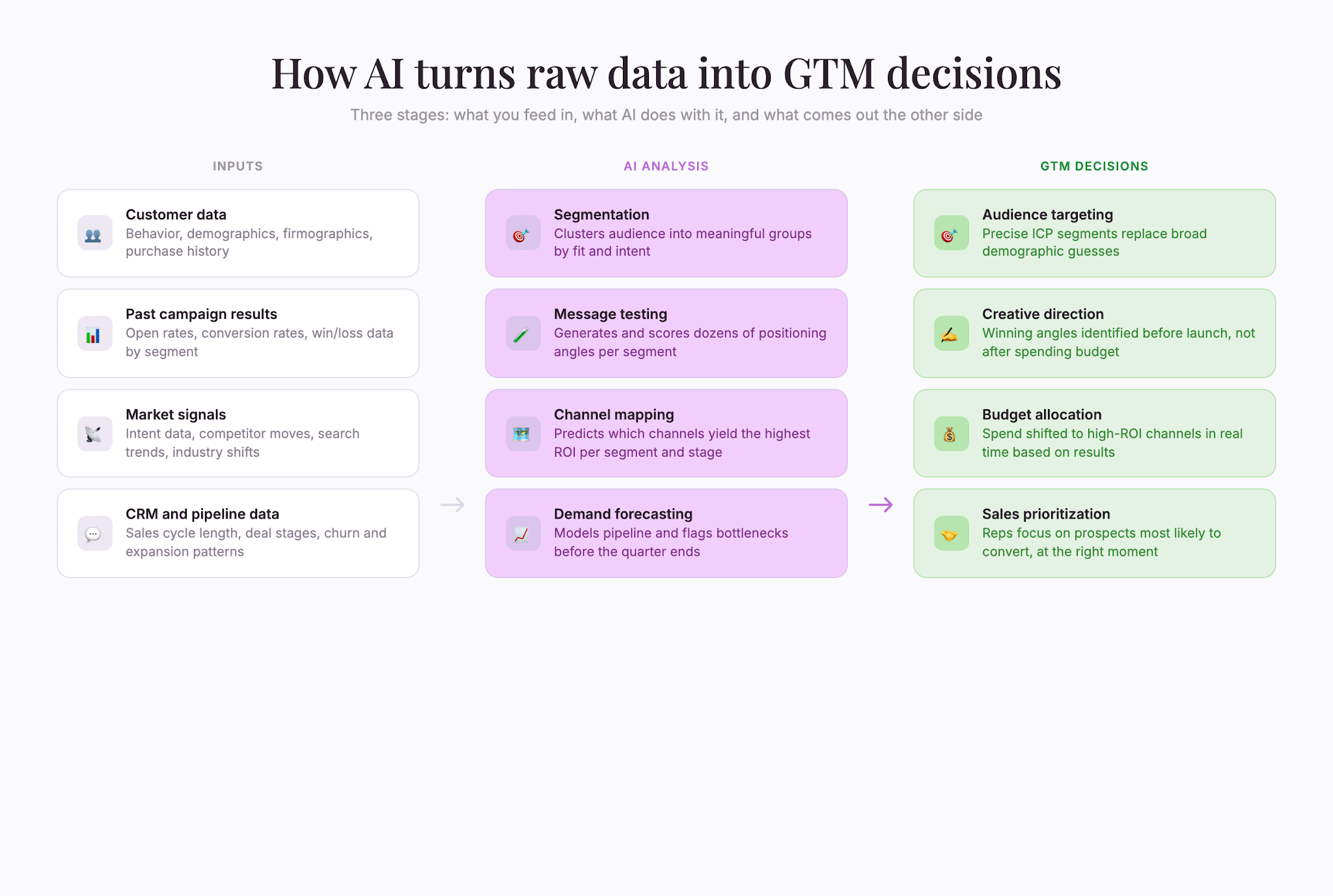
Customer segmentation and targeting – AI clusters your audience into meaningful groups based on behavior, demographics, firmographics, and intent. Instead of guessing which segments matter, you see where your ideal customers spend time and what resonates. Your message reaches the right people, not just more people.
Message and positioning testing – Rather than running one or two variants and hoping, AI generates and tests dozens. It identifies which words, angles, and value propositions drive engagement for each segment. You launch with confidence instead of launching and learning.
Channel optimization – AI predicts which channels (email, paid social, events, direct sales) deliver the highest ROI for each segment and stage. It reallocates budget in real time based on performance.
Sales enablement – AI prioritizes prospects by likelihood to convert, flags the best moments to reach out, and suggests next best actions. Your team spends less time on admin, more on high-value conversations.
Demand forecasting – AI models your pipeline and predicts revenue based on activity, win rates, and cycle length. You spot bottlenecks early and course-correct before the quarter ends.
Timing matters: planning versus execution
There’s a critical difference between using AI to plan a GTM strategy and using it to execute. Both matter, but at different moments.
In planning – Before launch, AI stress-tests assumptions. It answers: “If we focus on mid-market instead of enterprise, what happens to the addressable market?” or “Which positioning will resonate with our primary buyer versus our champion?” You iterate when iteration is cheap, not after you’ve spent the budget.
In execution – Once launched, AI monitors performance and adapts in real time. It shifts budget between channels, refines targeting, and identifies expansion opportunities. This is where compounding returns kick in.
Teams using AI only in execution miss early-stage mistakes that compound. Teams using it only in planning miss the chance to adapt as the market responds. The strongest strategies use AI at both gates.
The data problem
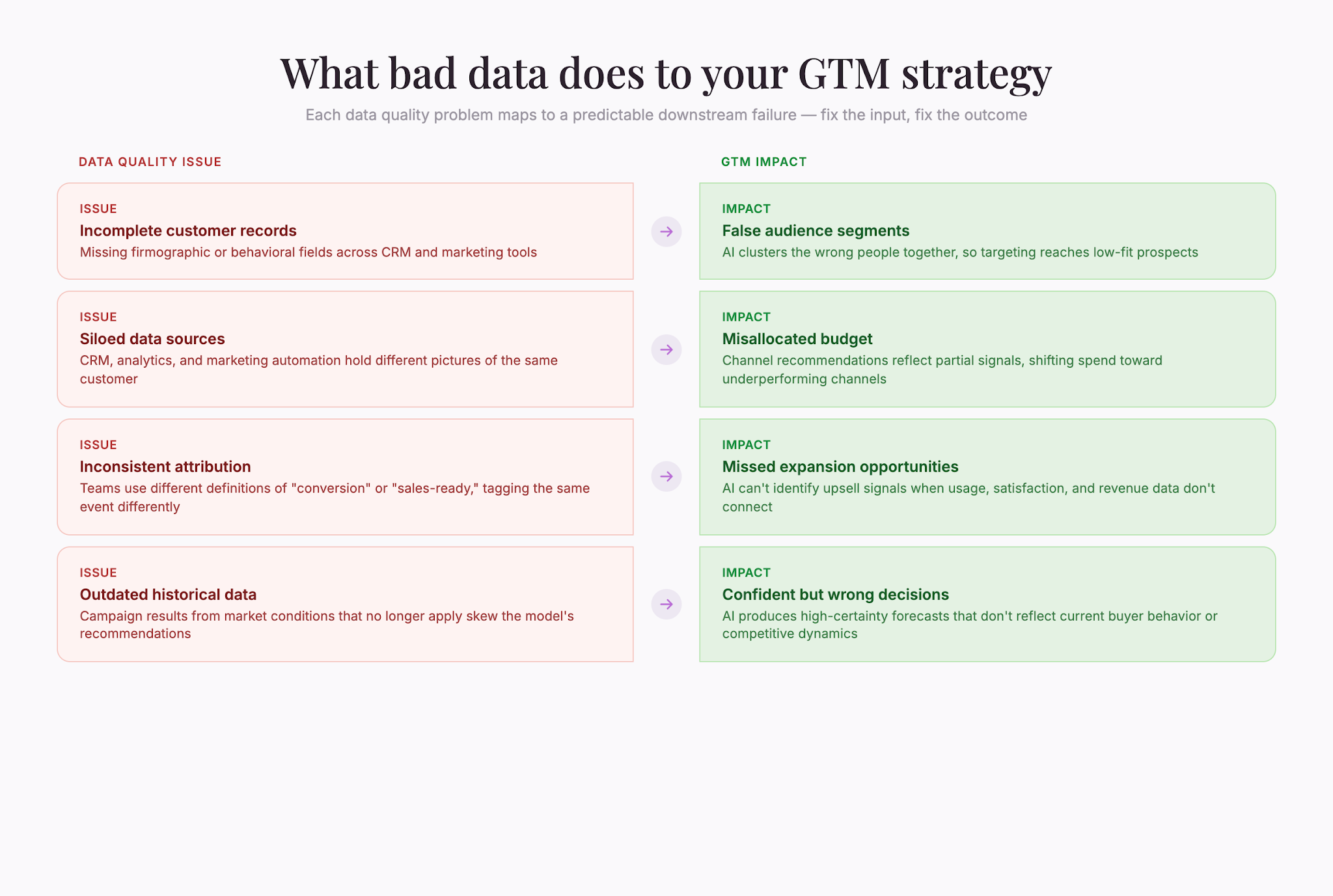
AI is only as good as the data you feed it.
If your customer data is incomplete, outdated, or siloed, AI will give you confident—but wrong—answers. If you track the wrong metrics, AI optimizes for the wrong outcomes. If your historical campaign data is messy, AI can’t learn the right lessons.
Before implementing AI for GTM, audit your data. Ask:
- Are customer records accurate across CRM, marketing automation, and analytics?
- Are you tracking attribution consistently?
- Do all teams use the same definition of “conversion” or “sales-ready”?
- Is behavioral data connected to account and opportunity data?
Fix these first. Then, AI becomes a force multiplier. Without them, it’s expensive guesswork wrapped in confidence.
How to start with AI GTM: a three-step approach
You don’t need to overhaul your entire GTM machine to leverage AI. Start small, validate, and scale. Here’s how:
Step 1: Pick one problem. Don’t try to AI-optimize everything at once. Choose one pain point: “We’re not reaching enough of our target ICP,” or “Sales spends hours on research instead of selling,” or “We don’t know which campaigns drive pipeline.” Solve that one first.
Step 2: Clean and consolidate your data. Pull what you need from CRM, analytics, and marketing automation. Check for gaps, duplicates, and inconsistencies. If you’re using an AI platform, it will tell you what format it needs. This step often takes longer than expected—budget for it.
Step 3: Test and measure. Use AI on a subset of your audience or one campaign. Compare to your control or baseline. Did message testing lift open rates? Did AI-recommended prospects convert at a higher rate? Only scale what works.
Common pitfalls
In addition to best practices, it’s helpful to understand common AI GTM pitfalls so you can actively avoid them. Common pitfalls include:
Over-relying on a single tool. Different AI tools solve different problems. One excels at predictive scoring, another at copy generation, another at account-based plays. Be skeptical of any vendor claiming to do it all.
Treating outputs as gospel. AI flags opportunities and warns about risks, but it shouldn’t be the final decision-maker. The best teams use AI to raise questions, not answer them. “Our model predicts this segment will churn—why?” beats “The model says drop it, so we will.”
Ignoring the human element. GTM is about conversations between your team and customers. AI improves how you find and message them, but it can’t replace the judgment, intuition, and creativity humans bring. AI finds patterns; humans decide what those patterns mean.
Launching without buy-in. If sales doesn’t trust the lead scoring, they’ll ignore it. If marketing doesn’t understand why a variant won, they won’t learn. Before deploying AI insights, make sure stakeholders understand how the AI reached its conclusion and what they’re being asked to do.
The compounding effect
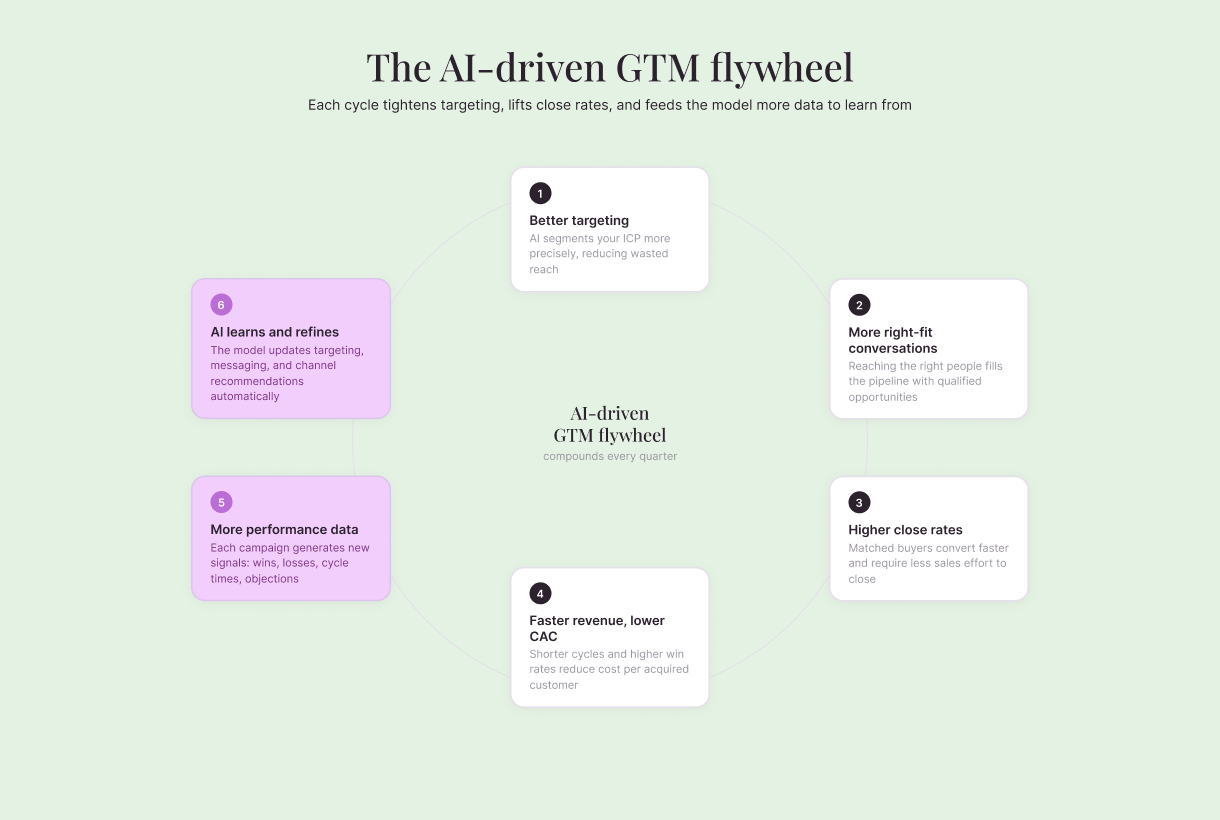
Better audience decisions ripple outward. You reach more of the right customers, which means more conversations. More right-fit conversations mean higher close rates and shorter cycles. That means faster revenue and lower CAC.
The real compounding comes from learning. Every campaign, win, and loss teaches the model something. Over time, your GTM tightens, and your ROI improves.
This isn’t a one-time boost. It’s a flywheel that turns faster every quarter—but only if you set it up right, feed it clean data, and stay disciplined about testing.
The teams winning in AI GTM today aren’t the ones with the biggest budgets. They’re the ones making better decisions with the budgets they have.

Liked that? Check these out:

Opinions and Expertise
What’s actually slowing research teams down (Hint: it’s not the research)
From recruiting participants and scheduling interviews to building the actual surveys, the operational drag is taking researchers away from what they do best. See what's actually slowing them down and how Research Flow fixes it.
Read more